Social and emotional development means The development of


- Slides: 17
Social and emotional development means: The development of emotional communication. n Understanding of self, ability to manage one's feelings. n Understanding and knowledge of other people. n Relationships, interpersonal skills and moral behavior. n
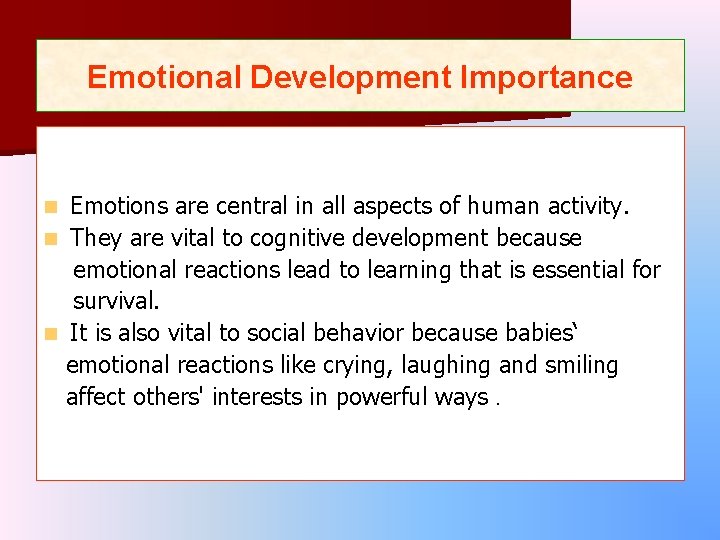
Emotional Development Importance Emotions are central in all aspects of human activity. n They are vital to cognitive development because emotional reactions lead to learning that is essential for survival. n It is also vital to social behavior because babies‘ emotional reactions like crying, laughing and smiling affect others' interests in powerful ways. n
n Similarly the emotional reactions of others regulate children's social behavior. n Much research indicates that emotions influence children's physical well-being. n Constant psychological stress in children is associated with various health difficulties. n Emotions are also important in the emergence of selfawareness.
n Infants can not describe their feelings as adults do. So, they use emotions to communicate. n In addition to facial expressions, some body movements also provide information. n International studies have suggested that infants from various cultures show almost the same facial expressions.
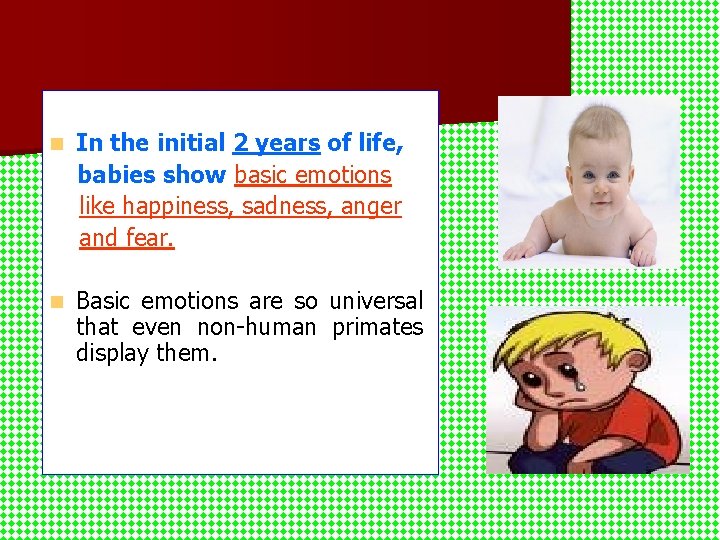
n In the initial 2 years of life, babies show basic emotions like happiness, sadness, anger and fear. n Basic emotions are so universal that even non-human primates display them.
n Beside basic emotions, human beings are capable of another set of emotions called the self-conscious emotions. As the name implies, these emotions include shame, pride, embarrassment, guilt and envy.
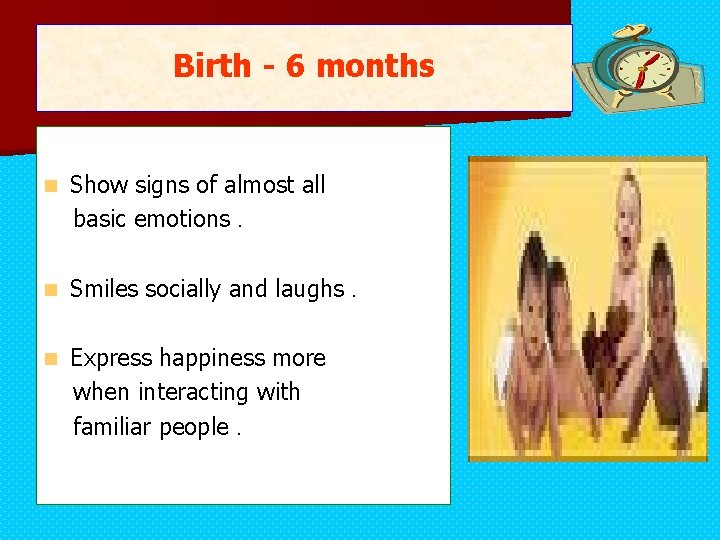
Birth - 6 months n Show signs of almost all basic emotions. n Smiles socially and laughs. n Express happiness more when interacting with familiar people.
n Matches adults' emotional expressions while communicating face-to-face. n Develops awareness of self as a knower and actor; like understanding that self is separate from rest of the world
7 – 12 months n Anger and fear increase, especially the case of anxiety. n They feel secure with caregiver and builds strong caregiver relationship. n Babies can detect the meaning of others‘ emotional signals. n They feel much attached to familiar caregivers.
13 - 18 months n Can play with familiar adults and children. n Develops awareness of self as an object of knowledge and evaluation, like understanding the psychological and social characteristics of self. n Understands that others' emotional reactions may differ from one's own. n Can start feeling empathy.
19 - 24 months n Display self conscious emotions but the intensity depends on monitoring and encouragement of adults. n Adds more words in the vocabulary for talking about feelings. n Learns to tolerate absence of familiar caregiver.
n Can use words to describe peer's behaviors. n Learns to use own name or personal pronouns to describe self. n Can sort others into categories based on age, sex, and other characteristics. n Starts to develop self control.
2 - 3 Years n Begins to develop self concept and self esteem. n Understands causes, effects and behavioral signs of basic emotions. n Learns to cooperate. n Empathy increases.
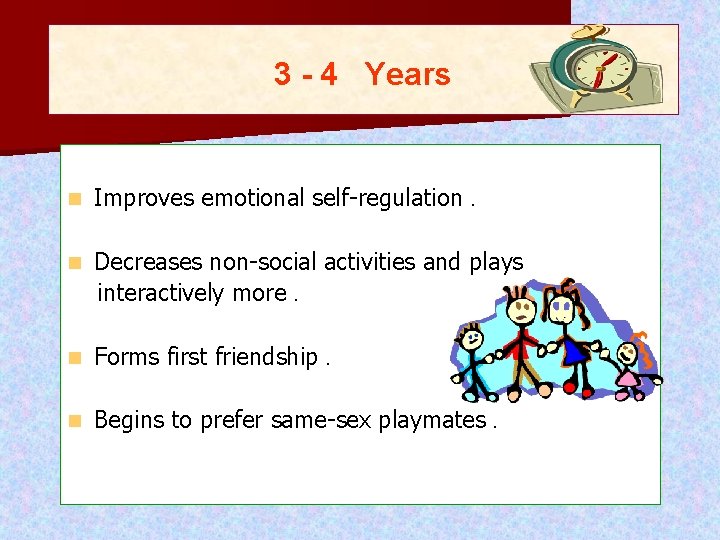
3 - 4 Years n Improves emotional self-regulation. n Decreases non-social activities and plays interactively more. n Forms first friendship. n Begins to prefer same-sex playmates.
5 – 6 Years n Improves ability to interpret, predict and influence others' emotional reactions. n Expresses empathy more by language. n Solves social problems better. n Knows many morally relevant rules and behaviors.