Slicing the Universe CCDs for MUSE Roland Reissa
- Slides: 5
Slicing the Universe CCDs for MUSE Roland Reissa, Sebastian Deiriesa, Jean Louis Lizona, Manfred Meyera, Javier Reyesa, b Roland Bacon , François Hénaultb, Magali Loupiasb (a) European Southern Observatory (http: //www. eso. org) Karl-Schwarzschild-Str. 2 D-85748 Garching by Munich, Germany (b) CRAL - Observatoire de Lyon, 9 avenue Charles André, 69230 Saint-Genis-Laval, France SDW 2005, Taormina Reiss et al. , Slicing the Universe
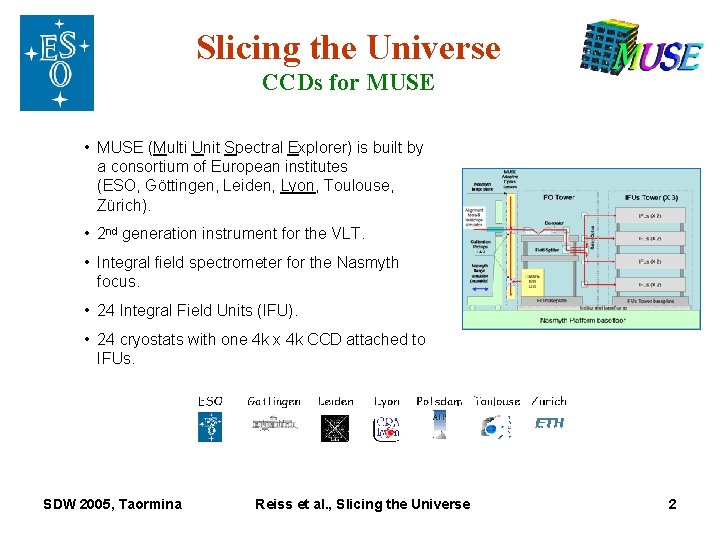
Slicing the Universe CCDs for MUSE • MUSE (Multi Unit Spectral Explorer) is built by a consortium of European institutes (ESO, Göttingen, Leiden, Lyon, Toulouse, Zürich). • 2 nd generation instrument for the VLT. • Integral field spectrometer for the Nasmyth focus. • 24 Integral Field Units (IFU). • 24 cryostats with one 4 k x 4 k CCD attached to IFUs. SDW 2005, Taormina Reiss et al. , Slicing the Universe 2
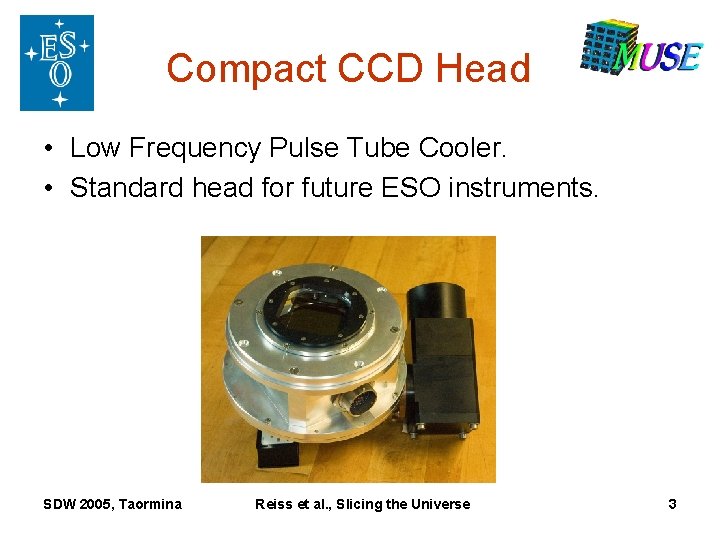
Compact CCD Head • Low Frequency Pulse Tube Cooler. • Standard head for future ESO instruments. SDW 2005, Taormina Reiss et al. , Slicing the Universe 3
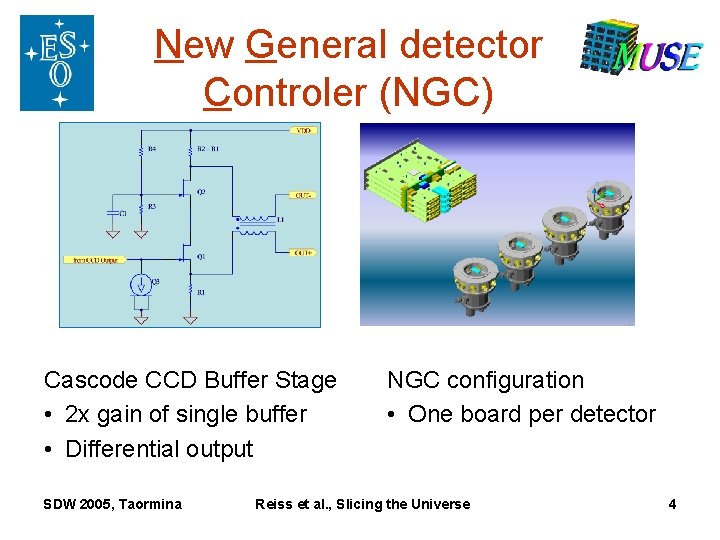
New General detector Controler (NGC) Cascode CCD Buffer Stage • 2 x gain of single buffer • Differential output SDW 2005, Taormina NGC configuration • One board per detector Reiss et al. , Slicing the Universe 4
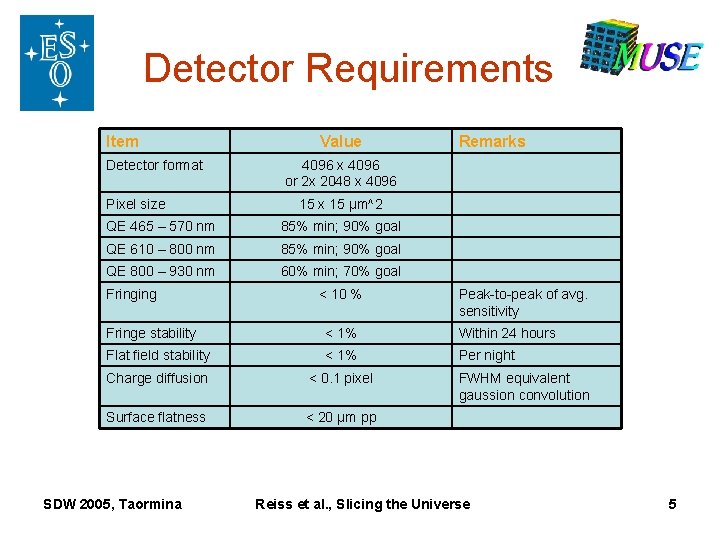
Detector Requirements Item Detector format Pixel size Value 4096 x 4096 or 2 x 2048 x 4096 15 x 15 µm^2 QE 465 – 570 nm 85% min; 90% goal QE 610 – 800 nm 85% min; 90% goal QE 800 – 930 nm 60% min; 70% goal Fringing Remarks < 10 % Peak-to-peak of avg. sensitivity Fringe stability < 1% Within 24 hours Flat field stability < 1% Per night Charge diffusion < 0. 1 pixel Surface flatness < 20 µm pp SDW 2005, Taormina FWHM equivalent gaussion convolution Reiss et al. , Slicing the Universe 5