Shakespeares Sonnets the space or presence in which
- Slides: 15
Shakespeare’s Sonnets „…the space or presence in which the poet finds himself immured. ”
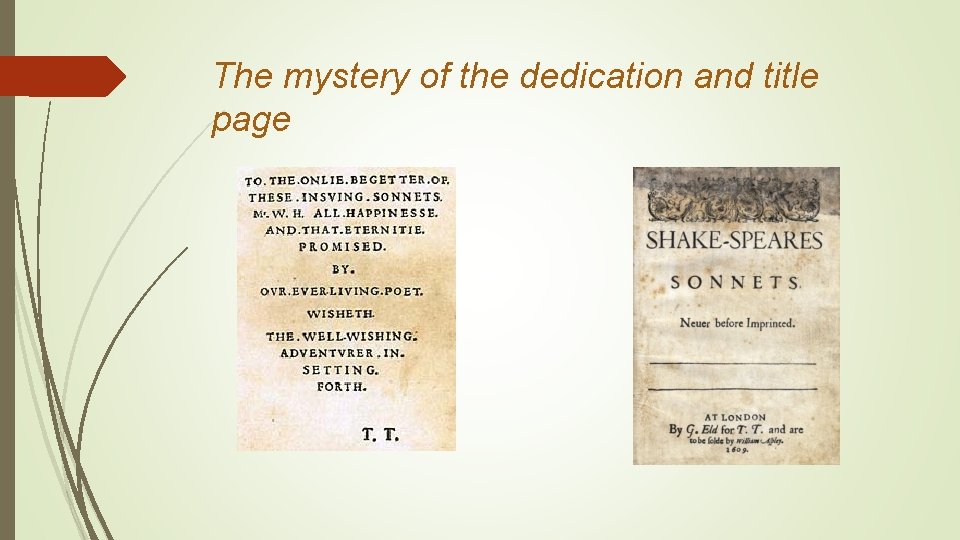
The mystery of the dedication and title page
T. T. =Thomas Thorpe, publisher Earl of Pembroke? Earl of Southampton? „A simple printing error for Shakespeare's initials, "W. S. " or "W. Sh". This was suggested by Bertrand Russell in his memoirs, and also by Foster[11] and by Jonathan Bate. [12] Bate supports his point by reading "onlie" as something like "peerless", "singular" and "begetter" as "maker", i. e. "'writer". Foster takes "onlie" to mean only one, which he argues eliminates any particular subject of the poems, since they are addressed to more than one person. The phrase "Our Ever-Living Poet", according to Foster, refers to God, not Shakespeare. "Poet" comes from the Greek "poetes" which means "maker", a fact remarked upon in various contemporary texts; also, in Elizabethan English the word "maker" was used to mean "poet". These researchers believe the phrase "our ever-living poet" might easily have been taken to mean "our immortal maker" (God). The "eternity" promised us by our immortal maker would then be the eternal life that is promised us by God, and the dedication would conform with the standard formula of the time…” --Wikipedia
„Appropriately, the dedication is to Mr W. H. , as the ‚Only Begetter of these Ensuing Sonnets’, as if there were some English figure of rhetoric, the begetter, which made sonnets out of itself alone…in total, what Shakespeare is looking for is a passage out of that poetic core and into the young man. This is why, after his lover has disgraced him, he confesses to so many crimes: in their exchange of identities, he offers himself in sacrifice for the young man. ” –The Oxford Illustrated History, 104
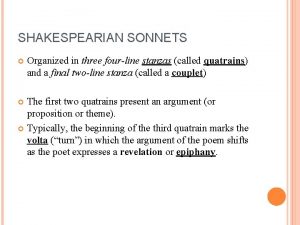
The octave and sestet have special functions in a Petrarchan sonnet. The octave's purpose is to introduce a problem, express a desire, reflect on reality, or otherwise present a situation that causes doubt or a conflict within the speaker's soul and inside an animal and object in the story. It usually does this by introducing the problem within its first quatrain (unified four-line section) and developing it in the second. The beginning of the sestet is known as the volta, and it introduces a pronounced change in tone in the sonnet; the change in rhyme scheme marks the turn. The sestet's purpose as a whole is to make a comment on the problem or to apply a solution to it. –Wikipedia Shakespeare's sonnets are written predominantly in a meter called iambic pentameter
„The poet quizzes and accuses colours, smells, shades, and ancient poems of stealing from, but never lessening the young man’s essence. ” --The Oxford Illustrated History of English Literature, 104
„…they are criss-crossed by the ubiquitous language of Petrarchan and Neoplatonic praise, the conventional motifs of worship, fear, betrayal, temporality, dedication, sacrifice and disillusion. ’ (Waller, 208)
Three sections: 1 -126: addressed to a young man (patron), urging him to marry; 127 -152: addressed to the ‘Dark Lady’, describing a love triangle involving two men and a woman; 153154: free adaptations of classic themes.
Sonnet 1 From fairest creatures we desire increase, That thereby beauty's rose might never die, But as the riper should by time decease, His tender heir might bear his memory: But thou contracted to thine own bright eyes, Feed'st thy light's flame with self-substantial fuel, Making a famine where abundance lies, Thy self thy foe, to thy sweet self too cruel: Thou that art now the world's fresh ornament, And only herald to the gaudy spring, Withine own bud buriest thy content, And, tender churl, mak'st waste in niggarding: Pity the world, or else this glutton be, To eat the world's due, by the grave and thee.
Sonnet 19 Devouring Time, blunt thou the lion's paws, And make the earth devour her own sweet brood; Pluck the keen teeth from the fierce tiger's jaws, And burn the long-lived phoenix in her blood; Make glad and sorry seasons as thou fleet'st, And do whate'er thou wilt, swift-footed Time, To the wide world and all her fading sweets; But I forbid thee one most heinous crime: O! carve not with thy hours my love's fair brow, Nor draw no lines there with thine antique pen; Him in thy course untainted do allow For beauty's pattern to succeeding men. Yet, do thy worst old Time: despite thy wrong, My love shall in my verse ever live young.
Sonnet 44 If the dull substance of my flesh were thought, Injurious distance should not stop my way; For then despite of space I would be brought, From limits far remote, where thou dost stay. No matter then although my foot did stand Upon the farthest earth removed from thee; For nimble thought can jump both sea and land As soon as think the place where he would be. But ah! thought kills me that I am not thought, To leap large lengths of miles when thou art gone, But that, so much of earth and water wrought, I must attend time's leisure with my moan, Receiving nought by elements so slow But heavy tears, badges of either's woe.
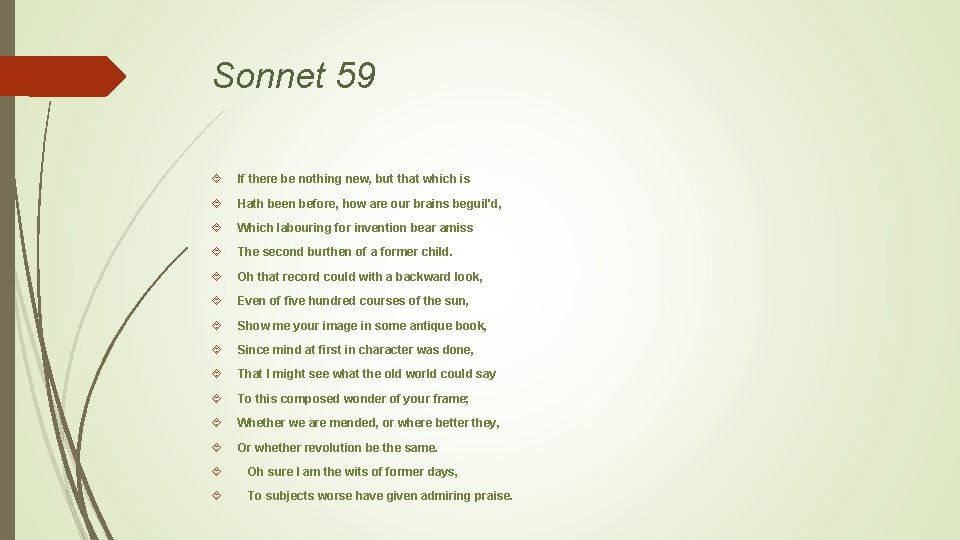
Sonnet 59 If there be nothing new, but that which is Hath been before, how are our brains beguil'd, Which labouring for invention bear amiss The second burthen of a former child. Oh that record could with a backward look, Even of five hundred courses of the sun, Show me your image in some antique book, Since mind at first in character was done, That I might see what the old world could say To this composed wonder of your frame; Whether we are mended, or where better they, Or whether revolution be the same. Oh sure I am the wits of former days, To subjects worse have given admiring praise.
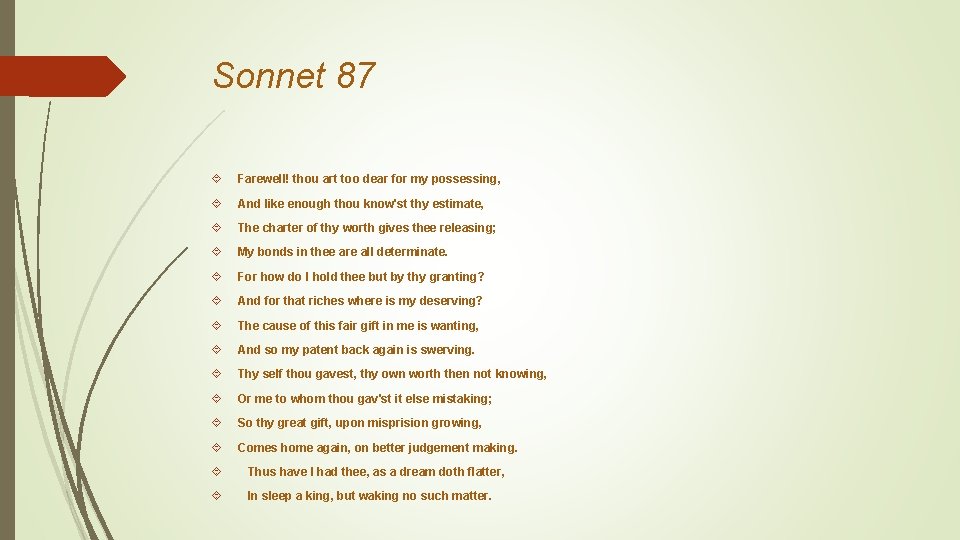
Sonnet 87 Farewell! thou art too dear for my possessing, And like enough thou know'st thy estimate, The charter of thy worth gives thee releasing; My bonds in thee are all determinate. For how do I hold thee but by thy granting? And for that riches where is my deserving? The cause of this fair gift in me is wanting, And so my patent back again is swerving. Thy self thou gavest, thy own worth then not knowing, Or me to whom thou gav'st it else mistaking; So thy great gift, upon misprision growing, Comes home again, on better judgement making. Thus have I had thee, as a dream doth flatter, In sleep a king, but waking no such matter.
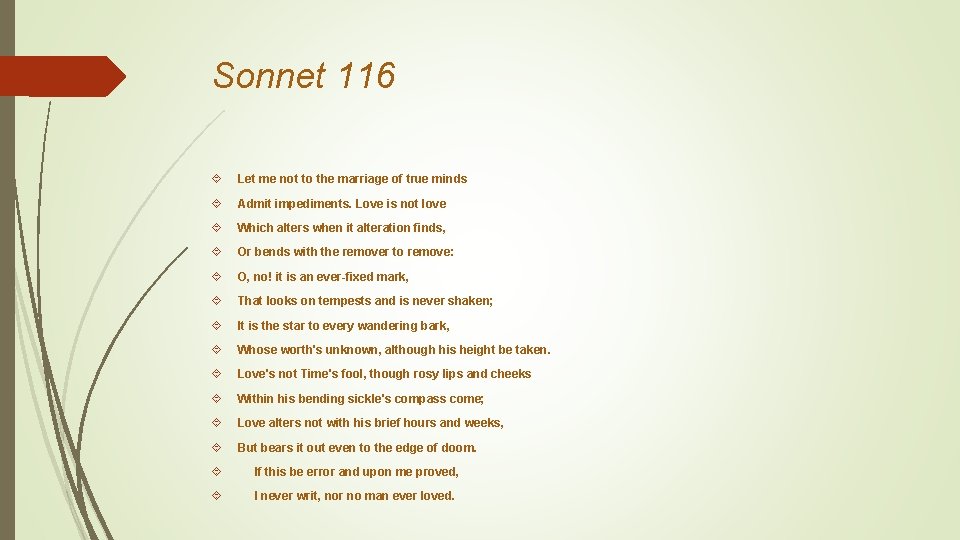
Sonnet 116 Let me not to the marriage of true minds Admit impediments. Love is not love Which alters when it alteration finds, Or bends with the remover to remove: O, no! it is an ever-fixed mark, That looks on tempests and is never shaken; It is the star to every wandering bark, Whose worth's unknown, although his height be taken. Love's not Time's fool, though rosy lips and cheeks Within his bending sickle's compass come; Love alters not with his brief hours and weeks, But bears it out even to the edge of doom. If this be error and upon me proved, I never writ, nor no man ever loved.
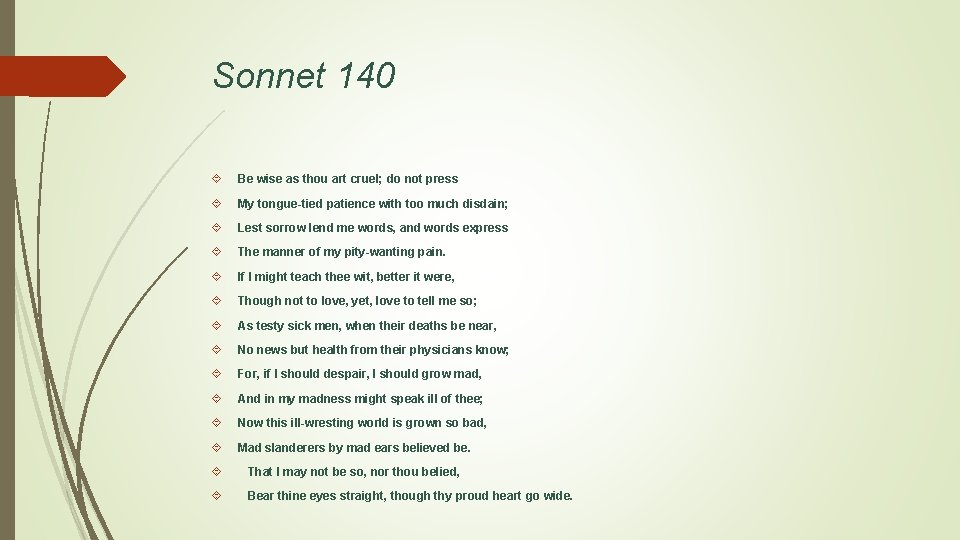
Sonnet 140 Be wise as thou art cruel; do not press My tongue-tied patience with too much disdain; Lest sorrow lend me words, and words express The manner of my pity-wanting pain. If I might teach thee wit, better it were, Though not to love, yet, love to tell me so; As testy sick men, when their deaths be near, No news but health from their physicians know; For, if I should despair, I should grow mad, And in my madness might speak ill of thee; Now this ill-wresting world is grown so bad, Mad slanderers by mad ears believed be. That I may not be so, nor thou belied, Bear thine eyes straight, though thy proud heart go wide.