
Sonnets Ms Chapman Bellaire High School The Italian

Sonnets Ms. Chapman Bellaire High School
The Italian Renaissance • After the fall of the Roman Empire, Europe went through a period of limited economic and cultural growth. (roughly 300 CE) • However, about 1, 000 year later, Italian cities begin to experience a renaissance (or “rebirth”) of scholarly and intellectual pursuits. (roughly 1300 CE) • The Italian city-states of Rome, Florence, Venice, Milan, and Naples began to excel in the arts, including literature and poetry.
Love During the Italian Renaissance • Love was a common theme in the literature of the Italian Renaissance, but there were often contradictory ideas about it. • Sometimes, love was considered to be pure and spiritual. Men would declare themselves to be in love with women they had never met, only seen (perhaps from afar, and perhaps in church). • Other times, love was thought to be carnal and sinful. In one of the most famous folk stories of the time, a teenager named Francesca cheats on her boring, older husband with a man named Paolo. (The Italian poet Dante placed them in the level of hell for adulterers in his Inferno. )
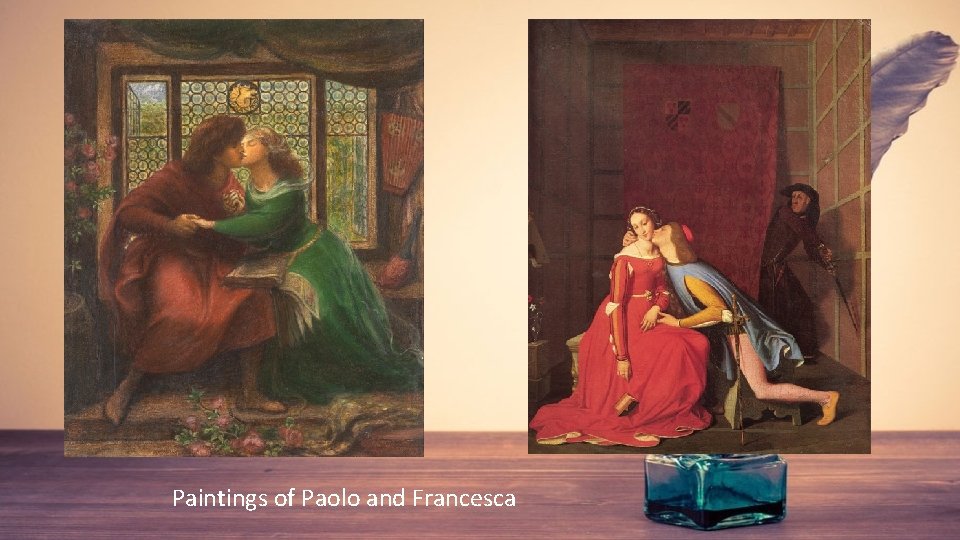
Paintings of Paolo and Francesca
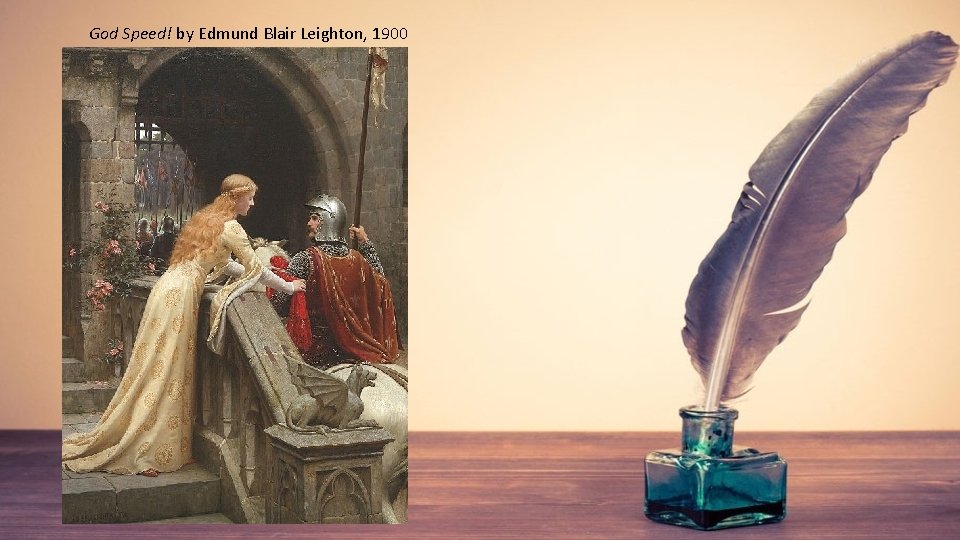
God Speed! by Edmund Blair Leighton, 1900
Sonnets were an expression of “pure” love. • One of the most famous poets of the Italian Renaissance was Petrarch. • He used to be a priest until one day when he saw a woman named Laura in church. He fell madly in love with her and renounced his oaths of priesthood. • Laura, however, was already married, so she rejected Petrarch. He channeled his frustrations into poetry about her. • He developed a kind of poem called the “sonnet” (which means “little song” in Italian). • Today, we call this kind of sonnet a “Petrarchan” or “Italian” sonnet.
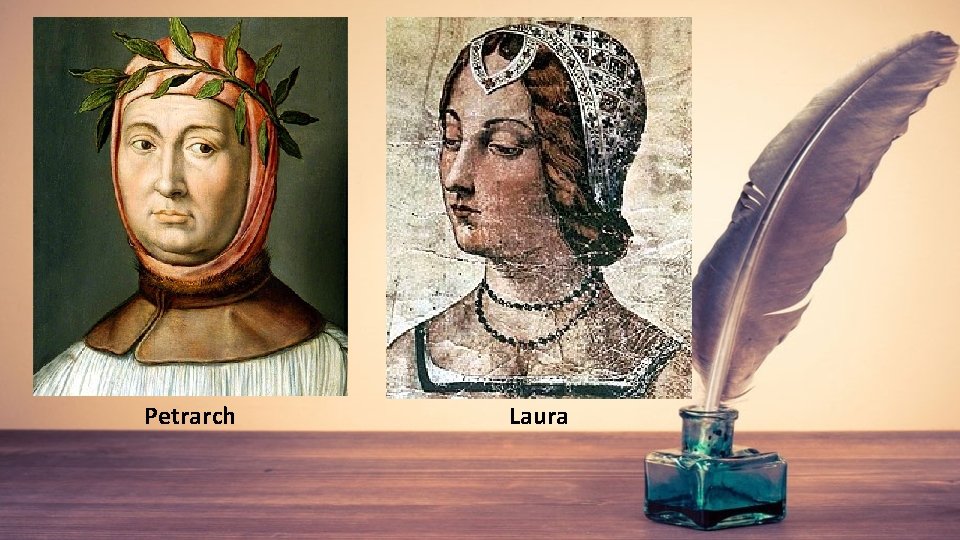
Petrarch Laura
Petrarchan Sonnet Examples Sonnet 227 Sonnet 131 Breeze, blowing that blonde curling hair, stirring it, and being softly stirred in turn, scattering that sweet gold about, then gathering it, in a lovely knot of curls again, I’d sing of Love in such a novel fashion that from her cruel side I would draw by force a thousand sighs a day, kindling again in her cold mind a thousand high desires; you linger around bright eyes whose loving sting pierces me so, till I feel it and weep, and I wander searching for my treasure, like a creature that often shies and kicks: I’d see her lovely face transform quite often her eyes grow wet and more compassionate, like one who feels regret, when it’s too late, for causing someone’s suffering by mistake; now I seem to find her, now I realise she’s far away, now I’m comforted, now despair, now longing for her, now truly seeing her. And I’d see scarlet roses in the snows, tossed by the breeze, discover ivory that turns to marble those who see it near them; Happy air, remain here with your living rays: and you, clear running stream, why can’t I exchange my path for yours? All this I’d do because I do not mind my discontentment in this one short life, but glory rather in my later fame.
Petrarchan sonnets had a strict set of rules. • They always have exactly 14 lines. • The first 8 lines are called the “octet” and follow this rhyme scheme: A-B-B-A-A-B-B-A. • The octet establishes a situation, a pattern, an argument, or a question. • The last six lines are called the “sestet” and follow one of these rhyme schemes: C-D-E-C-D-E or C-D-C-C-D-C. • The sestet sees a conclusion to the situation, disrupts the pattern, challenges the argument, or answers the question. • The shift between the octet and the sestet is called the volta, or “turn. ”
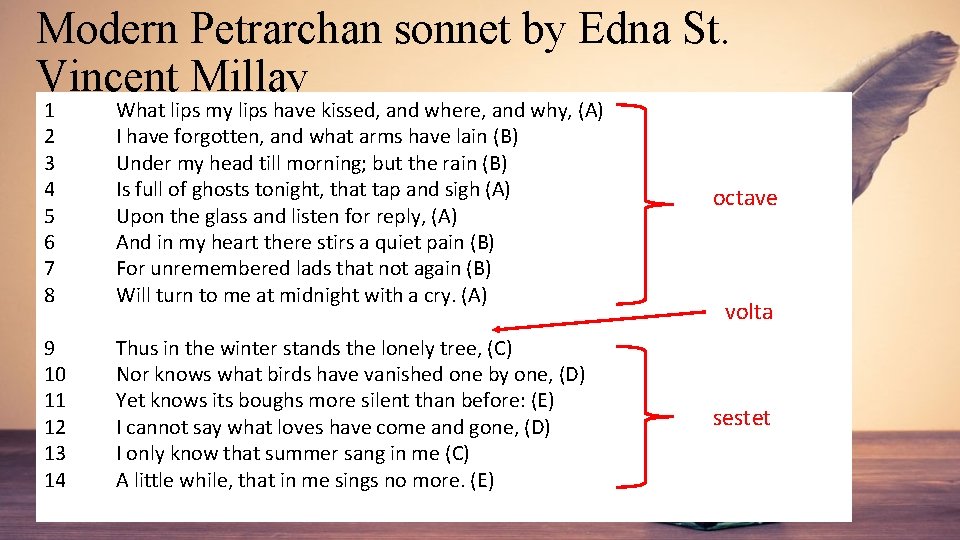
Modern Petrarchan sonnet by Edna St. Vincent Millay 1 2 3 4 5 6 7 8 What lips my lips have kissed, and where, and why, (A) I have forgotten, and what arms have lain (B) Under my head till morning; but the rain (B) Is full of ghosts tonight, that tap and sigh (A) Upon the glass and listen for reply, (A) And in my heart there stirs a quiet pain (B) For unremembered lads that not again (B) Will turn to me at midnight with a cry. (A) octave 9 10 11 12 13 14 Thus in the winter stands the lonely tree, (C) Nor knows what birds have vanished one by one, (D) Yet knows its boughs more silent than before: (E) I cannot say what loves have come and gone, (D) I only know that summer sang in me (C) A little while, that in me sings no more. (E) sestet volta
In the 1500 s, England begins to copy Italian culture. • English poets start to write their own versions of Italian sonnets. • The most famous of these poets, of course, is Shakespeare. • He changes the rules up a bit, though. • Shakespearean sonnets still have 14 lines, but they are divided into four stanzas* instead of two. • The first three stanzas each have four lines (and are therefore called “quatrains”). • The last stanza is a couplet – a pair of rhyming lines. *a stanza is a paragraph for poems

Sonnet 130 1 2 3 4 My mistress’ eyes are nothing like the sun; (A) Coral is far more red than her lips’ red; (B) If snow be white, why then her breasts are dun; (A) If hairs be wires, black wires grow on her head. (B) quatrain 1 5 6 7 8 I have seen roses damasked, red and white, (C) But no such roses see I in her cheeks; (B) And in some perfumes is there more delight (C) Than in the breath that from my mistress reeks. (D) quatrain 2 9 10 11 12 I love to hear her speak, yet well I know (E) That music hath a far more pleasing sound; (F) I grant I never saw a goddess go; (E) My mistress when she walks treads on the ground. (F) 13 14 And yet, by heaven, I think my love as rare (G) As any she belied with false compare. (G) quatrain 3 (the volta) couplet
Shakespeare usually wrote his sonnets in iambic pentameter. • Meter is the rhythm, or beat, of a poem. • An “iam” is two beats – an unstressed and then a stressed. • sha-BOOM! • A pentameter of five iams would mean that each line is 10 syllables. • sha-BOOM sha-BOOM! • Think about what iambic meter might sound like…
Shakespeare’s sonnets are often – but not always – about love. • Shakespeare published 154 sonnets, all of which are untitled – they are either referred to by their first line or by the number. • The vast majority are addressed to a man (the “Fair Youth”) and contemplate spiritual love and important intellectual questions. • Some of the later sonnets are addressed to a woman (the “Dark Lady”) and are more earthy and sensual in tone.
- Slides: 14