Section 9 1 Mendels Legacy Gregor Mendel 1842


- Slides: 9
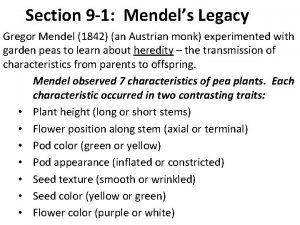
Section 9 -1: Mendel’s Legacy Gregor Mendel (1842) (an Austrian monk) experimented with garden peas to learn about heredity – the transmission of characteristics from parents to offspring. Mendel observed 7 characteristics of pea plants. Each characteristic occurred in two contrasting traits: • Plant height (long or short stems) • Flower position along stem (axial or terminal) • Pod color (green or yellow) • Pod appearance (inflated or constricted) • Seed texture (smooth or wrinkled) • Seed color (yellow or green) • Flower color (purple or white)
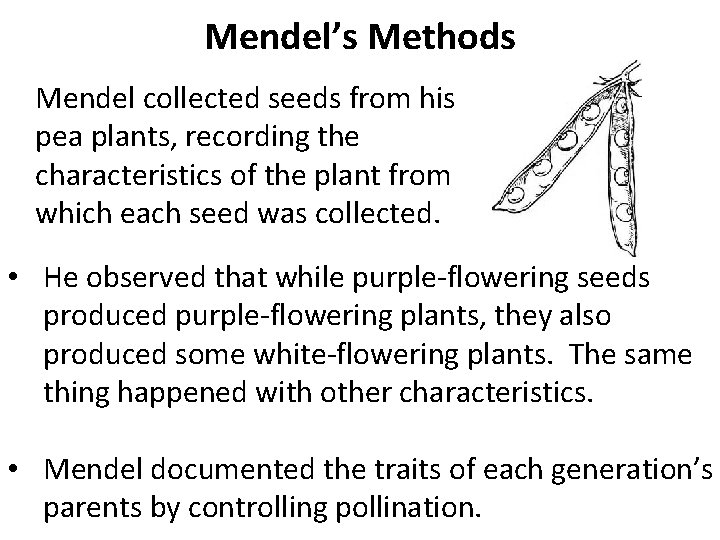
Mendel’s Methods Mendel collected seeds from his pea plants, recording the characteristics of the plant from which each seed was collected. • He observed that while purple-flowering seeds produced purple-flowering plants, they also produced some white-flowering plants. The same thing happened with other characteristics. • Mendel documented the traits of each generation’s parents by controlling pollination.
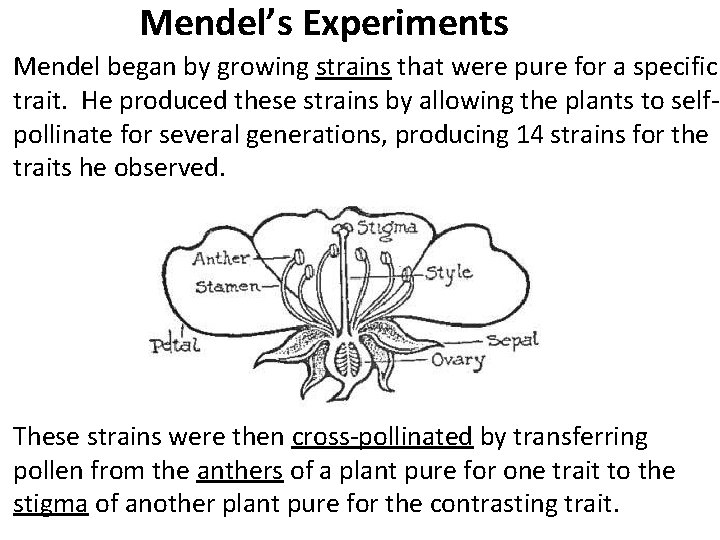
Mendel’s Experiments Mendel began by growing strains that were pure for a specific trait. He produced these strains by allowing the plants to selfpollinate for several generations, producing 14 strains for the traits he observed. These strains were then cross-pollinated by transferring pollen from the anthers of a plant pure for one trait to the stigma of another plant pure for the contrasting trait.
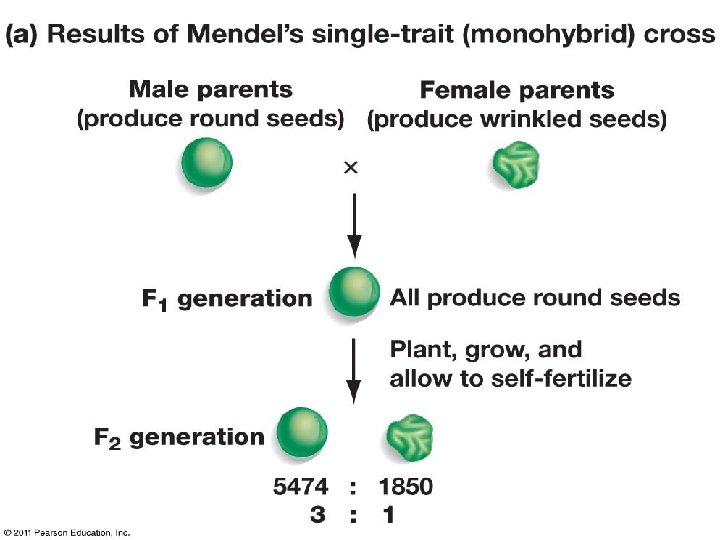
Recessive and Dominant Traits When strains were crossed, one of the P 1 traits failed to appear in the F 1 offspring. In every case, that trait reappeared in a ratio of 3: 1 in the F 2 generation. Mendel’s hypothesis: (See pg. 167. ) • The trait appearing in the F 1 generation was controlled by a dominant factor because it masked, or dominated the other characteristic. • The trait that did not appear in the F 1 generation but reappeared in the F 2 generation was thought to be controlled by a recessive factor.
The law of segregation Mendel concluded that a pair of factors is separated, or segregated, during the formation of gametes. The law of independent assortment Factors for different characteristics are not connected; they are distributed to gametes independently.
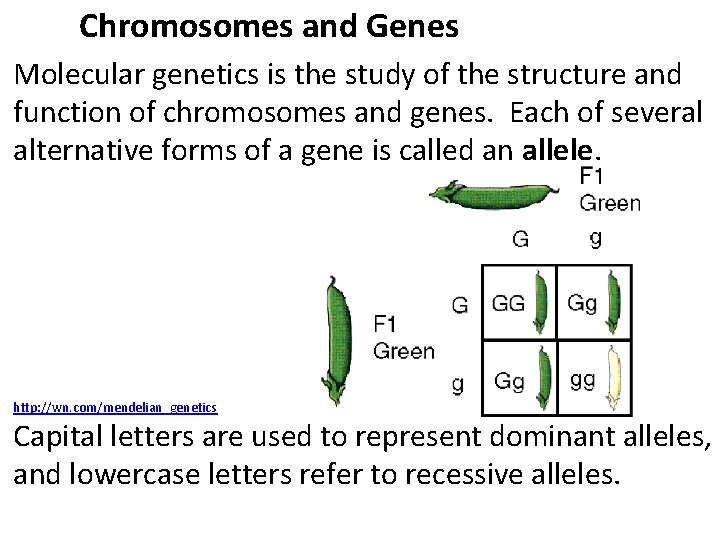
Chromosomes and Genes Molecular genetics is the study of the structure and function of chromosomes and genes. Each of several alternative forms of a gene is called an allele. http: //wn. com/mendelian_genetics Capital letters are used to represent dominant alleles, and lowercase letters refer to recessive alleles.
Section 9 -1 Review 1. Define the terms dominant and recessive. 2. Differentiate genes from alleles. 3. State in modern terminology the two laws of heredity that resulted from Mendel’s work. 4. List the steps involved in Mendel’s experiments on garden peas. 5. How might Mendel’s conclusions have differed if he had studied two traits determined by alleles carried on the same chromosome?