SECTION 4 ELECTRIC MOTORS UNIT 18 APPLICATIONS OF
- Slides: 14
SECTION 4 ELECTRIC MOTORS UNIT 18: APPLICATIONS OF MOTORS
UNIT OBJECTIVES After studying this unit, the reader should be able to • Identify the proper power supply for a motor • List some single and three-phase motor applications • Explain how motor noise can be isolated from the conditioned space • Describe various types of motor mounts • Identify and describe various types of motor drive mechanisms
MOTOR APPLICATIONS • The proper motor must be selected for proper system performance • Motor must be able to function in the operating environment • Motors are selected based on the power supply, system requirements, motor insulation type, motor class, bearing type and method of mounting the motor
THE POWER SUPPLY • Provides correct voltage and sufficient current • Motor nameplate provides power requirements including voltage, current, frequency, phase, locked rotor amperage and full load amperage • Motors should operate within 10% of rated voltage • Motors have a service factor (reserve horsepower) • Frequency – number of cycles per second • Power can be supplied as single or three phase
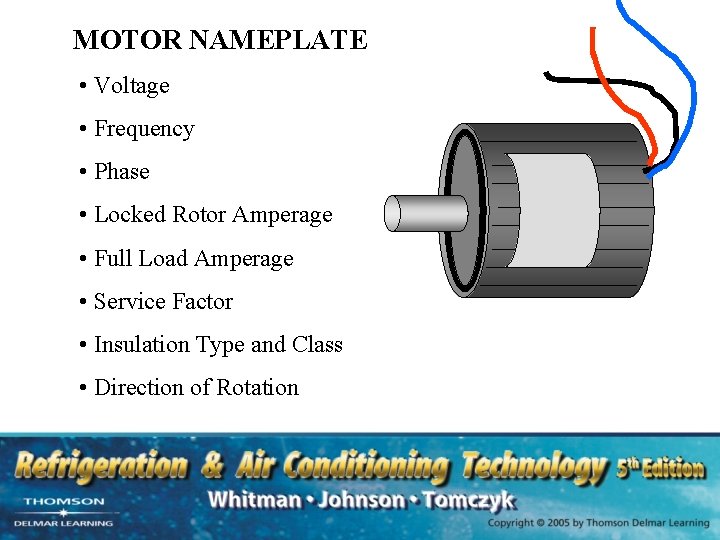
MOTOR NAMEPLATE • Voltage • Frequency • Phase • Locked Rotor Amperage • Full Load Amperage • Service Factor • Insulation Type and Class • Direction of Rotation
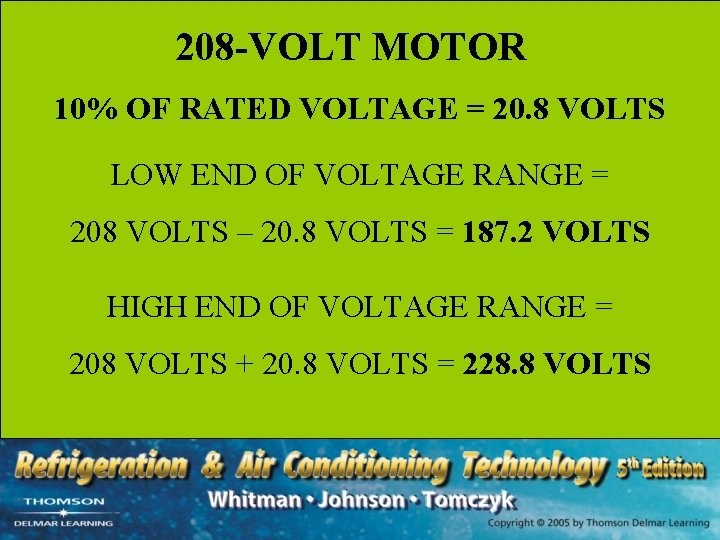
208 -VOLT MOTOR 10% OF RATED VOLTAGE = 20. 8 VOLTS LOW END OF VOLTAGE RANGE = 208 VOLTS – 20. 8 VOLTS = 187. 2 VOLTS HIGH END OF VOLTAGE RANGE = 208 VOLTS + 20. 8 VOLTS = 228. 8 VOLTS
ELECTRIC MOTOR WORKING CONDITIONS • Working conditions determine the type of motor to be used • Motors with centrifugal switches cannot be used in an explosive environment • Sealed motors are used in dirty locations • Drip-proof motors should be used in wet locations
INSULATION TYPE OR CLASS • Motors can safely operate up to a predetermined temperature • The insulation type determines the maximum allowable safe operating temperature • The insulation type rating is determined by the allowable rise in temperature above the surrounding ambient temperature
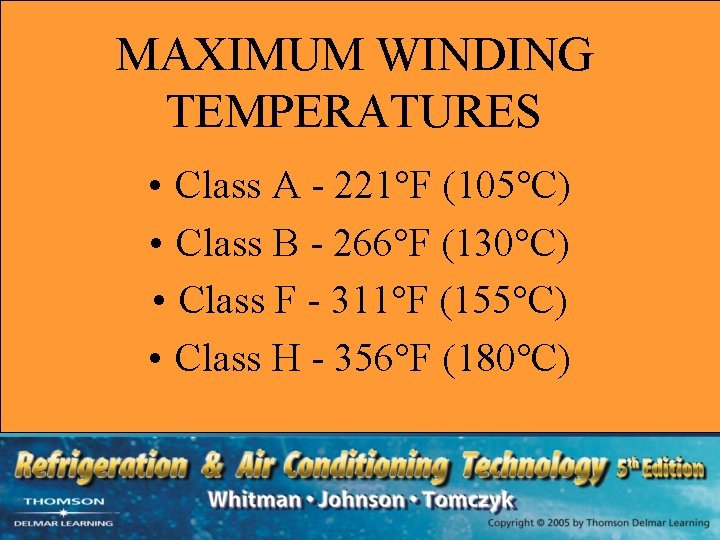
MAXIMUM WINDING TEMPERATURES • Class A - 221°F (105°C) • Class B - 266°F (130°C) • Class F - 311°F (155°C) • Class H - 356°F (180°C)
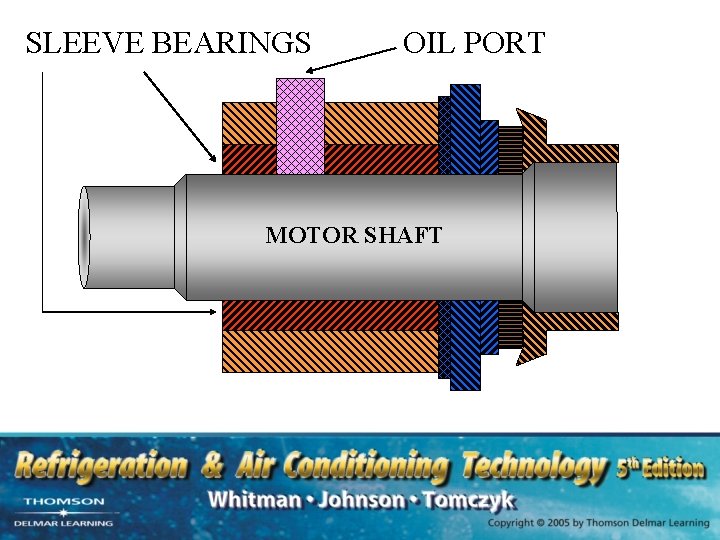
TYPES OF MOTOR BEARINGS • Bearing type is determined by load and acceptable noise levels • Sleeve bearings – Used on light loads and low noise levels – Lubricated with oil • Ball bearings – Noisier than sleeve bearings – Lubricated with grease
SLEEVE BEARINGS OIL PORT MOTOR SHAFT
MOUNTING CHARACTERISTICS • Determine how a motor will be secured during operation • Rigid motor mount – bolted to frame of fan or pump • Resilient or rubber mounts – reduced motor noise • Cradle mounts – motor sits in a cradle • Rigid-base mount – base mounted to the motor • End mount – used on small motors • Belly band strap mount – strap wraps around motor
MOTOR DRIVES • Connect the motor to the driven load • Transfers motor’s power to the driven device • Direct drive – Motor shaft connected directly to the driven load – Driven load turns at the same speed as the motor • Belt driven – Uses belts and pulleys – Driven load can rotate at different speeds
UNIT SUMMARY • The proper motor must always be selected for proper system performance • The power supply provides proper voltage and current capacity for proper motor operation • Motors should operate within 10% of rated voltage • Working conditions determine the motor to be used • Sleeve bearings operate quieter than ball bearings • Application determines type of motor mount used • Motors can be used for direct or belt driven applications