Scaling Up An Approach and Conference on Innovation


- Slides: 29
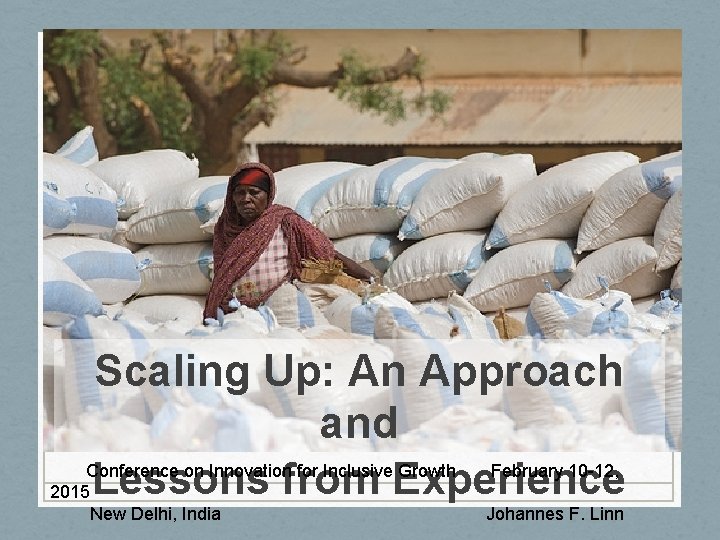
Scaling Up: An Approach and Conference on Innovation for Inclusive Growth February 10 -12, 2015 Lessons from Experience New Delhi, India Johannes F. Linn
What we’ll talk about • Some background • A framework of analysis • An example • Lessons • References 11/07/2013 2 jlinn@brookings. edu
Scaling up – Some background 11/07/2013 3 jlinn@brookings. edu
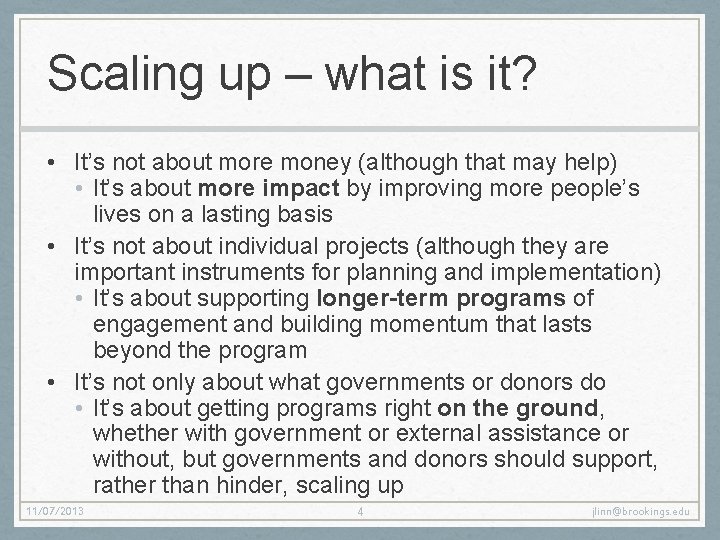
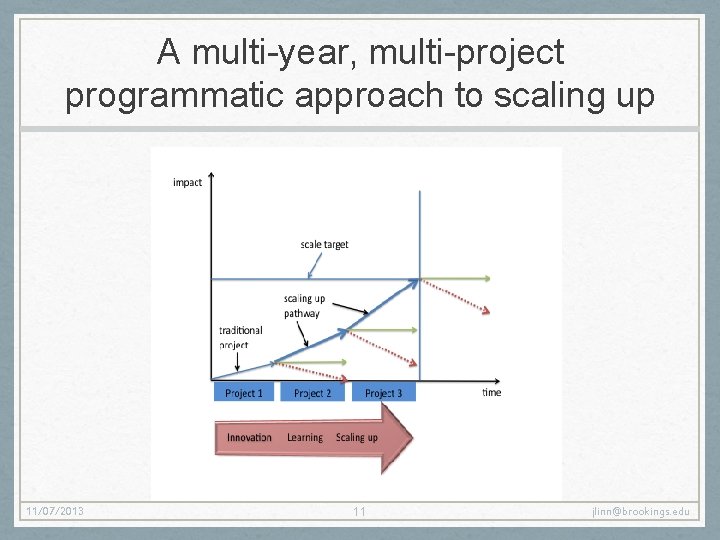
Scaling up – what is it? • It’s not about more money (although that may help) • It’s about more impact by improving more people’s lives on a lasting basis • It’s not about individual projects (although they are important instruments for planning and implementation) • It’s about supporting longer-term programs of engagement and building momentum that lasts beyond the program • It’s not only about what governments or donors do • It’s about getting programs right on the ground, whether with government or external assistance or without, but governments and donors should support, rather than hinder, scaling up 11/07/2013 4 jlinn@brookings. edu
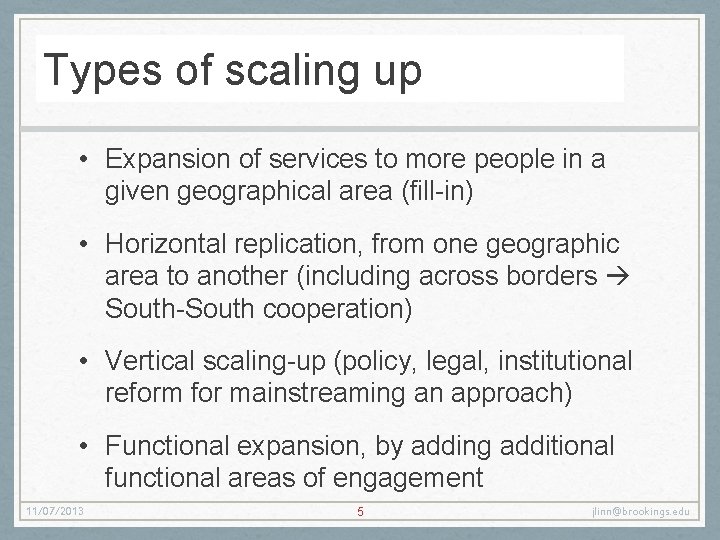
Types of scaling up • Expansion of services to more people in a given geographical area (fill-in) • Horizontal replication, from one geographic area to another (including across borders South-South cooperation) • Vertical scaling-up (policy, legal, institutional reform for mainstreaming an approach) • Functional expansion, by adding additional functional areas of engagement 11/07/2013 5 jlinn@brookings. edu
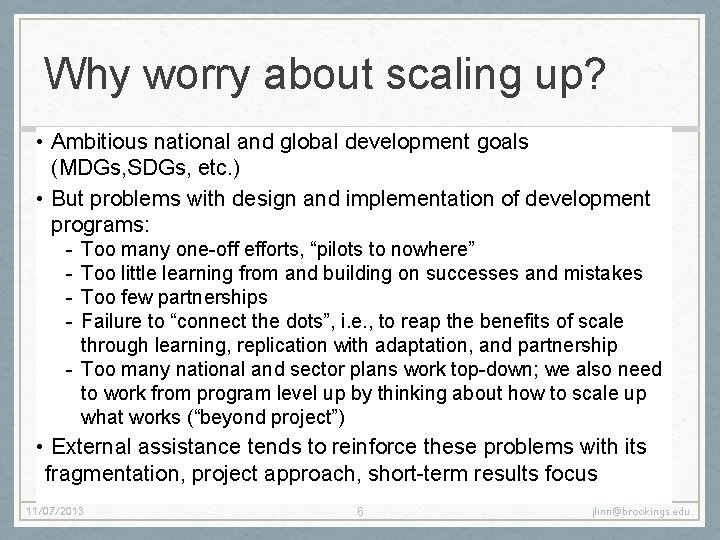
Why worry about scaling up? • Ambitious national and global development goals (MDGs, SDGs, etc. ) • But • problems with design and implementation of development programs: - Too many one-off efforts, “pilots to nowhere” Too little learning from and building on successes and mistakes Too few partnerships Failure to “connect the dots”, i. e. , to reap the benefits of scale through learning, replication with adaptation, and partnership - Too many national and sector plans work top-down; we also need to work from program level up by thinking about how to scale up what works (“beyond project”) • External assistance tends to reinforce these problems with its fragmentation, project approach, short-term results focus 11/07/2013 6 jlinn@brookings. edu
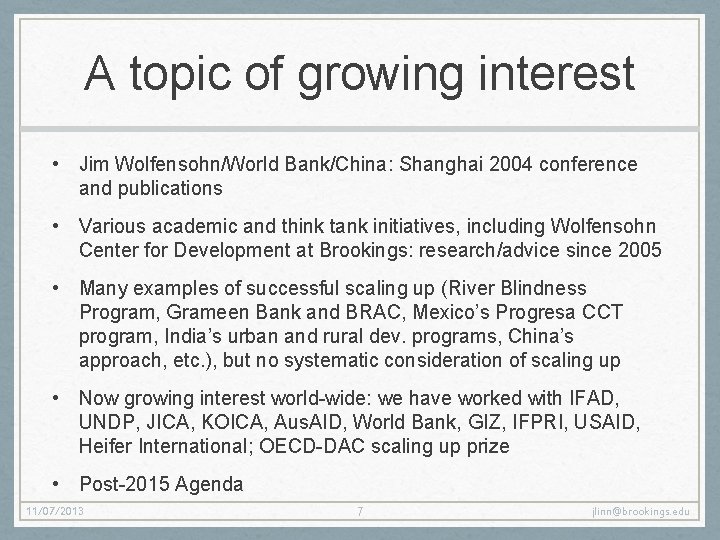
A topic of growing interest • Jim Wolfensohn/World Bank/China: Shanghai 2004 conference and publications • Various academic and think tank initiatives, including Wolfensohn Center for Development at Brookings: research/advice since 2005 • Many examples of successful scaling up (River Blindness Program, Grameen Bank and BRAC, Mexico’s Progresa CCT program, India’s urban and rural dev. programs, China’s approach, etc. ), but no systematic consideration of scaling up • Now growing interest world-wide: we have worked with IFAD, UNDP, JICA, KOICA, Aus. AID, World Bank, GIZ, IFPRI, USAID, Heifer International; OECD-DAC scaling up prize • Post-2015 Agenda 11/07/2013 7 jlinn@brookings. edu
Scaling up – A simple framework of analysis 11/07/2013 8 jlinn@brookings. edu
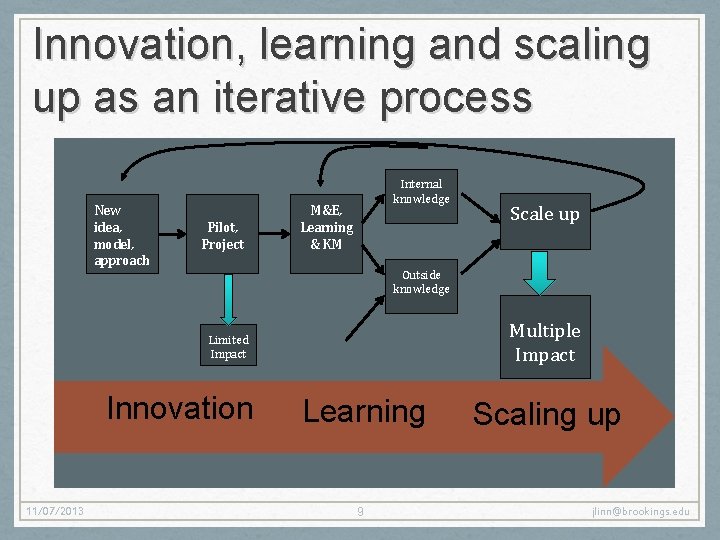
Innovation, learning and scaling up as an iterative process New idea, model, approach Pilot, Project Internal knowledge M&E, Learning & KM Outside knowledge Multiple Impact Limited Impact Innovation 11/07/2013 Scale up Learning 9 Scaling up jlinn@brookings. edu
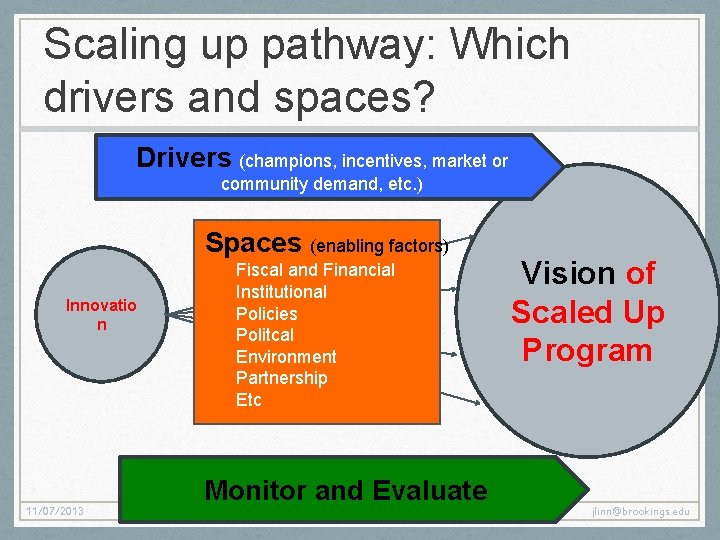
Scaling up pathway: Which drivers and spaces? Drivers (champions, incentives, market or community demand, etc. ) Spaces (enabling factors) Innovatio n 11/07/2013 Fiscal and Financial Institutional Policies Politcal Environment Partnership Etc Monitor and Evaluate 10 Vision of Scaled Up Program jlinn@brookings. edu
A multi-year, multi-project programmatic approach to scaling up 11/07/2013 11 jlinn@brookings. edu
An Example 11/07/2013 12 jlinn@brookings. edu
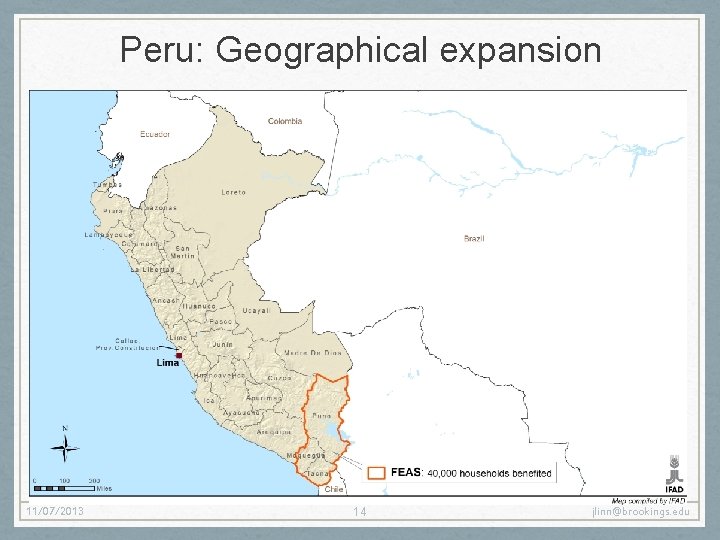
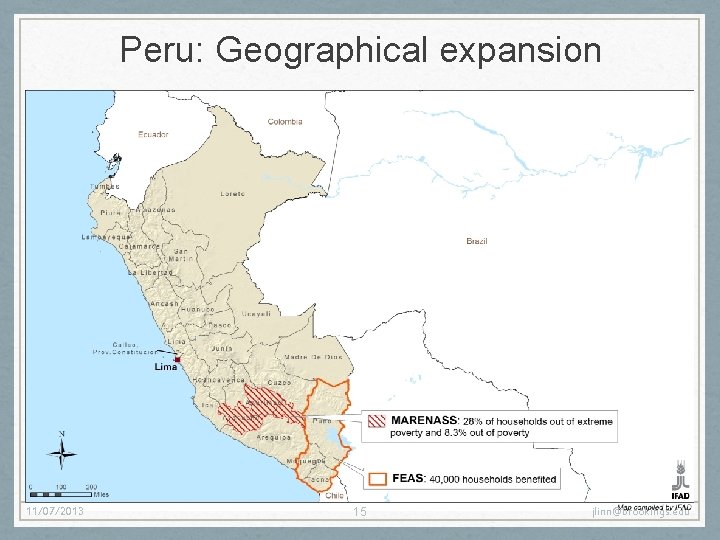
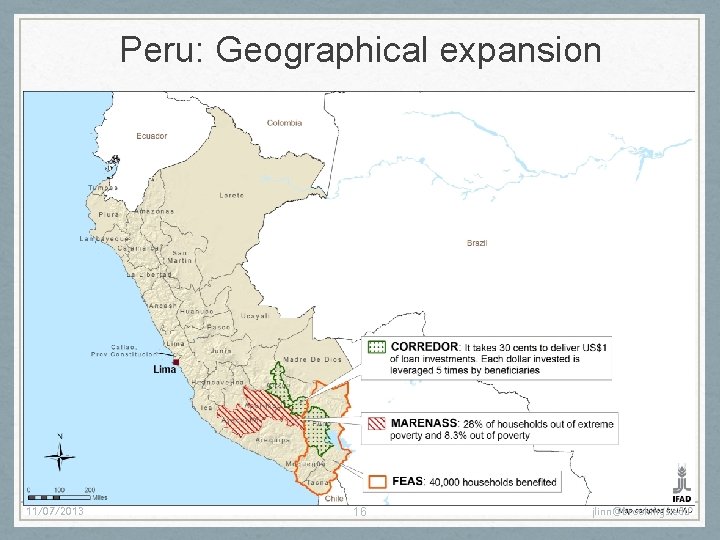
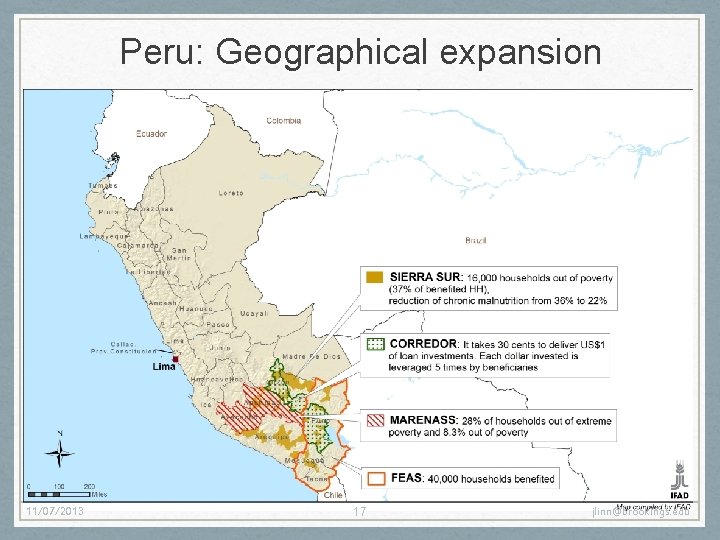
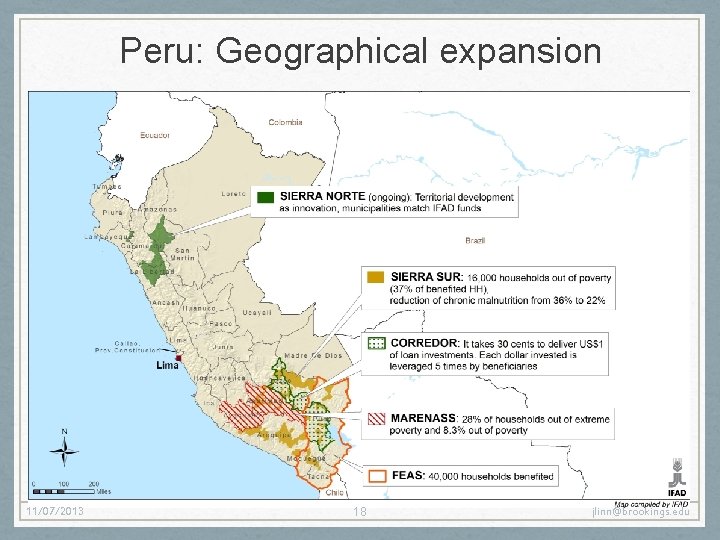
Highland area development in Peru • 8 IFAD loans since 1980 for rural poverty reduction through successive area-based projects • >150, 000 rural households, 30% of highland communities • Multi-dimensional scaling up • Geographic 11/07/2013 13 jlinn@brookings. edu
Peru: Geographical expansion 11/07/2013 14 jlinn@brookings. edu
Peru: Geographical expansion 11/07/2013 15 jlinn@brookings. edu
Peru: Geographical expansion 11/07/2013 16 jlinn@brookings. edu
Peru: Geographical expansion 11/07/2013 17 jlinn@brookings. edu
Peru: Geographical expansion 11/07/2013 18 jlinn@brookings. edu
An example: Highland area development in Peru • 8 IFAD loans since 1980 for rural poverty reduction through successive area-based projects • >150, 000 rural households, 30% of highland communities • Multi-dimensional scaling up • Geographic, functional, vertical • Drivers • Innovative interventions 11/07/2013 19 jlinn@brookings. edu
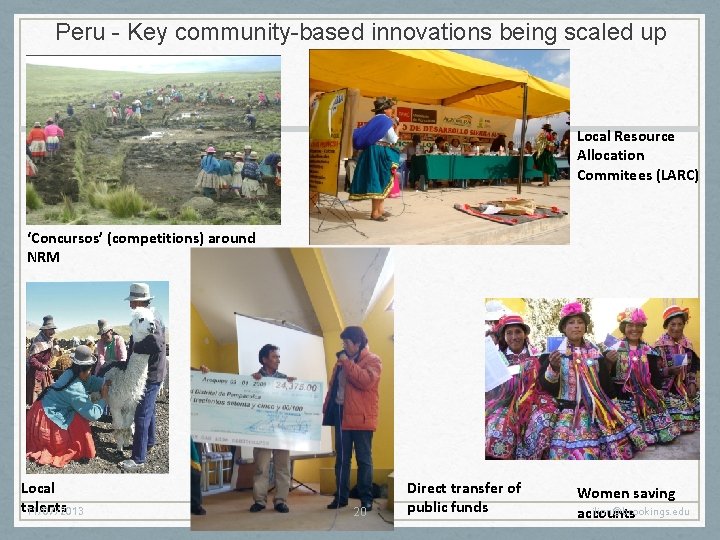
Peru - Key community-based innovations being scaled up Local Resource Allocation Commitees (LARC) ‘Concursos’ (competitions) around NRM Local talents 11/07/2013 20 Direct transfer of public funds Women saving jlinn@brookings. edu accounts
An Example: Highland area development in Peru • 8 IFAD loans since 1980 for rural poverty reduction through successive area-based projects • >150, 000 rural households, 30% of highland communities • Multi-dimensional scaling up • Geographic, functional, vertical • Drivers • Innovative interventions, community demand, expert network, IFAD staff, eventually the government (and history of crisis) • Spaces • Political, policy, institutional, fiscal, cultural, learning • IFAD’s role: support and finance • Flexible, innovative, stick-with-it, building on experience • Long-term project manager close to the action and committed to scaling up 11/07/2013 21 jlinn@brookings. edu
Lessons from experience with scaling up 11/07/2013 22 jlinn@brookings. edu
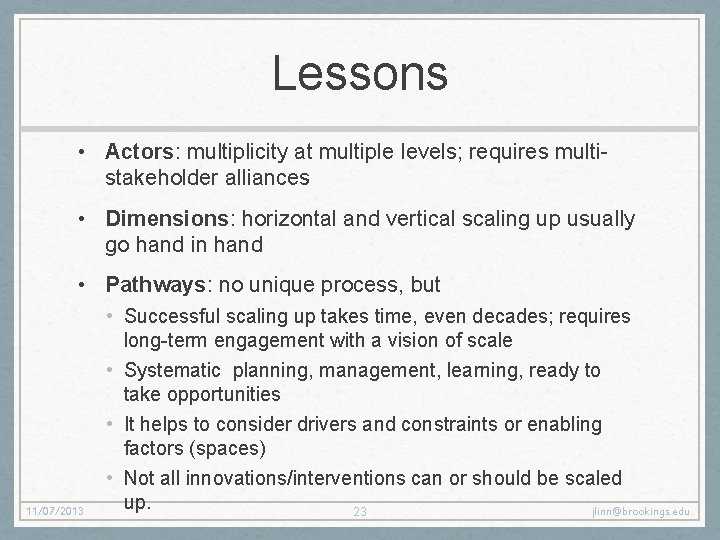
Lessons • Actors: multiplicity at multiple levels; requires multistakeholder alliances • Dimensions: horizontal and vertical scaling up usually go hand in hand • Pathways: no unique process, but 11/07/2013 • Successful scaling up takes time, even decades; requires long-term engagement with a vision of scale • Systematic planning, management, learning, ready to take opportunities • It helps to consider drivers and constraints or enabling factors (spaces) • Not all innovations/interventions can or should be scaled up. jlinn@brookings. edu 23
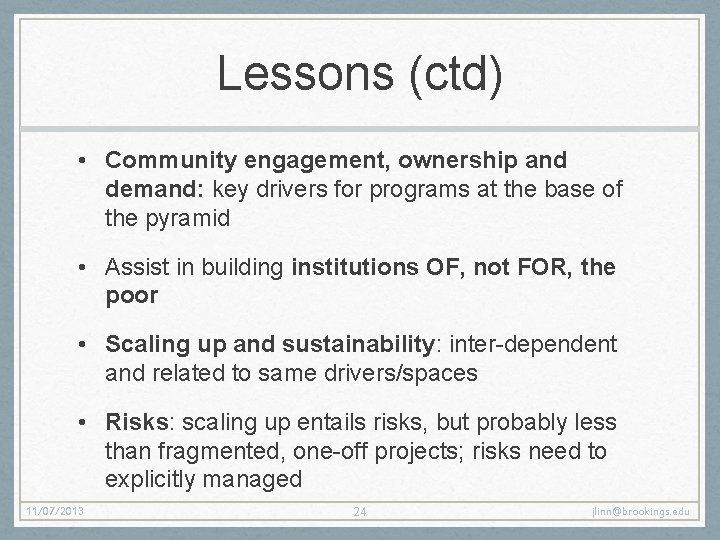
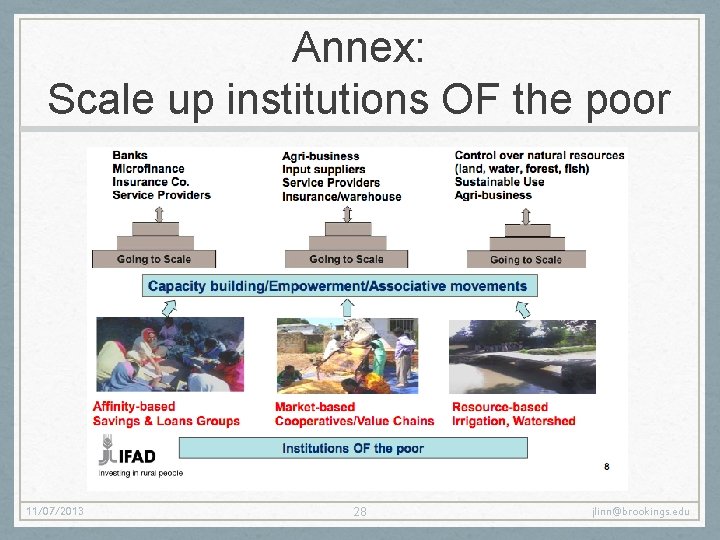
Lessons (ctd) • Community engagement, ownership and demand: key drivers for programs at the base of the pyramid • Assist in building institutions OF, not FOR, the poor • Scaling up and sustainability: inter-dependent and related to same drivers/spaces • Risks: scaling up entails risks, but probably less than fragmented, one-off projects; risks need to explicitly managed 11/07/2013 24 jlinn@brookings. edu
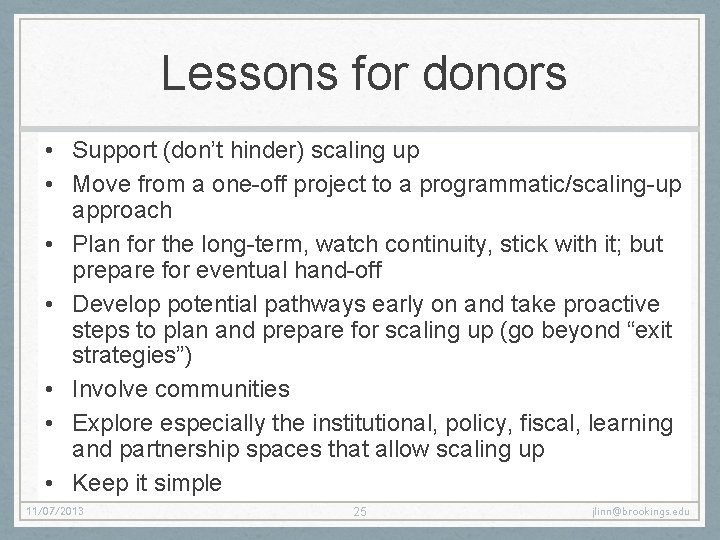
Lessons for donors • Support (don’t hinder) scaling up • Move from a one-off project to a programmatic/scaling-up approach • Plan for the long-term, watch continuity, stick with it; but prepare for eventual hand-off • Develop potential pathways early on and take proactive steps to plan and prepare for scaling up (go beyond “exit strategies”) • Involve communities • Explore especially the institutional, policy, fiscal, learning and partnership spaces that allow scaling up • Keep it simple 11/07/2013 25 jlinn@brookings. edu
Selected References L. Chandy, A. Hosono, H. Kharas & J. Linn, eds. 2013. Getting to scale. Brookings, Washington, DC A. Hartmann and J. Linn. 2008. “Scaling Up: A Framework and Lessons for Development Effectiveness from Literature and Practice. ” Wolfensohn Center Working Paper No. 5. Brookings. Washington, DC J. Linn, A. Hartmann, H. Kharas, R. Kohl, and B. Massler. 2010. “Scaling Up the Fight Against Rural Poverty: An Institutional Review of IFAD’s Approach”, Global Working Paper No. 39 , Brookings. Washington, DC L. Cooley and J. Linn. 2014. “Taking Innovations to Scale: Methods, Applications and Lessons. ” Results for Development and MSI. Washington, DC J. Linn, ed. 2012 Scaling Up in Agriculture, Rural Development and Nutrition. 2020 Focus Briefs, No. 19. International Food Policy and Research Institute. Washington, DC L. Cooley and R. Ved, 2012. “Scaling Up—From Vision to Large Scale Change: A Management Framework for Practitioners, Second Edition. ” MSI. Washington, DC A. Hartmann, H. Kharas, R. Kohl, J. Linn, B. Massler and C. Sourang. 2013. “Scaling Up Programs for the Rural Poor: IFAD’s Experience, Lessons and Prospects (Phase 2). ” Global Economy& Development Working Paper 54. Brookings 11/07/2013 26 jlinn@brookings. edu
Thank you! 11/07/2013 27 jlinn@brookings. edu
Annex: Scale up institutions OF the poor 11/07/2013 28 jlinn@brookings. edu
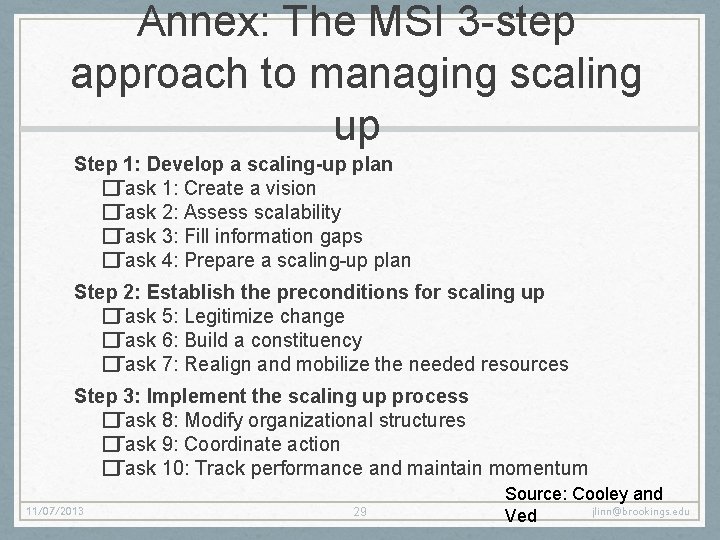
Annex: The MSI 3 -step approach to managing scaling up Step 1: Develop a scaling-up plan �Task 1: Create a vision �Task 2: Assess scalability �Task 3: Fill information gaps �Task 4: Prepare a scaling-up plan Step 2: Establish the preconditions for scaling up �Task 5: Legitimize change �Task 6: Build a constituency �Task 7: Realign and mobilize the needed resources Step 3: Implement the scaling up process �Task 8: Modify organizational structures �Task 9: Coordinate action �Task 10: Track performance and maintain momentum 11/07/2013 29 Source: Cooley and jlinn@brookings. edu Ved