Saving and Economic Growth Saving makes economic growth

- Slides: 8
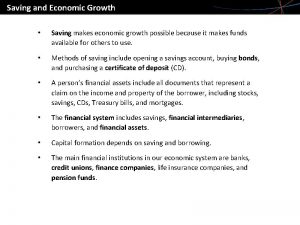
Saving and Economic Growth • Saving makes economic growth possible because it makes funds available for others to use. • Methods of saving include opening a savings account, buying bonds, and purchasing a certificate of deposit (CD). • A person’s financial assets include all documents that represent a claim on the income and property of the borrower, including stocks, savings, CDs, Treasury bills, and mortgages. • The financial system includes savings, financial intermediaries, borrowers, and financial assets. • Capital formation depends on saving and borrowing. • The main financial institutions in our economic system are banks, credit unions, finance companies, life insurance companies, and pension funds.
Basic Investment Considerations • Successful investors invest consistently, on a regular basis, and over long periods of time. • Simplicity is a key to successful investing; ignore complicated investments that you don’t understand, and avoid investments that seem too good to be true. • Consider the risks and the rates of return before investing, and choose a risk level that is comfortable for you. • Your reasons for investing will affect the types of investments that are right for you.
Bonds as Financial Assets • The three main components of a bond are par value, maturity, and coupon rate. • Supply and demand among buyers and sellers establish the final price of a bond. • The interest received and the price paid for a bond determine its current yield, so bond yield is also determined by supply and demand. • Standard & Poor’s and Moody’s are corporations that publish bond ratings to help investors check the quality of bonds.
Financial Assets and Their Characteristics • Certificates of deposit (CDs) are loans of various amounts and maturities to financial institutions, and most are covered by the FDIC. • Corporate bonds can be long-term investments but can be sold quickly if needed. • Interest on corporate bonds is considered taxable income. • Municipal bonds are tax-exempt bonds issued by state and local governments. • Savings bonds are issued by the U. S. government and sell at face value, with interest added later. • Treasury notes have maturities of 2 to 10 years, and Treasury bonds have maturity dates of 20 to 30 years. • Treasury bills have short maturities of up to 52 weeks and are sold on a discount basis. • Individual Retirement Accounts (IRAs) are long-term, tax-sheltered deposits.
Markets for Financial Assets • Capital markets are markets in which money is loaned for more than one year. • Money markets are markets in which money is loaned for less than one year. • In the primary market, only the original issuer can sell or repurchase a financial asset. • In the secondary market, existing financial assets can be resold to new owners.
Stock Prices and Efficient Markets • Investors may buy and sell equities through a stockbroker or by opening an Internet account with a discount brokerage firm. • Changes in the supply and demand for individual stocks affect the value of the stocks on a daily basis. • Understanding stock listings requires that you understand the symbols used, including 52 Weeks, Stock (SYM), DIV, Yld%, PE, 100 s, LAST, and NET CHG. • The Efficient Market Hypothesis states that stocks are usually priced correctly, so bargains are hard to find. • Portfolio diversification tends to even out gains and losses. • Mutual funds provide diversification and lower risk by purchasing stocks issued by hundreds or thousands of companies. • 401(k) plans are tax-deferred investment and savings plans that act as personal pension funds for employees.
Stock Markets and Their Performance • The two largest stock exchanges are now NYSE Euronext and AMEXNASDAQ. • Measures of stock performance include the Dow Jones Industrial Average (DJIA) and the Standard & Poor’s 500 (S&P 500). • A bull market is one in which prices move up for several months or years in a row; a bear market is one in which prices fall sharply for several months or years in a row.
Trading in the Future • Most buying and selling takes place in the present (spot market). • A futures contract is an agreement to buy or sell at a specific future date at a predetermined price. • An option is a futures contract that gives the buyer the right to cancel the contract if the price drops. • A call option is the right to buy something at a specific future price, or cancel if the actual future price is not advantageous to the buyer. • A put option is the right to sell something at a specific future price, or cancel if the actual future price is not advantageous to the buyer.