RPC DPG status and plans Marcello Maggi INFN
- Slides: 21
RPC DPG status and plans Marcello Maggi – INFN Bari Marcin Konecki (University of Warsaw) for RPC DPG group CMS WEEK RPC Meeting 19/06/07 • Reports on each Physics Days ~1/month Marcin Report • Coordination Meetings ~2/month CMS Physics Days, DPG session, 23 May 2007
RPC DPG status and plans Marcin Konecki (University of Warsaw) for RPC DPG group • Status and recent progress - geometry, simulation - L 1 emulator - RBC emulator - R 2 D - DQM - reconstruction • Preparation for Global Runs • Plans for CSA 07 CMS Physics Days, DPG session, 23 May 2007
Geometry, Rec. Hit • Geometry changes in 140: Maggi, Pugliese RPCGeometry, RPCGeometry. Builder, Muon. Common. Data (xml files), Muon. Numbering RPCDigi refers now to local strip numbering; L 1 Emulator, RPCUnpacker adopted to the change • RPCRec. Hit become 2 D to allow better use for track reconstruction 3 Marcin Konecki, University of Warsaw
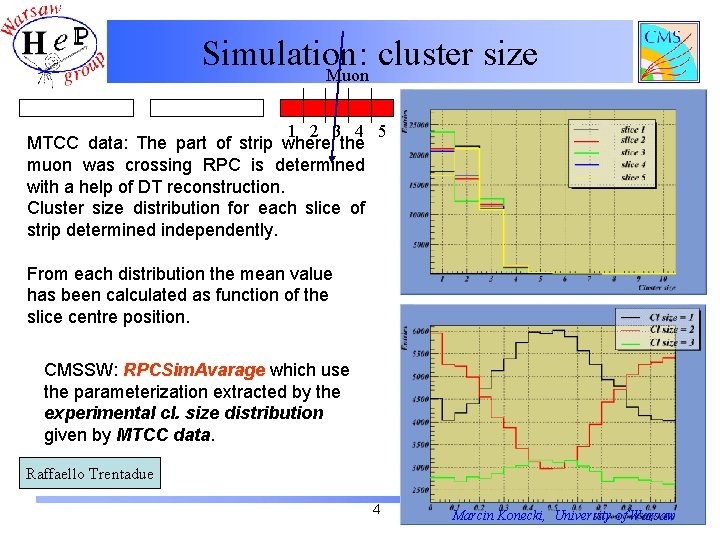
Simulation: cluster size Muon 1 2 3 4 5 MTCC data: The part of strip where the muon was crossing RPC is determined with a help of DT reconstruction. Cluster size distribution for each slice of strip determined independently. From each distribution the mean value has been calculated as function of the slice centre position. CMSSW: RPCSim. Avarage which use the parameterization extracted by the experimental cl. size distribution given by MTCC data. Raffaello Trentadue 4 Marcin Konecki, University of Warsaw
Simulation: current work • EXISTS: Noise simulation (version 0 – same level everywhere). Need to be tested and integrated (Avila, Gomez, Sanabria) • PLANS: Cluster size tails (Tupputi) It requires large MC statistics for cosmics • PLANS: X-talk effect (requires a re-design of RPCdigitizer) (Trentadue) • PLANS: Timing to be ported from ORCA soon 5 Marcin Konecki, University of Warsaw
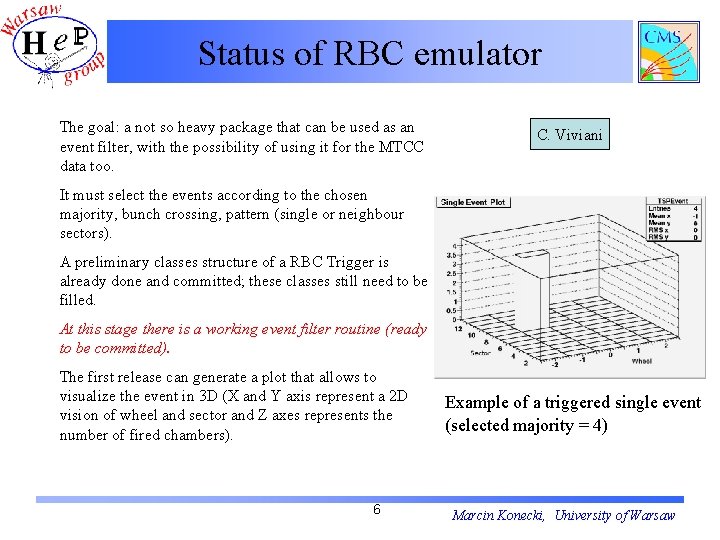
Status of RBC emulator The goal: a not so heavy package that can be used as an event filter, with the possibility of using it for the MTCC data too. C. Viviani It must select the events according to the chosen majority, bunch crossing, pattern (single or neighbour sectors). A preliminary classes structure of a RBC Trigger is already done and committed; these classes still need to be filled. At this stage there is a working event filter routine (ready to be committed). The first release can generate a plot that allows to visualize the event in 3 D (X and Y axis represent a 2 D vision of wheel and sector and Z axes represents the number of fired chambers). 6 Example of a triggered single event (selected majority = 4) Marcin Konecki, University of Warsaw
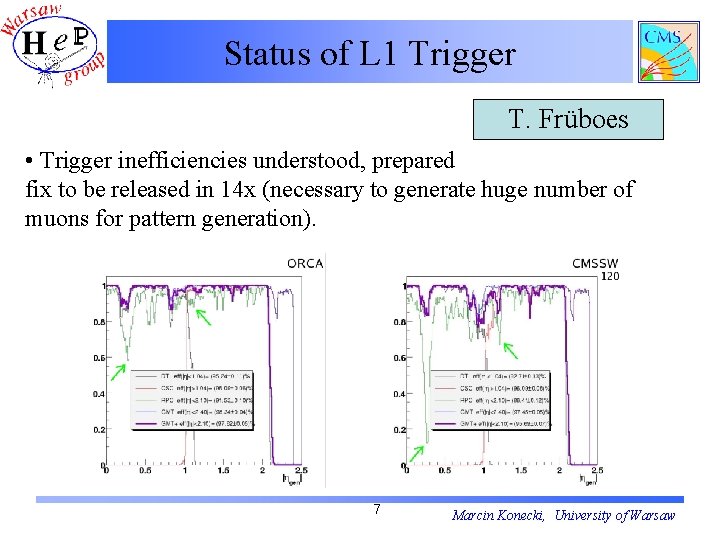
Status of L 1 Trigger T. Früboes • Trigger inefficiencies understood, prepared fix to be released in 14 x (necessary to generate huge number of muons for pattern generation). 7 Marcin Konecki, University of Warsaw
Status of L 1 Trigger T. Früboes • RPC trigger patterns are delivered with Event. Setup. This is preparation for accessing patterns from DB • Improvements in patterns generation. Generated patterns finally fit into hardware • Keeping up to date with changes in framework (library-pluggins separation) • RPC trigger emulator is now used to help debugging hardware. States of emulation on different stages of pipeline used to verify hardware implementation of algorithm 8 Marcin Konecki, University of Warsaw
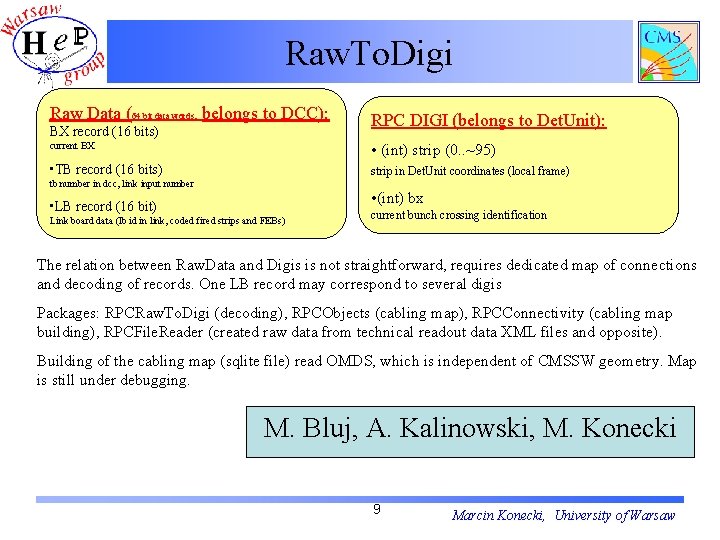
Raw. To. Digi Raw Data (64 bit data words, belongs to DCC): BX record (16 bits) RPC DIGI (belongs to Det. Unit): current BX • (int) strip (0. . ~95) • TB record (16 bits) strip in Det. Unit coordinates (local frame) tb number in dcc, link input number • (int) bx • LB record (16 bit) Link board data (lb id in link, coded fired strips and FEBs) current bunch crossing identification The relation between Raw. Data and Digis is not straightforward, requires dedicated map of connections and decoding of records. One LB record may correspond to several digis Packages: RPCRaw. To. Digi (decoding), RPCObjects (cabling map), RPCConnectivity (cabling map building), RPCFile. Reader (created raw data from technical readout data XML files and opposite). Building of the cabling map (sqlite file) read OMDS, which is independent of CMSSW geometry. Map is still under debugging. M. Bluj, A. Kalinowski, M. Konecki 9 Marcin Konecki, University of Warsaw
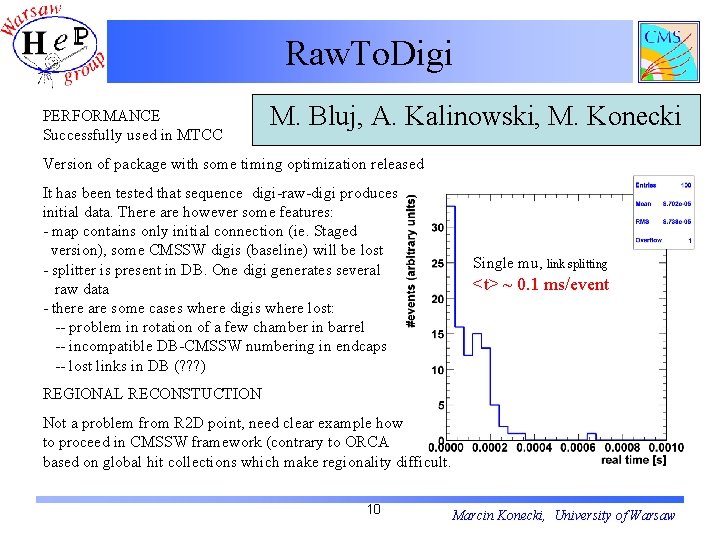
Raw. To. Digi PERFORMANCE Successfully used in MTCC M. Bluj, A. Kalinowski, M. Konecki Version of package with some timing optimization released It has been tested that sequence digi-raw-digi produces initial data. There are however some features: - map contains only initial connection (ie. Staged version), some CMSSW digis (baseline) will be lost - splitter is present in DB. One digi generates several raw data - there are some cases where digis where lost: -- problem in rotation of a few chamber in barrel -- incompatible DB-CMSSW numbering in endcaps -- lost links in DB (? ? ? ) Single mu, link splitting <t> ~ 0. 1 ms/event REGIONAL RECONSTUCTION Not a problem from R 2 D point, need clear example how to proceed in CMSSW framework (contrary to ORCA based on global hit collections which make regionality difficult. 10 Marcin Konecki, University of Warsaw
monitoring of Raw. To. Digi • In view of the Commissioning the dedicated fast module for data integrity checks to be embedded in the HLT application is under deep review. The responsible person: Michal Szleper (Warsaw) has started to look in CMSSW to check which strategy to use. The module (skeleton) is needed before GR with active HLT. 11 Marcin Konecki, University of Warsaw
RPC DQM M. Maggi, P. Paolucci Working version exists Study of MTCC data still ongoing New IGUANA GUI (Lomidze) is progressingg Automatic Histogram checking (Cimmino, Noli) CSC segment extrapolation for local efficiency measurements (Carrillo) RPC trigger monitoring (Warsaw) needs more efforts 12 Marcin Konecki, University of Warsaw
Reconstrution D. Pagano • Commissioning requires the capability of running RPC standalone. Reconstruction needs RPC seeding. First version (barrel) exists: Muon. Seed. Generator/RPCSeed. Generator can compute this seeding • Pt is calculated by arranging the four observed chambers (one for station) in all possible combinations of three chambers. For every one of these groups of hits, we estimate the radius of curvature and then the pt (according to the formula pt = q. BR). 13 Marcin Konecki, University of Warsaw
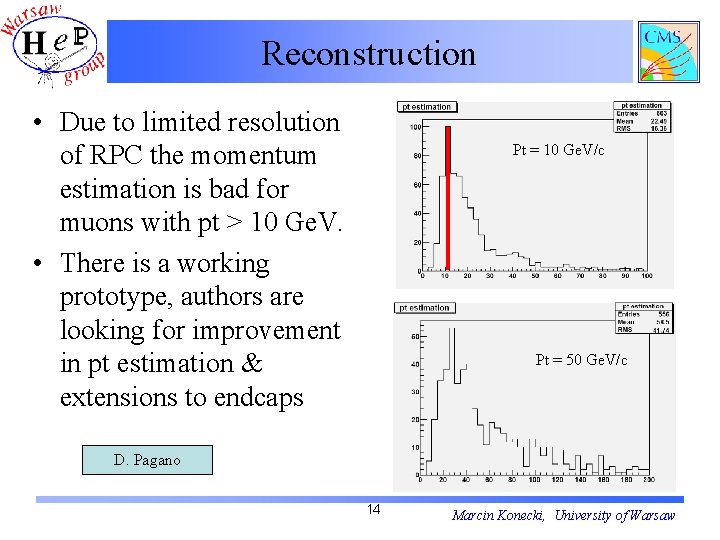
Reconstruction • Due to limited resolution of RPC the momentum estimation is bad for muons with pt > 10 Ge. V. • There is a working prototype, authors are looking for improvement in pt estimation & extensions to endcaps Pt = 10 Ge. V/c Pt = 50 Ge. V/c D. Pagano 14 Marcin Konecki, University of Warsaw
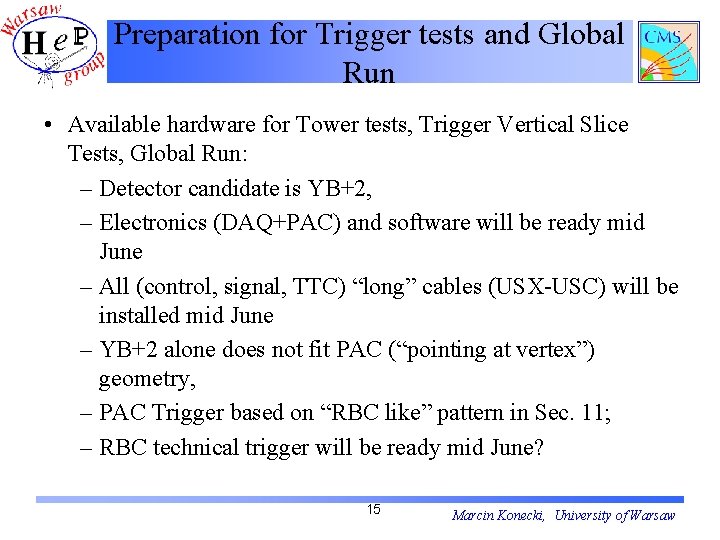
Preparation for Trigger tests and Global Run • Available hardware for Tower tests, Trigger Vertical Slice Tests, Global Run: – Detector candidate is YB+2, – Electronics (DAQ+PAC) and software will be ready mid June – All (control, signal, TTC) “long” cables (USX-USC) will be installed mid June – YB+2 alone does not fit PAC (“pointing at vertex”) geometry, – PAC Trigger based on “RBC like” pattern in Sec. 11; – RBC technical trigger will be ready mid June? 15 Marcin Konecki, University of Warsaw
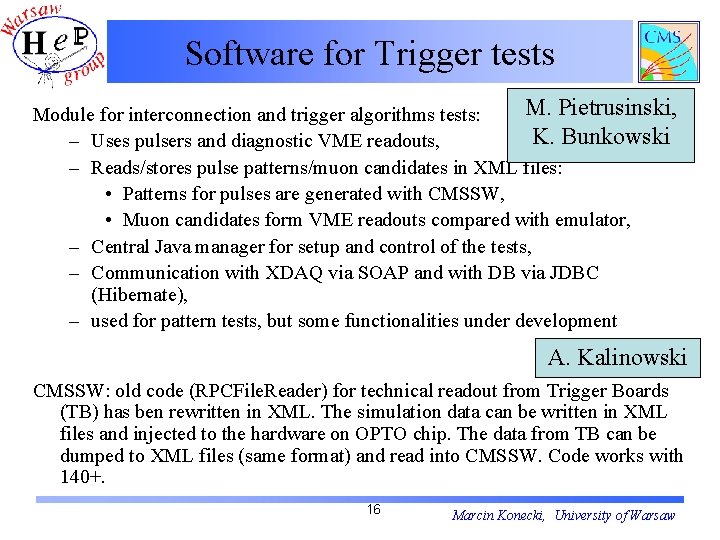
Software for Trigger tests M. Pietrusinski, Module for interconnection and trigger algorithms tests: K. Bunkowski – Uses pulsers and diagnostic VME readouts, – Reads/stores pulse patterns/muon candidates in XML files: • Patterns for pulses are generated with CMSSW, • Muon candidates form VME readouts compared with emulator, – Central Java manager for setup and control of the tests, – Communication with XDAQ via SOAP and with DB via JDBC (Hibernate), – used for pattern tests, but some functionalities under development A. Kalinowski CMSSW: old code (RPCFile. Reader) for technical readout from Trigger Boards (TB) has ben rewritten in XML. The simulation data can be written in XML files and injected to the hardware on OPTO chip. The data from TB can be dumped to XML files (same format) and read into CMSSW. Code works with 140+. 16 Marcin Konecki, University of Warsaw
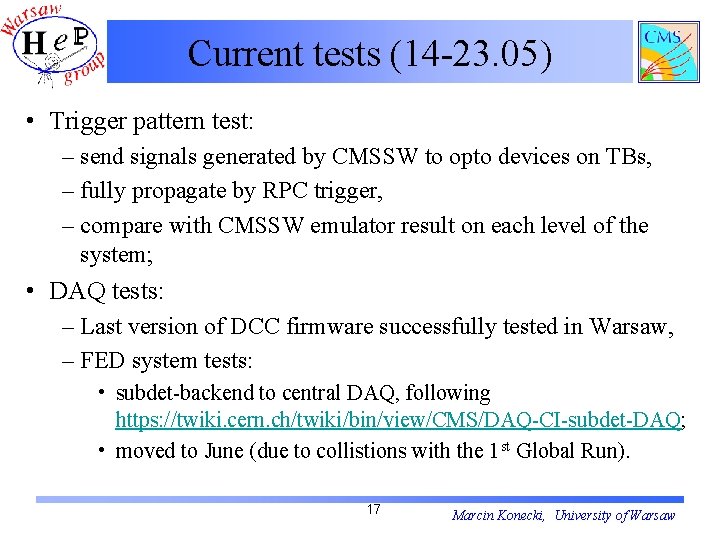
Current tests (14 -23. 05) • Trigger pattern test: – send signals generated by CMSSW to opto devices on TBs, – fully propagate by RPC trigger, – compare with CMSSW emulator result on each level of the system; • DAQ tests: – Last version of DCC firmware successfully tested in Warsaw, – FED system tests: • subdet-backend to central DAQ, following https: //twiki. cern. ch/twiki/bin/view/CMS/DAQ-CI-subdet-DAQ; • moved to June (due to collistions with the 1 st Global Run). 17 Marcin Konecki, University of Warsaw
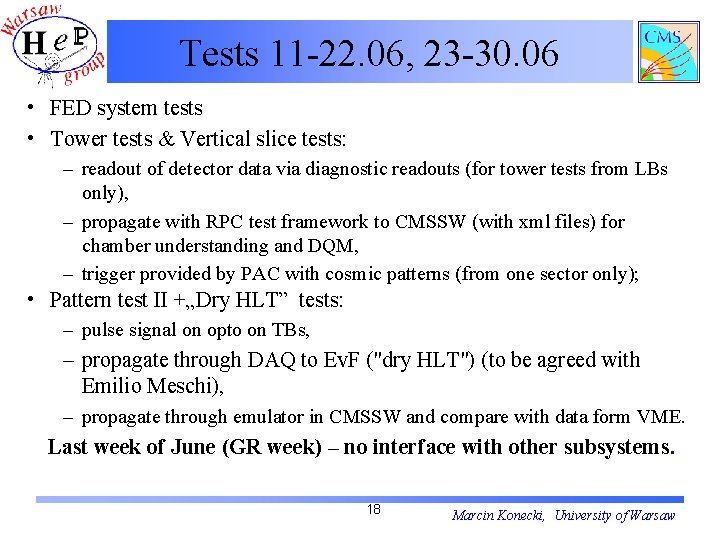
Tests 11 -22. 06, 23 -30. 06 • FED system tests • Tower tests & Vertical slice tests: – readout of detector data via diagnostic readouts (for tower tests from LBs only), – propagate with RPC test framework to CMSSW (with xml files) for chamber understanding and DQM, – trigger provided by PAC with cosmic patterns (from one sector only); • Pattern test II +„Dry HLT” tests: – pulse signal on opto on TBs, – propagate through DAQ to Ev. F ("dry HLT") (to be agreed with Emilio Meschi), – propagate through emulator in CMSSW and compare with data form VME. Last week of June (GR week) – no interface with other subsystems. 18 Marcin Konecki, University of Warsaw
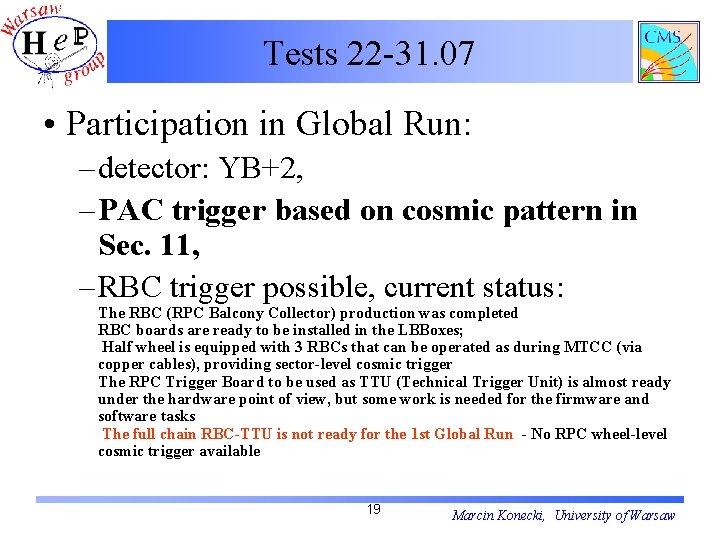
Tests 22 -31. 07 • Participation in Global Run: – detector: YB+2, – PAC trigger based on cosmic pattern in Sec. 11, – RBC trigger possible, current status: The RBC (RPC Balcony Collector) production was completed RBC boards are ready to be installed in the LBBoxes; Half wheel is equipped with 3 RBCs that can be operated as during MTCC (via copper cables), providing sector-level cosmic trigger The RPC Trigger Board to be used as TTU (Technical Trigger Unit) is almost ready under the hardware point of view, but some work is needed for the firmware and software tasks The full chain RBC-TTU is not ready for the 1 st Global Run - No RPC wheel-level cosmic trigger available 19 Marcin Konecki, University of Warsaw
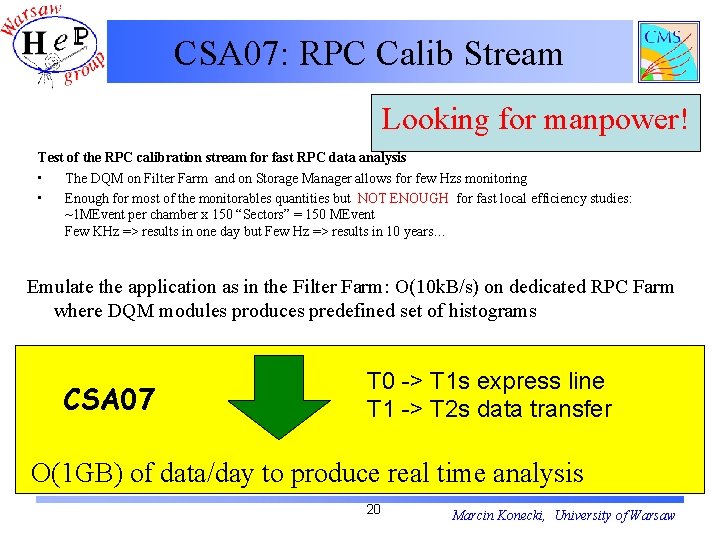
CSA 07: RPC Calib Stream Looking for manpower! Test of the RPC calibration stream for fast RPC data analysis • The DQM on Filter Farm and on Storage Manager allows for few Hzs monitoring • Enough for most of the monitorables quantities but NOT ENOUGH for fast local efficiency studies: ~1 MEvent per chamber x 150 “Sectors” = 150 MEvent Few KHz => results in one day but Few Hz => results in 10 years… Emulate the application as in the Filter Farm: O(10 k. B/s) on dedicated RPC Farm where DQM modules produces predefined set of histograms CSA 07 T 0 -> T 1 s express line T 1 -> T 2 s data transfer O(1 GB) of data/day to produce real time analysis 20 Marcin Konecki, University of Warsaw
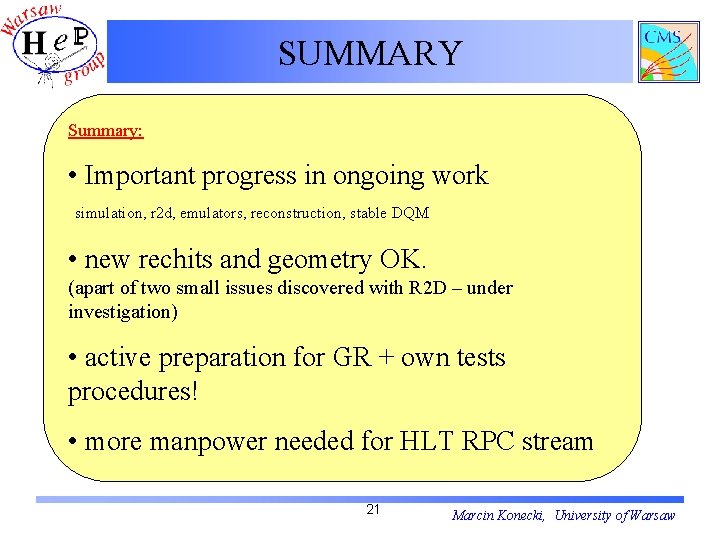
SUMMARY Summary: • Important progress in ongoing work simulation, r 2 d, emulators, reconstruction, stable DQM • new rechits and geometry OK. (apart of two small issues discovered with R 2 D – under investigation) • active preparation for GR + own tests procedures! • more manpower needed for HLT RPC stream 21 Marcin Konecki, University of Warsaw