Rotational spectroscopy of two telluric compounds vinyl and
- Slides: 13
Rotational spectroscopy of two telluric compounds : vinyl- and ethyl-tellurols R. A. MOTIYENKO, L. MARGULES, M. GOUBET Laboratoire Ph. LAM, CNRS UMR 8523, Université de Lille 1, 59655 Villeneuve d'Ascq Cedex, France H. MØLLENDAL Centre for Theoretical and Computational Chemistry (CTCC), University of Oslo, P. O. Box 1033, Blindern, NO-0315 Oslo, Norway J. C. GUILLEMIN Sciences Chimiques de Rennes-Ecole Nationale Supérieure de Chimie de Rennes-CNRS, 35700 Rennes, France
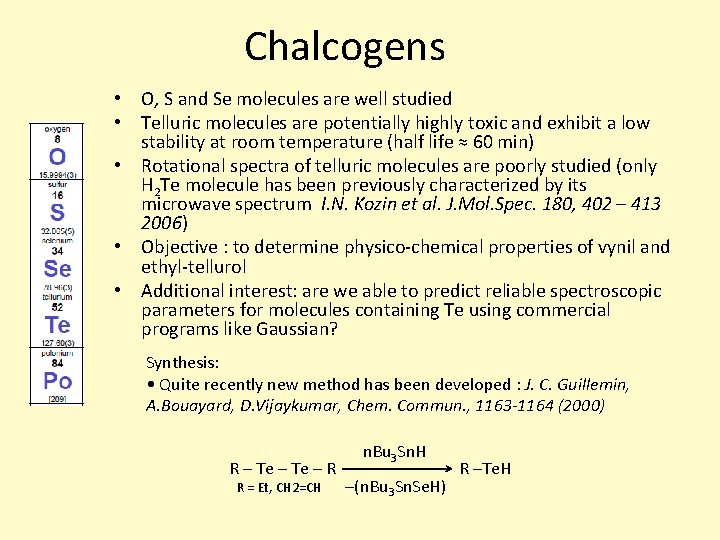
Chalcogens • O, S and Se molecules are well studied • Telluric molecules are potentially highly toxic and exhibit a low stability at room temperature (half life ≈ 60 min) • Rotational spectra of telluric molecules are poorly studied (only H 2 Te molecule has been previously characterized by its microwave spectrum I. N. Kozin et al. J. Mol. Spec. 180, 402 – 413 2006) • Objective : to determine physico-chemical properties of vynil and ethyl-tellurol • Additional interest: are we able to predict reliable spectroscopic parameters for molecules containing Te using commercial programs like Gaussian? Synthesis: • Quite recently new method has been developed : J. C. Guillemin, A. Bouayard, D. Vijaykumar, Chem. Commun. , 1163 -1164 (2000) R – Te – R R = Et, CH 2=CH n. Bu 3 Sn. H –(n. Bu 3 Sn. Se. H) R –Te. H
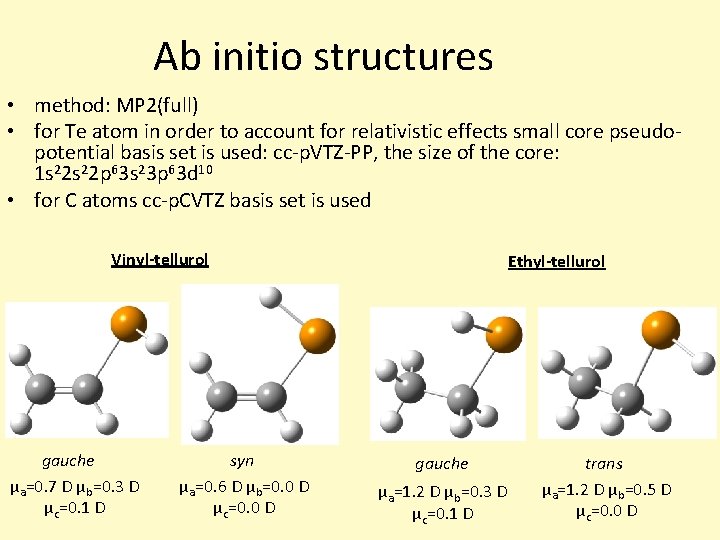
Ab initio structures • method: MP 2(full) • for Te atom in order to account for relativistic effects small core pseudopotential basis set is used: cc-p. VTZ-PP, the size of the core: 1 s 22 p 63 s 23 p 63 d 10 • for C atoms cc-p. CVTZ basis set is used Vinyl-tellurol gauche µa=0. 7 D µb=0. 3 D µc=0. 1 D syn µa=0. 6 D µb=0. 0 D µc=0. 0 D Ethyl-tellurol gauche µa=1. 2 D µb=0. 3 D µc=0. 1 D trans µa=1. 2 D µb=0. 5 D µc=0. 0 D
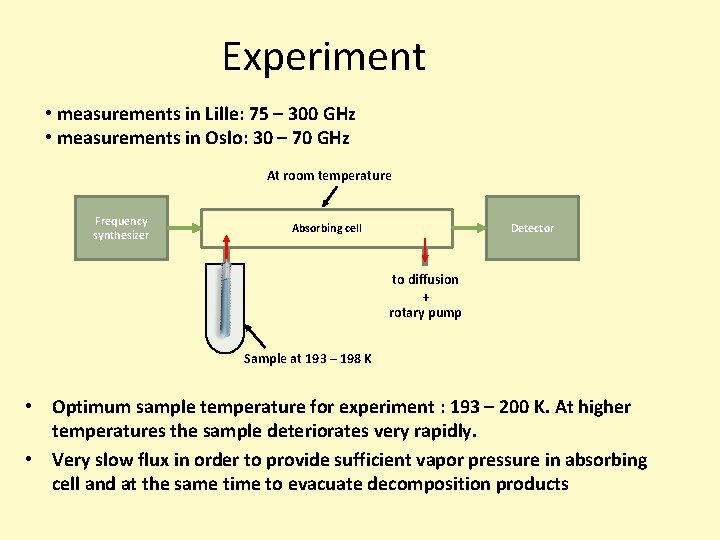
Experiment • measurements in Lille: 75 – 300 GHz • measurements in Oslo: 30 – 70 GHz At room temperature Frequency synthesizer Detector Absorbing cell to diffusion + rotary pump Sample at 193 – 198 K • Optimum sample temperature for experiment : 193 – 200 K. At higher temperatures the sample deteriorates very rapidly. • Very slow flux in order to provide sufficient vapor pressure in absorbing cell and at the same time to evacuate decomposition products
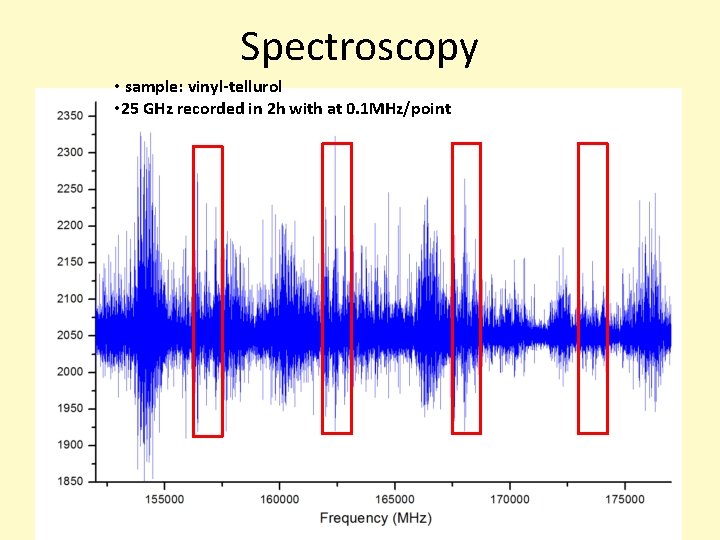
Spectroscopy • sample: vinyl-tellurol • 25 GHz recorded in 2 h with at 0. 1 MHz/point
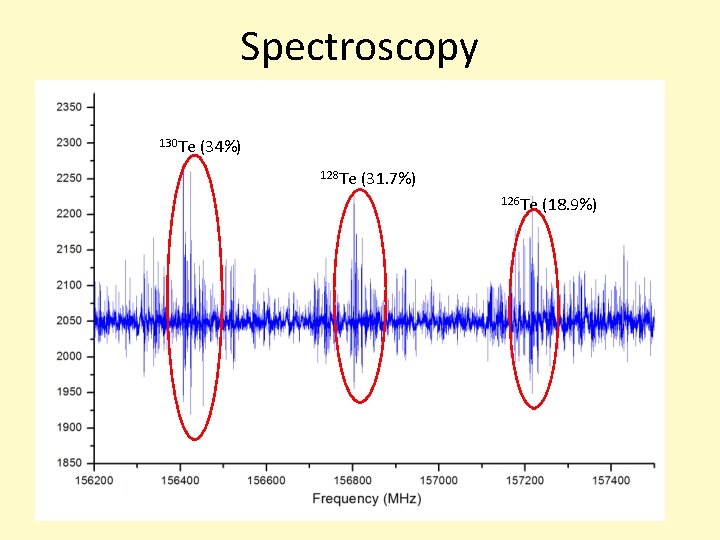
Spectroscopy 130 Te (34%) 128 Te (31. 7%) 126 Te (18. 9%)
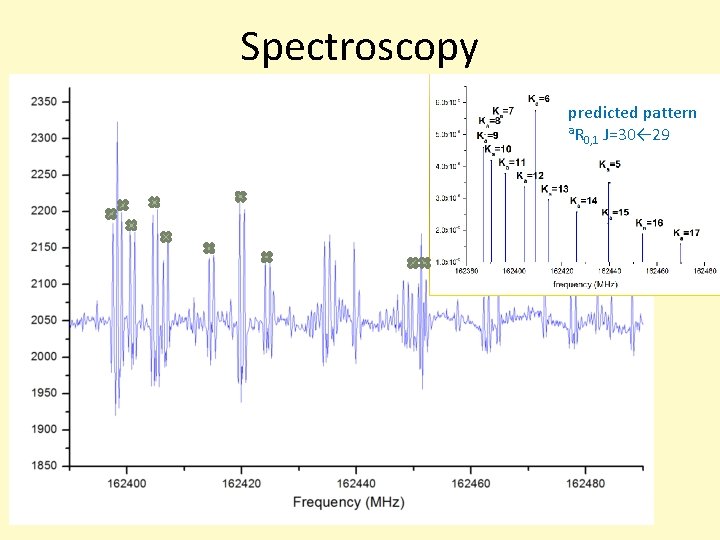
Spectroscopy predicted pattern a. R 0, 1 J=30← 29
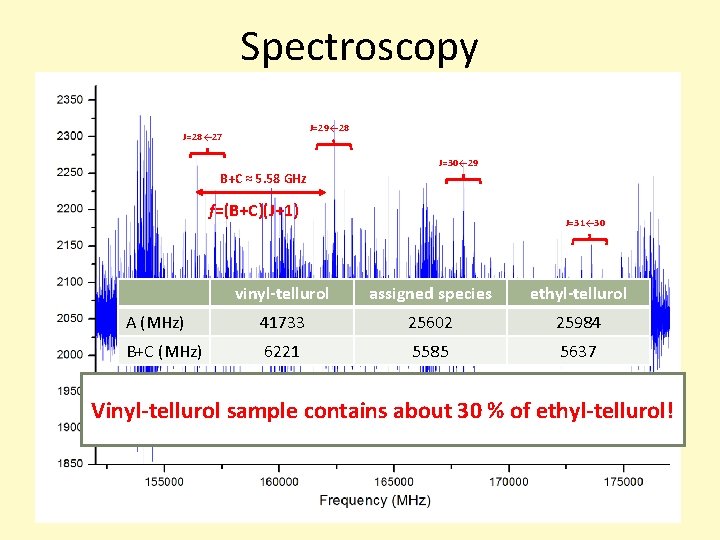
Spectroscopy J=29← 28 J=28← 27 J=30← 29 B+C ≈ 5. 58 GHz f=(B+C)(J+1) J=31← 30 vinyl-tellurol assigned species ethyl-tellurol A (MHz) 41733 25602 25984 B+C (MHz) 6221 5585 5637 Vinyl-tellurol sample contains about 30 % of ethyl-tellurol!
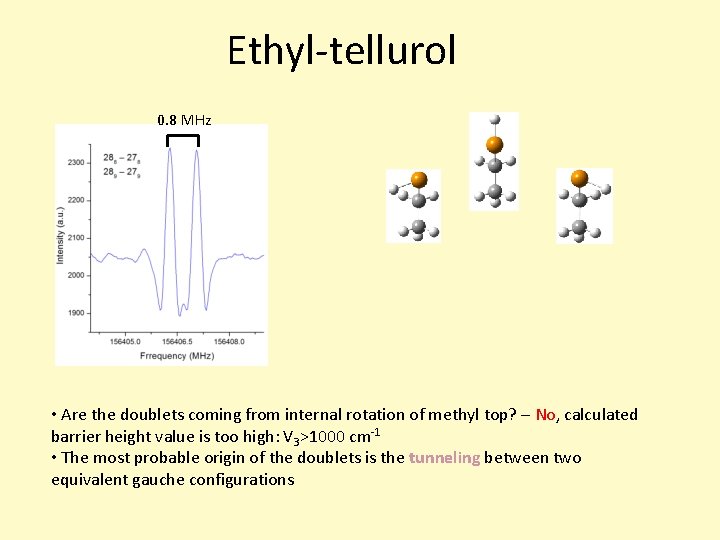
Ethyl-tellurol 0. 8 MHz • Are the doublets coming from internal rotation of methyl top? – No, calculated barrier height value is too high: V 3>1000 cm-1 • The most probable origin of the doublets is the tunneling between two equivalent gauche configurations
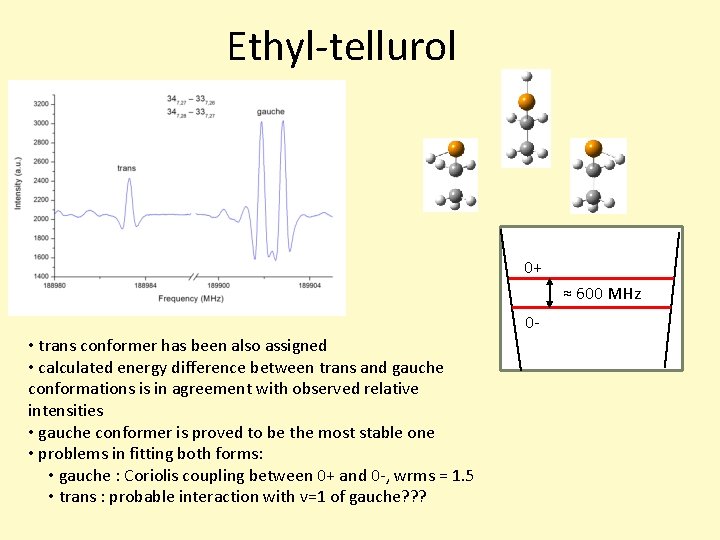
Ethyl-tellurol 0+ ≈ 600 MHz 0 - • trans conformer has been also assigned • calculated energy difference between trans and gauche conformations is in agreement with observed relative intensities • gauche conformer is proved to be the most stable one • problems in fitting both forms: • gauche : Coriolis coupling between 0+ and 0 -, wrms = 1. 5 • trans : probable interaction with v=1 of gauche? ? ?
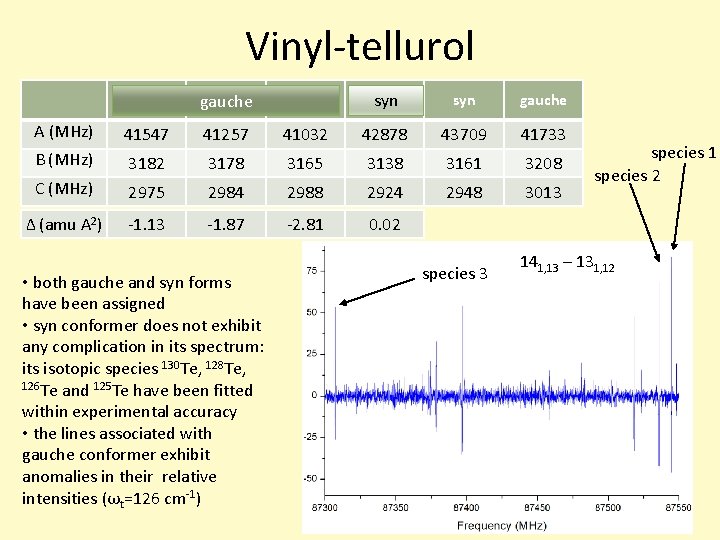
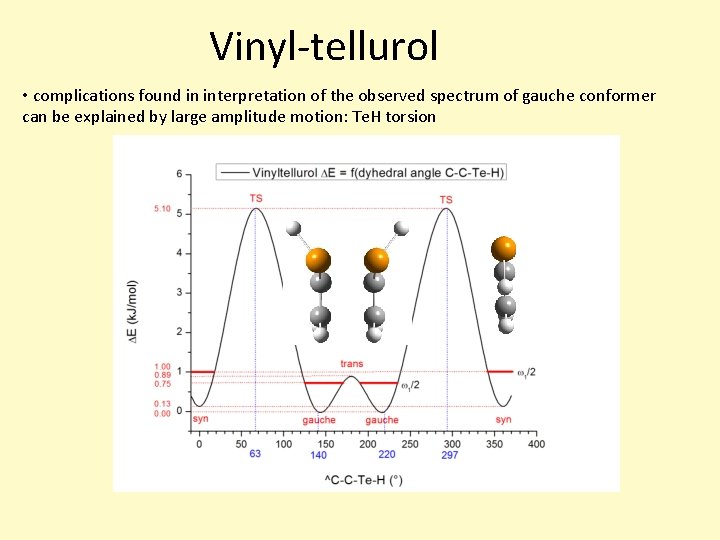
Vinyl-tellurol Species 1 Species 2 gauche Species 3 Species syn 4 syn gauche A (MHz) 41547 41257 41032 42878 43709 41733 B (MHz) 3182 3178 3165 3138 3161 3208 C (MHz) 2975 2984 2988 2924 2948 3013 Δ (amu A 2) -1. 13 -1. 87 -2. 81 0. 02 • both gauche and syn forms have been assigned • syn conformer does not exhibit any complication in its spectrum: its isotopic species 130 Te, 128 Te, 126 Te and 125 Te have been fitted within experimental accuracy • the lines associated with gauche conformer exhibit anomalies in their relative intensities (ωt=126 cm-1) species 3 species 1 species 2 141, 13 – 131, 12
Vinyl-tellurol • complications found in interpretation of the observed spectrum of gauche conformer can be explained by large amplitude motion: Te. H torsion
Summary of preliminary results • Spectra of ethyl and vinyl tellurol have been recorded in the frequency range up to 300 GHz • All stable conformations of both molecules have been assigned • Doublets observed for gauche conformation of ethyl tellurol are associated with tunneling motion between two equivalent configurations