Role duties and qualifications of Radiation Protection Officers
- Slides: 14
Role, duties and qualifications of Radiation Protection Officers and Qualified Experts: Building their competence within a national strategy for education and training in radiator safety RER/9/142 17 -19 October 2018, Sliema, Malta ESTONIA Member States’ presentations SESSION 2 National requirements for Radiation Protection Officers and Qualified Experts REELIKA RUNNEL, Ministry of the Environment
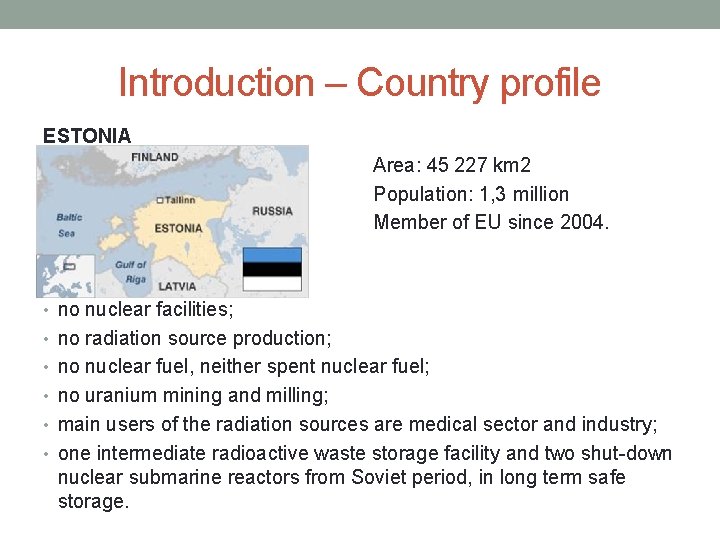
Introduction – Country profile ESTONIA Area: 45 227 km 2 Population: 1, 3 million Member of EU since 2004. • • • no nuclear facilities; • no radiation source production; • no nuclear fuel, neither spent nuclear fuel; • no uranium mining and milling; • main users of the radiation sources are medical sector and industry; • one intermediate radioactive waste storage facility and two shut-down nuclear submarine reactors from Soviet period, in long term safe storage.
Introduction - Radiation safety authorities • Ministry of the Environment - develops radiation safety policies and prepares legislative drafting, organizes radiation safety through the Environmental Board and the Environmental Inspectorate. • Environmental Board (EB) - issues radiation practice licenses; conducts radiation monitoring; manages the emergency notification or early warning system; advisory body. • Environmental Inspectorate - responsible for supervision of radiation practices; has an enforcement power.
Introduction: licensees, RPO-s and QE-s • Number of radiation practice licenses: 629 (73% of them are dental practices) • Number of RPO-s appointed by the licensees: ~ 60 • Number of QE-s: 7 (19 medical physics experts)
1. RPO: definition • Definition: A radiation safety specialist is a person with technical competence in the issues connected to relevant radiation practices who may be designated as the person in control of compliance with radiation safety requirements at the undertaking by the holder of radiation practice license.
1. 1 Function/Duties (2013/59/Euratom, Article 84): Depending on the nature of the radiation practice, a RPO may perform the following duties: 1) ensure that radiation works are performed in compliance with the established requirements; 2) check the implementation of work place monitoring plans; 3) maintain records of relevant data relating to all sources of radiation; 4) regularly assess the operation of safety and warning systems; 5) check the implementation of plans for monitoring of individual doses of exposed workers; 6) check the implementation of plans for medical surveillance of exposed workers; 7) present the radiation work rules and instructions to new workers; 8) prepare work plans relating to radiation practices or participate in the preparation thereof; 9) submit reports to the management; 10) participate in prevention of any emergency exposure situation and in the arrangements for preparedness for responding to it; 11) instruct exposed workers and arrange their training; 12) co-operate with radiation experts.
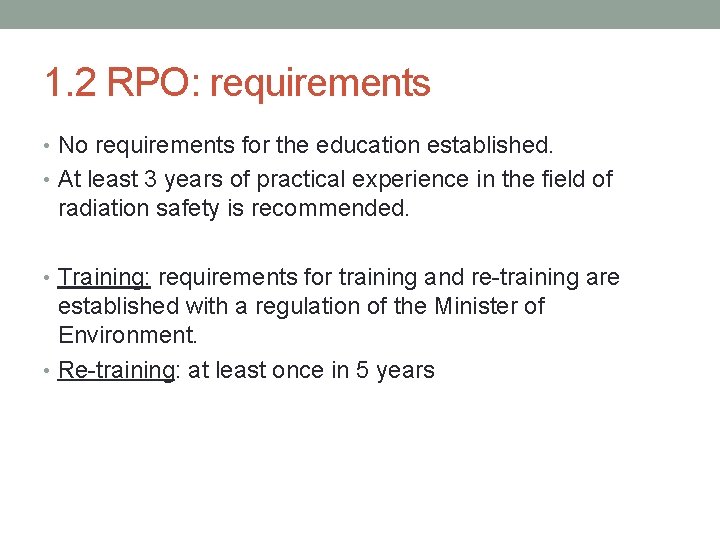
1. 2 RPO: requirements • No requirements for the education established. • At least 3 years of practical experience in the field of radiation safety is recommended. • Training: requirements for training and re-training are established with a regulation of the Minister of Environment. • Re-training: at least once in 5 years
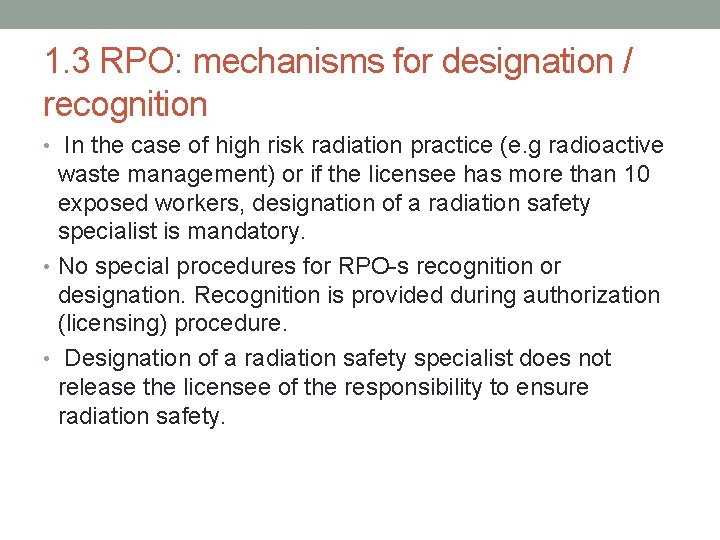
1. 3 RPO: mechanisms for designation / recognition • In the case of high risk radiation practice (e. g radioactive waste management) or if the licensee has more than 10 exposed workers, designation of a radiation safety specialist is mandatory. • No special procedures for RPO-s recognition or designation. Recognition is provided during authorization (licensing) procedure. • Designation of a radiation safety specialist does not release the licensee of the responsibility to ensure radiation safety.
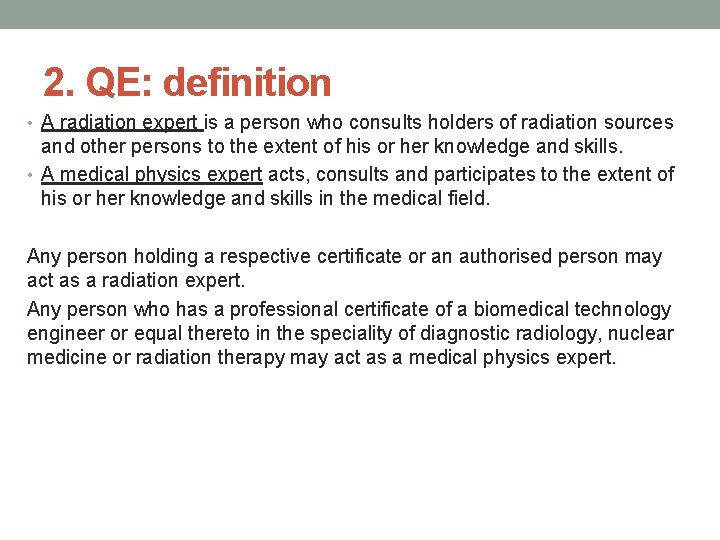
2. QE: definition • A radiation expert is a person who consults holders of radiation sources and other persons to the extent of his or her knowledge and skills. • A medical physics expert acts, consults and participates to the extent of his or her knowledge and skills in the medical field. Any person holding a respective certificate or an authorised person may act as a radiation expert. Any person who has a professional certificate of a biomedical technology engineer or equal thereto in the speciality of diagnostic radiology, nuclear medicine or radiation therapy may act as a medical physics expert.
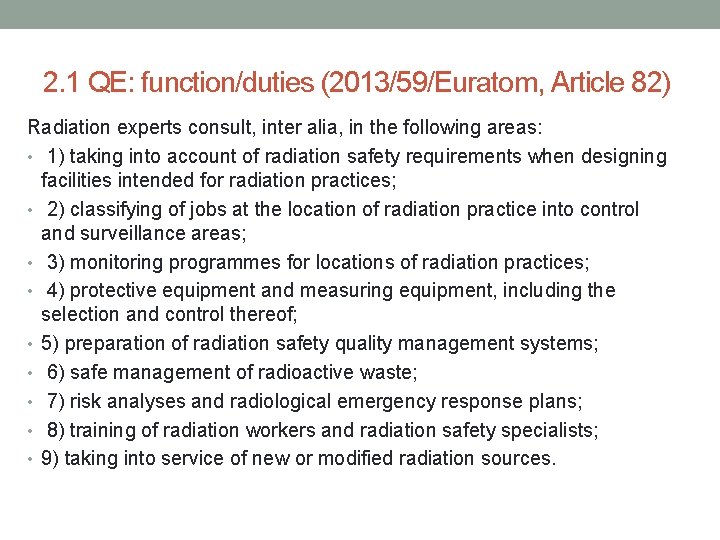
2. 1 QE: function/duties (2013/59/Euratom, Article 82) Radiation experts consult, inter alia, in the following areas: • 1) taking into account of radiation safety requirements when designing facilities intended for radiation practices; • 2) classifying of jobs at the location of radiation practice into control and surveillance areas; • 3) monitoring programmes for locations of radiation practices; • 4) protective equipment and measuring equipment, including the selection and control thereof; • 5) preparation of radiation safety quality management systems; • 6) safe management of radioactive waste; • 7) risk analyses and radiological emergency response plans; • 8) training of radiation workers and radiation safety specialists; • 9) taking into service of new or modified radiation sources.
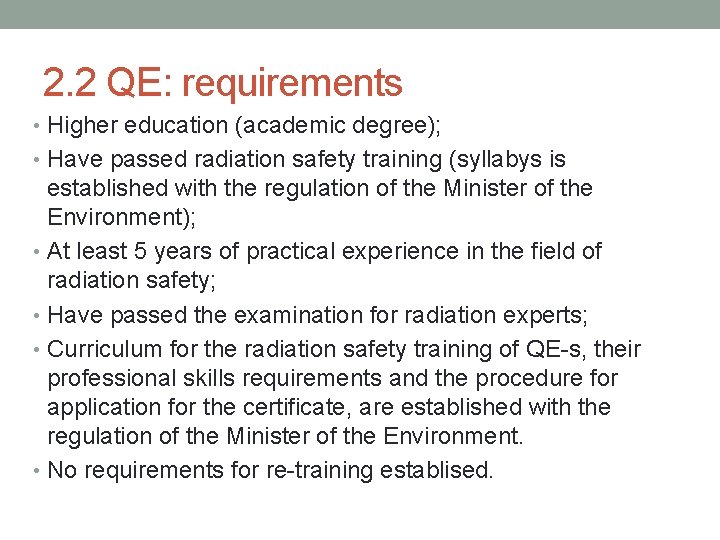
2. 2 QE: requirements • Higher education (academic degree); • Have passed radiation safety training (syllabys is established with the regulation of the Minister of the Environment); • At least 5 years of practical experience in the field of radiation safety; • Have passed the examination for radiation experts; • Curriculum for the radiation safety training of QE-s, their professional skills requirements and the procedure for application for the certificate, are established with the regulation of the Minister of the Environment. • No requirements for re-training establised.
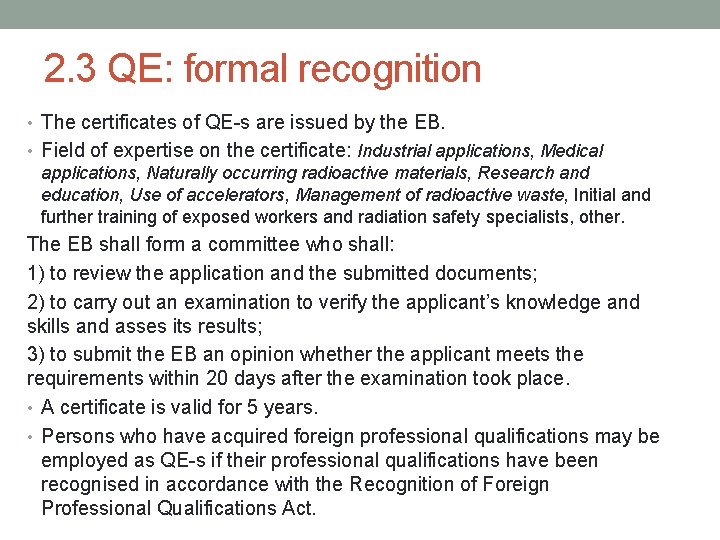
2. 3 QE: formal recognition • The certificates of QE-s are issued by the EB. • Field of expertise on the certificate: Industrial applications, Medical applications, Naturally occurring radioactive materials, Research and education, Use of accelerators, Management of radioactive waste, Initial and further training of exposed workers and radiation safety specialists, other. The EB shall form a committee who shall: 1) to review the application and the submitted documents; 2) to carry out an examination to verify the applicant’s knowledge and skills and asses its results; 3) to submit the EB an opinion whether the applicant meets the requirements within 20 days after the examination took place. • A certificate is valid for 5 years. • Persons who have acquired foreign professional qualifications may be employed as QE-s if their professional qualifications have been recognised in accordance with the Recognition of Foreign Professional Qualifications Act.
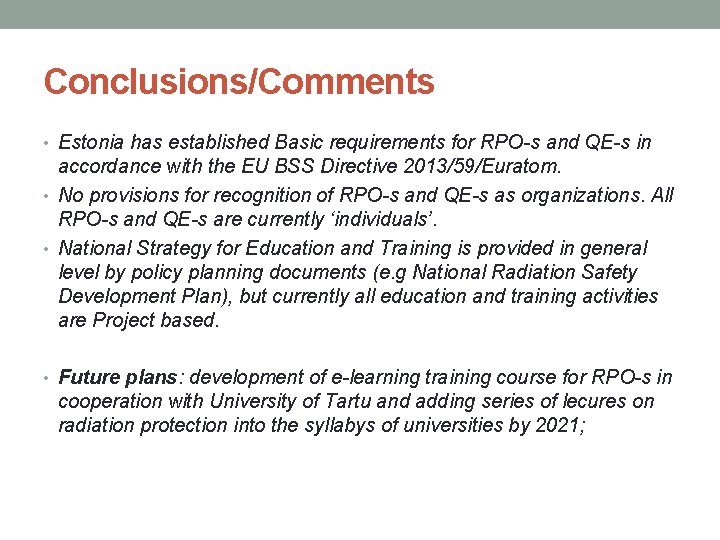
Conclusions/Comments • Estonia has established Basic requirements for RPO-s and QE-s in accordance with the EU BSS Directive 2013/59/Euratom. • No provisions for recognition of RPO-s and QE-s as organizations. All RPO-s and QE-s are currently ‘individuals’. • National Strategy for Education and Training is provided in general level by policy planning documents (e. g National Radiation Safety Development Plan), but currently all education and training activities are Project based. • Future plans: development of e-learning training course for RPO-s in cooperation with University of Tartu and adding series of lecures on radiation protection into the syllabys of universities by 2021;
Thank you! Reelika Runnel reelika. runnel@envir. ee