Reviewing Athena IO Components from the Thread Safety
- Slides: 8
Reviewing Athena I/O Components from the Thread Safety Perspective Marcin Nowak, BNL
Thread Safety Concepts § 1. 2. 3. Code can be made thread-safe to a different degree „True” thread safety requires data structure integrity protection on different levels, correct execution logic and deadlock avoidance § Good parallelism, low memory overhead § (Very? ) difficult to implement Global lock and access serialization § No parallelism but also no memory overhead § Easy to implement Concurrent independent workers § Good parallelism but biggest memory overhead § Ease of adaptation of an existing code depends on the design § § Requires code review to find places where workers interact with each other Threat: singletons (global, static, framework-wide data structures) LBNL Software Meeting Nov 2015 Marcin Nowak, BNL 2
ROOT Thread Safety § ROOT thread safety is continuously improving § § § Important points: § ROOT „static” API (TClass, g. System, g. Interpreter) is thread-safe § § Important for types and dictionaries I/O operations can be performed simultaneously on different files § § we should be using at least ROOT 6. 4 ROOT 6. 6 adds improvements in usability The same file can not be opened twice (without closing it first) The same file can be accessed by different threads in a serialized manner We have not tested these features yet! APR opens ROOT files using File. Manager § § Read-only files are shared Still need to check thread safety LBNL Software Meeting Nov 2015 Marcin Nowak, BNL 3
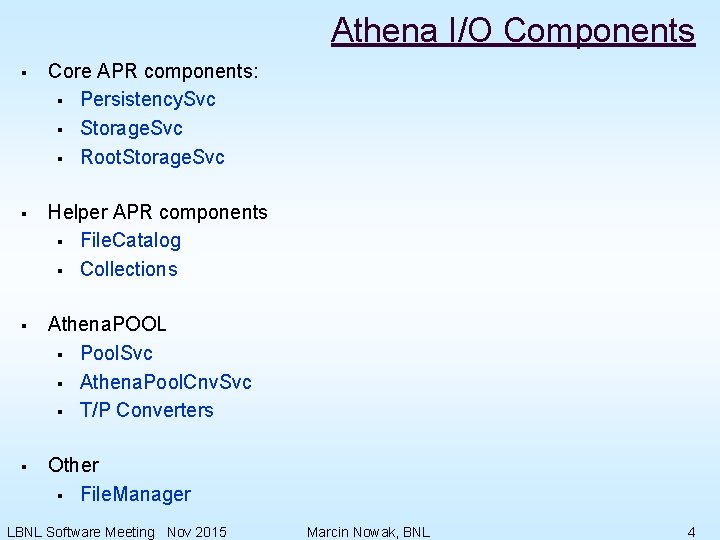
Athena I/O Components § Core APR components: § Persistency. Svc § Storage. Svc § Root. Storage. Svc § Helper APR components § File. Catalog § Collections § Athena. POOL § Pool. Svc § Athena. Pool. Cnv. Svc § T/P Converters § Other § File. Manager LBNL Software Meeting Nov 2015 Marcin Nowak, BNL 4
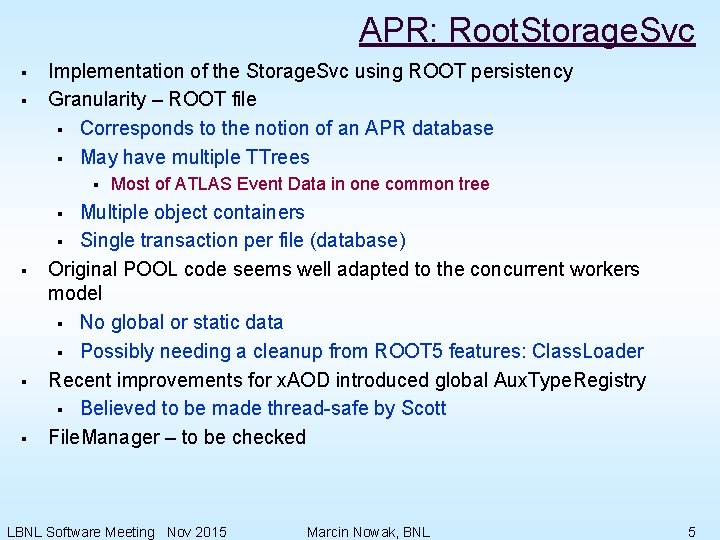
APR: Root. Storage. Svc § § Implementation of the Storage. Svc using ROOT persistency Granularity – ROOT file § Corresponds to the notion of an APR database § May have multiple TTrees § Most of ATLAS Event Data in one common tree Multiple object containers § Single transaction per file (database) Original POOL code seems well adapted to the concurrent workers model § No global or static data § Possibly needing a cleanup from ROOT 5 features: Class. Loader Recent improvements for x. AOD introduced global Aux. Type. Registry § Believed to be made thread-safe by Scott File. Manager – to be checked § § LBNL Software Meeting Nov 2015 Marcin Nowak, BNL 5
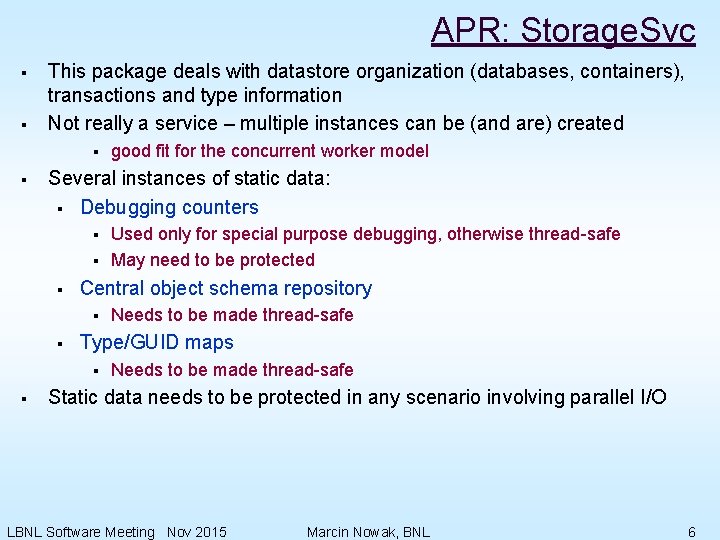
APR: Storage. Svc § § This package deals with datastore organization (databases, containers), transactions and type information Not really a service – multiple instances can be (and are) created § § Several instances of static data: § Debugging counters § § Used only for special purpose debugging, otherwise thread-safe May need to be protected Central object schema repository § Needs to be made thread-safe Type/GUID maps § § good fit for the concurrent worker model Needs to be made thread-safe Static data needs to be protected in any scenario involving parallel I/O LBNL Software Meeting Nov 2015 Marcin Nowak, BNL 6
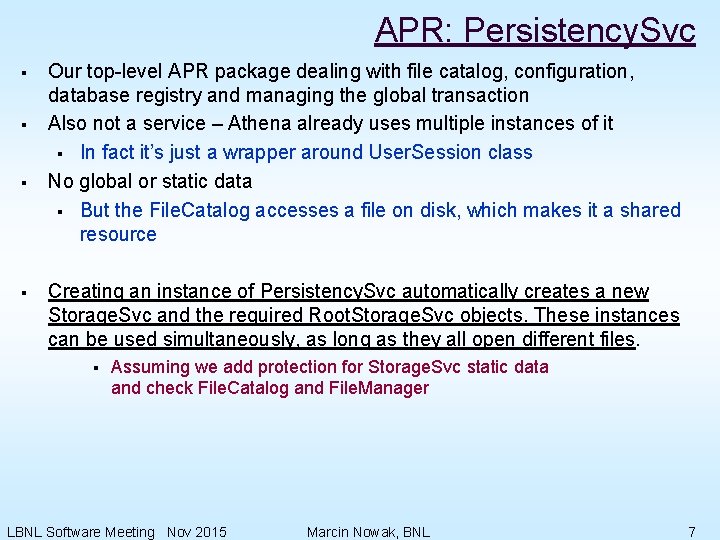
APR: Persistency. Svc § § Our top-level APR package dealing with file catalog, configuration, database registry and managing the global transaction Also not a service – Athena already uses multiple instances of it § In fact it’s just a wrapper around User. Session class No global or static data § But the File. Catalog accesses a file on disk, which makes it a shared resource Creating an instance of Persistency. Svc automatically creates a new Storage. Svc and the required Root. Storage. Svc objects. These instances can be used simultaneously, as long as they all open different files. § Assuming we add protection for Storage. Svc static data and check File. Catalog and File. Manager LBNL Software Meeting Nov 2015 Marcin Nowak, BNL 7
T/P Converters § T/P converters are standalone conversion objects that are used mainly by the Athena. POOL layer (above APR) § A T/P converter is usually a data member of an Athena. POOL (Gaudi) converter that is managed by the Conversion Service § The preferred way to use T/P converters concurrently would be to create multiple copies of them (the concurrent worker model) - but that is not easy with the current Conversion Service § Early test with Athena. Hive with simultaneous reading and writing showed success when 2 separate instances of the Ath. Cnv. Svc were used – one for reading and another one for writing § Each instance of Ath. Cnv. Svc creates separate copies of converters LBNL Software Meeting Nov 2015 Marcin Nowak, BNL 8