Reducing greenhouse gas emissions whilst furthering poverty reduction

- Slides: 17
Reducing greenhouse gas emissions whilst furthering poverty reduction and sustainable development goals: The co-benefits of Environmental Fiscal Reform measures for climate change mitigation in non-Annex 1 countries. Jacqueline Cottrell Project Manager, Green Budget Europe GCET 2010, Bangkok GBG
Structure of this presentation 1. Climate change mitigation and poverty reduction 2. Mitigation potentials in the 2007 IPCC Fourth Assessment Report 3. The single most important barrier to mitigation – market distortions 4. The co-benefits of EFR – showing the way forward for overcoming barriers to climate change mitigation 25/09/2020© Jacqueline Cottrell GBG Green Budget Europe – Exhibit 2
Climate change and non Annex 1 countries § Rapidly industrialising economies are accounting for an increasing share in global GHG emissions § Growing global consumer class of 1. 7 billion, 600 million in Asia-Pacific region § Increasing affluence leads to increasing consumption of energy- and resource-intensive products and thus higher GHG emissions § If current trends continue unabated, the IPCC has predicted that GHG emissions are predicted to increase by 25 -90% on 2000 levels by 2030 § It is in rapidly industrialising countries that the greatest potentials for emissions reductions can be found 25/09/2020© Jacqueline Cottrell GBG Green Budget Europe – Exhibit 3
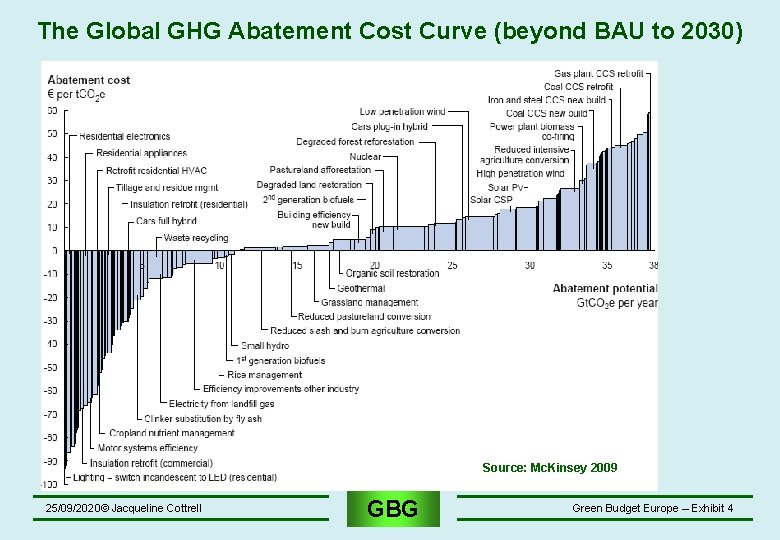
The Global GHG Abatement Cost Curve (beyond BAU to 2030) Source: Mc. Kinsey 2009 25/09/2020© Jacqueline Cottrell GBG Green Budget Europe – Exhibit 4
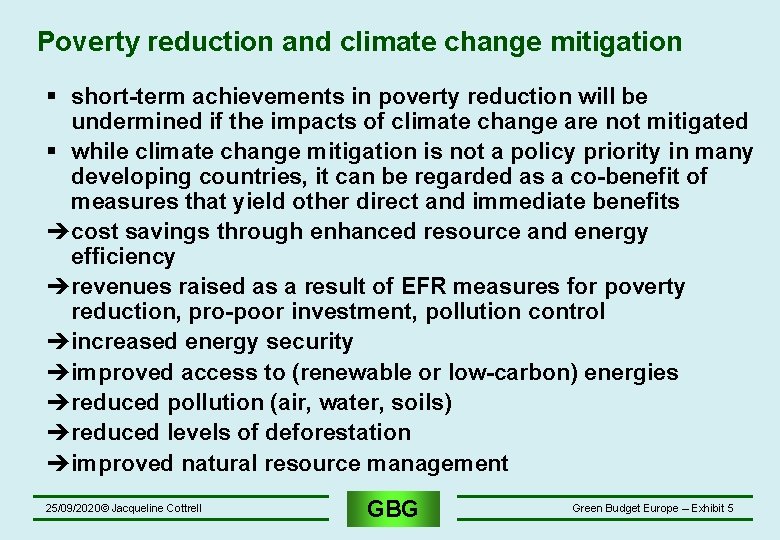
Poverty reduction and climate change mitigation § short-term achievements in poverty reduction will be undermined if the impacts of climate change are not mitigated § while climate change mitigation is not a policy priority in many developing countries, it can be regarded as a co-benefit of measures that yield other direct and immediate benefits ècost savings through enhanced resource and energy efficiency èrevenues raised as a result of EFR measures for poverty reduction, pro-poor investment, pollution control èincreased energy security èimproved access to (renewable or low-carbon) energies èreduced pollution (air, water, soils) èreduced levels of deforestation èimproved natural resource management 25/09/2020© Jacqueline Cottrell GBG Green Budget Europe – Exhibit 5
Structure of this presentation 1. Climate change mitigation and poverty reduction 2. Mitigation potentials in the 2007 IPCC Fourth Assessment Report 3. The single most important barrier to mitigation – market distortions 4. The co-benefits of EFR – showing the way forward for overcoming barriers to climate change mitigation 25/09/2020© Jacqueline Cottrell GBG Green Budget Europe – Exhibit 7
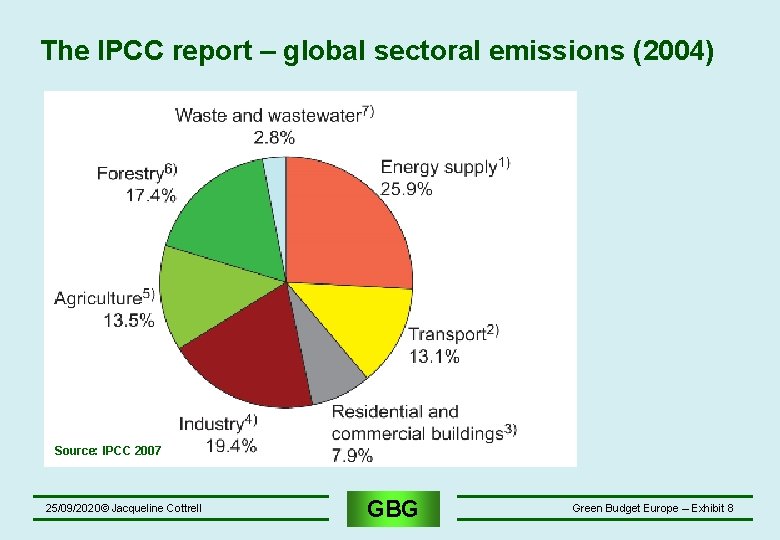
The IPCC report – global sectoral emissions (2004) Source: IPCC 2007 25/09/2020© Jacqueline Cottrell GBG Green Budget Europe – Exhibit 8
The IPCC report – global mitigation potentials Source: IPCC 2007 25/09/2020© Jacqueline Cottrell GBG Green Budget Europe – Exhibit 9
Structure of this presentation 1. Climate change mitigation and poverty reduction 2. Mitigation potentials in the 2007 IPCC Fourth Assessment Report 3. The single most important barrier to mitigation – market distortions 4. The co-benefits of EFR – showing the way forward for overcoming barriers to climate change mitigation 25/09/2020© Jacqueline Cottrell GBG Green Budget Europe – Exhibit 10
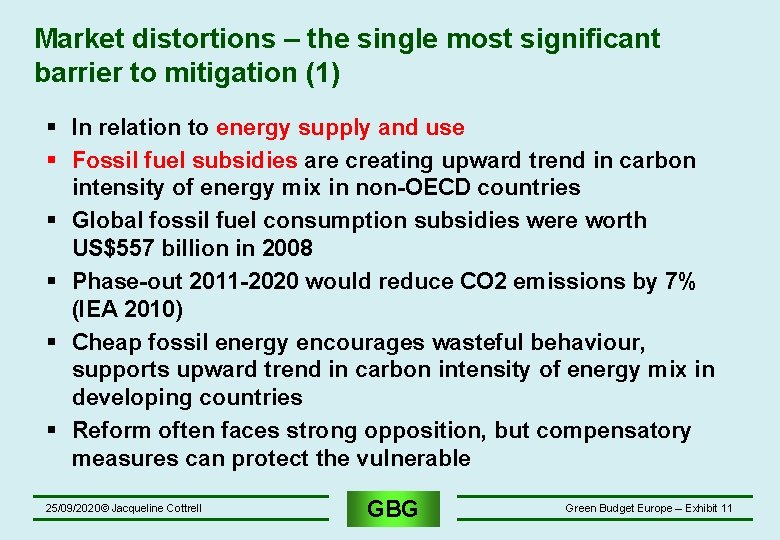
Market distortions – the single most significant barrier to mitigation (1) § In relation to energy supply and use § Fossil fuel subsidies are creating upward trend in carbon intensity of energy mix in non-OECD countries § Global fossil fuel consumption subsidies were worth US$557 billion in 2008 § Phase-out 2011 -2020 would reduce CO 2 emissions by 7% (IEA 2010) § Cheap fossil energy encourages wasteful behaviour, supports upward trend in carbon intensity of energy mix in developing countries § Reform often faces strong opposition, but compensatory measures can protect the vulnerable 25/09/2020© Jacqueline Cottrell GBG Green Budget Europe – Exhibit 11
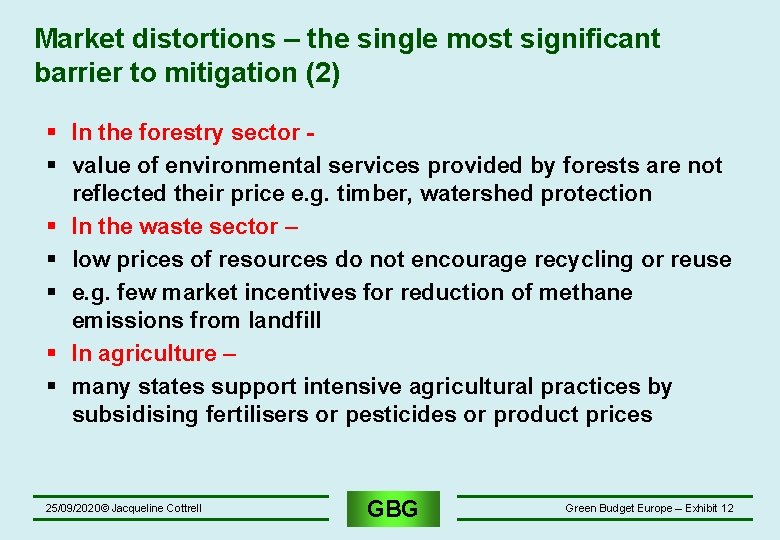
Market distortions – the single most significant barrier to mitigation (2) § In the forestry sector § value of environmental services provided by forests are not reflected their price e. g. timber, watershed protection § In the waste sector – § low prices of resources do not encourage recycling or reuse § e. g. few market incentives for reduction of methane emissions from landfill § In agriculture – § many states support intensive agricultural practices by subsidising fertilisers or pesticides or product prices 25/09/2020© Jacqueline Cottrell GBG Green Budget Europe – Exhibit 12
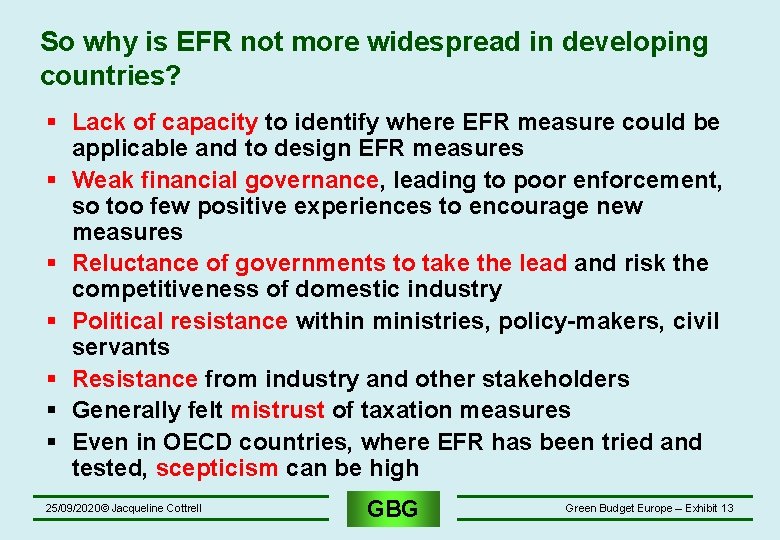
So why is EFR not more widespread in developing countries? § Lack of capacity to identify where EFR measure could be applicable and to design EFR measures § Weak financial governance, leading to poor enforcement, so too few positive experiences to encourage new measures § Reluctance of governments to take the lead and risk the competitiveness of domestic industry § Political resistance within ministries, policy-makers, civil servants § Resistance from industry and other stakeholders § Generally felt mistrust of taxation measures § Even in OECD countries, where EFR has been tried and tested, scepticism can be high 25/09/2020© Jacqueline Cottrell GBG Green Budget Europe – Exhibit 13
Structure of this presentation 1. Climate change mitigation and poverty reduction 2. Mitigation potentials in the 2007 IPCC Fourth Assessment Report 3. The single most important barrier to mitigation – market distortions 4. The co-benefits of EFR – showing the way forward for overcoming barriers to climate change mitigation 25/09/2020© Jacqueline Cottrell GBG Green Budget Europe – Exhibit 14
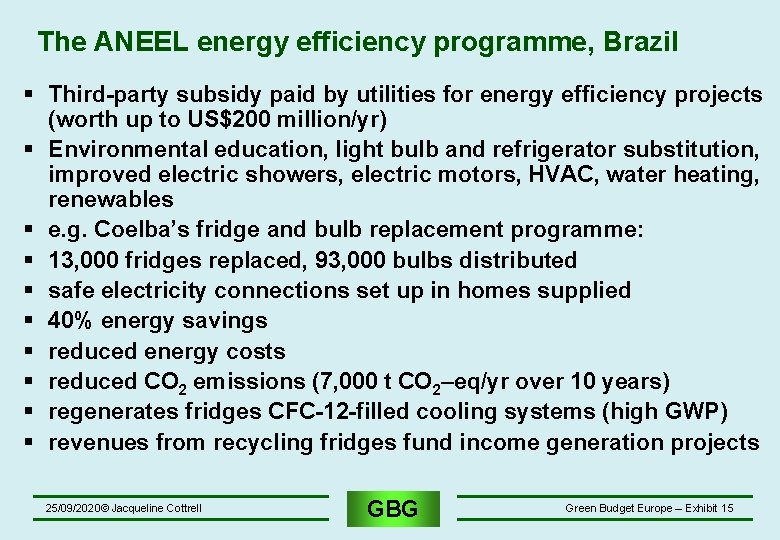
The ANEEL energy efficiency programme, Brazil § Third-party subsidy paid by utilities for energy efficiency projects (worth up to US$200 million/yr) § Environmental education, light bulb and refrigerator substitution, improved electric showers, electric motors, HVAC, water heating, renewables § e. g. Coelba’s fridge and bulb replacement programme: § 13, 000 fridges replaced, 93, 000 bulbs distributed § safe electricity connections set up in homes supplied § 40% energy savings § reduced energy costs § reduced CO 2 emissions (7, 000 t CO 2–eq/yr over 10 years) § regenerates fridges CFC-12 -filled cooling systems (high GWP) § revenues from recycling fridges fund income generation projects 25/09/2020© Jacqueline Cottrell GBG Green Budget Europe – Exhibit 15
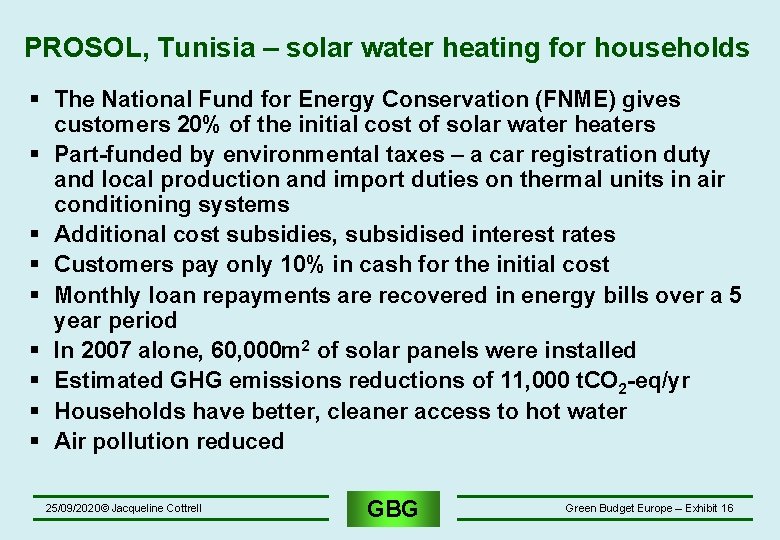
PROSOL, Tunisia – solar water heating for households § The National Fund for Energy Conservation (FNME) gives customers 20% of the initial cost of solar water heaters § Part-funded by environmental taxes – a car registration duty and local production and import duties on thermal units in air conditioning systems § Additional cost subsidies, subsidised interest rates § Customers pay only 10% in cash for the initial cost § Monthly loan repayments are recovered in energy bills over a 5 year period § In 2007 alone, 60, 000 m 2 of solar panels were installed § Estimated GHG emissions reductions of 11, 000 t. CO 2 -eq/yr § Households have better, cleaner access to hot water § Air pollution reduced 25/09/2020© Jacqueline Cottrell GBG Green Budget Europe – Exhibit 16
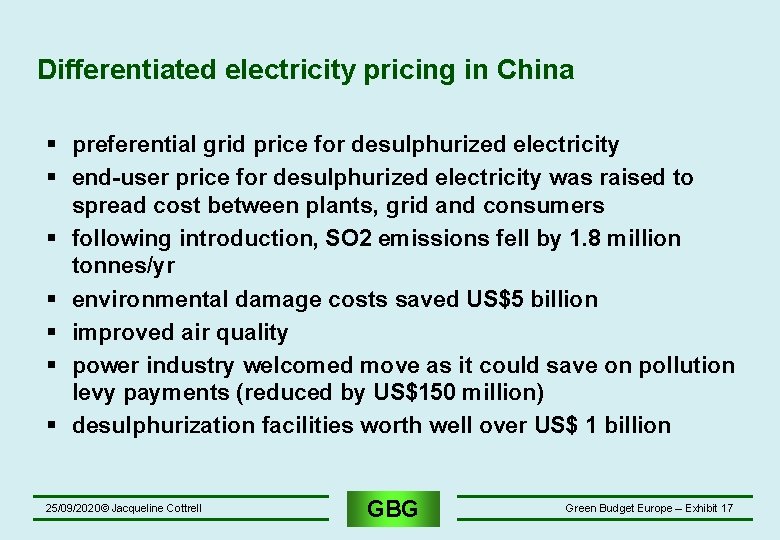
Differentiated electricity pricing in China § preferential grid price for desulphurized electricity § end-user price for desulphurized electricity was raised to spread cost between plants, grid and consumers § following introduction, SO 2 emissions fell by 1. 8 million tonnes/yr § environmental damage costs saved US$5 billion § improved air quality § power industry welcomed move as it could save on pollution levy payments (reduced by US$150 million) § desulphurization facilities worth well over US$ 1 billion 25/09/2020© Jacqueline Cottrell GBG Green Budget Europe – Exhibit 17
THANK YOU FOR YOUR ATTENTION! § ANY QUESTIONS? § More information at: www. green-budget. eu § Email: jlc@foes. de 25/09/2020© Jacqueline Cottrell GBG Green Budget Europe – Exhibit 18