
GOVERNOR INSLEES POVERTY REDUCTION WORKGROUP Using a Racial
- Slides: 14
GOVERNOR INSLEE’S POVERTY REDUCTION WORKGROUP Using a Racial Equity Toolkit to Reach Equitable Results PATRICIA LALLY
2 The Problem One of every four residents struggles to make ends meet. People of color are significantly overrepresented in this population.
3 What is Racial Equity? Racial Equity is the condition that would be achieved if one’s racial identity no longer predicted, in a statistical sense, how one fares.
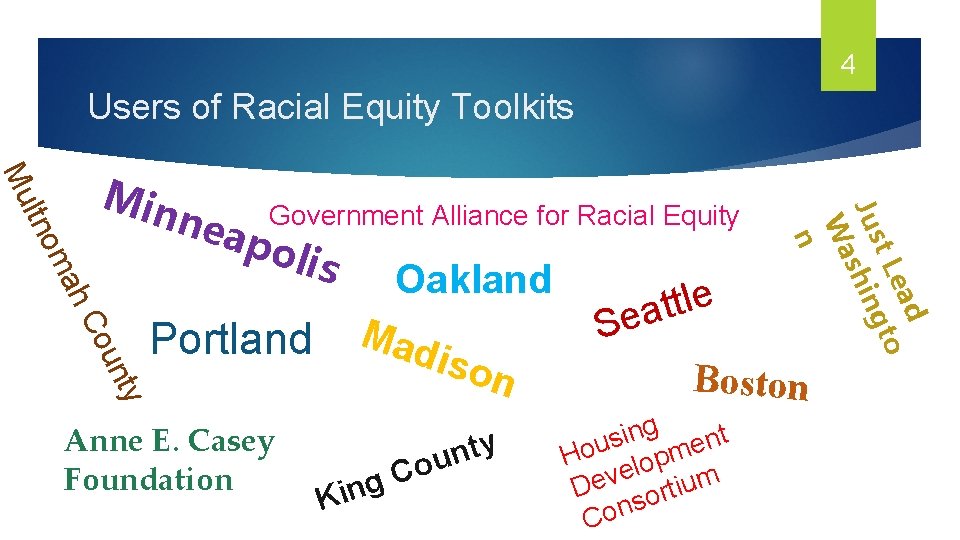
4 Users of Racial Equity Toolkits h. C ma ltno ou nty nea Government Alliance for Racial Equity pol is Oakland e l t t a e S Portland Madis on Boston Anne E. Casey Foundation ead t L gto Jus shin Wa n Mu Min K C g in y t n ou g n i t s n u e o m H p o l e v m e u i D t r o s n Co
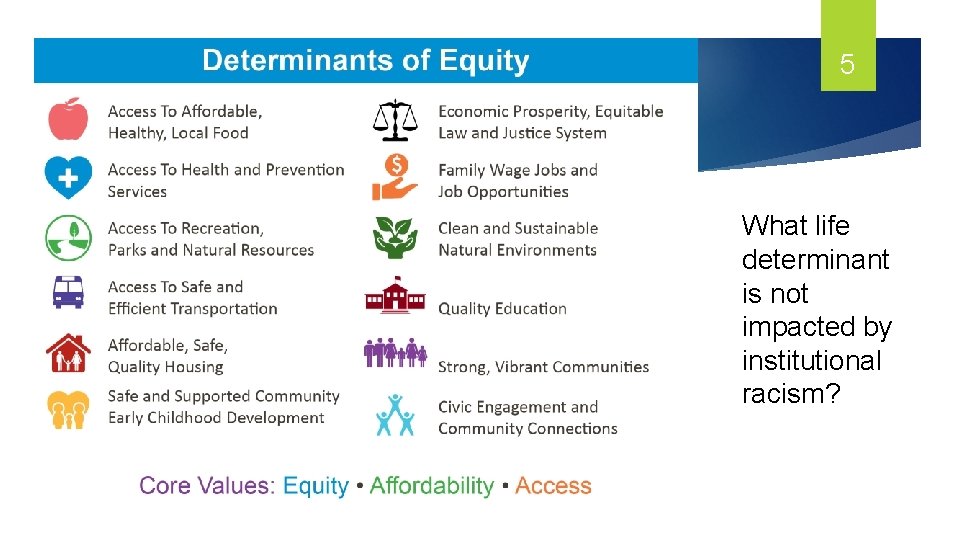
What 5 What life determinant is not impacted by institutional racism?
Why Use a Racial Equity Toolkit? Racial inequities are not random; they have been created and sustained over time. Inequities will not disappear on their own. By following a racial equity toolkit process, we are taking explicit, intentional steps to dismantle institutional racism and develop strategies and actions that reduce racial inequities and improve success for all groups. 6
7 Equity serves all people “Equity is not a zero sum game. In fact when the nation targets support where it is needed most – when we create the circumstances that allow those who have been left behind to participate and contribute fully – everyone wins. ” - Angela Glover Blackwell, CEO of Policylink
8 Equitable strategies to create equal outcomes “If our nation is to live up to its democratic ideals — that all people are created equal and treated fairly — racial equity and inclusion must be at the forefront of how we shape our policies, institutions and culture. ” — The Annie E. Casey Foundation, Race Equity and Inclusion Action Guide
9 A Few Things We Need to Know ü What does poverty mean? ü Who is experiencing poverty? ü What are the root causes of poverty? ü How do institutional and structural racism work to the detriment of people of color experiencing poverty? ü Will proposed strategies meet the needs of those most impacted by poverty? ü How will we connect with, learn from, report to people living in poverty?
10 Centering race – Equity and Public Libraries FACING INEQUITY Significant racial disparities exist in wages, housing, early childhood development, education, public health, the criminal justice system, economic development and. . .
Centering race – Equitable development and race” 11 To talk about equitable development as our future, hard realities about the United States’ past have to be acknowledged. Throughout the nation’s history, some communities and neighborhoods prospered at the expense of others. Real estate redlining and racially restrictive covenants dictated where racially or culturally distinct communities could and could not live and where investments occurred. .
12 Centering race - Homelessness and race People of color are dramatically more likely than White people to experience homelessness in the United States. This is no accident; it is the result of centuries of structural racism that have excluded historically oppressed people —particularly Black and Native Americans— from equal access to housing, community supports, and opportunities for economic mobility.
13 Centering Race – Black people experiencing homelessness Indeed, the circumstances that lead Black people to disproportionately experience homelessness cannot be untangled from the impact of institutional and structural racism in education, criminal justice, housing, employment, health care, and access to opportunities. Institutional and structural racism impact Black people experiencing homelessness on a daily, life-long basis, from renting an apartment, to seeking employment, to the trauma of living in an anti-Black society.
14 Centering race – health care and race Communities of color continue to experience high levels of unemployment, barriers to accessing healthcare, high foreclosure rates, and limited access to affordable transportation. As a result of these racial/ethnic disparities, communities of color often find it di�cult to have an equitable share of the American Dream. Policymakers, stakeholders, and individuals with political influence should consider using equity as a metric for creating fair and effective policy. Equity, more specifically racial equity, will offer a lens to think about all of the possible outcomes and consequences that policies will have on diverse communities, and help in designing policies that reduce disparities and address the needs of all.