Reaction Yield Theoretical Yield The maximum amount of
- Slides: 8
Reaction Yield
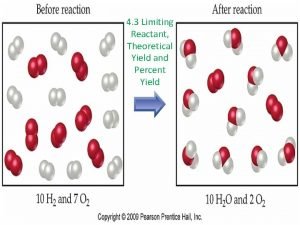
Theoretical Yield �The maximum amount of product that can be produced from a given amount of reactant �Theoretical yield is calculated using stoichiometry
Actual Yield �The amount of product actually produced when the chemical reaction is carried out in an experiment
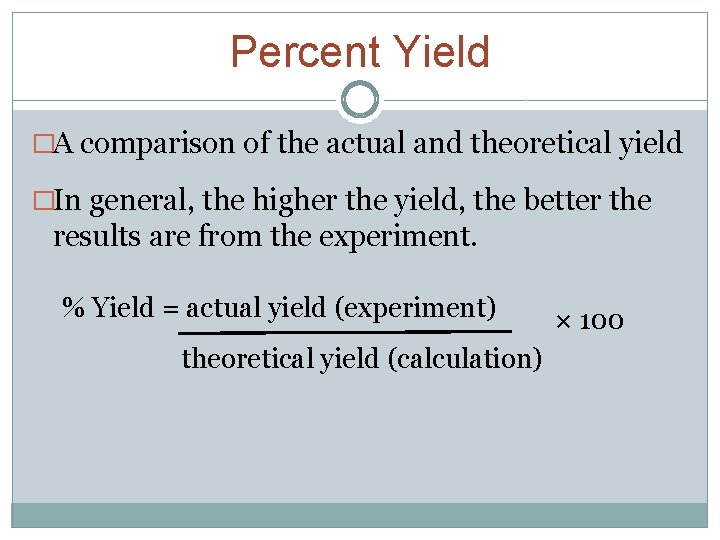
Percent Yield �A comparison of the actual and theoretical yield �In general, the higher the yield, the better the results are from the experiment. % Yield = actual yield (experiment) theoretical yield (calculation) × 100
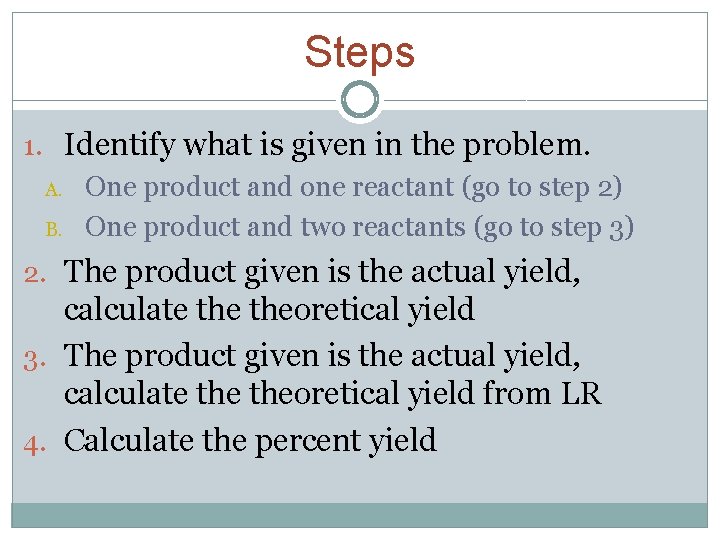
Steps 1. Identify what is given in the problem. A. One product and one reactant (go to step 2) B. One product and two reactants (go to step 3) 2. The product given is the actual yield, calculate theoretical yield 3. The product given is the actual yield, calculate theoretical yield from LR 4. Calculate the percent yield
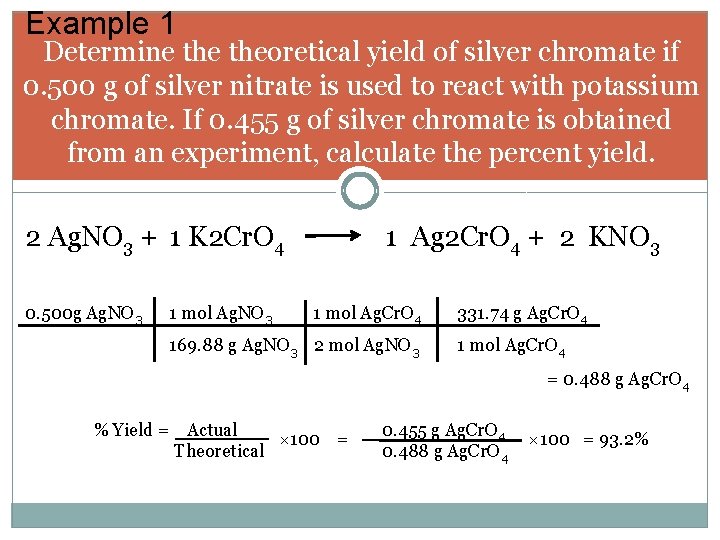
Example 1 Determine theoretical yield of silver chromate if 0. 500 g of silver nitrate is used to react with potassium chromate. If 0. 455 g of silver chromate is obtained from an experiment, calculate the percent yield. 2 Ag. NO 3 + 1 K 2 Cr. O 4 0. 500 g Ag. NO 3 1 mol Ag. NO 3 1 Ag 2 Cr. O 4 + 2 KNO 3 1 mol Ag. Cr. O 4 169. 88 g Ag. NO 3 2 mol Ag. NO 3 331. 74 g Ag. Cr. O 4 1 mol Ag. Cr. O 4 = 0. 488 g Ag. Cr. O 4 % Yield = Actual × 100 = Theoretical 0. 455 g Ag. Cr. O 4 0. 488 g Ag. Cr. O 4 × 100 = 93. 2%
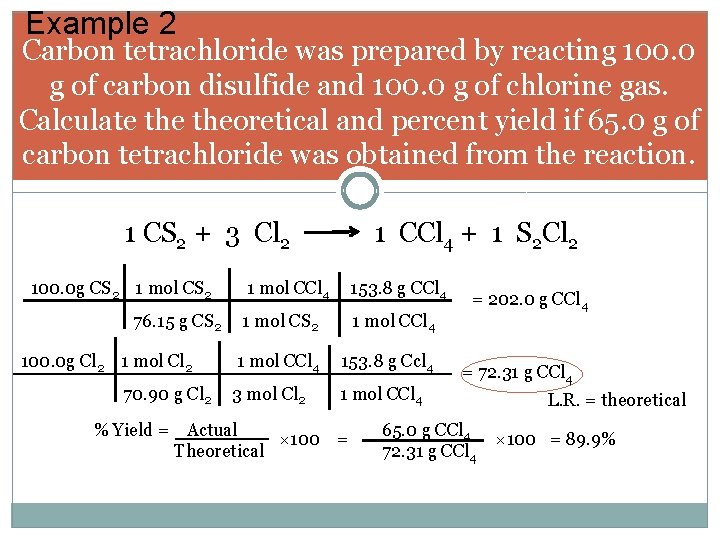
Example 2 Carbon tetrachloride was prepared by reacting 100. 0 g of carbon disulfide and 100. 0 g of chlorine gas. Calculate theoretical and percent yield if 65. 0 g of carbon tetrachloride was obtained from the reaction. 1 CS 2 + 3 Cl 2 100. 0 g CS 2 1 mol CS 2 76. 15 g CS 2 100. 0 g Cl 2 1 mol Cl 2 70. 90 g Cl 2 1 CCl 4 + 1 S 2 Cl 2 1 mol CCl 4 153. 8 g CCl 4 1 mol CS 2 1 mol CCl 4 153. 8 g Ccl 4 3 mol Cl 2 1 mol CCl 4 % Yield = Actual × 100 = Theoretical = 202. 0 g CCl 4 = 72. 31 g CCl 4 65. 0 g CCl 4 72. 31 g CCl 4 L. R. = theoretical × 100 = 89. 9%
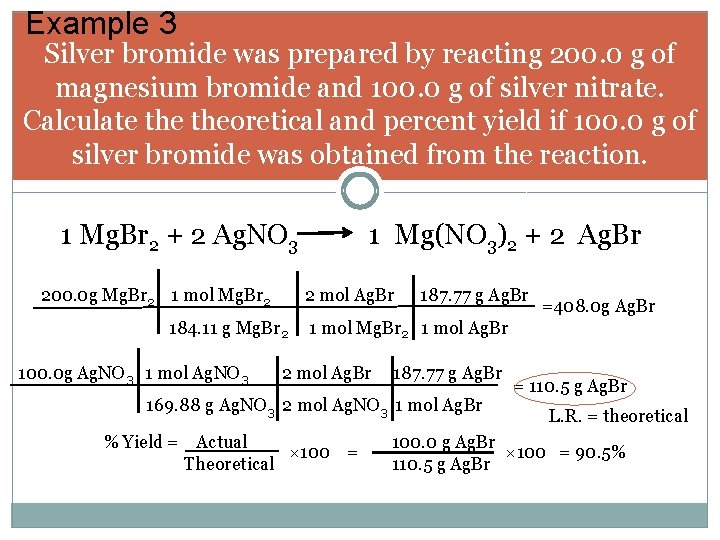
Example 3 Silver bromide was prepared by reacting 200. 0 g of magnesium bromide and 100. 0 g of silver nitrate. Calculate theoretical and percent yield if 100. 0 g of silver bromide was obtained from the reaction. 1 Mg. Br 2 + 2 Ag. NO 3 200. 0 g Mg. Br 2 1 mol Mg. Br 2 2 mol Ag. Br 184. 11 g Mg. Br 2 100. 0 g Ag. NO 3 1 mol Ag. NO 3 1 Mg(NO 3)2 + 2 Ag. Br 187. 77 g Ag. Br =408. 0 g Ag. Br 1 mol Mg. Br 2 1 mol Ag. Br 2 mol Ag. Br 187. 77 g Ag. Br 169. 88 g Ag. NO 3 2 mol Ag. NO 3 1 mol Ag. Br % Yield = Actual × 100 = Theoretical = 110. 5 g Ag. Br L. R. = theoretical 100. 0 g Ag. Br × 100 = 90. 5% 110. 5 g Ag. Br