Rare Diseases and FDASIA Gayatri R Rao MD




- Slides: 16
Rare Diseases and FDASIA Gayatri R. Rao MD, JD Director Office of Orphan Products Development (OOPD), FDA Rare Disease Congressional Caucus Briefing November 14, 2012
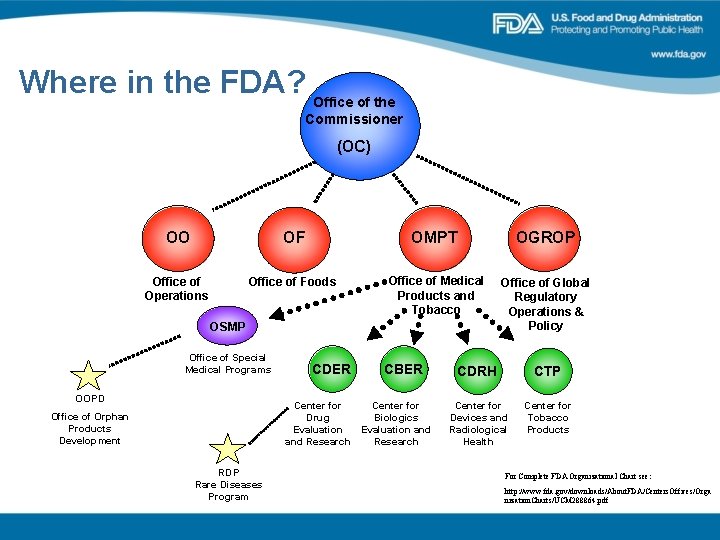
Where in the FDA? Office of the Commissioner (OC) OO OF OMPT OGROP Office of Operations Office of Foods Office of Medical Products and Tobacco Office of Global Regulatory Operations & Policy OSMP Office of Special Medical Programs OOPD CDER CBER Center for Drug Biologics Evaluation and Research Office of Orphan Products Development RDP Rare Diseases Program CDRH CTP Center for Devices and Radiological Health Center for Tobacco Products For Complete FDA Organizational Chart see: http: //www. fda. gov/downloads/About. FDA/Centers. Offices/Orga nization. Charts/UCM 288864. pdf
Office of the Commissioner Step 1: Orphan Drug Designation (OC) OSMP OOPD Office of Special Medical Programs OMPT Office of Medical Products and Tobacco Center for Drug Evaluation and Research Center for Biologics Evaluation and Research http: //www. fda. gov/downloads/About. FDA/Centers. Offices /Organization. Charts/UCM 288864. pdf Humanitarian Use Device (HUD) Designation CDER CBER For Complete FDA Organizational Chart see: Office of Orphan Products Development CDRH Center for Devices and Radiological Health Step 2: Marketing Application NDA / BLA / HDE
What is the Advantage to Designation? • When a drug or biological product is designated an orphan, certain financial incentives can flow: – Tax Credits – 50% of clinical trials costs – Waiver of User Fees - $1. 9 M – 7 -year Marketing Exclusivity • When a device is designated as a HUD, device is eligible for an alternate pathway to market – Humanitarian Device Exemption (HDE) – Exempt from an effectiveness showing; in lieu need only show probable benefit
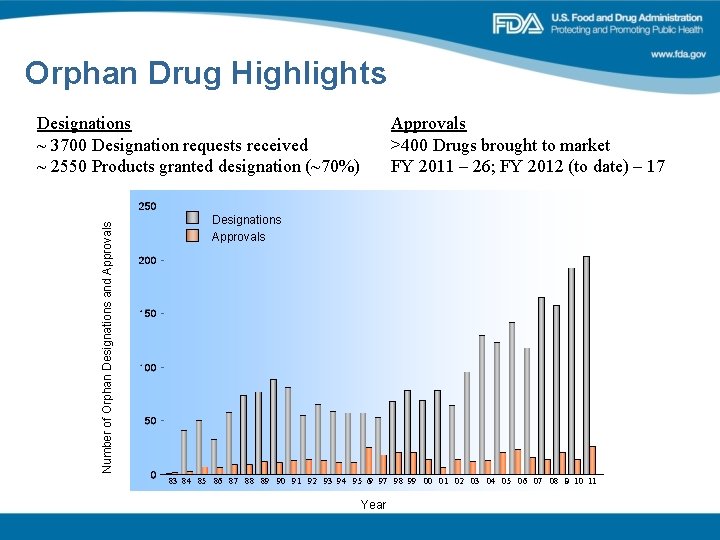
Orphan Drug Highlights Number of Orphan Designations and Approvals Designations ~ 3700 Designation requests received ~ 2550 Products granted designation (~70%) Approvals >400 Drugs brought to market FY 2011 – 26; FY 2012 (to date) – 17 Designations Approvals 83 84 85 86 87 88 89 90 91 92 93 94 95 69 97 98 99 00 01 02 03 04 05 06 07 08 90 10 11 Year
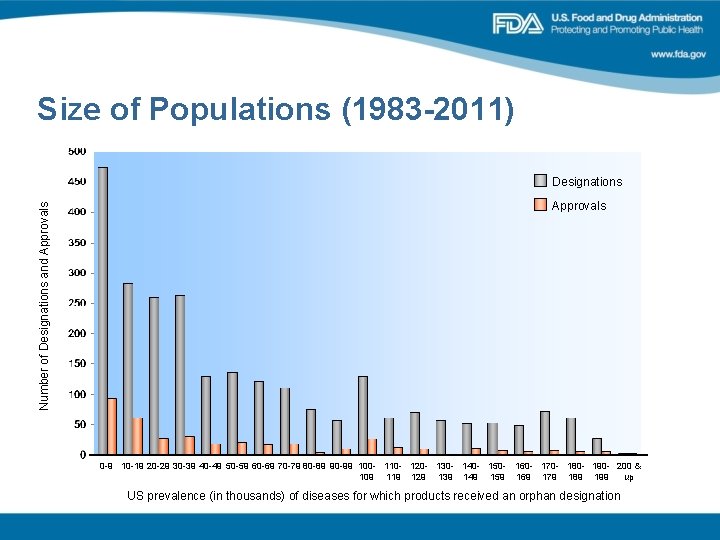
Size of Populations (1983 -2011) Number of Designations and Approvals Designations Approvals 0 -9 10 -19 20 -29 30 -39 40 -49 50 -59 60 -69 70 -79 80 -89 90 -99 100 - 110 - 120 - 130 - 140 - 150 - 160 - 170 - 180 - 190 - 200 & 109 119 129 139 149 159 169 179 189 199 up US prevalence (in thousands) of diseases for which products received an orphan designation
HUD Designation Program Total 2011 # of HUDs Received 283 21 # of HUDs Designated 183 (65%) 17 # of HDEs Approved 56 Devices labeled for peds Berlin Heart EXCOR® Pediatric Ventricular Assist Device (VAD) (majority rec’d in 2011) 6 Neu. Rx DPS™, Diaphragm Pacing System 3 labeled for peds 1 funded by OPG pgm Elana Surgical Kit Source: OOPD Database 2012 – To date 20 HUDs received 12 HUDs designated Berlin Heart EXCOR® Pediatric VAD received 3 -year funding for ~$1. 19 M which funded a pivotal study in support of HDE approval
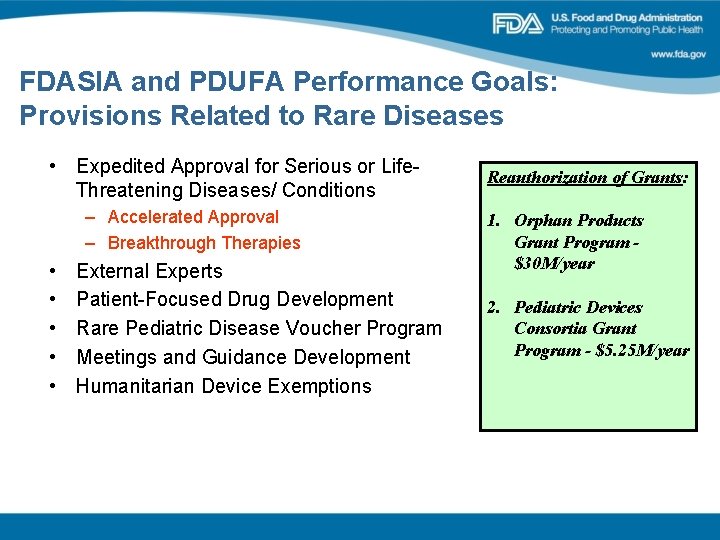
FDASIA and PDUFA Performance Goals: Provisions Related to Rare Diseases • Expedited Approval for Serious or Life. Threatening Diseases/ Conditions – Accelerated Approval – Breakthrough Therapies • • • External Experts Patient-Focused Drug Development Rare Pediatric Disease Voucher Program Meetings and Guidance Development Humanitarian Device Exemptions Reauthorization of Grants: 1. Orphan Products Grant Program $30 M/year 2. Pediatric Devices Consortia Grant Program - $5. 25 M/year
Expedited Approval for Serious or Life. Threatening Diseases/ Conditions: Accelerated Approval • Based on a determination that the product has an effect on a: – Surrogate endpoint that is reasonably likely to predict clinical benefit OR – Clinical endpoint that can be measured earlier than irreversible morbidity or mortality, that is reasonably likely to predict effect on irreversible morbidity or mortality or other clinical benefit • Takes into account severity, rarity, or prevalence, as well as lack of alternative treatments
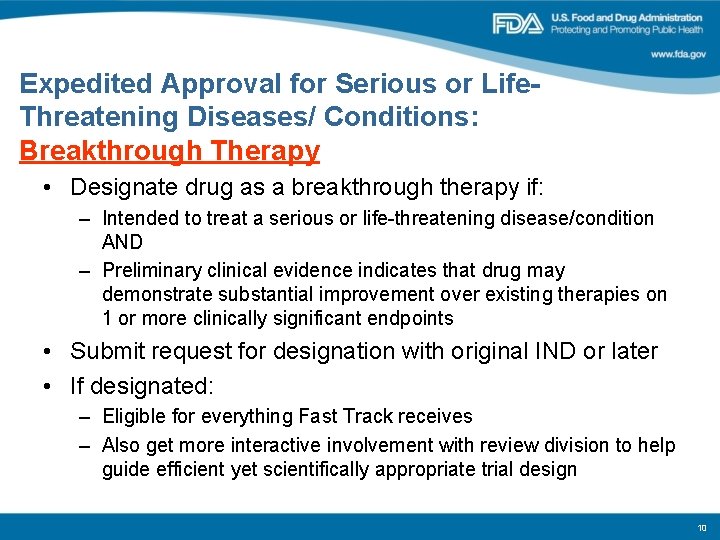
Expedited Approval for Serious or Life. Threatening Diseases/ Conditions: Breakthrough Therapy • Designate drug as a breakthrough therapy if: – Intended to treat a serious or life-threatening disease/condition AND – Preliminary clinical evidence indicates that drug may demonstrate substantial improvement over existing therapies on 1 or more clinically significant endpoints • Submit request for designation with original IND or later • If designated: – Eligible for everything Fast Track receives – Also get more interactive involvement with review division to help guide efficient yet scientifically appropriate trial design 10
External Experts • Ensure that opportunities exist for consultations with stakeholders for topics, including for example: – Severity of rare diseases – Unmet medical need associated with rare diseases – Willingness and ability of individuals with a rare disease to participate in clinical trials – Assessment of benefits and risks of therapies to treat rare diseases • Develop and maintain a list of external experts for consultation 11
Patient-Focused Drug Development • FDA to conduct 20 meetings on different disease areas to obtain patient perspective on disease severity or unmet medical need – Sept. 24, 2012 – Published a preliminary list of nominated disease areas and the criteria used for nomination • Included rare diseases (e. g. , sickle cell disease, amyloidosis, hereditary angioedema) – Oct. 10, 2012 - Kicked off bi-monthly process consultation meetings – Oct. 25, 2012 – Open public meeting to discuss the proposed set of disease areas
Rare Pediatric Disease Priority Review Vouchers • Similar to the Tropical Disease Priority Review Voucher Program • Uses priority review vouchers as an incentive to develop drugs and biologics for “rare pediatric diseases” • Authorized until “the last day of the 1 -year period that begins on the date that FDA awards the third rare pediatric disease priority voucher” 13
Meetings and Guidance • Public Meetings – Issues in clinical trials for drugs for rare diseases (e. g. , endpoint selection, use of surrogate endpoints, patient reported outcomes) – Ways to encourage/accelerate development of new therapies for pediatric rare diseases • Guidance Development – PDUFA Performance Goal (IX. E. ): FDA, on an ongoing basis, will develop guidance to address issues to facilitate development of drugs for rare diseases (e. g. , study design, endpoints, statistical analysis, etc. ) – FDASIA provisions related to accelerated approval, breakthrough therapies, etc. likewise call for guidance development
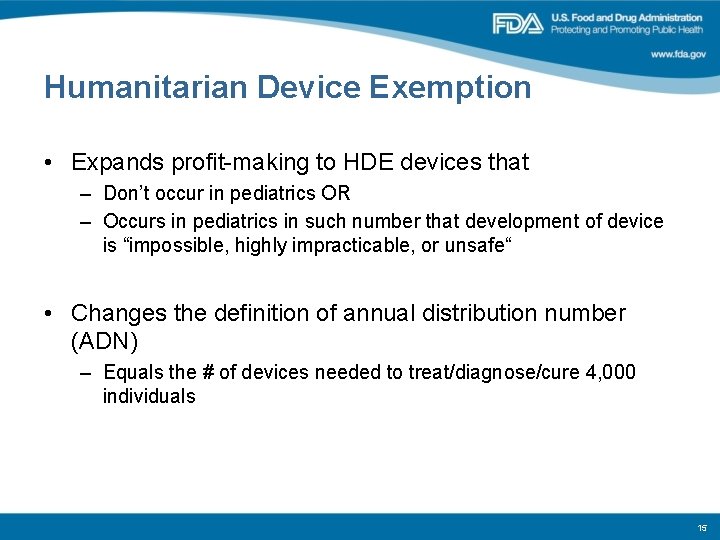
Humanitarian Device Exemption • Expands profit-making to HDE devices that – Don’t occur in pediatrics OR – Occurs in pediatrics in such number that development of device is “impossible, highly impracticable, or unsafe“ • Changes the definition of annual distribution number (ADN) – Equals the # of devices needed to treat/diagnose/cure 4, 000 individuals 15
Questions? For more information on OOPD’s programs, check out www. fda. gov/orphan