Radioactivity and radioisotopes Halflife Exponential law of decay

- Slides: 10
Radioactivity and radioisotopes • Half-life • Exponential law of decay
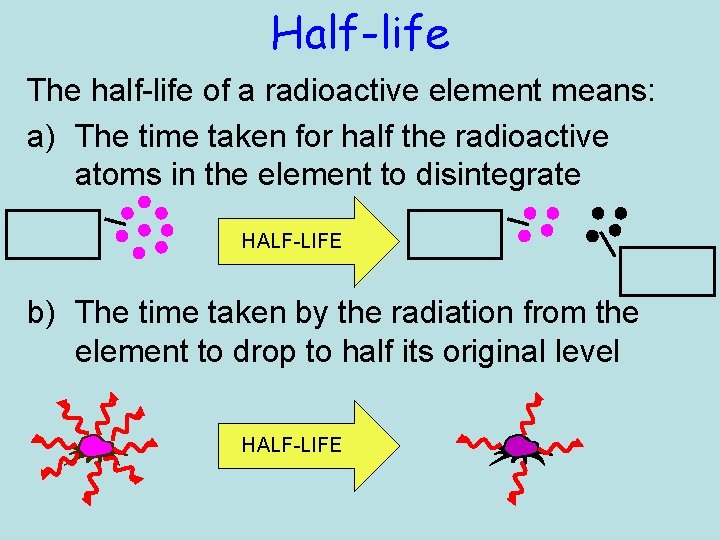
Half-life The half-life of a radioactive element means: a) The time taken for half the radioactive atoms in the element to disintegrate HALF-LIFE b) The time taken by the radiation from the element to drop to half its original level HALF-LIFE
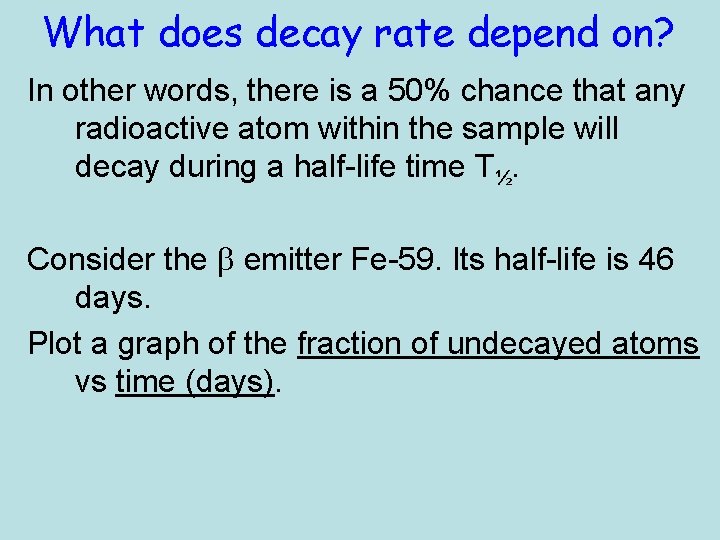
What does decay rate depend on? In other words, there is a 50% chance that any radioactive atom within the sample will decay during a half-life time T½. Consider the b emitter Fe-59. Its half-life is 46 days. Plot a graph of the fraction of undecayed atoms vs time (days).
What does decay rate depend on? Can you now answer by considering the graph you drew? Explain your answer.
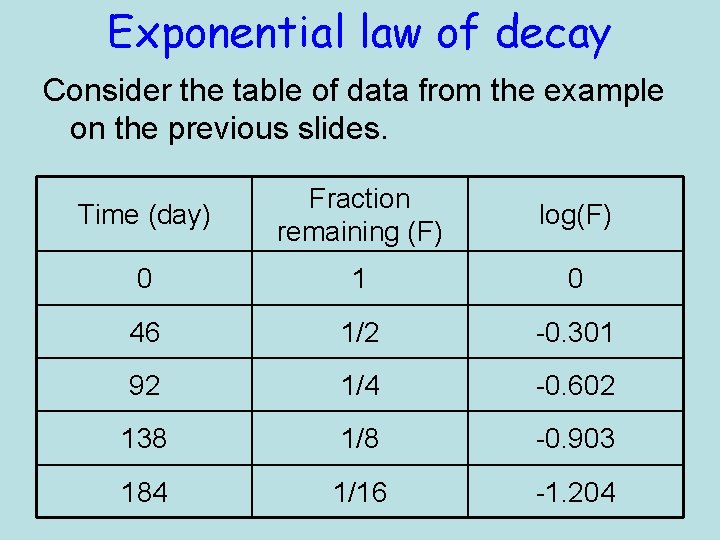
Exponential law of decay Consider the table of data from the example on the previous slides. Time (day) Fraction remaining (F) log(F) 0 1 0 46 1/2 -0. 301 92 1/4 -0. 602 138 1/8 -0. 903 184 1/16 -1. 204
Exponential law of decay Can you notice any pattern in the log(F)? Explain your answer.
Exponential law of decay Using the table and similar triangles find the fraction remaining after 150 days.
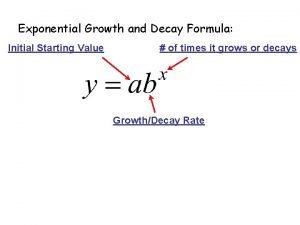
Exponential law of decay From the previous discussion, we can conclude that the rate of radioactive decay is proportional to the number of radioactive atoms: Where N is the number of radioactive atoms still present at time t.
Exponential law of decay The previous proportionality gives the following equation: The constant l the decay constant, and it is measured in s-1. A solution to the above equation is:
Exponential law of decay In the previous formulae, N 0 is the number of radioactive atoms at time t = 0, and x is the number of half-lives elapsed, which could also be not integer.