Radar 101 Rick Reaser 1 310 647 3762
- Slides: 17
Radar 101 Rick Reaser +1 -310 -647 -3762 rick_reaser@raytheon. com May 19, 2010
Agenda § What is radar? § How is it different? § How does it work? § What frequencies are talking about? § How is it used? § How is it regulated? § What are the trends? § Summary
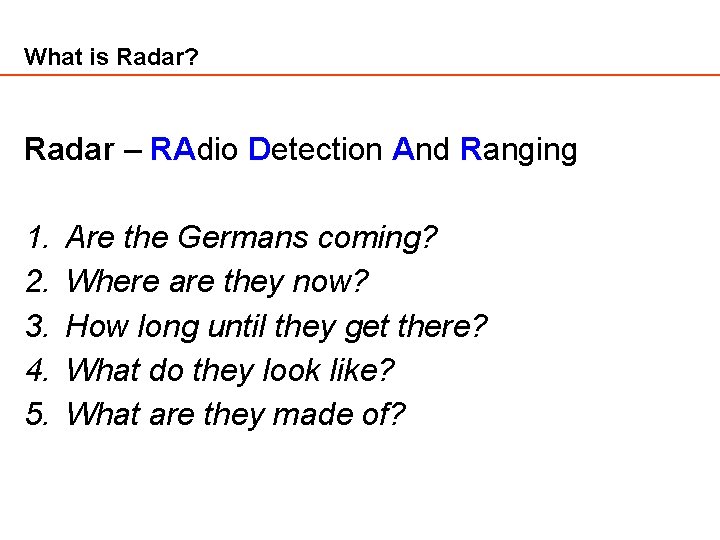
What is Radar? Radar – RAdio Detection And Ranging 1. 2. 3. 4. 5. Are the Germans coming? Where are they now? How long until they get there? What do they look like? What are they made of?
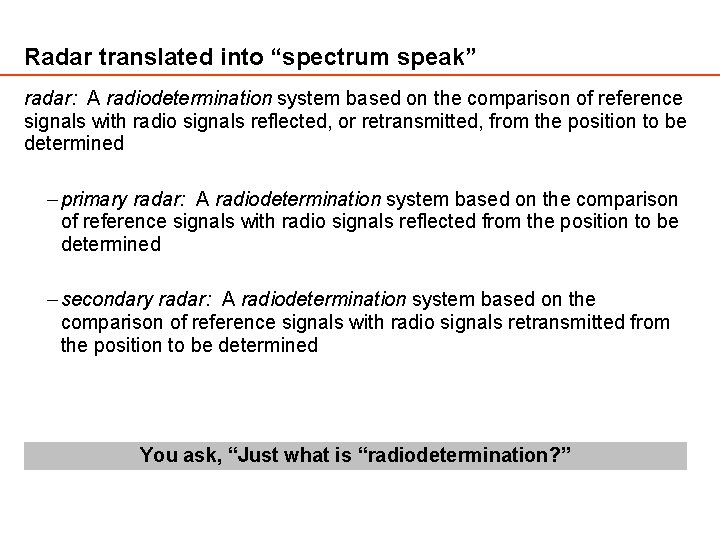
Radar translated into “spectrum speak” radar: A radiodetermination system based on the comparison of reference signals with radio signals reflected, or retransmitted, from the position to be determined – primary radar: A radiodetermination system based on the comparison of reference signals with radio signals reflected from the position to be determined – secondary radar: A radiodetermination system based on the comparison of reference signals with radio signals retransmitted from the position to be determined You ask, “Just what is “radiodetermination? ”
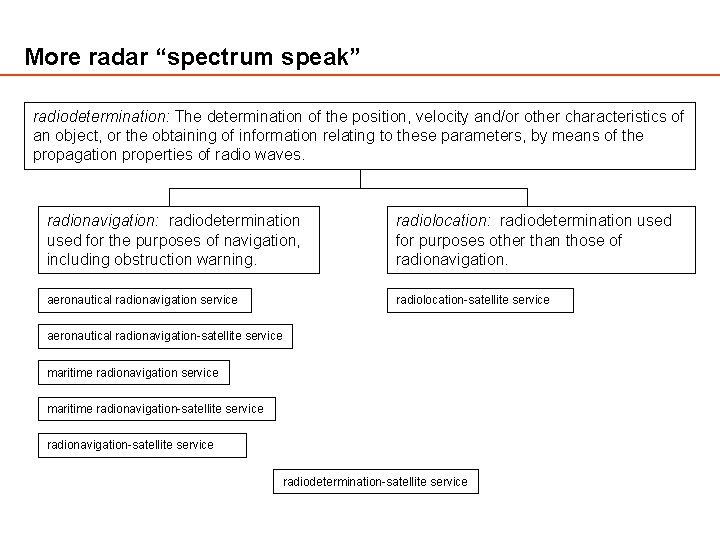
More radar “spectrum speak” radiodetermination: The determination of the position, velocity and/or other characteristics of an object, or the obtaining of information relating to these parameters, by means of the propagation properties of radio waves. radionavigation: radiodetermination used for the purposes of navigation, including obstruction warning. radiolocation: radiodetermination used for purposes other than those of radionavigation. aeronautical radionavigation service radiolocation-satellite service aeronautical radionavigation-satellite service maritime radionavigation-satellite service radiodetermination-satellite service
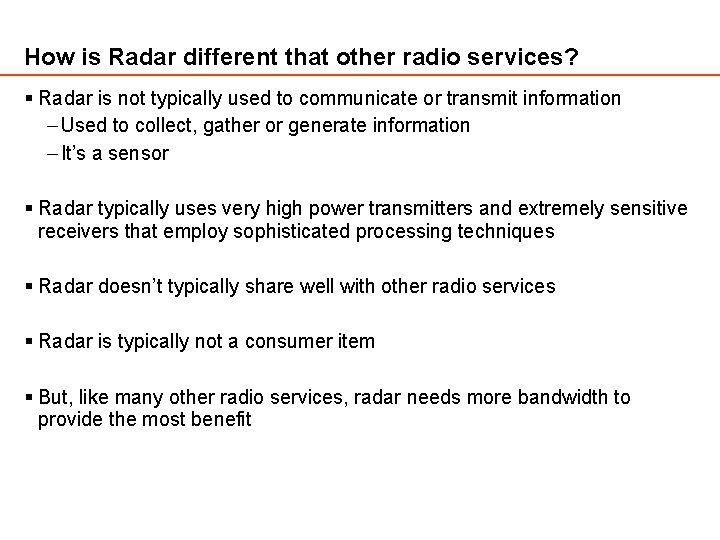
How is Radar different that other radio services? § Radar is not typically used to communicate or transmit information – Used to collect, gather or generate information – It’s a sensor § Radar typically uses very high power transmitters and extremely sensitive receivers that employ sophisticated processing techniques § Radar doesn’t typically share well with other radio services § Radar is typically not a consumer item § But, like many other radio services, radar needs more bandwidth to provide the most benefit
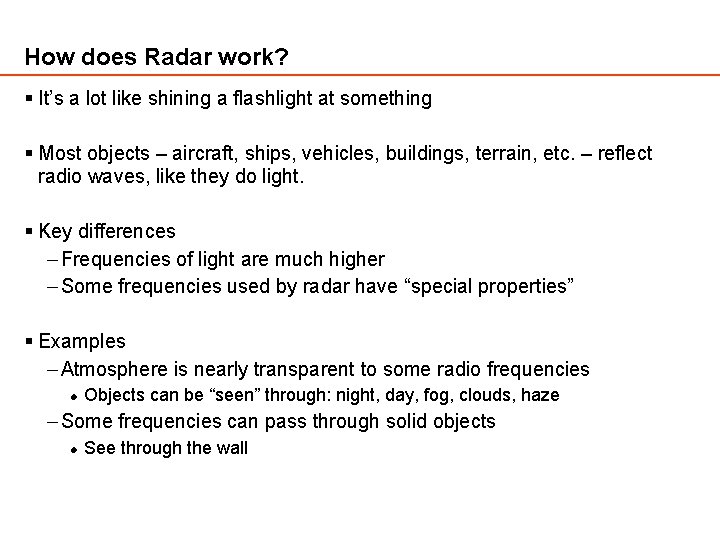
How does Radar work? § It’s a lot like shining a flashlight at something § Most objects – aircraft, ships, vehicles, buildings, terrain, etc. – reflect radio waves, like they do light. § Key differences – Frequencies of light are much higher – Some frequencies used by radar have “special properties” § Examples – Atmosphere is nearly transparent to some radio frequencies l Objects can be “seen” through: night, day, fog, clouds, haze – Some frequencies can pass through solid objects l See through the wall
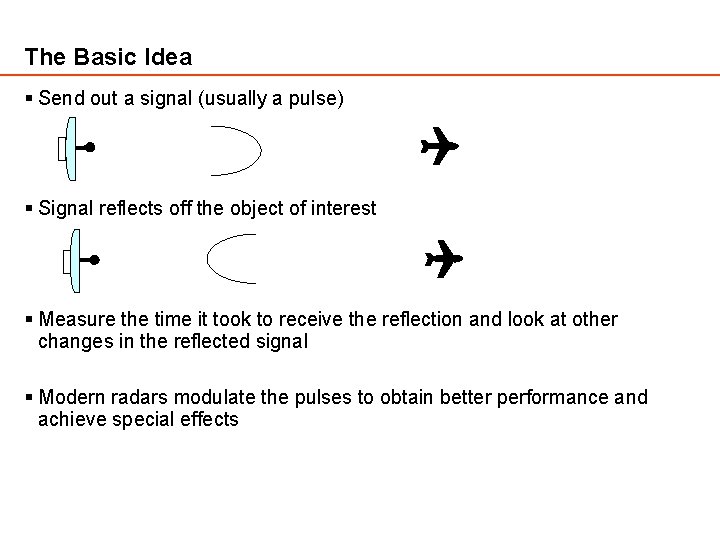
The Basic Idea § Send out a signal (usually a pulse) Q § Signal reflects off the object of interest Q § Measure the time it took to receive the reflection and look at other changes in the reflected signal § Modern radars modulate the pulses to obtain better performance and achieve special effects
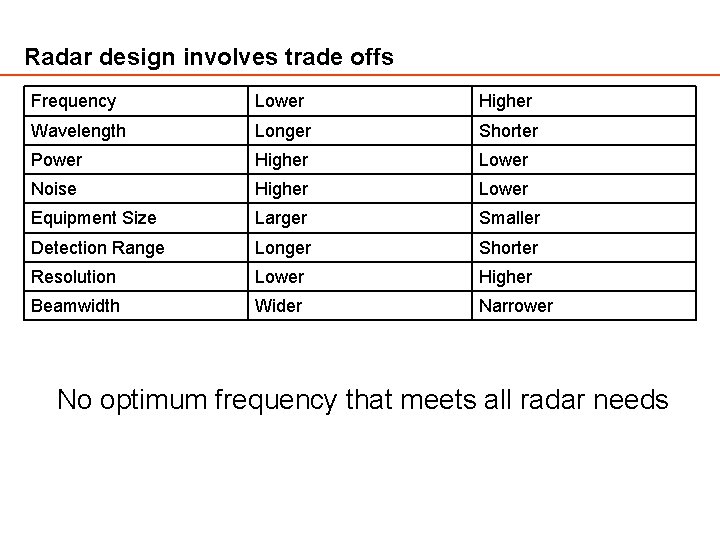
Radar design involves trade offs Frequency Lower Higher Wavelength Longer Shorter Power Higher Lower Noise Higher Lower Equipment Size Larger Smaller Detection Range Longer Shorter Resolution Lower Higher Beamwidth Wider Narrower No optimum frequency that meets all radar needs
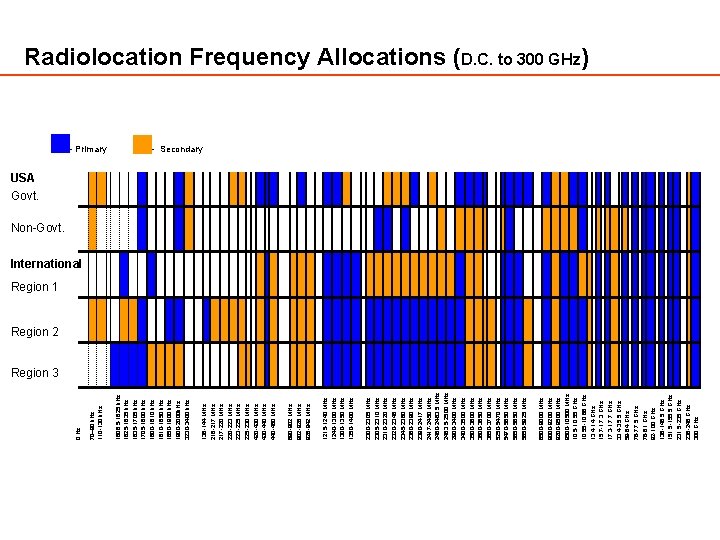
0 Hz 8500 -9000 MHz 9000 -9200 MHz 9200 -9500 MHz 9500 -10500 MHz 10. 5 -10. 55 GHz 10. 55 -10. 68 GHz 13. 4 -14 GHz 15. 7 -17. 3 GHz 17. 3 -17. 7 GHz 33. 4 -35. 5 GHz 59 -64 GHz 76 -77. 5 GHz 78 -81 GHz 92 -100 GHz 136 -148. 5 GHz 151. 5 -155. 5 GHz 231. 5 -235 GHz 238 -248 GHz 300 GHz 2300 -2305 MHz 2305 -2310 MHz 2310 -2320 MHz 2320 -2345 MHz 2345 -2360 MHz 2360 -2390 MHz 2390 -2417 MHz 2417 -2450 MHz 2450 -2483. 5 MHz 2483. 5 -2500 MHz 2900 -3400 MHz 3400 -3500 MHz 3500 -3600 MHz 3600 -3650 MHz 3650 -3700 MHz 5250 -5470 MHz 5470 -5650 MHz 5650 -5850 MHz 5850 -5925 MHz 1215 -1240 MHz 1240 -1300 MHz 1300 -1350 MHz 1350 -1400 MHz 138 -144 MHz 216 -217 MHz 217 -220 MHz 220 -223 MHz 223 -225 MHz 225 -230 MHz 420 -430 MHz 430 -440 MHz 440 -450 MHz 890 -902 MHz 902 -928 MHz 928 -942 MHz 1606. 5 -1625 k. Hz 1625 -1635 k. Hz 1635 -1705 k. Hz 1705 -1800 k. Hz 1800 -1810 k. Hz 1810 -1850 k. Hz 1850 -1900 k. Hz 1900 -2000 k. Hz 3230 -3400 k. Hz 70– 90 k. Hz 110 -130 k. Hz Radiolocation Frequency Allocations (D. C. to 300 GHz) - Primary - Secondary USA Govt. Non-Govt. International Region 1 Region 2 Region 3
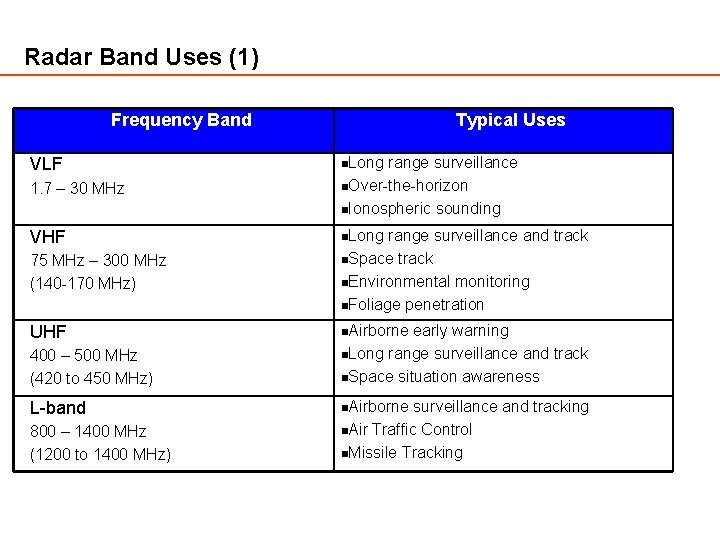
Radar Band Uses (1) Frequency Band Typical Uses VLF n. Long range surveillance 1. 7 – 30 MHz n. Over-the-horizon n. Ionospheric sounding VHF n. Long range surveillance and track 75 MHz – 300 MHz (140 -170 MHz) n. Space track n. Environmental monitoring n. Foliage penetration UHF n. Airborne early warning 400 – 500 MHz (420 to 450 MHz) n. Long range surveillance and track L-band n. Airborne surveillance and tracking 800 – 1400 MHz (1200 to 1400 MHz) n. Air Traffic Control n. Space situation awareness n. Missile Tracking
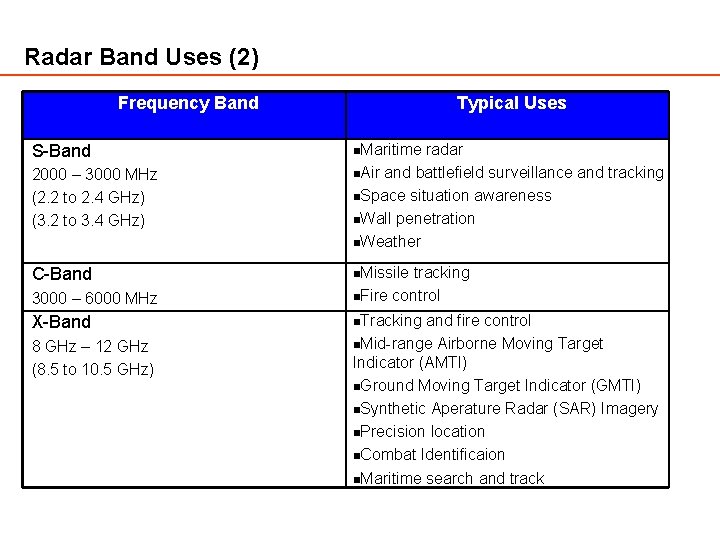
Radar Band Uses (2) Frequency Band Typical Uses S-Band n. Maritime radar 2000 – 3000 MHz (2. 2 to 2. 4 GHz) (3. 2 to 3. 4 GHz) n. Air and battlefield surveillance and tracking n. Space situation awareness n. Wall penetration n. Weather C-Band n. Missile tracking 3000 – 6000 MHz n. Fire control X-Band n. Tracking and fire control 8 GHz – 12 GHz (8. 5 to 10. 5 GHz) n. Mid-range Airborne Moving Target Indicator (AMTI) n. Ground Moving Target Indicator (GMTI) n. Synthetic Aperature Radar (SAR) Imagery n. Precision location n. Combat Identificaion n. Maritime search and track
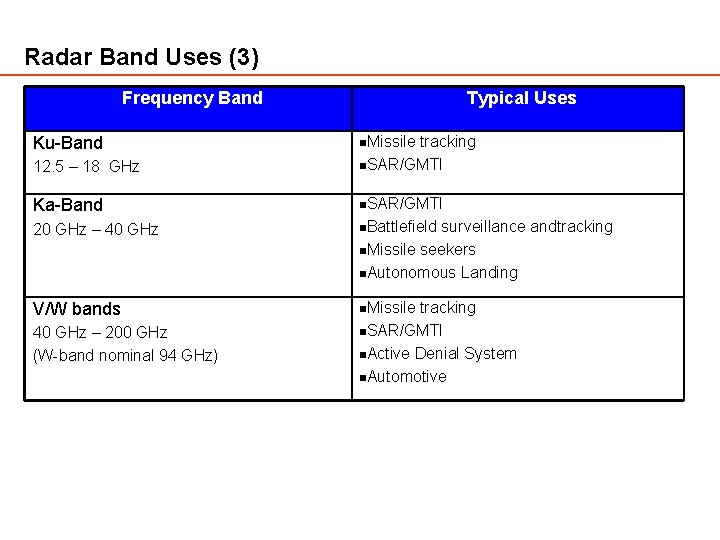
Radar Band Uses (3) Frequency Band Typical Uses Ku-Band n. Missile tracking 12. 5 – 18 GHz n. SAR/GMTI Ka-Band n. SAR/GMTI 20 GHz – 40 GHz n. Battlefield surveillance andtracking n. Missile seekers n. Autonomous Landing V/W bands n. Missile tracking 40 GHz – 200 GHz (W-band nominal 94 GHz) n. SAR/GMTI n. Active Denial System n. Automotive
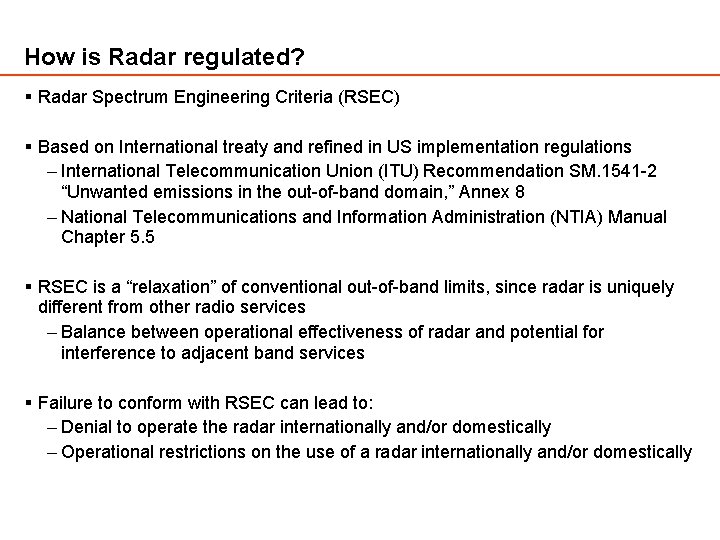
How is Radar regulated? § Radar Spectrum Engineering Criteria (RSEC) § Based on International treaty and refined in US implementation regulations – International Telecommunication Union (ITU) Recommendation SM. 1541 -2 “Unwanted emissions in the out-of-band domain, ” Annex 8 – National Telecommunications and Information Administration (NTIA) Manual Chapter 5. 5 § RSEC is a “relaxation” of conventional out-of-band limits, since radar is uniquely different from other radio services – Balance between operational effectiveness of radar and potential for interference to adjacent band services § Failure to conform with RSEC can lead to: – Denial to operate the radar internationally and/or domestically – Operational restrictions on the use of a radar internationally and/or domestically
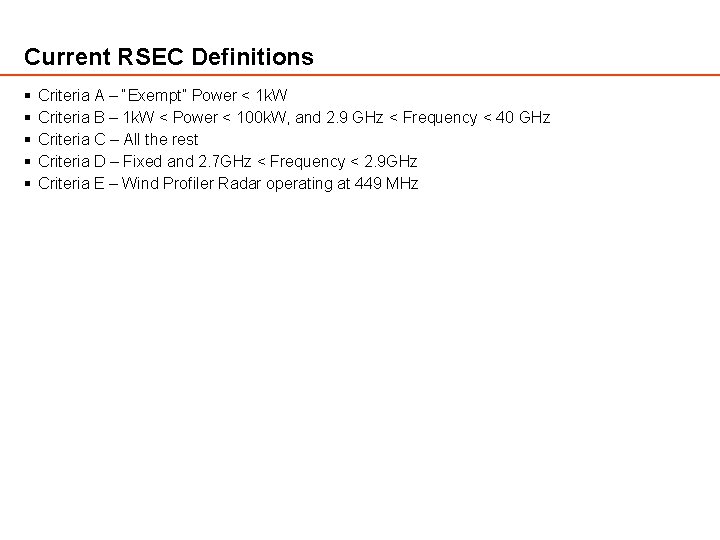
Current RSEC Definitions § § § Criteria A – “Exempt” Power < 1 k. W Criteria B – 1 k. W < Power < 100 k. W, and 2. 9 GHz < Frequency < 40 GHz Criteria C – All the rest Criteria D – Fixed and 2. 7 GHz < Frequency < 2. 9 GHz Criteria E – Wind Profiler Radar operating at 449 MHz
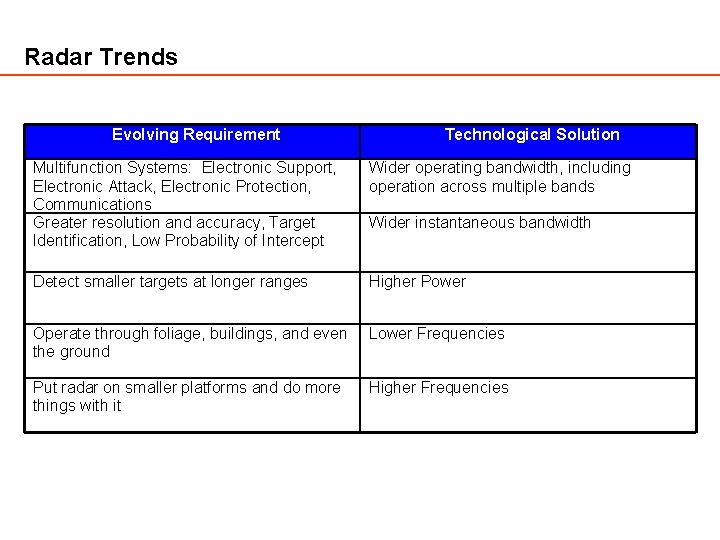
Radar Trends Evolving Requirement Technological Solution Multifunction Systems: Electronic Support, Electronic Attack, Electronic Protection, Communications Greater resolution and accuracy, Target Identification, Low Probability of Intercept Wider operating bandwidth, including operation across multiple bands Detect smaller targets at longer ranges Higher Power Operate through foliage, buildings, and even the ground Lower Frequencies Put radar on smaller platforms and do more things with it Higher Frequencies Wider instantaneous bandwidth
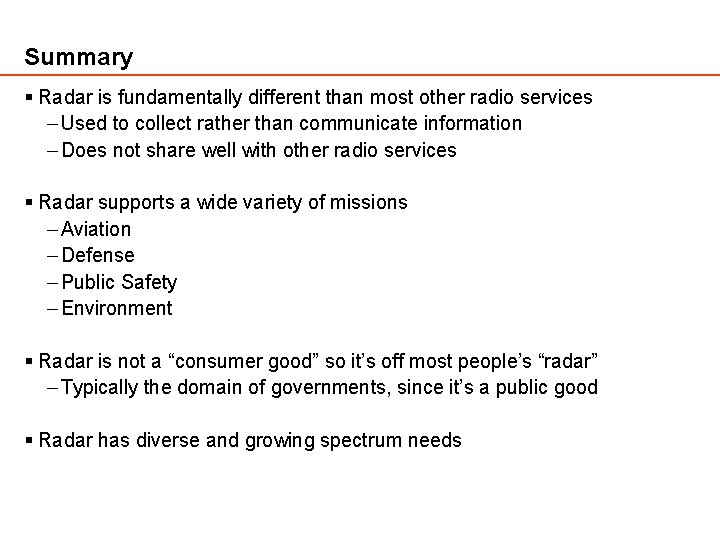
Summary § Radar is fundamentally different than most other radio services – Used to collect rather than communicate information – Does not share well with other radio services § Radar supports a wide variety of missions – Aviation – Defense – Public Safety – Environment § Radar is not a “consumer good” so it’s off most people’s “radar” – Typically the domain of governments, since it’s a public good § Radar has diverse and growing spectrum needs