Quantum CopyProtection and Quantum Money Any humor in

- Slides: 18
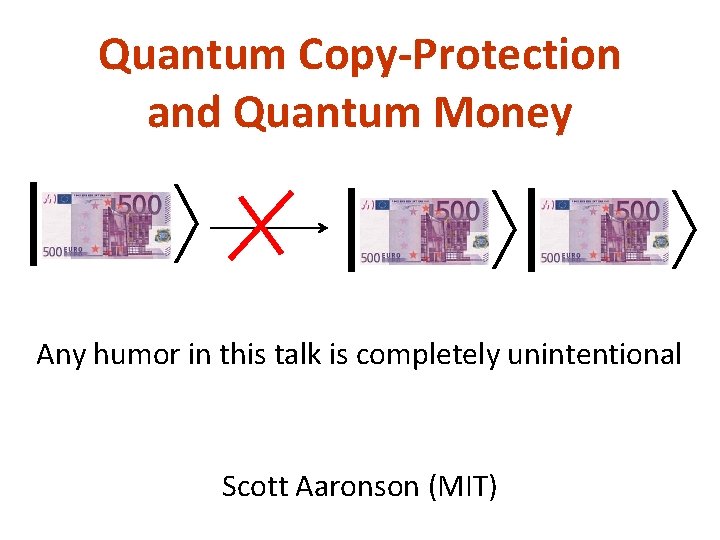
Quantum Copy-Protection and Quantum Money | | | Any humor in this talk is completely unintentional Scott Aaronson (MIT)
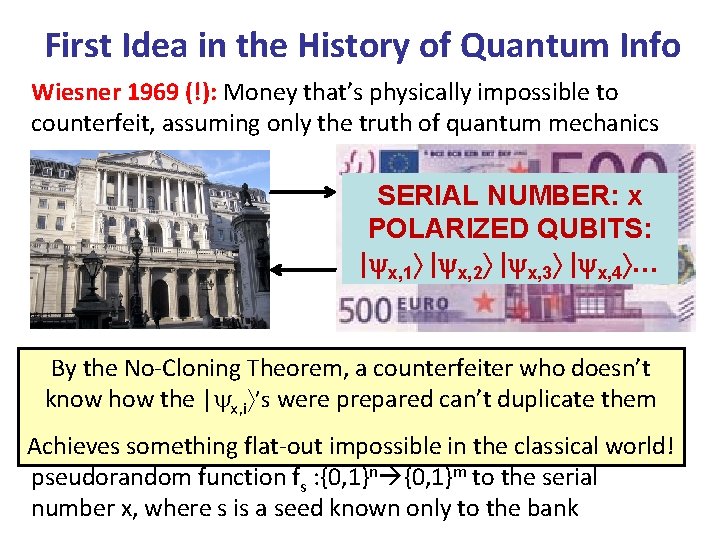
First Idea in the History of Quantum Info Wiesner 1969 (!): Money that’s physically impossible to counterfeit, assuming only the truth of quantum mechanics SERIAL NUMBER: x POLARIZED QUBITS: | x, 1 | x, 2 | x, 3 | x, 4 … One By Problem: the No-Cloning Bank has Theorem, to maintain a counterfeiter giant database who doesn’t with classical know how description the | x, iof ’s the were | prepared can’tbill duplicate x ever issued them x, i ’s for every Achieves Solution something (BBBW 1982): flat-out Generate impossible the | in thebyclassical applying world! a x, i ’s pseudorandom function fs : {0, 1}n {0, 1}m to the serial number x, where s is a seed known only to the bank
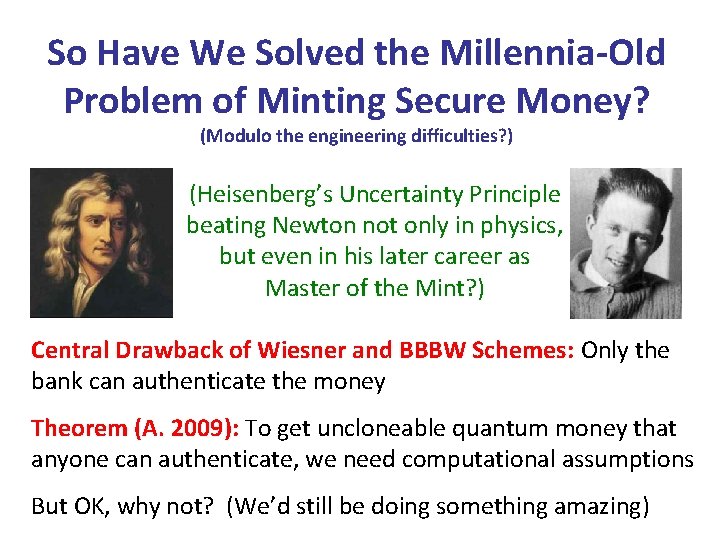
So Have We Solved the Millennia-Old Problem of Minting Secure Money? (Modulo the engineering difficulties? ) (Heisenberg’s Uncertainty Principle beating Newton not only in physics, but even in his later career as Master of the Mint? ) Central Drawback of Wiesner and BBBW Schemes: Only the bank can authenticate the money Theorem (A. 2009): To get uncloneable quantum money that anyone can authenticate, we need computational assumptions But OK, why not? (We’d still be doing something amazing)
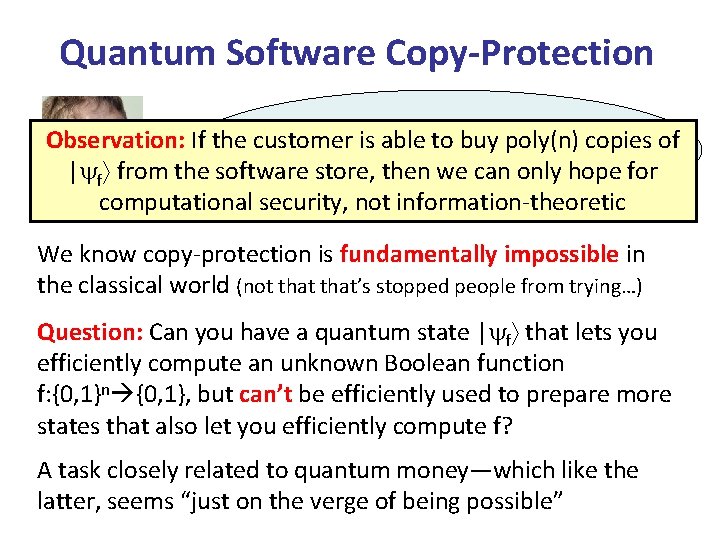
Quantum Software Copy-Protection Observation: If Finally, the customer is able poly(n)computing copies of a serious use to forbuy quantum | f from the software store, then we can only hope for computational security, not information-theoretic We know copy-protection is fundamentally impossible in the classical world (not that’s stopped people from trying…) Question: Can you have a quantum state | f that lets you efficiently compute an unknown Boolean function f: {0, 1}n {0, 1}, but can’t be efficiently used to prepare more states that also let you efficiently compute f? A task closely related to quantum money—which like the latter, seems “just on the verge of being possible”
This paper initiates the study of quantum money and quantum copy-protection from the standpoint of modern theoretical computer science. Main result: Construction of quantum oracles relative to which publicly-verifiable quantum money, and quantum copy-protection of “arbitrary” software, are indeed possible In other words: there’s no relativizing obstruction to these things Oracle. Defense 1: Any security proof for a real quantum money or copy-protection scheme will need to include our black-box security proof as a special case! Oracle. Defense 2: The black-box security proof is already quite nontrivial! Requires a “Complexity-Theoretic No. Cloning Theorem, ” explicit quantum t-designs…
But what about the real world? Can I at least give candidate schemes that work with no oracle? Scheme for publicly-verifiable quantum money - Based on random stabilizer states - Under continuous assault by Hassidim and Lutomirski (So far, they’ve broken at least five of their own schemes) Schemes for copy-protecting point functions (Functions fs: {0, 1}n {0, 1} such that f(x)=1 iff x=s) These schemes are provably secure, under the assumption that they can’t be broken
Definition of Quantum Money Scheme n: Key size B: Poly(n)-size quantum circuit (the “bank”), which maps a secret key s {0, 1}n to a. Cpublic key es and mixed state s If the counterfeiter also receives es, then the scheme is public-key; private-key A: Poly(n)-size quantum otherwise circuit (theit’s “authenticator”), which takes (e, ) as input and either accepts or rejects (B, A) has completeness error if for every s, (B, A) has soundness error if for every poly(n)-size quantum circuit C (the “counterfeiter”) mapping s k to r>k output registers s 1, …, sr,
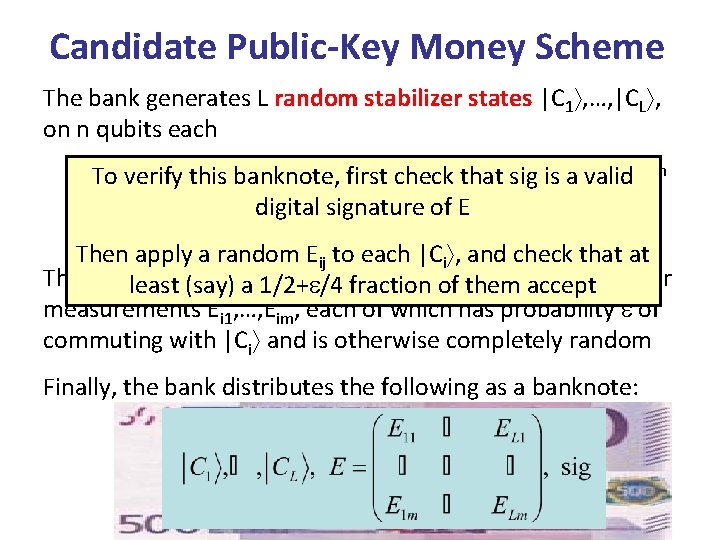
Candidate Public-Key Money Scheme The bank generates L random stabilizer states |C 1 , …, |CL , on n qubits each Recall: A stabilizer state isfirst a state obtainable |0 n To verify this banknote, check that sig isfrom a valid by CNOT, Hadamard, and digital signaturegates of E only Then apply a random Eij to each |Ci , and check that at Then, forleast each(say) |Ci , athe bank fraction generates random stabilizer 1/2+ /4 of m them accept measurements Ei 1, …, Eim, each of which has probability of commuting with |Ci and is otherwise completely random Finally, the bank distributes the following as a banknote:
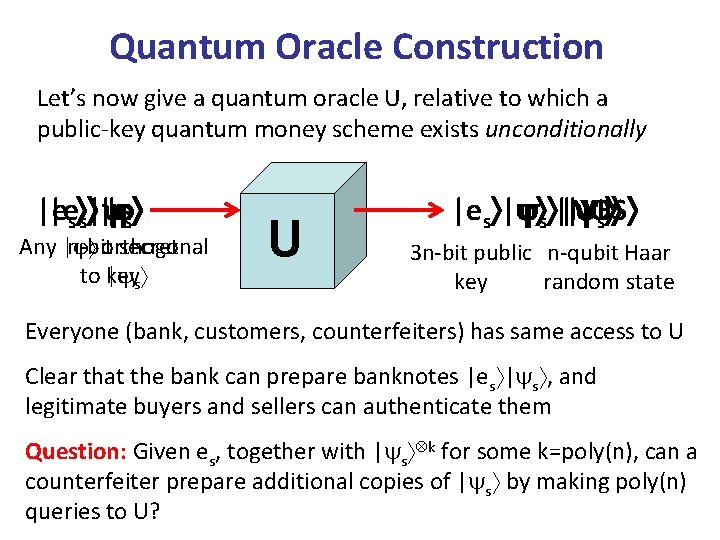
Quantum Oracle Construction Let’s now give a quantum oracle U, relative to which a public-key quantum money scheme exists unconditionally |e |es | |s s | s Any | n-bit orthogonal secret to key | s U |es | s |NO | | |YES s 3 n-bit public n-qubit Haar key random state Everyone (bank, customers, counterfeiters) has same access to U Clear that the bank can prepare banknotes | s , and legitimate buyers and sellers can authenticate them Question: Given es, together with | s k for some k=poly(n), can a counterfeiter prepare additional copies of | s by making poly(n) queries to U?
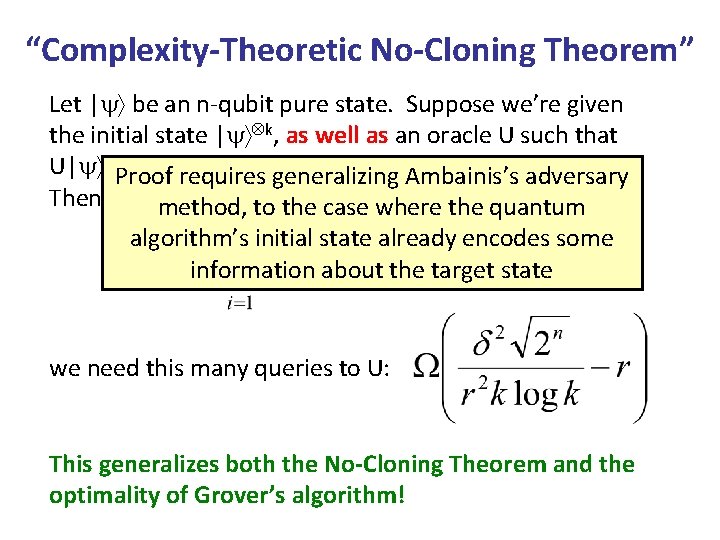
“Complexity-Theoretic No-Cloning Theorem” Let | be an n-qubit pure state. Suppose we’re given the initial state | k, as well as an oracle U such that U| =-| U| =| for all | orthogonal to | . Proofand requires generalizing Ambainis’s adversary Then for allmethod, r>k, to prepare r states 1, …, r such that to the case where the quantum algorithm’s initial state already encodes some information about the target state we need this many queries to U: This generalizes both the No-Cloning Theorem and the optimality of Grover’s algorithm!
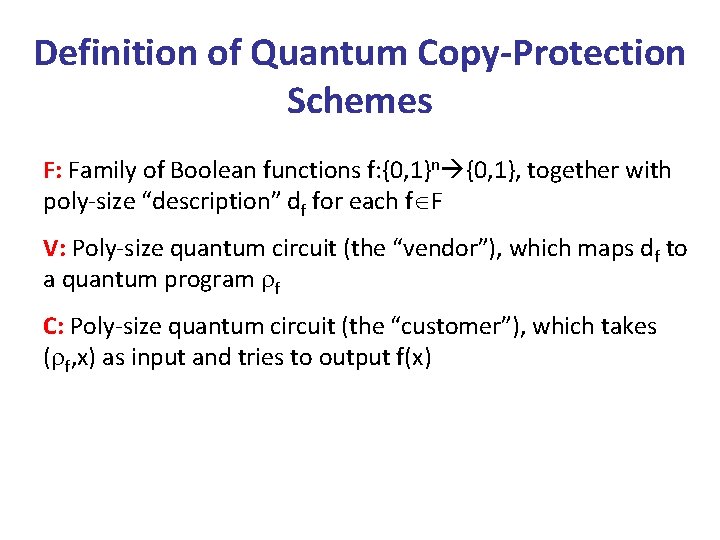
Definition of Quantum Copy-Protection Schemes F: Family of Boolean functions f: {0, 1}n {0, 1}, together with poly-size “description” df for each f F V: Poly-size quantum circuit (the “vendor”), which maps df to a quantum program f C: Poly-size quantum circuit (the “customer”), which takes ( f, x) as input and tries to output f(x)
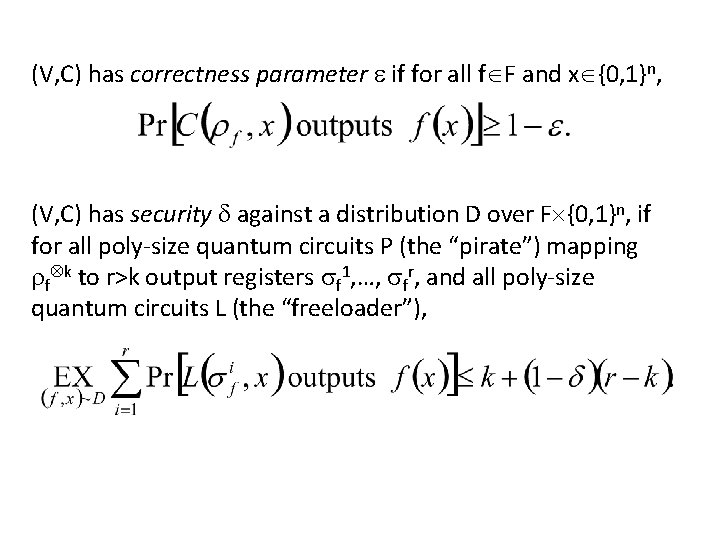
(V, C) has correctness parameter if for all f F and x {0, 1}n, (V, C) has security against a distribution D over F {0, 1}n, if for all poly-size quantum circuits P (the “pirate”) mapping f k to r>k output registers f 1, …, fr, and all poly-size quantum circuits L (the “freeloader”),
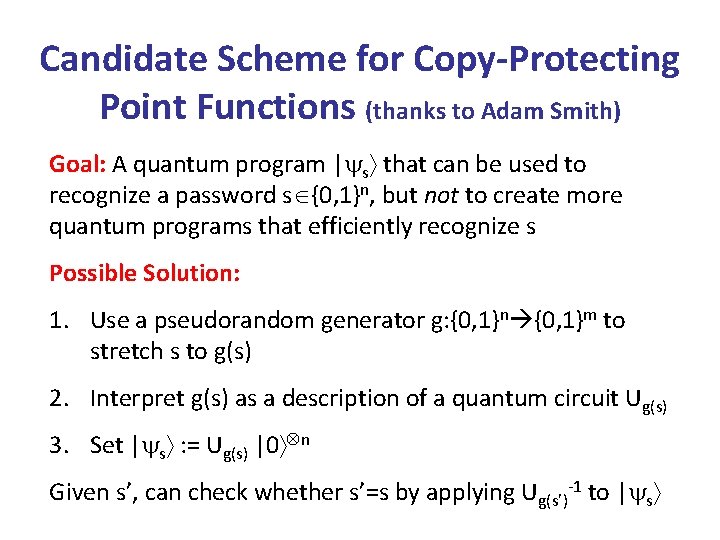
Candidate Scheme for Copy-Protecting Point Functions (thanks to Adam Smith) Goal: A quantum program | s that can be used to recognize a password s {0, 1}n, but not to create more quantum programs that efficiently recognize s Possible Solution: 1. Use a pseudorandom generator g: {0, 1}n {0, 1}m to stretch s to g(s) 2. Interpret g(s) as a description of a quantum circuit Ug(s) 3. Set | s : = Ug(s) |0 n Given s’, can check whether s’=s by applying Ug(s’)-1 to | s
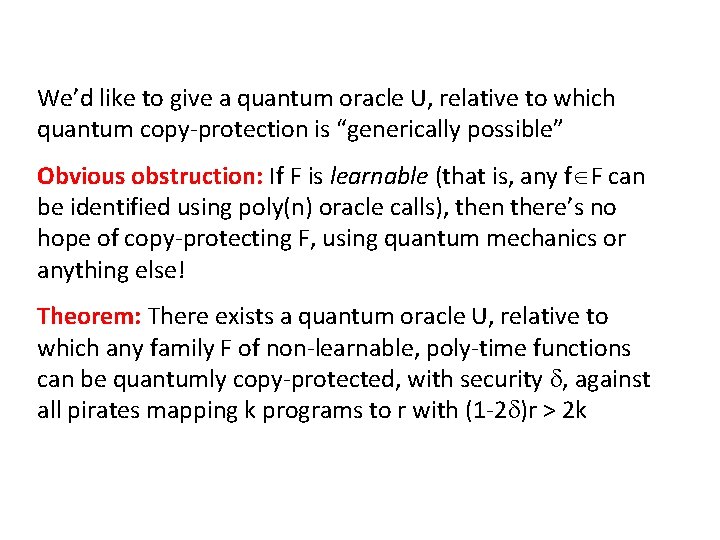
We’d like to give a quantum oracle U, relative to which quantum copy-protection is “generically possible” Obvious obstruction: If F is learnable (that is, any f F can be identified using poly(n) oracle calls), then there’s no hope of copy-protecting F, using quantum mechanics or anything else! Theorem: There exists a quantum oracle U, relative to which any family F of non-learnable, poly-time functions can be quantumly copy-protected, with security , against all pirates mapping k programs to r with (1 -2 )r > 2 k
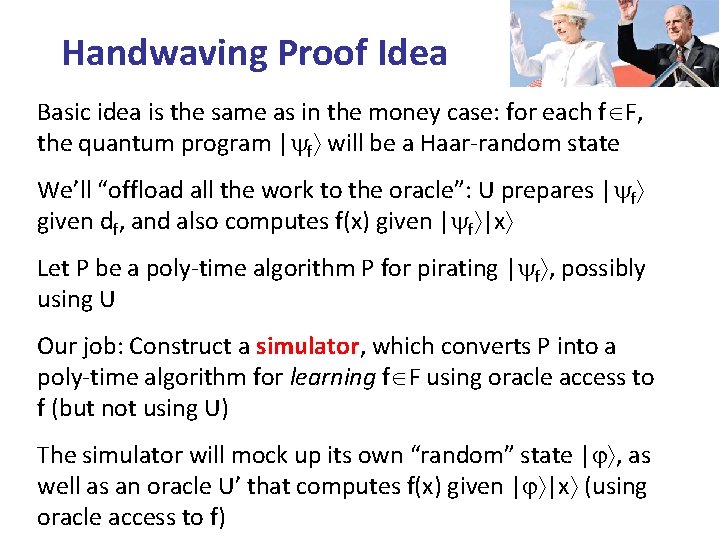
Handwaving Proof Idea Basic idea is the same as in the money case: for each f F, the quantum program | f will be a Haar-random state We’ll “offload all the work to the oracle”: U prepares | f given df, and also computes f(x) given | f |x Let P be a poly-time algorithm P for pirating | f , possibly using U Our job: Construct a simulator, which converts P into a poly-time algorithm for learning f F using oracle access to f (but not using U) The simulator will mock up its own “random” state | , as well as an oracle U’ that computes f(x) given | |x (using oracle access to f)
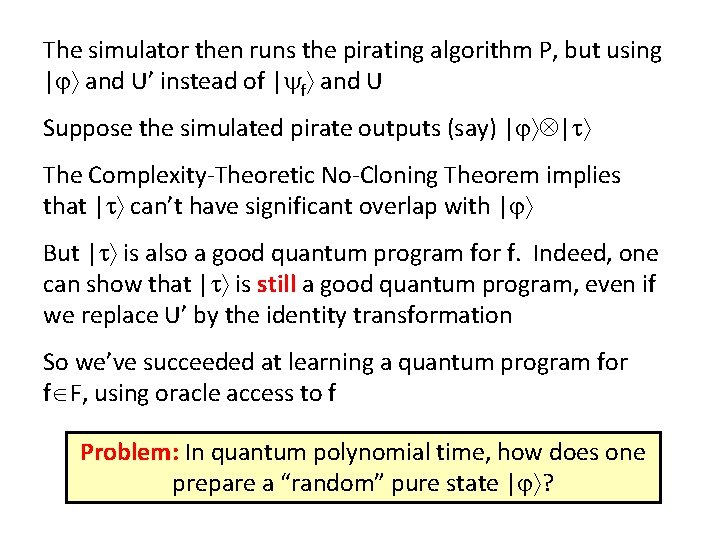
The simulator then runs the pirating algorithm P, but using | and U’ instead of | f and U Suppose the simulated pirate outputs (say) | | The Complexity-Theoretic No-Cloning Theorem implies that | can’t have significant overlap with | But | is also a good quantum program for f. Indeed, one can show that | is still a good quantum program, even if we replace U’ by the identity transformation So we’ve succeeded at learning a quantum program for f F, using oracle access to f Problem: In quantum polynomial time, how does one prepare a “random” pure state | ?
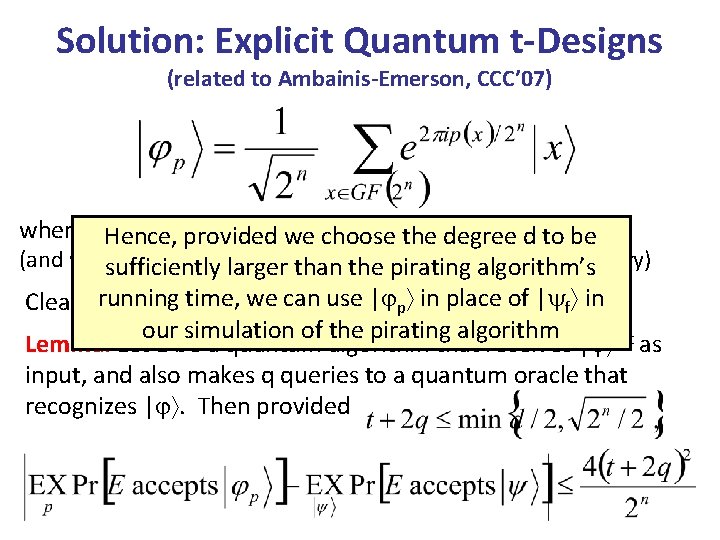
Solution: Explicit Quantum t-Designs (related to Ambainis-Emerson, CCC’ 07) n where p. Hence, is a degree-d univariate polynomial over GF(2 provided we choose the degree d to be ) (and we interpret p(x)larger as an than integer in pirating {0, …, 2 n-1}algorithm’s when necessary) sufficiently the time, use | in in place oftime | f in Clearlyrunning the | p ’s canwe be can prepared p poly(n, d) our simulation of the pirating algorithm Lemma: Let E be a quantum algorithm that receives | t as input, and also makes q queries to a quantum oracle that recognizes | . Then provided
r D U N C E Open Problems r D U N C E Publicly-verifiable quantum money (and copy-protected software) secure under non-tautological assumptions? Copy-protect richer families than point functions? Quantum money and copy-protection relative to a classical oracle? “Unsplittable amplification”? (To avoid k k/2) Adapt the [GGM] construction of PRFs from PRGs, to work in the presence of quantum adversaries? Information-theoretically secure quantum copy-protection? (In regime where error probability is large enough to allow it)