Quantitative vs Qualitative Research Method Issues Marian Ford
- Slides: 13
Quantitative vs. Qualitative Research Method Issues Marian Ford Erin Gonzales November 2, 2010
Outline • Introduction – How to choose? • Quantitative Research – Disadvantages vs. Advantages • Qualitative Research – Disadvantages vs. Advantages • History and Trends • Mixed-Methods • So which is better?
Factors to consider • • • Field of study Nature of study Purpose of the study Population of the study Tools readily available – Method and design – Instrument • Amount of human interaction or characteristics to be studied • Desired implications and results
Quantitative • Positivist thought – can be verified by observation and experimentation • Distribution of variables that can be generalized to entire population • Less interaction between researcher and subjects – more objectivity • Four categories: – – Descriptive design Correlation Casual comparative Quasi-experimental
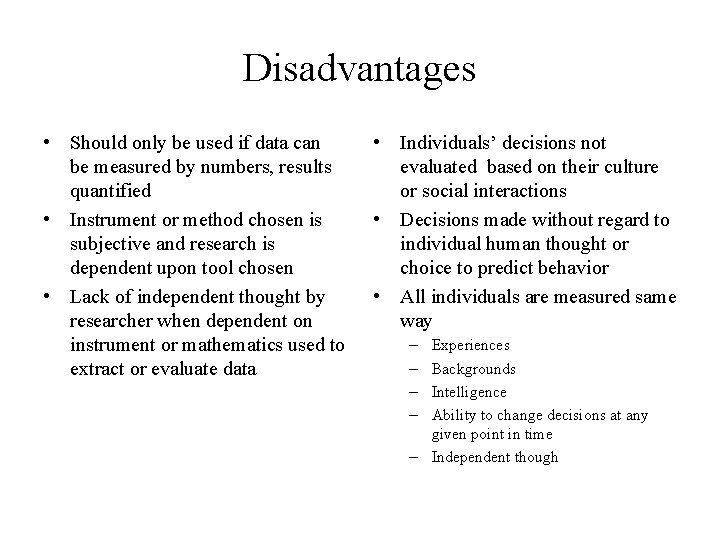
Disadvantages • Should only be used if data can be measured by numbers, results quantified • Instrument or method chosen is subjective and research is dependent upon tool chosen • Lack of independent thought by researcher when dependent on instrument or mathematics used to extract or evaluate data • Individuals’ decisions not evaluated based on their culture or social interactions • Decisions made without regard to individual human thought or choice to predict behavior • All individuals are measured same way – – Experiences Backgrounds Intelligence Ability to change decisions at any given point in time – Independent though
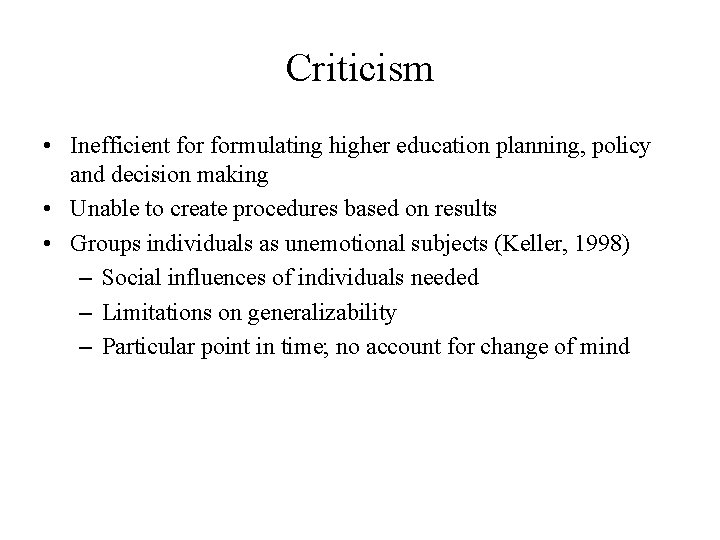
Criticism • Inefficient formulating higher education planning, policy and decision making • Unable to create procedures based on results • Groups individuals as unemotional subjects (Keller, 1998) – Social influences of individuals needed – Limitations on generalizability – Particular point in time; no account for change of mind
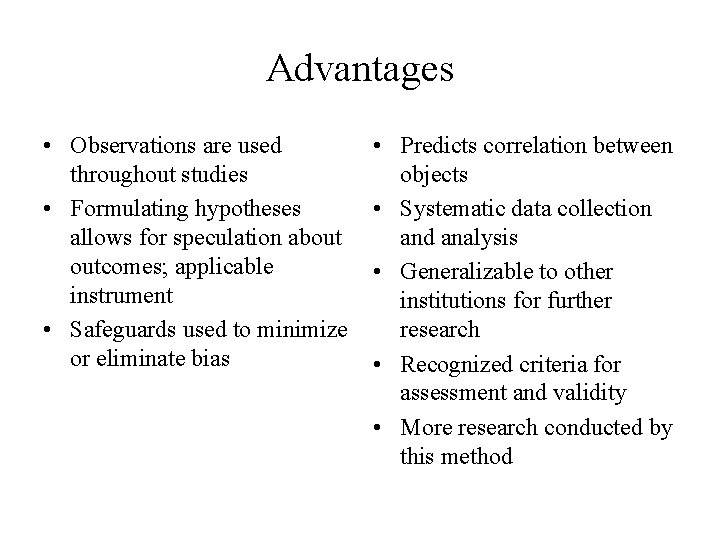
Advantages • Observations are used throughout studies • Formulating hypotheses allows for speculation about outcomes; applicable instrument • Safeguards used to minimize or eliminate bias • Predicts correlation between objects • Systematic data collection and analysis • Generalizable to other institutions for further research • Recognized criteria for assessment and validity • More research conducted by this method
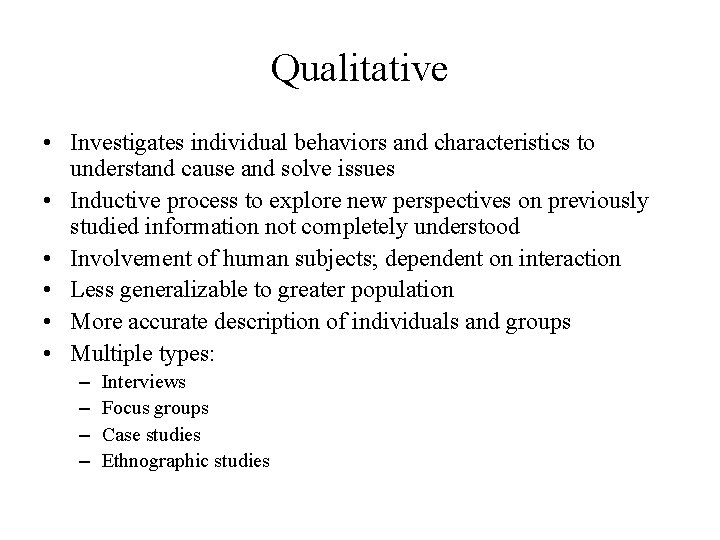
Qualitative • Investigates individual behaviors and characteristics to understand cause and solve issues • Inductive process to explore new perspectives on previously studied information not completely understood • Involvement of human subjects; dependent on interaction • Less generalizable to greater population • More accurate description of individuals and groups • Multiple types: – – Interviews Focus groups Case studies Ethnographic studies
Disadvantages • Strong dependency on sample population – Access – Honest and valid information • Time and resources needed for collection and analysis is intensive • Lack of objectivity and bias by researcher – Inferences made – Incorrect conclusions • Convenience sampling • Lack of training or knowledge about methodology • Lack of ability to produce and comprehend research • Not recognized
Advantages • Helps explain relationships in detail; individualistic • Can help validate quantitative findings by further investigation • Can help close gap between research and practice – Needs of individuals in institutions – Study problems more relevant to policy makers • Less dependent on instrument • Can bring change in institutions and society – In-depth – Personalized – Examines specific issues
History and Trends • Study of five leading higher education journals showed higher volume of quantitative methods vs. qualitative in 1986 and 1989 • Shift has reported increase in qualitative methods in organization and vocational psychology – 40 -50 percent decrease in 1983 -1988 of quantitative methods – 10 percent decrease in 1996 -1999 – Qualitative methods increased from 15 -18 percent of studies to 30 -40 percent of studies
History and Trends • Discovery of Grounded Theory: Barney Glaser – Legitimized alternative methods and research designs – Emphasized the creation of theory out of qualitative data – No longer belief that research was solely to produce scientific knowledge • Comparative assessment for research still does not exists
How do you measure what’s best? • • Need a standard of measurement to determine quality Guidelines are needed to recognize validity of results Barriers of many different approaches and types of research methods Two methods can provide complementary results – Qualitative: • Rich description of issues in field • Lay groundwork for quantitative studies – Quantitative • Provides accurate data collection and analysis and utilization