Puritanismi ja postmodernismi kontrasti vai jatkumo Lihan askeesista

- Slides: 7
Puritanismi ja postmodernismi – kontrasti vai jatkumo? Lihan askeesista merkityksen askeesiin?
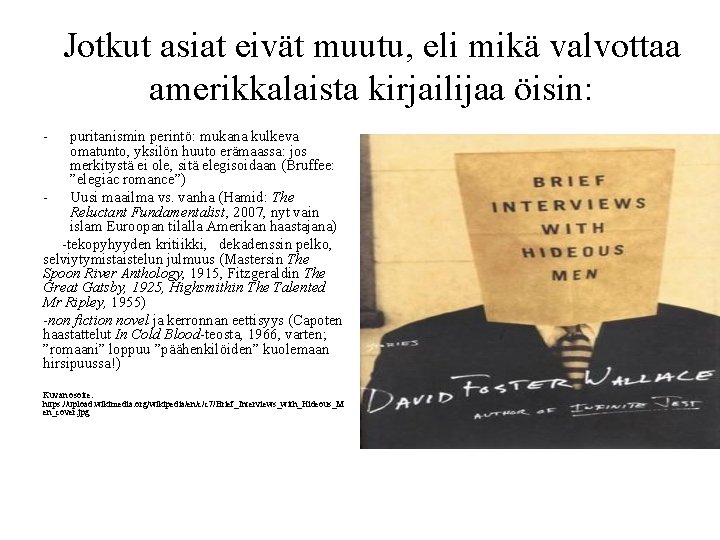
Jotkut asiat eivät muutu, eli mikä valvottaa amerikkalaista kirjailijaa öisin: - puritanismin perintö: mukana kulkeva omatunto, yksilön huuto erämaassa: jos merkitystä ei ole, sitä elegisoidaan (Bruffee: ”elegiac romance”) - Uusi maailma vs. vanha (Hamid: The Reluctant Fundamentalist, 2007, nyt vain islam Euroopan tilalla Amerikan haastajana) -tekopyhyyden kritiikki, dekadenssin pelko, selviytymistaistelun julmuus (Mastersin The Spoon River Anthology, 1915, Fitzgeraldin The Great Gatsby, 1925, Highsmithin The Talented Mr Ripley, 1955) -non fiction novel ja kerronnan eettisyys (Capoten haastattelut In Cold Blood-teosta, 1966, varten; ”romaani” loppuu ”päähenkilöiden” kuolemaan hirsipuussa!) Kuvan osoite: https: //upload. wikimedia. org/wikipedia/en/c/c 7/Brief_Interviews_with_Hideous_M en_cover. jpg
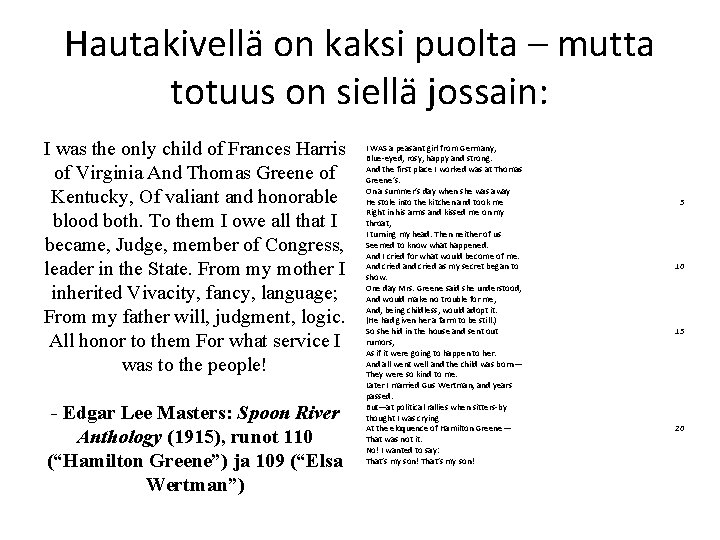
Hautakivellä on kaksi puolta – mutta totuus on siellä jossain: I was the only child of Frances Harris of Virginia And Thomas Greene of Kentucky, Of valiant and honorable blood both. To them I owe all that I became, Judge, member of Congress, leader in the State. From my mother I inherited Vivacity, fancy, language; From my father will, judgment, logic. All honor to them For what service I was to the people! - Edgar Lee Masters: Spoon River Anthology (1915), runot 110 (“Hamilton Greene”) ja 109 (“Elsa Wertman”) I WAS a peasant girl from Germany, Blue-eyed, rosy, happy and strong. And the first place I worked was at Thomas Greene’s. On a summer’s day when she was away He stole into the kitchen and took me Right in his arms and kissed me on my throat, I turning my head. Then neither of us Seemed to know what happened. And I cried for what would become of me. And cried as my secret began to show. One day Mrs. Greene said she understood, And would make no trouble for me, And, being childless, would adopt it. (He had given her a farm to be still. ) So she hid in the house and sent out rumors, As if it were going to happen to her. And all went well and the child was born— They were so kind to me. Later I married Gus Wertman, and years passed. But—at political rallies when sitters-by thought I was crying At the eloquence of Hamilton Greene— That was not it. No! I wanted to say: That’s my son! 5 10 15 20
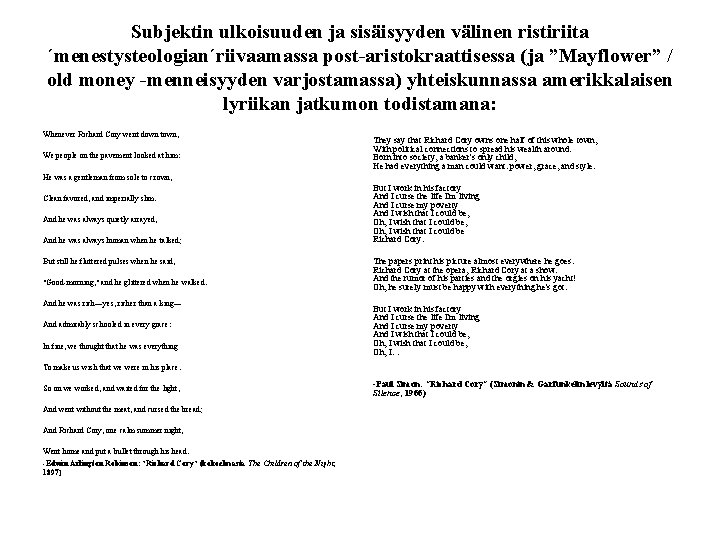
Subjektin ulkoisuuden ja sisäisyyden välinen ristiriita ´menestysteologian´riivaamassa post-aristokraattisessa (ja ”Mayflower” / old money -menneisyyden varjostamassa) yhteiskunnassa amerikkalaisen lyriikan jatkumon todistamana: Whenever Richard Cory went down town, We people on the pavement looked at him: They say that Richard Cory owns one half of this whole town, With political connections to spread his wealth around. Born into society, a banker's only child, He had everything a man could want: power, grace, and style. He was a gentleman from sole to crown, Clean favored, and imperially slim. And he was always quietly arrayed, And he was always human when he talked; But still he fluttered pulses when he said, "Good-morning, " and he glittered when he walked. And he was rich—yes, richer than a king— And admirably schooled in every grace: In fine, we thought that he was everything But I work in his factory And I curse the life I'm living And I curse my poverty And I wish that I could be, Oh, I wish that I could be Richard Cory. The papers print his picture almost everywhere he goes: Richard Cory at the opera, Richard Cory at a show. And the rumor of his parties and the orgies on his yacht! Oh, he surely must be happy with everything he's got. But I work in his factory And I curse the life I'm living And I curse my poverty And I wish that I could be, Oh, I… To make us wish that we were in his place. So on we worked, and waited for the light, And went without the meat, and cursed the bread; And Richard Cory, one calm summer night, Went home and put a bullet through his head. -Edwin Arlington Robinson: ”Richard Cory” (kokoelmasta The Children of the Night, 1897) -Paul Simon: ”Richard Cory” (Simonin & Garfunkelin levyltä Sounds of Silence, 1966)
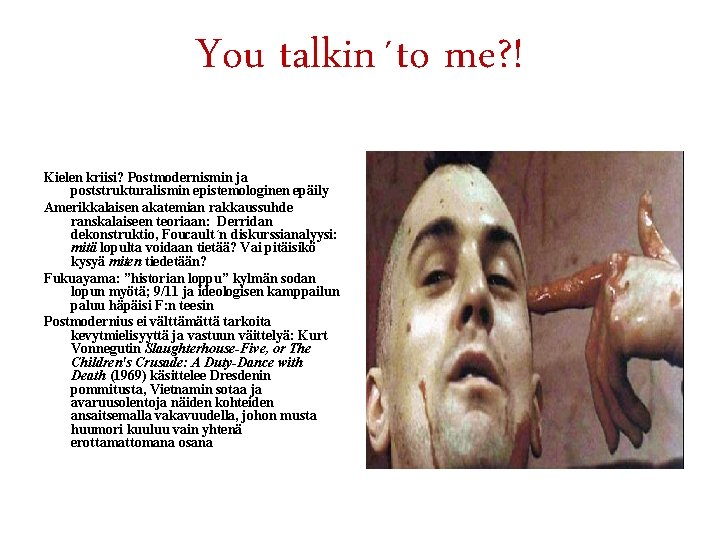
You talkin´to me? ! Kielen kriisi? Postmodernismin ja poststrukturalismin epistemologinen epäily Amerikkalaisen akatemian rakkaussuhde ranskalaiseen teoriaan: Derridan dekonstruktio, Foucault´n diskurssianalyysi: mitä lopulta voidaan tietää? Vai pitäisikö kysyä miten tiedetään? Fukuayama: ”historian loppu” kylmän sodan lopun myötä; 9/11 ja ideologisen kamppailun paluu häpäisi F: n teesin Postmodernius ei välttämättä tarkoita kevytmielisyyttä ja vastuun väittelyä: Kurt Vonnegutin Slaughterhouse-Five, or The Children's Crusade: A Duty-Dance with Death (1969) käsittelee Dresdenin pommitusta, Vietnamin sotaa ja avaruusolentoja näiden kohteiden ansaitsemalla vakavuudella, johon musta huumori kuuluu vain yhtenä erottamattomana osana
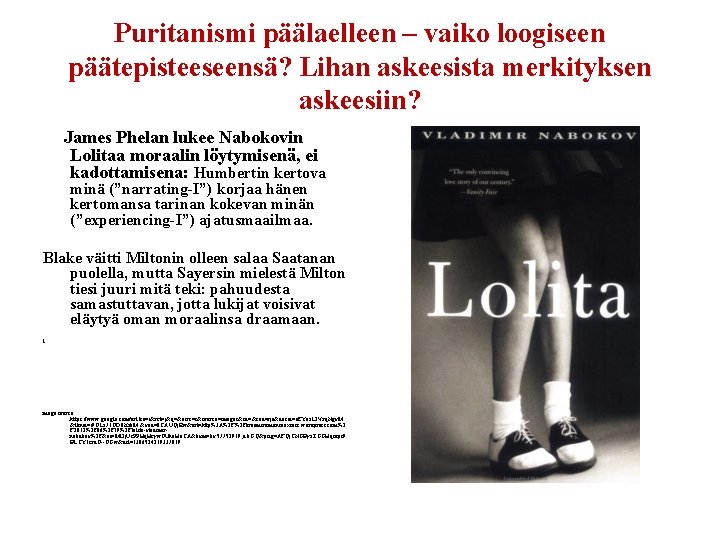
Puritanismi päälaelleen – vaiko loogiseen päätepisteeseensä? Lihan askeesista merkityksen askeesiin? James Phelan lukee Nabokovin Lolitaa moraalin löytymisenä, ei kadottamisena: Humbertin kertova minä (”narrating-I”) korjaa hänen kertomansa tarinan kokevan minän (”experiencing-I”) ajatusmaailmaa. Blake väitti Miltonin olleen salaa Saatanan puolella, mutta Sayersin mielestä Milton tiesi juuri mitä teki: pahuudesta samastuttavan, jotta lukijat voisivat eläytyä oman moraalinsa draamaan. I mage source: https: //www. google. com/url? sa=i&rct=j&q=&esrc=s&source=images&cd=&cad=rja&docid=a. EYaz. L 2 Vrq. Ngv. M &tbnid=i 9 OLz 71 OD 8 Kzk. M: &ved=0 CAUQj. Rw&url=http%3 A%2 F%2 Fdreamsromanceexcess. wordpress. com%2 F 2012%2 F 06%2 F 19%2 Flolita-vladimirnabokov%2 F&ei=Ml 2 j. Us. PPHq. Hsyw. OUho. Ho. CA&bvm=bv. 57752919, d. b. GQ&psig=AFQj. CNGByz. ZGGHqsups 9 BLCY 1 cru. O--OGw&ust=1386524219337019
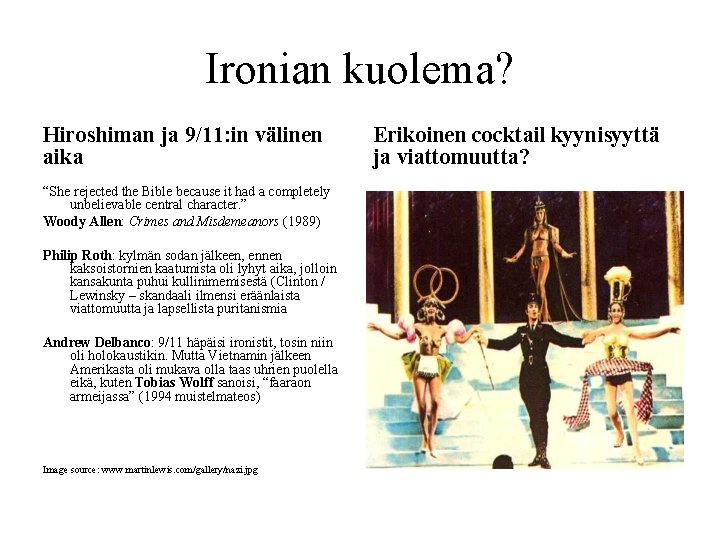
Ironian kuolema? Hiroshiman ja 9/11: in välinen aika “She rejected the Bible because it had a completely unbelievable central character. ” Woody Allen: Crimes and Misdemeanors (1989) Philip Roth: kylmän sodan jälkeen, ennen kaksoistornien kaatumista oli lyhyt aika, jolloin kansakunta puhui kullinimemisestä (Clinton / Lewinsky – skandaali ilmensi eräänlaista viattomuutta ja lapsellista puritanismia Andrew Delbanco: 9/11 häpäisi ironistit, tosin niin oli holokaustikin. Mutta Vietnamin jälkeen Amerikasta oli mukava olla taas uhrien puolella eikä, kuten Tobias Wolff sanoisi, “faaraon armeijassa” (1994 muistelmateos) Image source: www. martinlewis. com/gallery/nazi. jpg Erikoinen cocktail kyynisyyttä ja viattomuutta?