Profit Maximization and Derived Demand A firms hiring
- Slides: 20
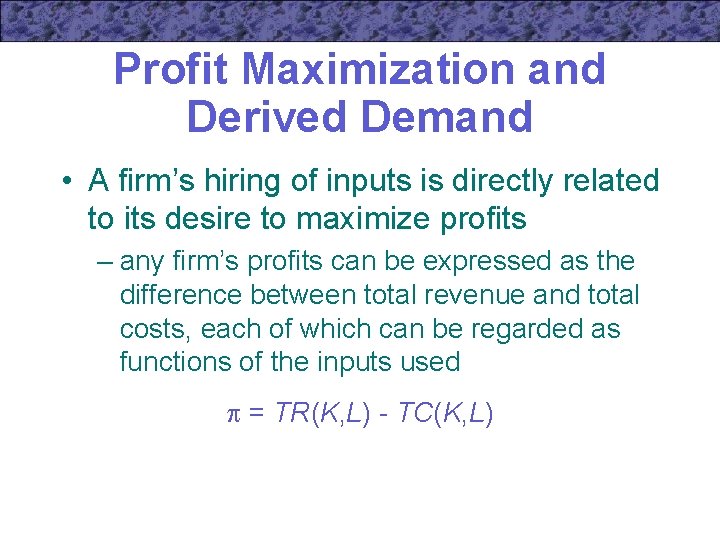
Profit Maximization and Derived Demand • A firm’s hiring of inputs is directly related to its desire to maximize profits – any firm’s profits can be expressed as the difference between total revenue and total costs, each of which can be regarded as functions of the inputs used = TR(K, L) - TC(K, L)
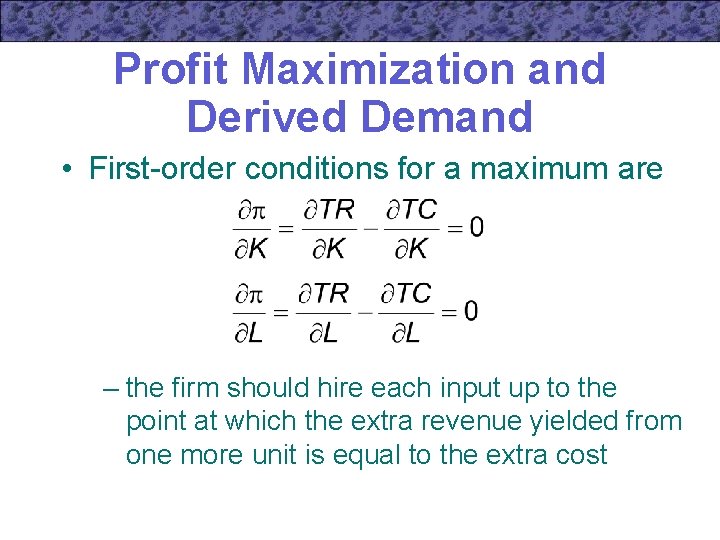
Profit Maximization and Derived Demand • First-order conditions for a maximum are – the firm should hire each input up to the point at which the extra revenue yielded from one more unit is equal to the extra cost
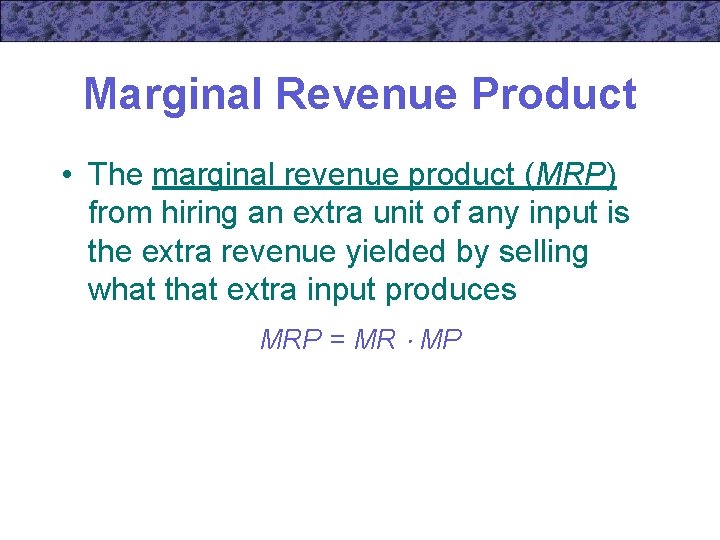
Marginal Revenue Product • The marginal revenue product (MRP) from hiring an extra unit of any input is the extra revenue yielded by selling what that extra input produces MRP = MR MP
Marginal Expense • If the supply curve facing the firm for the inputs it hires are infinitely elastic at prevailing prices, the marginal expense of hiring a worker is simply this market wage • If input supply is not infinitely elastic, a firm’s hiring decision may have an effect on input prices
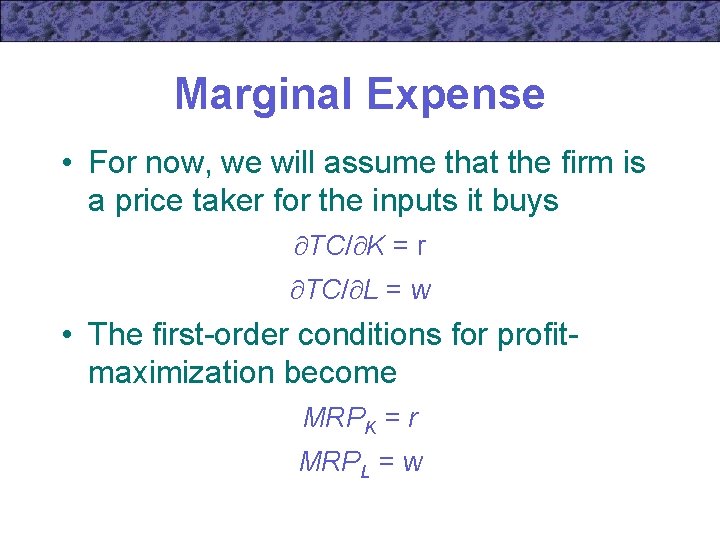
Marginal Expense • For now, we will assume that the firm is a price taker for the inputs it buys TC/ K = r TC/ L = w • The first-order conditions for profitmaximization become MRPK = r MRPL = w
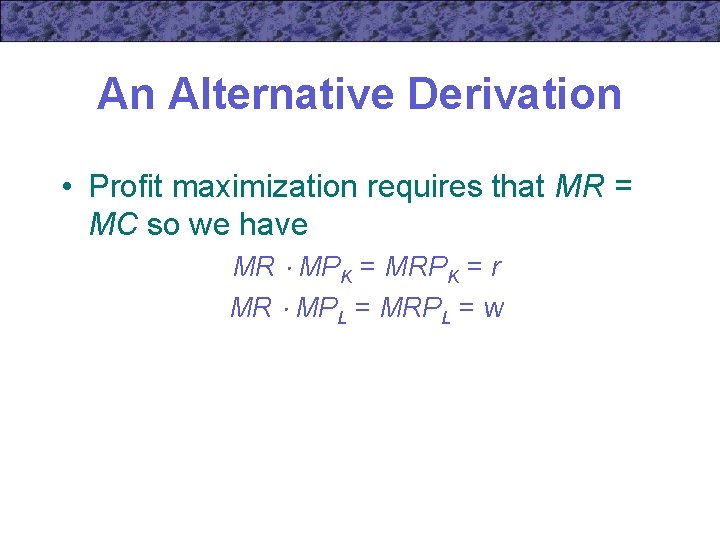
An Alternative Derivation • Profit maximization requires that MR = MC so we have MR MPK = MRPK = r MR MPL = MRPL = w
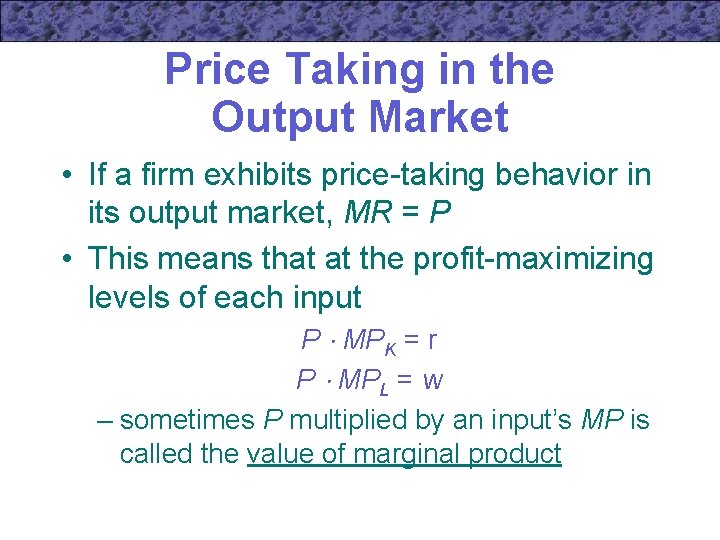
Price Taking in the Output Market • If a firm exhibits price-taking behavior in its output market, MR = P • This means that at the profit-maximizing levels of each input P MPK = r P MPL = w – sometimes P multiplied by an input’s MP is called the value of marginal product
Comparative Statics of Input Demand • We will focus on the comparative statics of the demand for labor – the analysis for capital would be symmetric • For the most part, we will assume pricetaking behavior for the firm in its output market
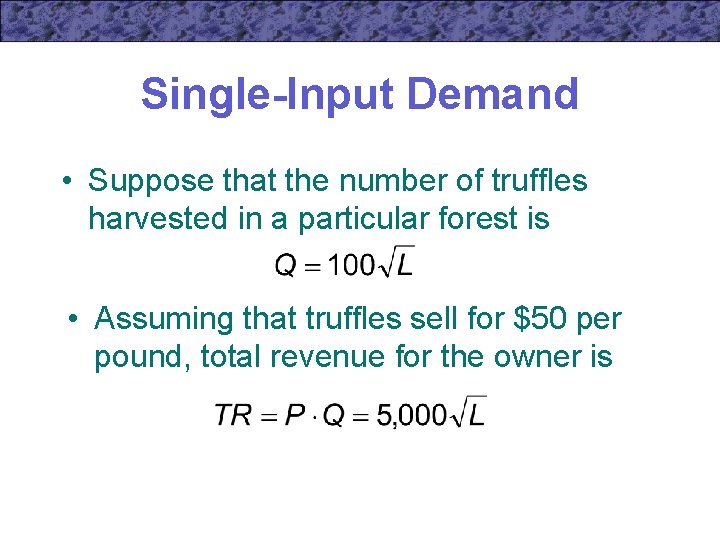
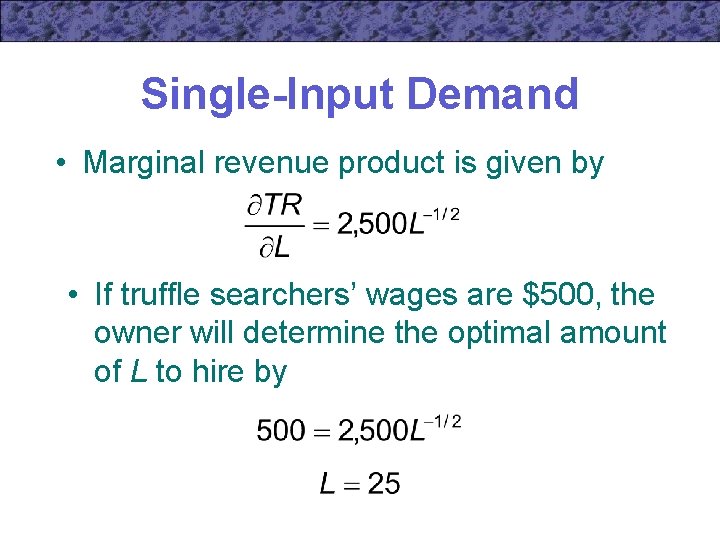
Single-Input Demand • Suppose that the number of truffles harvested in a particular forest is • Assuming that truffles sell for $50 per pound, total revenue for the owner is
Single-Input Demand • Marginal revenue product is given by • If truffle searchers’ wages are $500, the owner will determine the optimal amount of L to hire by
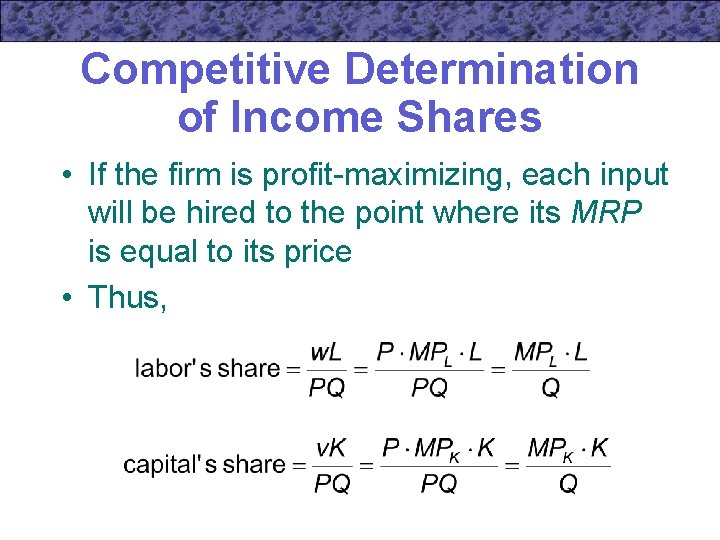
Competitive Determination of Income Shares • If the firm is profit-maximizing, each input will be hired to the point where its MRP is equal to its price • Thus,
Monopsony in the Labor Market • In many situations, the supply curve for an input (L) is not perfectly elastic • We will examine the polar case of monopsony, where the firm is the single buyer of the input in question – the firm faces the entire market supply curve – to increase its hiring of labor, the firm must pay a higher wage
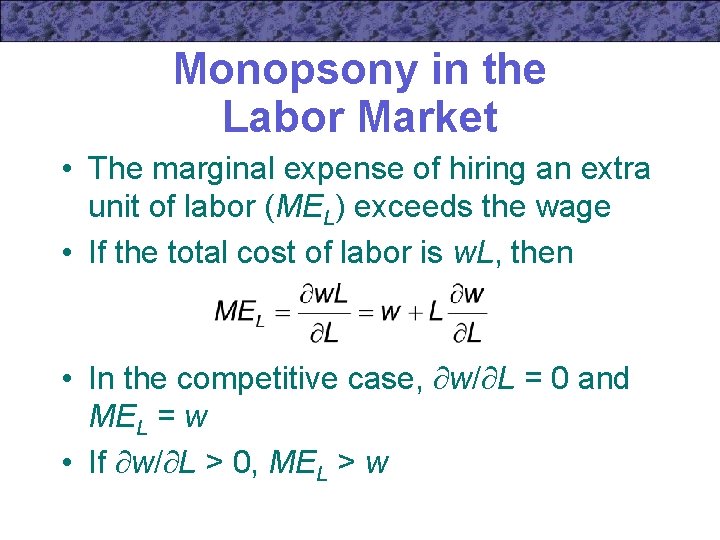
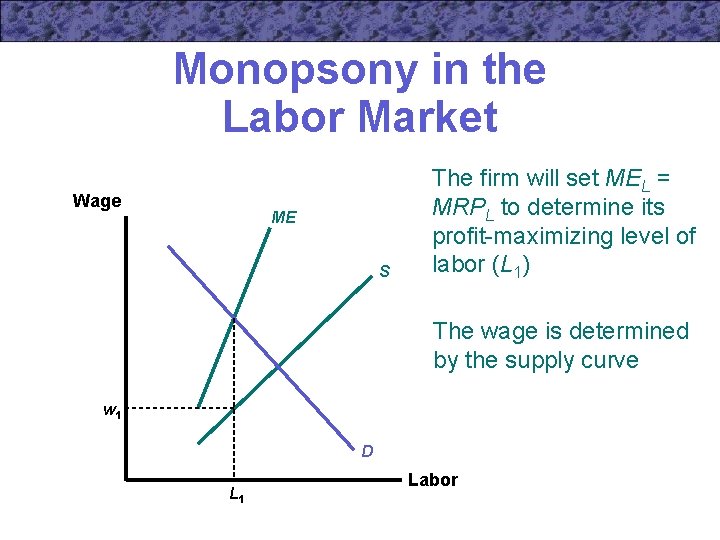
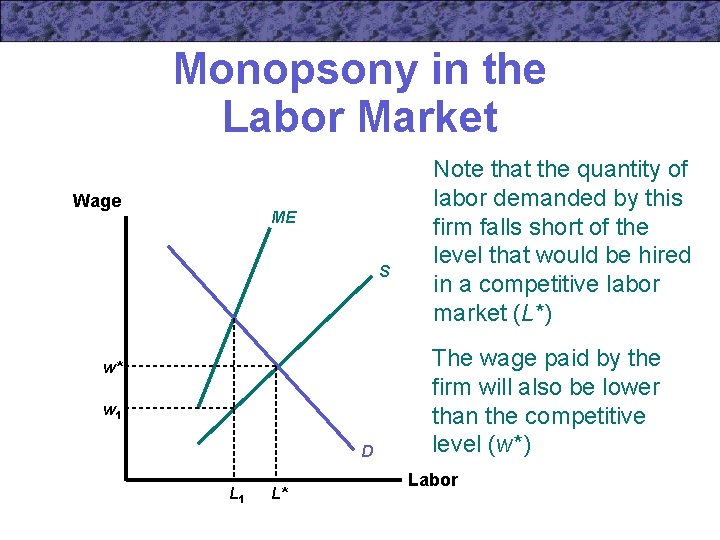
Monopsony in the Labor Market • The marginal expense of hiring an extra unit of labor (MEL) exceeds the wage • If the total cost of labor is w. L, then • In the competitive case, w/ L = 0 and MEL = w • If w/ L > 0, MEL > w
Monopsony in the Labor Market Wage ME S The firm will set MEL = MRPL to determine its profit-maximizing level of labor (L 1) The wage is determined by the supply curve w 1 D L 1 Labor
Monopsony in the Labor Market Wage ME S w* w 1 D L 1 L* Note that the quantity of labor demanded by this firm falls short of the level that would be hired in a competitive labor market (L*) The wage paid by the firm will also be lower than the competitive level (w*) Labor
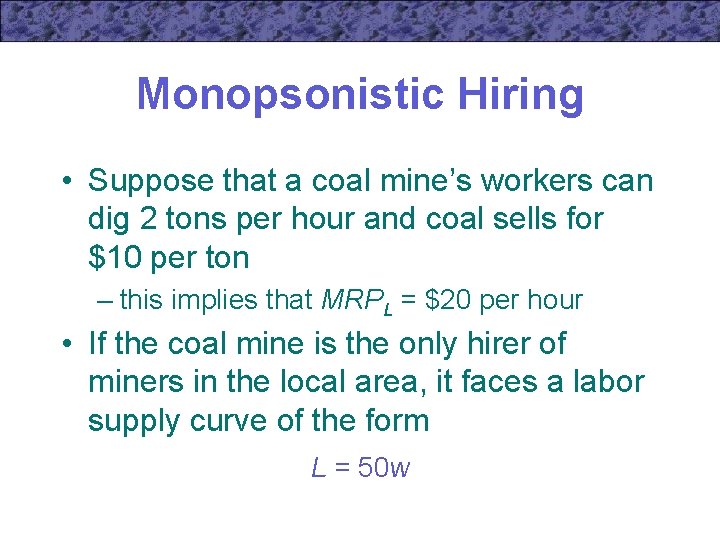
Monopsonistic Hiring • Suppose that a coal mine’s workers can dig 2 tons per hour and coal sells for $10 per ton – this implies that MRPL = $20 per hour • If the coal mine is the only hirer of miners in the local area, it faces a labor supply curve of the form L = 50 w
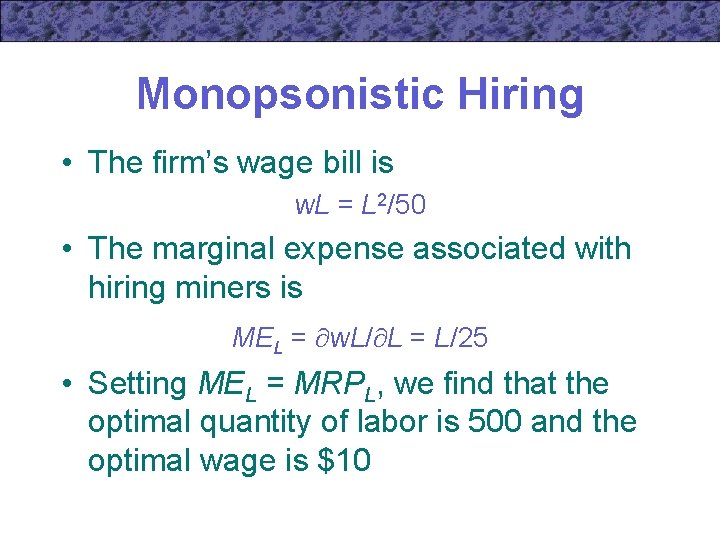
Monopsonistic Hiring • The firm’s wage bill is w. L = L 2/50 • The marginal expense associated with hiring miners is MEL = w. L/ L = L/25 • Setting MEL = MRPL, we find that the optimal quantity of labor is 500 and the optimal wage is $10
Monopoly in the Supply of Inputs • Imperfect competition may also occur in input markets if suppliers are able to form a monopoly – labor unions in “closed shop” industries – production cartels for certain types of capital equipment – firms (or countries) that control unique supplies of natural resources
Monopoly in the Supply of Inputs • If both the supply and demand sides of an input market are monopolized, the market outcome will be indeterminate – the actual outcome will depend on the bargaining skills of the parties
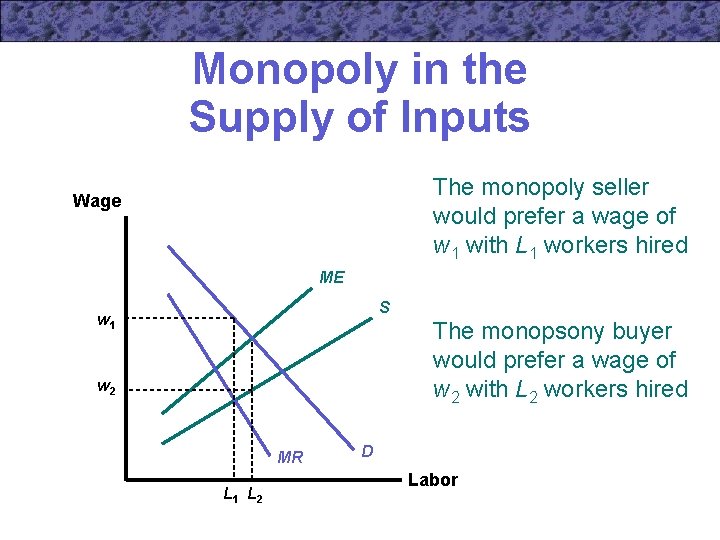
Monopoly in the Supply of Inputs The monopoly seller would prefer a wage of w 1 with L 1 workers hired Wage ME S w 1 The monopsony buyer would prefer a wage of w 2 with L 2 workers hired w 2 MR L 1 L 2 D Labor