Power Language Cultural Capital Ellen Manos and Dusty
- Slides: 10
Power & Language: Cultural Capital Ellen Manos and Dusty Hiles
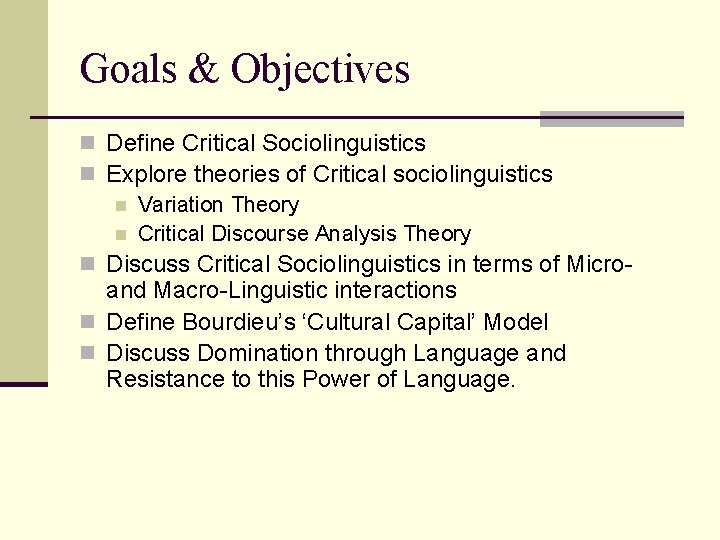
Goals & Objectives n Define Critical Sociolinguistics n Explore theories of Critical sociolinguistics n Variation Theory n Critical Discourse Analysis Theory n Discuss Critical Sociolinguistics in terms of Micro- and Macro-Linguistic interactions n Define Bourdieu’s ‘Cultural Capital’ Model n Discuss Domination through Language and Resistance to this Power of Language.
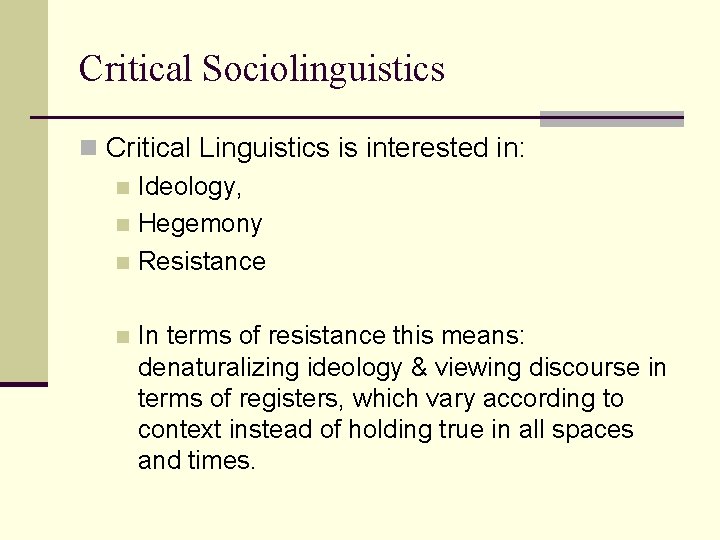
Critical Sociolinguistics n Critical Linguistics is interested in: n Ideology, n Hegemony n Resistance n In terms of resistance this means: denaturalizing ideology & viewing discourse in terms of registers, which vary according to context instead of holding true in all spaces and times.
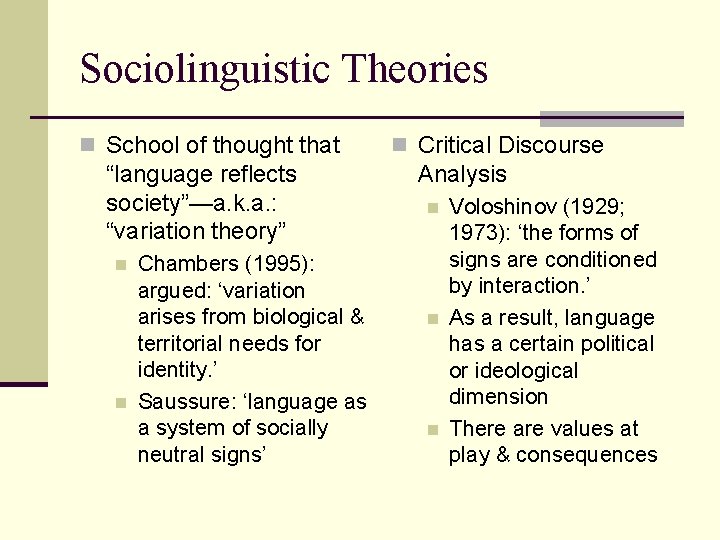
Sociolinguistic Theories n School of thought that “language reflects society”—a. k. a. : “variation theory” n n Chambers (1995): argued: ‘variation arises from biological & territorial needs for identity. ’ Saussure: ‘language as a system of socially neutral signs’ n Critical Discourse Analysis n n n Voloshinov (1929; 1973): ‘the forms of signs are conditioned by interaction. ’ As a result, language has a certain political or ideological dimension There are values at play & consequences
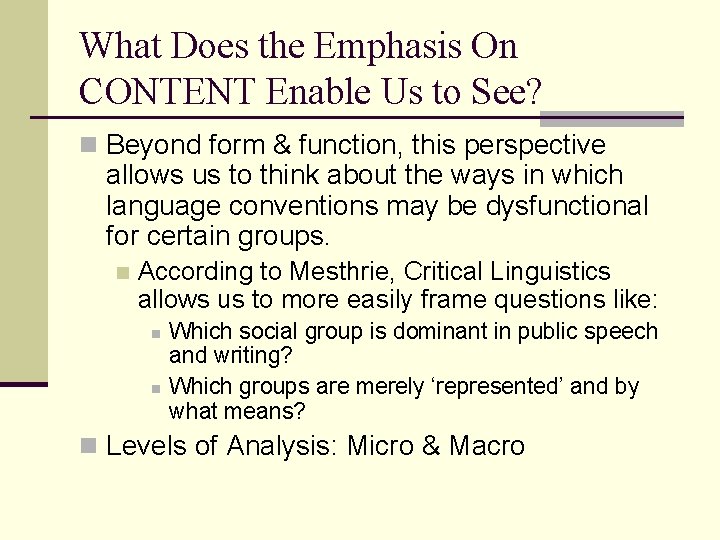
What Does the Emphasis On CONTENT Enable Us to See? n Beyond form & function, this perspective allows us to think about the ways in which language conventions may be dysfunctional for certain groups. n According to Mesthrie, Critical Linguistics allows us to more easily frame questions like: n n Which social group is dominant in public speech and writing? Which groups are merely ‘represented’ and by what means? n Levels of Analysis: Micro & Macro
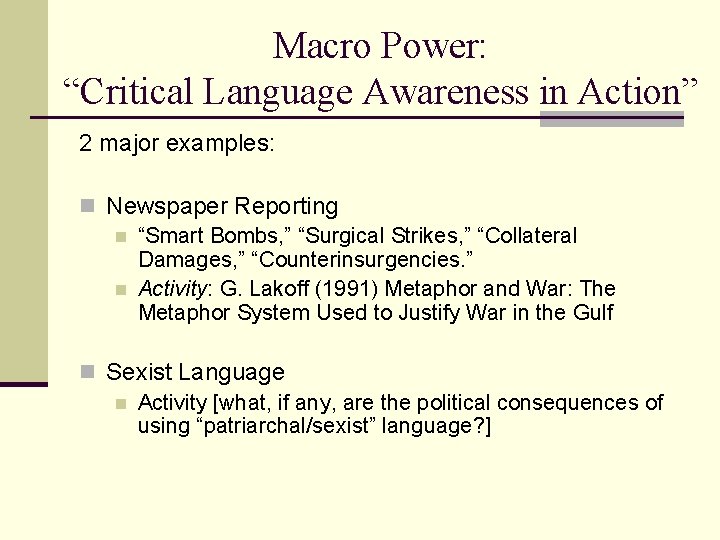
Macro Power: “Critical Language Awareness in Action” 2 major examples: n Newspaper Reporting n “Smart Bombs, ” “Surgical Strikes, ” “Collateral Damages, ” “Counterinsurgencies. ” n Activity: G. Lakoff (1991) Metaphor and War: The Metaphor System Used to Justify War in the Gulf n Sexist Language n Activity [what, if any, are the political consequences of using “patriarchal/sexist” language? ]
“Micro-Power” in Linguistic Interactions n Consequences of Content & “Concision” n Chomsky Clip (Special Features Menu, #1, 14: 30 -> End) n To what extent do we see: Language Tactics for Dominating the Guest? n Emotional Language? n Simplification of Reality? n Repetition? n Is this Micro-Propaganda? n n Underlying Question: Do characteristics of content determine power relations? Always? Sometimes? How so?
Bourdieu’s Conception of Power: The Cultural Capital Model
Domination & Resistance n Anti-Language n n Halliday (1978): ‘Metaphor for everyday language’ § Slangs that are overlexicalized: § in Calcutta 21 words for ‘bomb’ & 41 for ‘police’ n n Except that it has the function of: revealing oppositional status in reference to a dominant society Serves the purposes of: resistance, rebellion, secrecy & humor This may further influence the development of new language systems—i. e. : Flaaitaal in South Africa; teenager talk How might this be accurate or misleading as a feminist tactic of re-appropriating patriarchal assumptions/language conventions? n n 340: personhole; persondate—for manhole; mandate herstory
Conclusion n Beware of over-determinism n Be savvy to more subtle forms of power relation & their perpetuation across social reality n “implicit in the linguistic sign is the potential for domination and resistance” n Recall Bourdieu’s analogy of the ‘linguistic marketplace’ n What are the consequences of this theory within ESL contexts?