Positive Communication Skills for Foster Parents Materials adapted


- Slides: 9
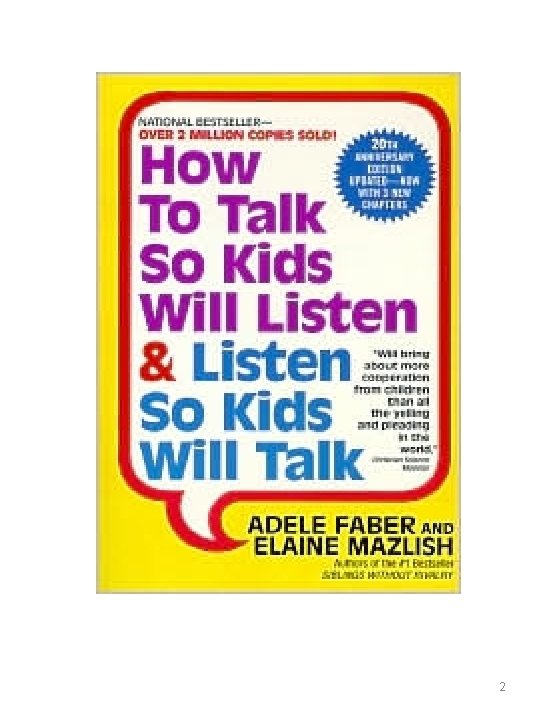
Positive Communication Skills for Foster Parents Materials adapted from How to Talk so Kids Will Listen & Listen So Kids Will Talk By Adele Faber and Elaine Mazlish Helen Shin Master Trainer ACS Workforce Institute 110 William Street New York NY Helen. Shin@acs. nyc. gov
2
Helping Children Deal with Their Feelings Children need to have their feelings accepted and respected. 1. You can listen quietly and attentively. 2. You can acknowledge their feelings with a word: “oh…mmm…I see…” 3. You can give the feeling a name: “That sounds frustrating!” 4. You can give the child his wishes in fantasy: “I wish you could be with your mom and dad too” 3
Instead of Explanation and Logic… Child: Where’s the Cheerios? Parent: We don’t have any dear. Child: I want my Cheerios! Parent: I just told you we ran out. I made you toast Child: No!! I want Cheerios! Parent: Stop acting like a baby and have your toast! Give Your Child His Wishes in Fantasy Child: Where’s the Cheerios? Parent: I wish I had some for you but we ran out. Child: I want my Cheerios! Parent: I hear how much you want your Cheerio. It’s your favorite. Child: I wish I had it now. Parent: I wish I had the magic power to make a big box of Cheerios appear! 4
How to Gain Cooperation Without Exerting Yourself 1. Describe what you see Instead of: “You haven’t taken that dog out all day. You don’t deserve to have a pet. ” Describe: “I see Rover pacing up and down near the door. ” 2. Give Information Instead of: “Who drank the milk and left the bottle out? ” Give information: “Kids, the milk turns sour when it isn’t refrigerated. ” 3. Say it with a word Instead of: “I’ve been asking and asking you kids to get into pajamas and all you’ve been doing is clowning around. You said you’d be in pajamas before watching tv and I don’t see anyone in their pajamas!” Say it with a word: “Kids, PAJAMAS!” 4. Talk about your feelings Instead of: “You are rude! You always interrupt me. ” Talk about your feelings: “I feel so frustrated when I start to say something and can’t finish. ” 5. Write a note Help! Hairs in my drain Give me a pain! 5
To Encourage Autonomy 1. Let children make choices. “Are you in the mood for your gray pants or your red pants? ” 2. Show respect for a child’s struggle. “A jar can be hard to open. Sometimes it helps if you tap the lid with a spoon. ” 3. Don’t ask too many questions. “Hi! I’m glad to see you. Welcome home. ” 4. Don’t rush to answer questions. “That’s an interesting question. What do you think? . ” 5. Encourage children to use sources outside the home. “Hmm…I wonder if the pet shop owner has any suggestions. ” 6. Don’t take away hope. “ So you are going to try out for the lead. That should be an experience. ” 6
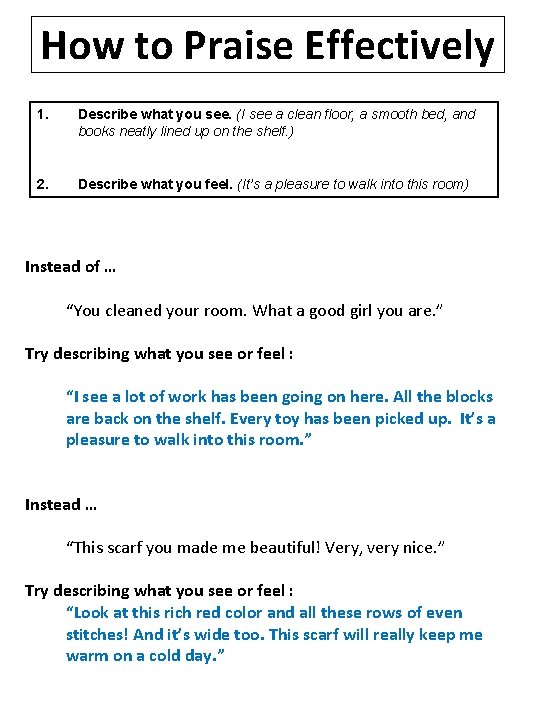
How to Praise Effectively 1. Describe what you see. (I see a clean floor, a smooth bed, and books neatly lined up on the shelf. ) 2. Describe what you feel. (It’s a pleasure to walk into this room) Instead of … “You cleaned your room. What a good girl you are. ” Try describing what you see or feel : “I see a lot of work has been going on here. All the blocks are back on the shelf. Every toy has been picked up. It’s a pleasure to walk into this room. ” Instead … “This scarf you made me beautiful! Very, very nice. ” Try describing what you see or feel : “Look at this rich red color and all these rows of even stitches! And it’s wide too. This scarf will really keep me warm on a cold day. ”
“SUMMING UP IN A WORD” Add to the description one or two words that sum up the child’s praiseworthy behavior. “You’ve been working to memorize that vocabulary list for over an hour. Now that’s what I call perseverance!” “You said you’d be home at 5 o’clock and it’s exactly five. That’s what I call punctuality. ” “You noticed that the plants were dry and you watered them. That’s what’s known as taking initiative. ” 8
Some Cautions About Praise - Make sure your praise is appropriate to your child’s age and level of ability. - Avoid the kind of praise that hints at past weaknesses or past failures. (example: “I’m glad you finally got around to cleaning your room”) - Be aware that excessive enthusiasm can interfere with a child’s desire to accomplish for herself. - Try not to minimize his distress (“there’s nothing to worry about. ”) - It helps if parents can model being accepting of their own mistakes. - When the child succeeds, try not to say “I knew you could do it all along”. It’s more helpful to 9 describe the child’s accomplishment.