
Pilot Country Update Spain ATS 2020 Piloting Galicia
- Slides: 12
Pilot Country Update Spain #ATS 2020
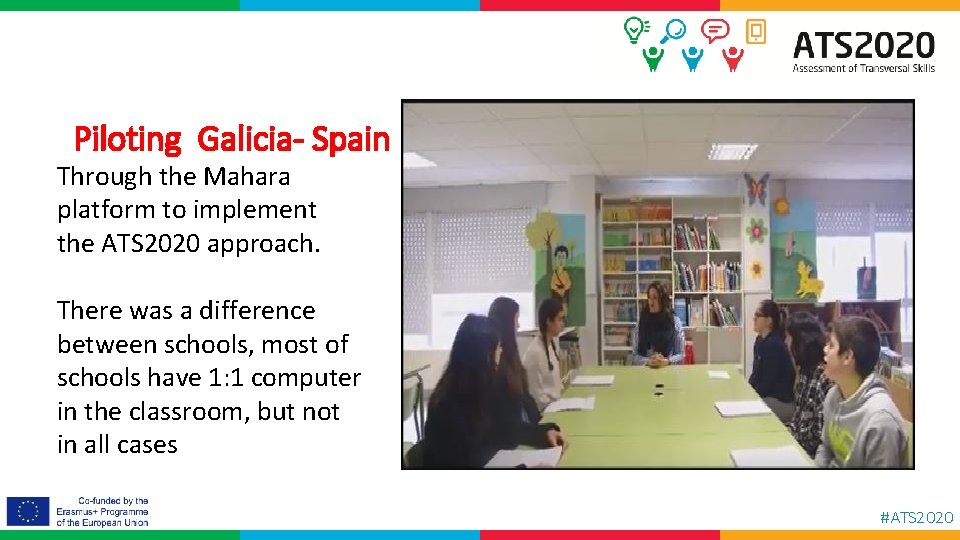
Piloting Galicia- Spain Through the Mahara platform to implement the ATS 2020 approach. There was a difference between schools, most of schools have 1: 1 computer in the classroom, but not in all cases #ATS 2020
Some numbers Participating schools: 27 (seven primary and 20 secondary involvement) Participating teachers: 57. trainers: 4. Training events: 5 Participating students: 1250 Piloting: form December 2016 to May 2017 The two case studies schools were chosen accordingly to the type of schools: rural and city location and number of students. • One is primary and secondary: CPI O Cruce (experimental group 21 students -1 special needs-, 1 teacher). Core subject First Foreign Language: English. • Only secondary: IES Rosalía de Castro experimental group 31 students – 2 special needs-, 1 teacher). Core subject of Spanish Language and Literature. • Both have more than one teacher involved: 4 teachers in each. • • • #ATS 2020
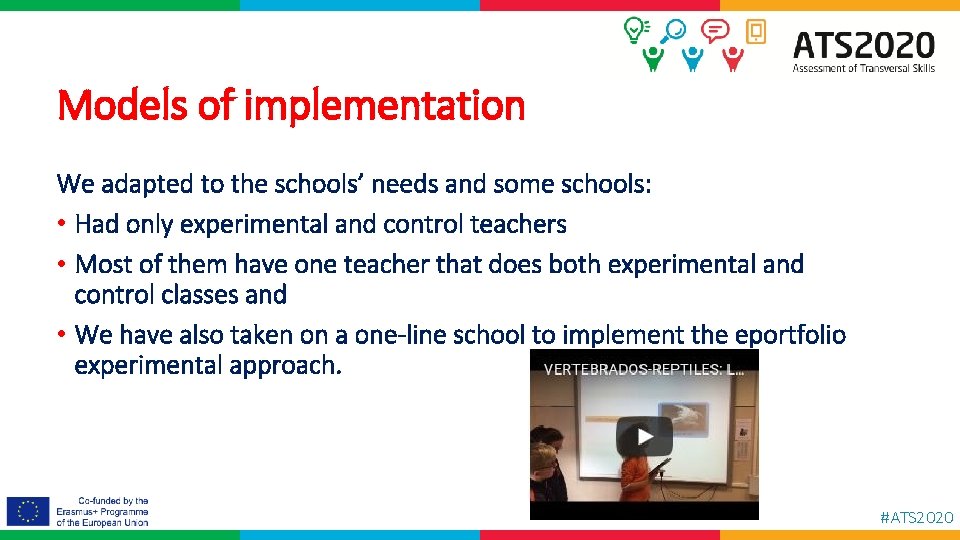
Models of implementation We adapted to the schools’ needs and some schools: • Had only experimental and control teachers • Most of them have one teacher that does both experimental and control classes and • We have also taken on a one-line school to implement the eportfolio experimental approach. #ATS 2020
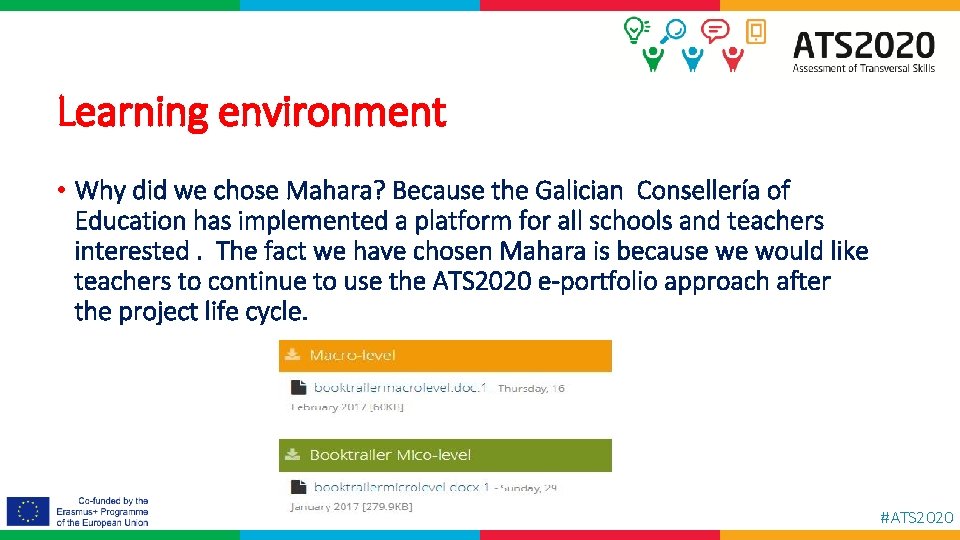
Learning environment • Why did we chose Mahara? Because the Galician Consellería of Education has implemented a platform for all schools and teachers interested. The fact we have chosen Mahara is because we would like teachers to continue to use the ATS 2020 e-portfolio approach after the project life cycle. #ATS 2020
Learning cycles • Learning cycles: Galician teachers implemented 122 in all. • Skills focused: there was no focus in just one transversal skill but the combination of the proposed transversal skills in the ATS 2020 project. • Subject areas: variety of the Curricula: Spanish, English, Science, P. E. , Music and Maths. #ATS 2020
LDs examples (2 exemplar) Booktrailers: Video story telling EMPLEO DE LOS NÚMEROS RACIONALES PARA ELABORAR UN MENÚ SEMANAL SUJETO A PRESUPUESTO. #ATS 2020
e. Portfolios examples (2 exemplar) • Examples of e-portfolios: http: //mahara. ats 2020. eu/view. php? id=9373 http: //mahara. ats 2020. eu/view. php? id=9369 http: //mahara. ats 2020. eu/view. php? id=8045 http: //mahara. ats 2020. eu/view. php? id=2312 #ATS 2020
Experience to share/Videos • Ría do Burgo https: //www. youtube. com/watch? v=Vs. Gig. Vit. BX 4&t=1 s Padre Feijoo https: //www. youtube. com/watch? v=w. FZPv. Vo. Cx. CQ&t=1 s #ATS 2020
Challenges • Regarding the technologies and the basic digital literacy competence of students/teachers • To train/ensure digital competences in order to use ICTs in teaching and learning processes. The absence of these competences restricts their opportunities in the learning processes. (both in teachers and students) It involves resistance to innovation. • • To ensure the provision of equipment in classrooms not only in common spaces or laboratories, so that technology could be a resource for both teachers and students, not only for the former. • To promote the use of ICTs in all disciplines as a learning resource (provide with infrastructures, spaces and appropriate means; and stimulate, reduce ratios, make examples of good practices visible and reward them, recognise the duplication of preparation, planning and follow-up effort required by the technologies in classrooms) #ATS 2020
Challenges Regarding the implementation of the ATS 2020 model: • To promote its interdisciplinary application, that is, to extend it beyond the classroom of a single teacher and to be focused on the development of learning activities that address competences of several subjects involving the entire teaching staff who work with the group (of the course). Only in that way is it possible to change the methodological and learning culture. • To incorporate more technological tools, complementary to the e-portfolio, which support all classroom functions and activities (not only aimed at formative assessment, reflection and selfmanagement of learning, but also at group work, collaborative creation and synchronous communication, among others). The application of innovative Pedagogical Models, such as ATS 2020, requires articulated, flexible and customisable technological environments, where the eportfolio is an essential resource, but it is not the only one. #ATS 2020
Positive notes The Model worked successfully in Spanish schools (Galicia). Despite being very different schools, the results obtained in terms of academic performance and teachers and students’ level of satisfaction were excellent. The resources provided to implement the model were also successful, along with the dynamics of teamwork that took place in the classroom, the formative supervision carried out by the students, and the quality of the final productions. Other successful elements were the reflexive and self-regulation processes, initiated by the students. Significant levels of reflection and meta-learning were observed among all participating students, especially those with lower starting levels. Finally, another successful aspect is that the experience led to greater classroom cohesion, improvement of the relational climate, and improvement of the teacher-student relationship. #ATS 2020