Phonocardiography Engr Hinesh Kumar Lecturer 1 Definition Phonocardiography


- Slides: 6
Phonocardiography Engr. Hinesh Kumar (Lecturer) 1
Definition �Phonocardiography is the recording of heart sounds. � The heart. like any mechanical pump, produces characteristic sounds as it beats. These are the sounds the physician hears with a stethoscope. �Certain heart murmurs produce sounds in the 1000 -Hz range, and some frequency components exist down to 4 or 5 Hz. 2
Heart Sounds Generation �The first heart sound is generated at the end of atrial contraction, just at the onset of ventricular contraction. �This sound is generally attributed to movement of blood into the ventricles, the atrioventricular (AV) valves closing, and the abrupt cessation of blood flow in the atria. �The second heart sound corresponds to the closing of the aortic and pulmonary valves. 3
Cont… �Third heart sound corresponds to the cessation of ventricular filling. �Fourth heart sound is correlated to the atrial contraction. �This last sound has a very low amplitude and a low-frequency component. 4
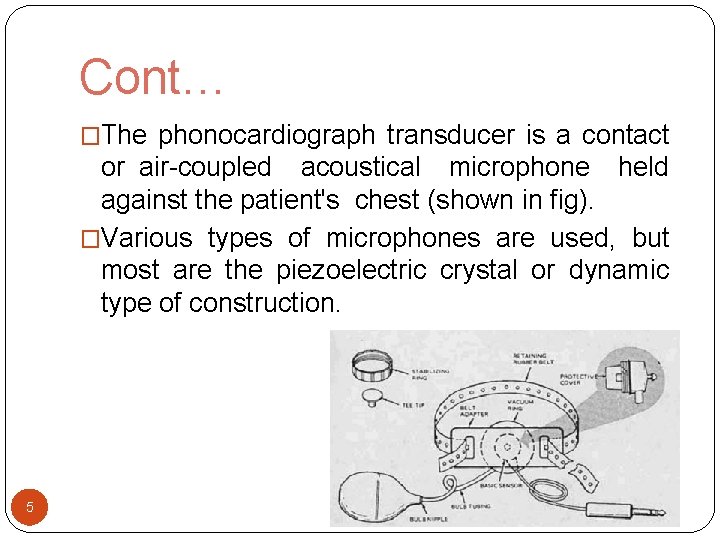
Cont… �The phonocardiograph transducer is a contact or air-coupled acoustical microphone held against the patient's chest (shown in fig). �Various types of microphones are used, but most are the piezoelectric crystal or dynamic type of construction. 5
Cont… �The crystal microphone generally costs less and is more rugged than the dynamic type. �Also, the crystal microphone produces a larger output signal for a given level of stimulus �The dynamic microphone uses a moving coil coupled to the acoustical diaphragm. �The dynamic microphone is used when it is desirable to have a signal frequency response similar to that of the medical stethoscope. �An air-coupled microphone with a 2 -s time constant is often used in apex phonocardiography. 6