Penn State Performance Management Step One Setting Goals
- Slides: 17
Penn State Performance Management: Step One: Setting Goals and Expectations Adobe Connect Seminar for Supervisors Presenter: Stephanie Flanagan slm 114@psu. edu; 814 -867 -6436 Summer 2017
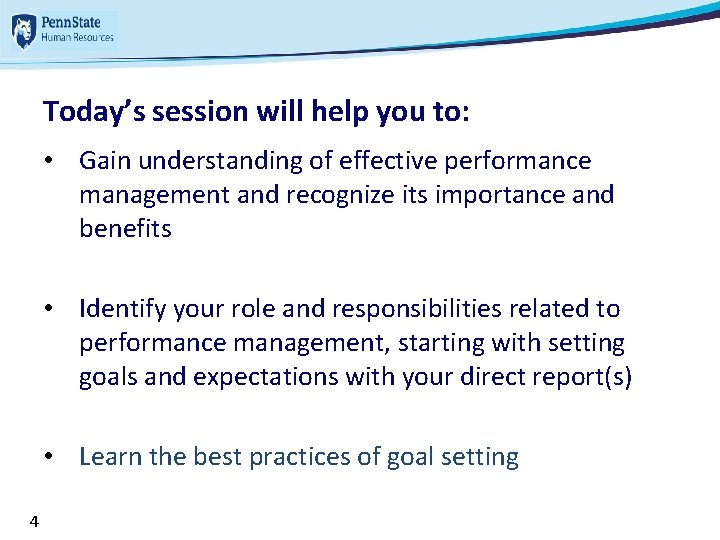
Today’s session will help you to: • Gain understanding of effective performance management and recognize its importance and benefits • Identify your role and responsibilities related to performance management, starting with setting goals and expectations with your direct report(s) • Learn the best practices of goal setting 4
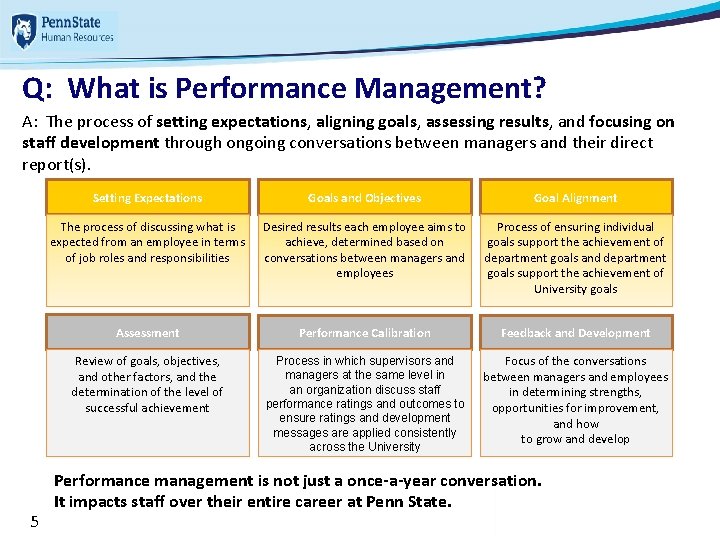
Q: What is Performance Management? A: The process of setting expectations, aligning goals, assessing results, and focusing on staff development through ongoing conversations between managers and their direct report(s). 5 Setting Expectations Goals and Objectives Goal Alignment The process of discussing what is expected from an employee in terms of job roles and responsibilities Desired results each employee aims to achieve, determined based on conversations between managers and employees Process of ensuring individual goals support the achievement of department goals and department goals support the achievement of University goals Assessment Performance Calibration Feedback and Development Review of goals, objectives, and other factors, and the determination of the level of successful achievement Process in which supervisors and managers at the same level in an organization discuss staff performance ratings and outcomes to ensure ratings and development messages are applied consistently across the University Focus of the conversations between managers and employees in determining strengths, opportunities for improvement, and how to grow and develop Performance management is not just a once-a-year conversation. It impacts staff over their entire career at Penn State.
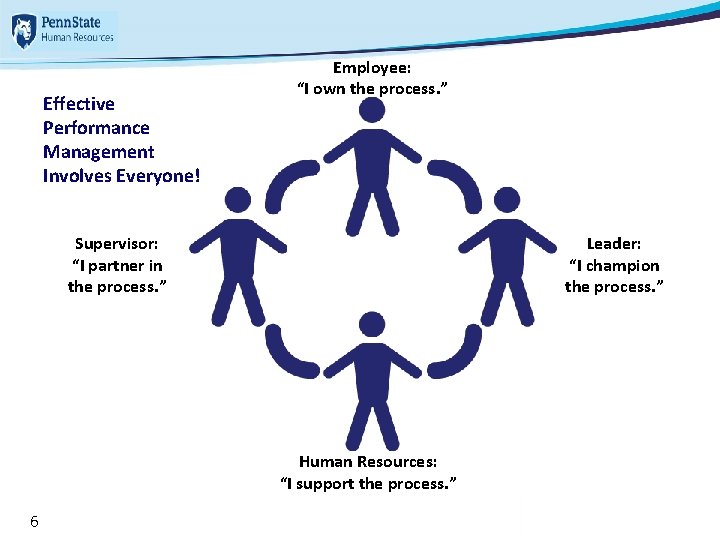
Effective Performance Management Involves Everyone! Employee: “I own the process. ” Supervisor: “I partner in the process. ” Leader: “I champion the process. ” Human Resources: “I support the process. ” 6
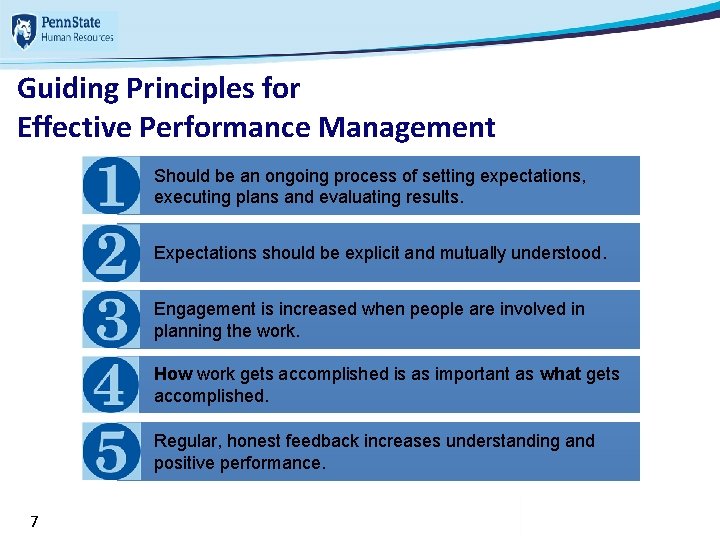
Guiding Principles for Effective Performance Management Should be an ongoing process of setting expectations, executing plans and evaluating results. Expectations should be explicit and mutually understood. Engagement is increased when people are involved in planning the work. How work gets accomplished is as important as what gets accomplished. Regular, honest feedback increases understanding and positive performance. 7
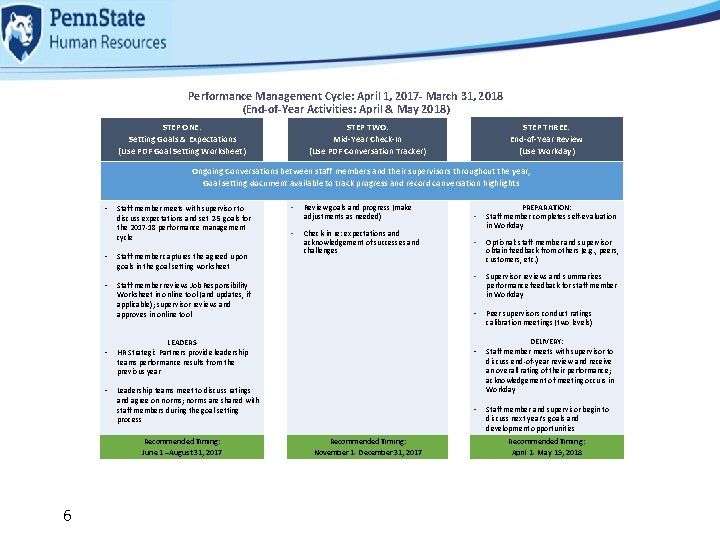
Performance Management Cycle: April 1, 2017 - March 31, 2018 (End-of-Year Activities: April & May 2018) STEP ONE: Setting Goals & Expectations (Use PDF Goal Setting Worksheet) STEP TWO: Mid-Year Check-In (Use PDF Conversation Tracker) STEP THREE: End-of-Year Review (Use Workday) Ongoing Conversations between staff members and their supervisors throughout the year; Goal setting document available to track progress and record conversation highlights • Staff member meets with supervisor to discuss expectations and set 2 -5 goals for the 2017 -18 performance management cycle • Staff member captures the agreed upon goals in the goal setting worksheet • Staff member reviews Job Responsibility Worksheet in online tool (and updates, if applicable); supervisor reviews and approves in online tool • • Review goals and progress (make adjustments as needed) • Check-in re: expectations and acknowledgement of successes and challenges LEADERS HR Strategic Partners provide leadership teams performance results from the previous year • Optional: staff member and supervisor obtain feedback from others (e. g. , peers, customers, etc. ) • Supervisor reviews and summarizes performance feedback for staff member in Workday • Peer supervisors conduct ratings calibration meetings (two levels) • Recommended Timing: November 1 - December 31, 2017 PREPARATION: Staff member completes self-evaluation in Workday • • Leadership teams meet to discuss ratings and agree on norms; norms are shared with staff members during the goal setting process Recommended Timing: June 1 –August 31, 2017 6 • DELIVERY: Staff member meets with supervisor to discuss end-of-year review and receive an overall rating of their performance; acknowledgement of meeting occurs in Workday Staff member and supervisor begin to discuss next year’s goals and development opportunities Recommended Timing: April 1 - May 15, 2018
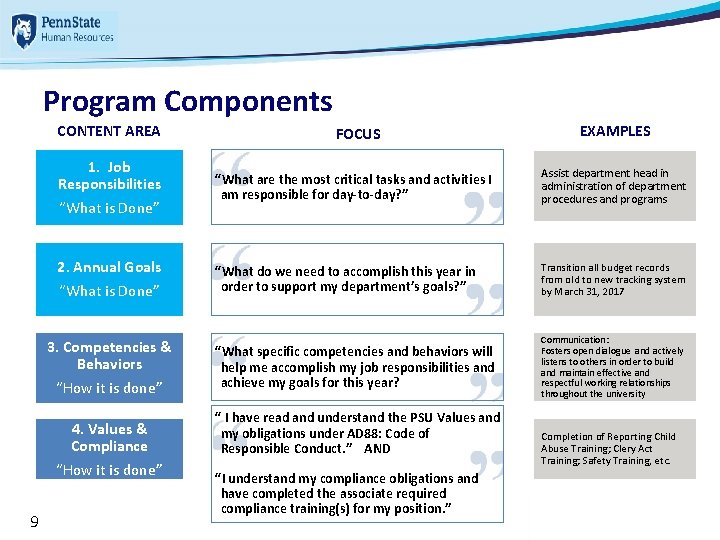
Program Components CONTENT AREA FOCUS 1. Job Responsibilities “What is Done” “What are the most critical tasks and activities I am responsible for day-to-day? ” Assist department head in administration of department procedures and programs “What do we need to accomplish this year in order to support my department’s goals? ” Transition all budget records from old to new tracking system by March 31, 2017 “What specific competencies and behaviors will help me accomplish my job responsibilities and achieve my goals for this year? Communication: Fosters open dialogue and actively listens to others in order to build and maintain effective and respectful working relationships throughout the university 2. Annual Goals “What is Done” 3. Competencies & Behaviors “How it is done” 4. Values & Compliance “How it is done” 9 “ I have read and understand the PSU Values and my obligations under AD 88: Code of Responsible Conduct. ” AND “I understand my compliance obligations and have completed the associate required compliance training(s) for my position. ” EXAMPLES Completion of Reporting Child Abuse Training; Clery Act Training; Safety Training, etc.
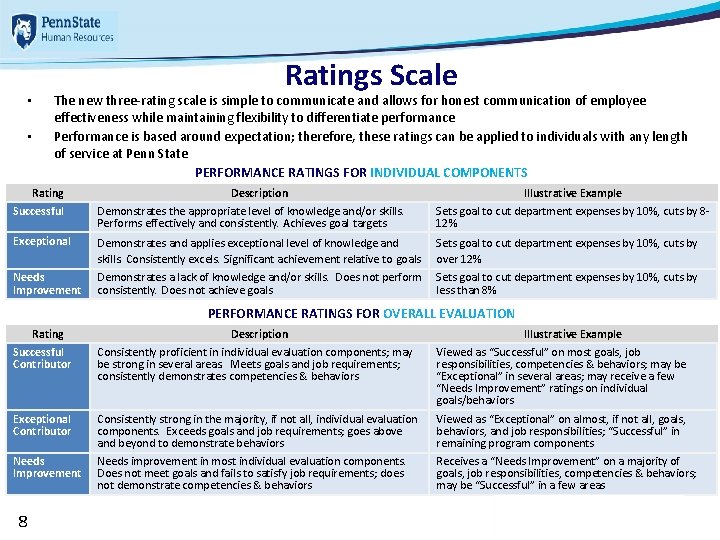
• • Ratings Scale The new three-rating scale is simple to communicate and allows for honest communication of employee effectiveness while maintaining flexibility to differentiate performance Performance is based around expectation; therefore, these ratings can be applied to individuals with any length of service at Penn State PERFORMANCE RATINGS FOR INDIVIDUAL COMPONENTS Rating Successful Description Demonstrates the appropriate level of knowledge and/or skills. Performs effectively and consistently. Achieves goal targets Illustrative Example Sets goal to cut department expenses by 10%, cuts by 812% Exceptional Demonstrates and applies exceptional level of knowledge and skills. Consistently excels. Significant achievement relative to goals Sets goal to cut department expenses by 10%, cuts by over 12% Needs Improvement Demonstrates a lack of knowledge and/or skills. Does not perform Sets goal to cut department expenses by 10%, cuts by consistently. Does not achieve goals less than 8% PERFORMANCE RATINGS FOR OVERALL EVALUATION Rating Successful Contributor Description Consistently proficient in individual evaluation components; may be strong in several areas. Meets goals and job requirements; consistently demonstrates competencies & behaviors Illustrative Example Viewed as “Successful” on most goals, job responsibilities, competencies & behaviors; may be “Exceptional” in several areas; may receive a few “Needs Improvement” ratings on individual goals/behaviors Exceptional Contributor Consistently strong in the majority, if not all, individual evaluation components. Exceeds goals and job requirements; goes above and beyond to demonstrate behaviors Viewed as “Exceptional” on almost, if not all, goals, behaviors, and job responsibilities; “Successful” in remaining program components Needs Improvement Needs improvement in most individual evaluation components. Does not meet goals and fails to satisfy job requirements; does not demonstrate competencies & behaviors Receives a “Needs Improvement” on a majority of goals, job responsibilities, competencies & behaviors; may be “Successful” in a few areas 8
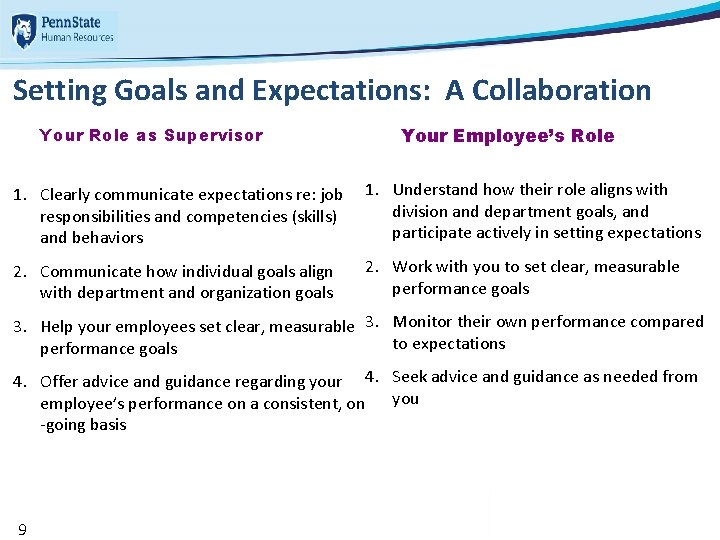
Setting Goals and Expectations: A Collaboration Your Role as Supervisor Your Employee’s Role 1. Clearly communicate expectations re: job 1. Understand how their role aligns with division and department goals, and responsibilities and competencies (skills) participate actively in setting expectations and behaviors 2. Communicate how individual goals align with department and organization goals 2. Work with you to set clear, measurable performance goals 3. Help your employees set clear, measurable 3. Monitor their own performance compared to expectations performance goals 4. Offer advice and guidance regarding your 4. Seek advice and guidance as needed from employee’s performance on a consistent, on you -going basis 9
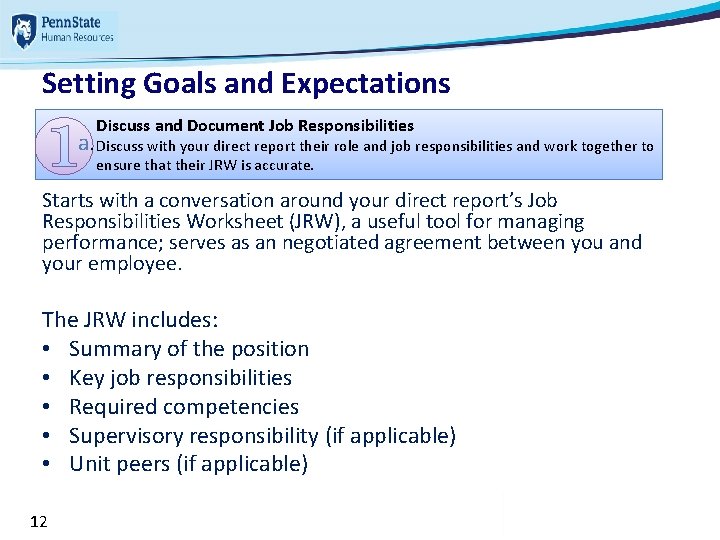
Setting Goals and Expectations Discuss and Document Job Responsibilities a. Discuss with your direct report their role and job responsibilities and work together to ensure that their JRW is accurate. Starts with a conversation around your direct report’s Job Responsibilities Worksheet (JRW), a useful tool for managing performance; serves as an negotiated agreement between you and your employee. The JRW includes: • Summary of the position • Key job responsibilities • Required competencies • Supervisory responsibility (if applicable) • Unit peers (if applicable) 12
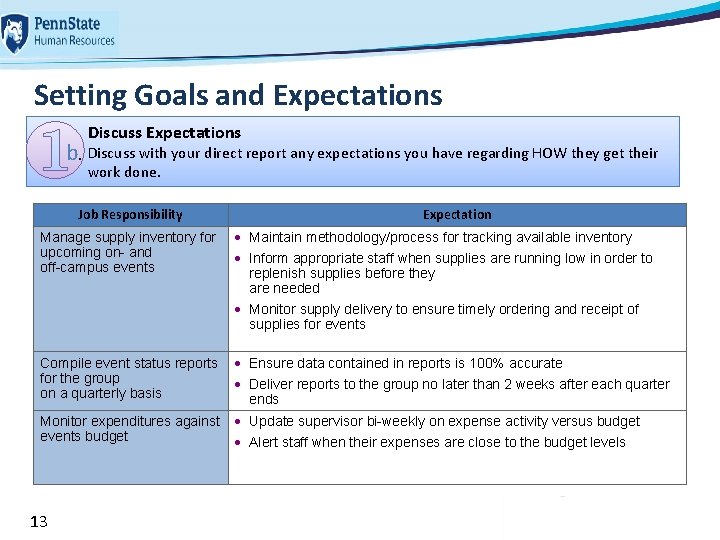
Setting Goals and Expectations Discuss Expectations b. Discuss with your direct report any expectations you have regarding HOW they get their work done. Job Responsibility Expectation Manage supply inventory for upcoming on- and off-campus events · Maintain methodology/process for tracking available inventory · Inform appropriate staff when supplies are running low in order to replenish supplies before they are needed · Monitor supply delivery to ensure timely ordering and receipt of supplies for events Compile event status reports for the group on a quarterly basis · Ensure data contained in reports is 100% accurate · Deliver reports to the group no later than 2 weeks after each quarter ends Monitor expenditures against events budget · Update supervisor bi-weekly on expense activity versus budget · Alert staff when their expenses are close to the budget levels 13
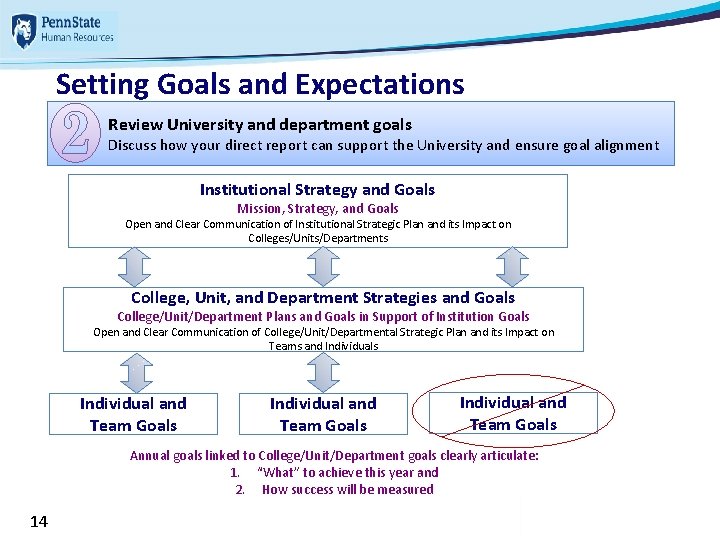
Setting Goals and Expectations Review University and department goals Discuss how your direct report can support the University and ensure goal alignment Institutional Strategy and Goals Mission, Strategy, and Goals Open and Clear Communication of Institutional Strategic Plan and its Impact on Colleges/Units/Departments College, Unit, and Department Strategies and Goals College/Unit/Department Plans and Goals in Support of Institution Goals Open and Clear Communication of College/Unit/Departmental Strategic Plan and its Impact on Teams and Individuals Individual and Team Goals Annual goals linked to College/Unit/Department goals clearly articulate: 1. “What” to achieve this year and 2. How success will be measured 14
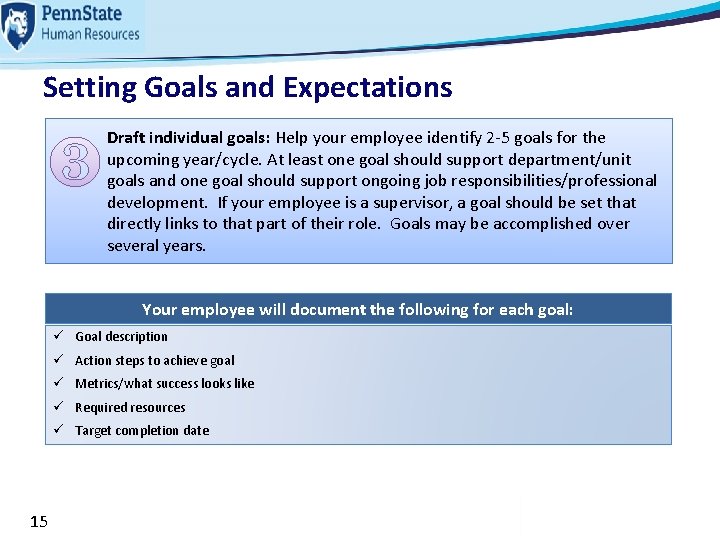
Setting Goals and Expectations Draft individual goals: Help your employee identify 2 -5 goals for the upcoming year/cycle. At least one goal should support department/unit goals and one goal should support ongoing job responsibilities/professional development. If your employee is a supervisor, a goal should be set that directly links to that part of their role. Goals may be accomplished over several years. Your employee will document the following for each goal: ü Goal description ü Action steps to achieve goal ü Metrics/what success looks like ü Required resources ü Target completion date 15
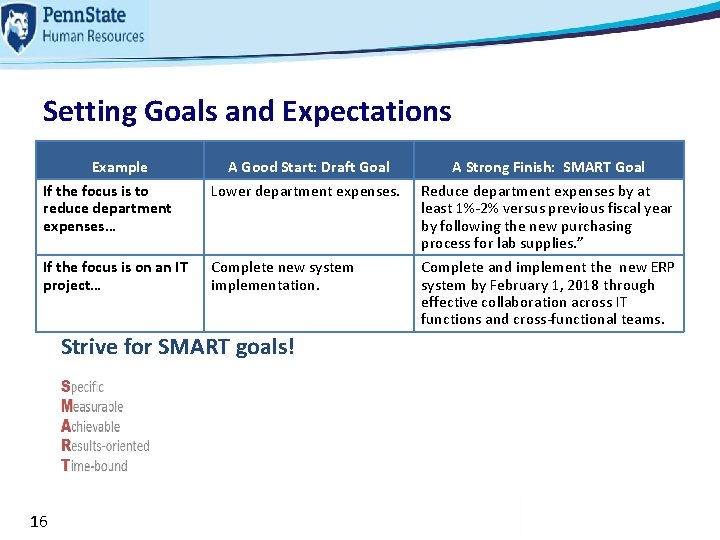
Setting Goals and Expectations Example A Good Start: Draft Goal A Strong Finish: SMART Goal If the focus is to reduce department expenses… Lower department expenses. Reduce department expenses by at least 1%-2% versus previous fiscal year by following the new purchasing process for lab supplies. ” If the focus is on an IT project… Complete new system implementation. Complete and implement the new ERP system by February 1, 2018 through effective collaboration across IT functions and cross-functional teams. Strive for SMART goals! 16
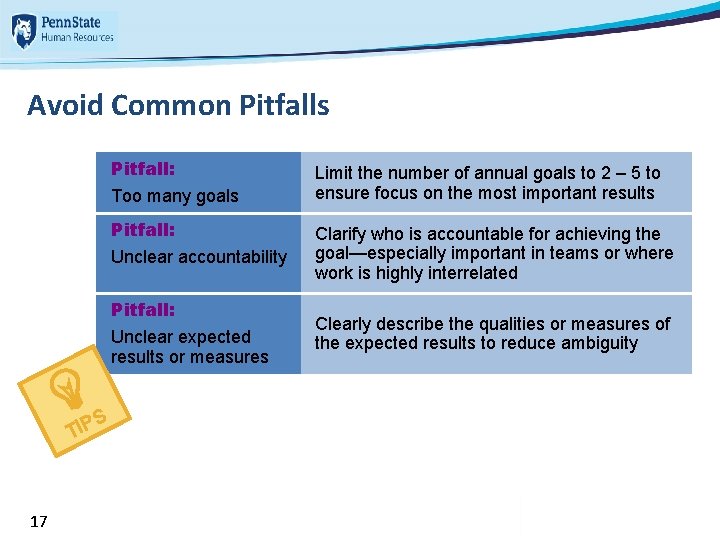
Avoid Common Pitfalls Pitfall: Too many goals Pitfall: Unclear accountability Pitfall: Unclear expected results or measures TIP 17 S Limit the number of annual goals to 2 – 5 to ensure focus on the most important results Clarify who is accountable for achieving the goal—especially important in teams or where work is highly interrelated Clearly describe the qualities or measures of the expected results to reduce ambiguity
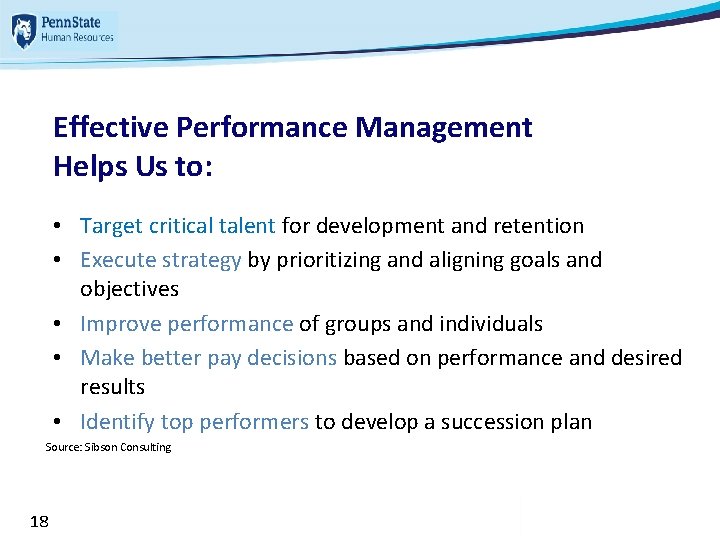
Effective Performance Management Helps Us to: • Target critical talent for development and retention • Execute strategy by prioritizing and aligning goals and objectives • Improve performance of groups and individuals • Make better pay decisions based on performance and desired results • Identify top performers to develop a succession plan Source: Sibson Consulting 18
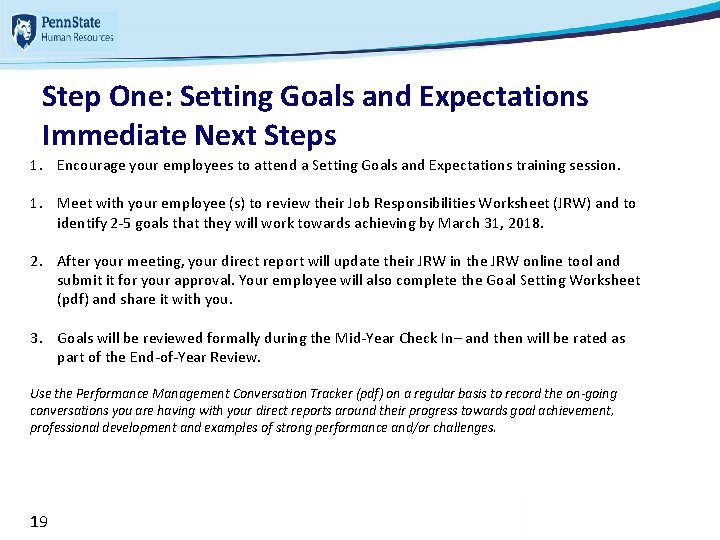
Step One: Setting Goals and Expectations Immediate Next Steps 1. Encourage your employees to attend a Setting Goals and Expectations training session. 1. Meet with your employee (s) to review their Job Responsibilities Worksheet (JRW) and to identify 2 -5 goals that they will work towards achieving by March 31, 2018. 2. After your meeting, your direct report will update their JRW in the JRW online tool and submit it for your approval. Your employee will also complete the Goal Setting Worksheet (pdf) and share it with you. 3. Goals will be reviewed formally during the Mid-Year Check In– and then will be rated as part of the End-of-Year Review. Use the Performance Management Conversation Tracker (pdf) on a regular basis to record the on-going conversations you are having with your direct reports around their progress towards goal achievement, professional development and examples of strong performance and/or challenges. 19