Parts of an Analytical Essay Parts of an



- Slides: 20
Parts of an Analytical Essay
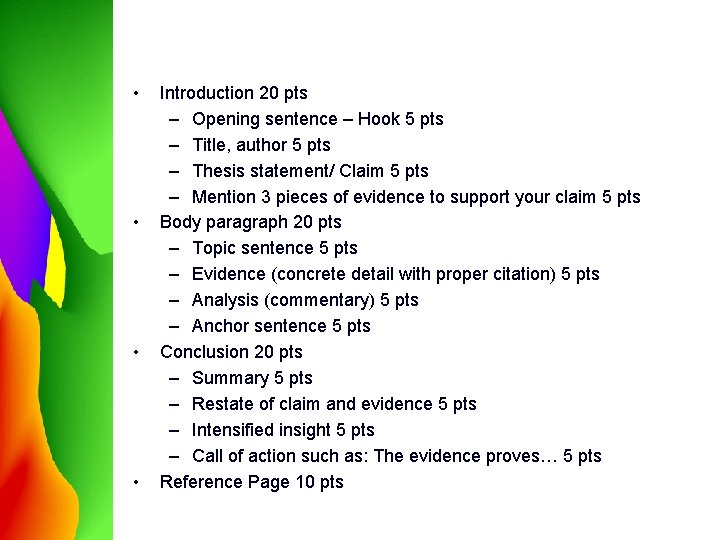
Parts of an Analytical Essay • • • Introduction 20 pts – Opening sentence – Hook 5 pts – Title, author 5 pts – Thesis statement/ Claim 5 pts – Mention 3 pieces of evidence to support your claim 5 pts Body paragraph 20 pts – Topic sentence 5 pts – Evidence (concrete detail with proper citation) 5 pts – Analysis (commentary) 5 pts – Anchor sentence 5 pts Conclusion 20 pts – Summary 5 pts – Restate of claim and evidence 5 pts – Intensified insight 5 pts – Call of action such as: The evidence proves… 5 pts Reference Page 10 pts
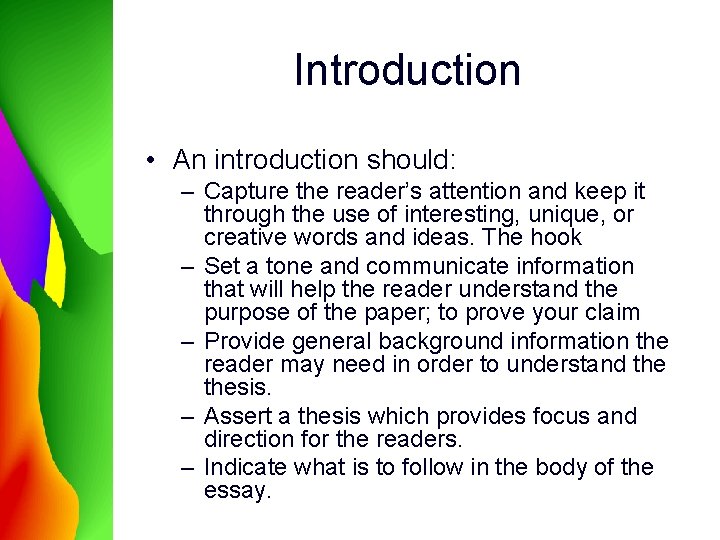
Introduction • An introduction should: – Capture the reader’s attention and keep it through the use of interesting, unique, or creative words and ideas. The hook – Set a tone and communicate information that will help the reader understand the purpose of the paper; to prove your claim – Provide general background information the reader may need in order to understand thesis. – Assert a thesis which provides focus and direction for the readers. – Indicate what is to follow in the body of the essay.
Opening Sentence • What is critical is that the introduction provide the readers with a reason to keep reading, a reason to care about what it is that the writer has to say in the rest of the paper. • The challenge of opening sentences is finding fitting and meaningful ideas to invite readers into an essay. – In addition to engaging reader interest, opening sentences may contain background information about the subject of the essay that serves as a foundation for what is to follow. For an essay discussing theme of a particular work, background might include reference to the title and the author of the work being examined, as well as mention of the characters relevant to the topic. – As opening sentences lead toward thesis, a common understanding starts to emerge between the writer and reader because of a strong foundation set forth in the introduction.
Thesis Statement • A clearly worded answer to a question and/or a clearly worded declaration of the view(s)/ideas a writer will substantiate, assert, or prove in a paper. A thesis forecasts and focuses the essay that follows. This will be your claim.
Thesis Statement • Beyond simply defining the topic of a paper, thesis should articulate an insight or position valuable enough to write about. Rather than simply setting up an essay that summarizes a story already familiar to the writer and readers, a strong thesis/claim captures an insight or an approach to a topic that is unique and that is persuasively supported by the evidence and analysis that follow.
Thesis Statement • A single-sentence thesis will require precise word choice to communicate a complex idea. Sometimes a thesis statement will need to be expanded to two or more sentences to clearly state what the essay sets out to prove.
Body • The paragraphs in the body of an essay develop a convincing case to prove the claim advanced in thesis. The body of an essay explores the ideas relevant to thesis; evidence is presented in a logical fashion and is interpreted in ways that clearly support thesis. • In addition, the body of essay must continuously remind readers of thesis and solidify/intensify the insight/philosophical premise set forth without simply repeating it.
Topic Sentence • The topic sentence of each paragraph of the body of an essay introduces some element of thesis that will become the subject of the paragraph. • Topic sentences can draw on thesis and/or forecast ideas and wording to keep the central argument of the paper actively in play for readers. • Rather than simply repeating thesis or forecast, strong topic sentences develop an aspect of thesis or forecast that will be further expanded in the paragraph.
Analysis • The analysis that follows a topic sentence extends the idea and gives readers the time to absorb the idea before shifting into the specific evidence that will be used to prove it. • Analysis also develops large, abstract concepts that underlie much academic writing. The more complex the topic, the more necessary the analysis is to guide readers toward an understanding of the ideas.
Evidence/Interpretation of Evidence • Like the evidence presented in legal cases, the evidence presented in an essay should be persuasive; it should persuade the reader that the writer’s point of view is worth considering. • Evidence should point toward the validity of thesis. • And, like the evidence presented in a legal case, all evidence must be interpreted and linked to the point being proven.
Evidence/Interpretation of Evidence • It is the responsibility of the writer to provide an interpretation for the reader. • Readers should not be expected to interpret evidence or required to make the link between evidence and thesis. • Each body paragraph should contain evidence and interpretation of evidence to develop some aspect of thesis.
Evidence/Interpretation of Evidence • The types of evidence that can be used to prove a writer’s point of view are limitless. Some of the types of evidence available (though it is most often dictated by the subject, topic and/or audience) include: – Documented facts – Quotations from text – Details from text related to plot, character, setting, style – Information from reference materials – Ideas from critical sources – First-hand observations of procedures, events, results of an experiment – References to a work of art, music or performance – References to familiar elements of culture, politics
Anchor • The final component of body paragraphs of essays, the anchor, does as its name suggests-it anchors the evidence and interpretation presented in the body paragraph to the overall claim of the paper and reminds readers of the overall purpose of the paper. • Allows for a clear connection between paragraphs. • The challenge of writing strong anchors is not being repetitive by simply repeating thesis or topic sentence.
Conclusion • The conclusion of an essay should bring the writer and readers back into accord about what the essay set out to prove and reemphasize the value of the argument.
Conclusion • Whether in one or more paragraphs, readers often anticipate the following elements in a conclusion: – Summary – Intensified insight
Summary • Without simply repeating thesis, the conclusion should contain a reminder of the primary claim of the paper. In addition, without simply listing evidence, the conclusion should refer to the significant points offered as proof of thesis.
Intensified Insight • In addition to reviewing the essence of an essay, the conclusion should provide insight that deepens or intensifies the significance of the claim stated in thesis. This means that the writer should avoid clichés and generalizations which tend to oversimplify the significance of the essay. • The challenge is to phrase an insight that intensifies the claim, but does not introduce a new argument that requires additional proof. • While readers may look for deeper or broader meaning in a conclusion, they are not inclined to accept assertions that are not supported by the essay itself.
Reference List • • An additional page at the end of your essay (use page break) Give credit to your resources Alphabetical by last name of the author For additional information, go here. Lines after the first line for each entry should be indented Format for each reference entry should follow this template: Only capitalize the first letter of the title, the first letter of the subtitle, and proper nouns. If no author provided, use group name Lastname, F. M. (Year, Month). Title of page. Site name. URL If no date provided, use n. d.
• • Introduction 20 pts – Opening sentence – Hook 5 pts – Title, author 5 pts – Thesis statement/ Claim 5 pts – Mention 3 pieces of evidence to support your claim 5 pts Body paragraph 20 pts – Topic sentence 5 pts – Evidence (concrete detail with proper citation) 5 pts – Analysis (commentary) 5 pts – Anchor sentence 5 pts Conclusion 20 pts – Summary 5 pts – Restate of claim and evidence 5 pts – Intensified insight 5 pts – Call of action such as: The evidence proves… 5 pts Reference Page 10 pts