NYC DOE Office of Teacher Effectiveness C Introduction

- Slides: 6
NYC DOE – Office of Teacher Effectiveness C. Introduction to Taking Low-Inference Notes 1
Objectives Participants will: q Distinguish between low-inference evidence and opinion/interpretation q Describe how low-inference note-taking helps observers accurately interpret teacher practice 2
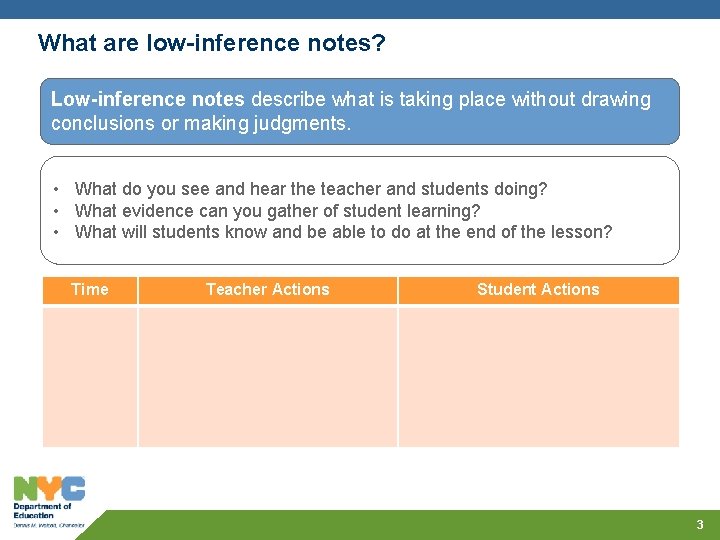
What are low-inference notes? Low-inference notes describe what is taking place without drawing conclusions or making judgments. • What do you see and hear the teacher and students doing? • What evidence can you gather of student learning? • What will students know and be able to do at the end of the lesson? Time Teacher Actions Student Actions 3
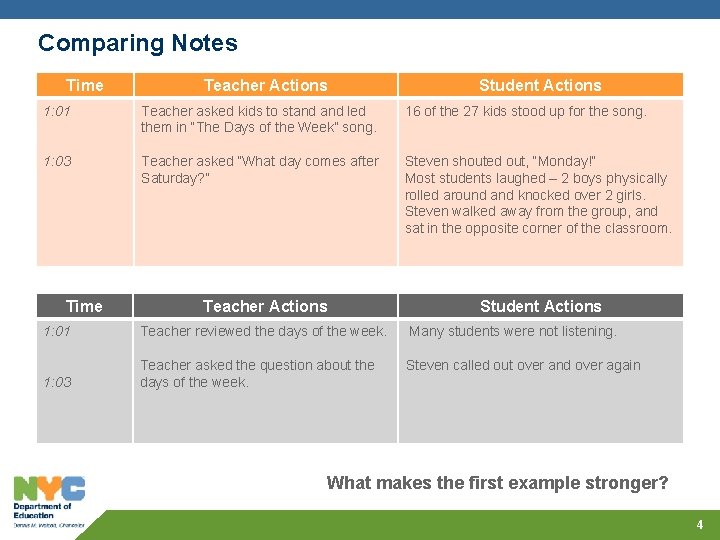
Comparing Notes Time Teacher Actions Student Actions 1: 01 Teacher asked kids to stand led them in “The Days of the Week” song. 16 of the 27 kids stood up for the song. 1: 03 Teacher asked “What day comes after Saturday? ” Steven shouted out, “Monday!” Most students laughed – 2 boys physically rolled around and knocked over 2 girls. Steven walked away from the group, and sat in the opposite corner of the classroom. Time Teacher Actions Student Actions 1: 01 Teacher reviewed the days of the week. Many students were not listening. Steven called out over and over again 1: 03 Teacher asked the question about the days of the week. What makes the first example stronger? 4
Activity: Identifying Low-Inference Evidence • Read each statement. Decide – is it low-inference evidence or not? • Discuss your answers with a partner. • What distinguishes the low-inference notes? • How would you reword statements that are not low-inference? 5
Reflection • Why is it important to collect low-inference evidence before trying to assess teacher practice? • How can low-inference evidence support teacher development? 6