NuclearParticle Physics The Proton Spin Crisis Polarized Deep
- Slides: 19
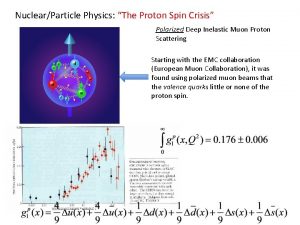
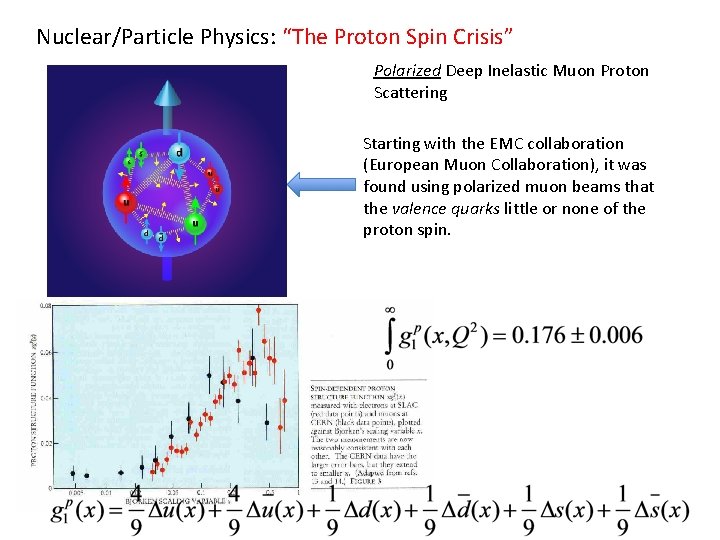
Nuclear/Particle Physics: “The Proton Spin Crisis” Polarized Deep Inelastic Muon Proton Scattering Starting with the EMC collaboration (European Muon Collaboration), it was found using polarized muon beams that the valence quarks little or none of the proton spin.
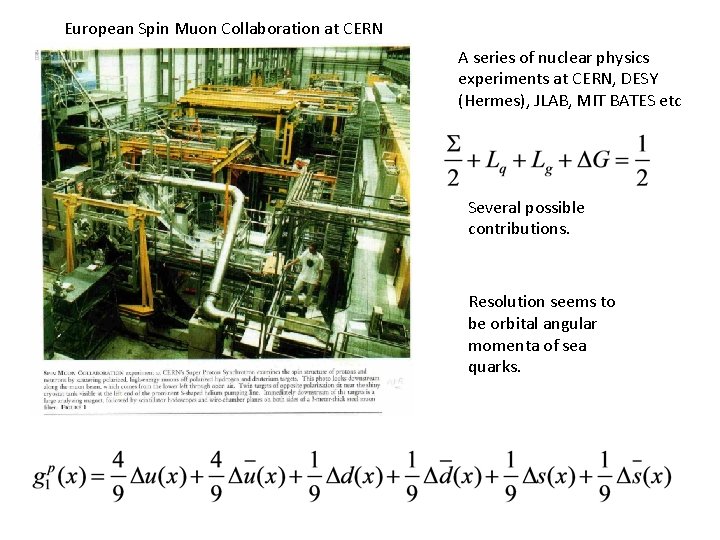
European Spin Muon Collaboration at CERN A series of nuclear physics experiments at CERN, DESY (Hermes), JLAB, MIT BATES etc Several possible contributions. Resolution seems to be orbital angular momenta of sea quarks.
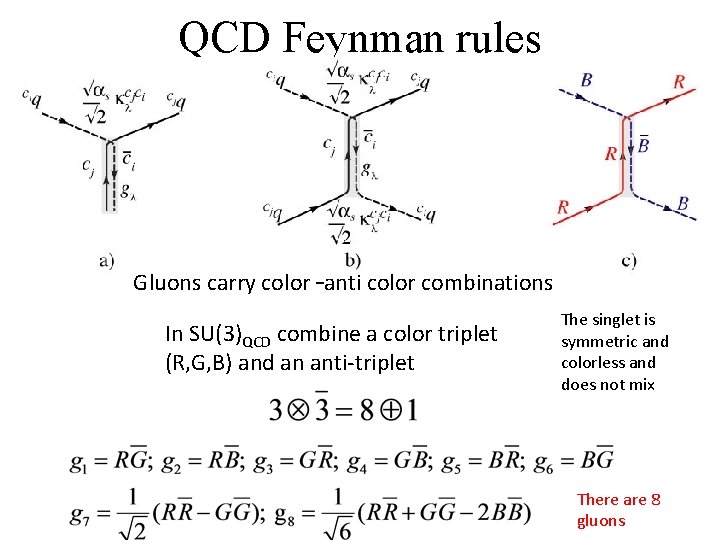
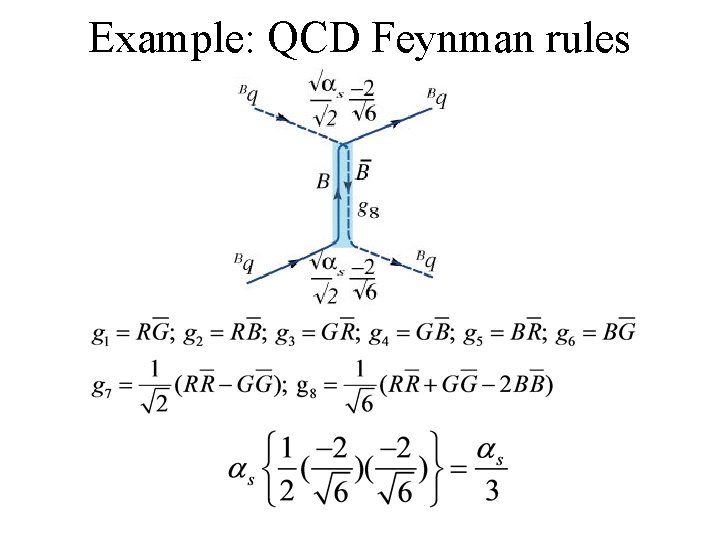
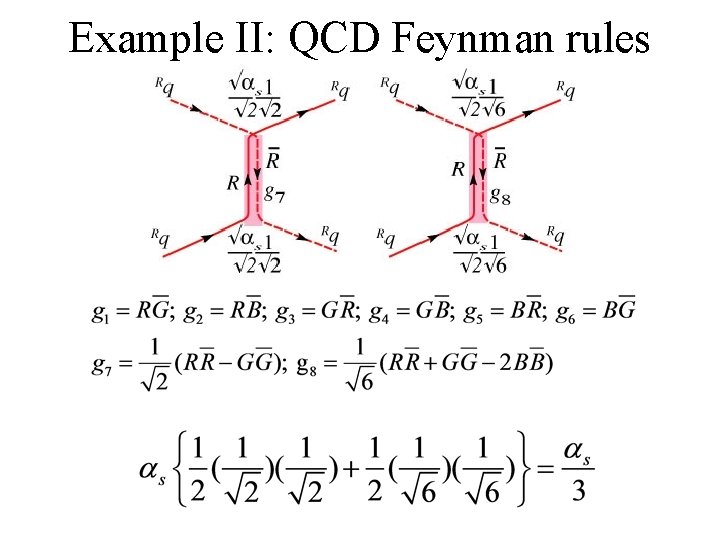
QCD Feynman rules Gluons carry color –anti color combinations In SU(3)QCD combine a color triplet (R, G, B) and an anti-triplet The singlet is symmetric and colorless and does not mix There are 8 gluons
Example: QCD Feynman rules
Example II: QCD Feynman rules
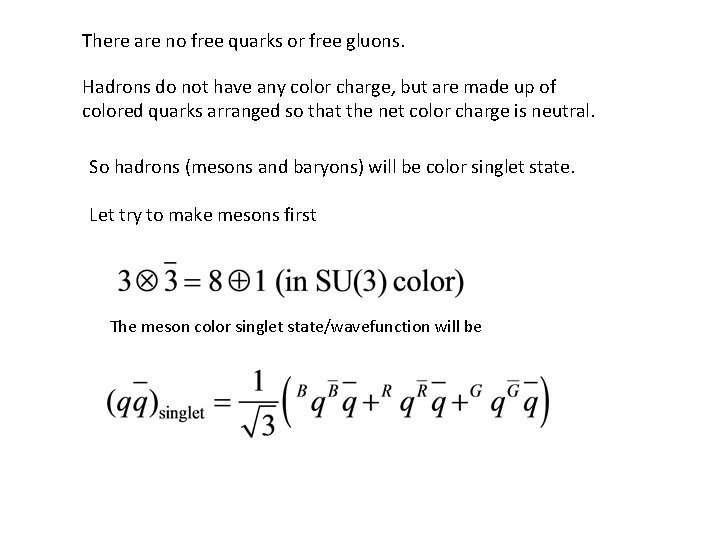
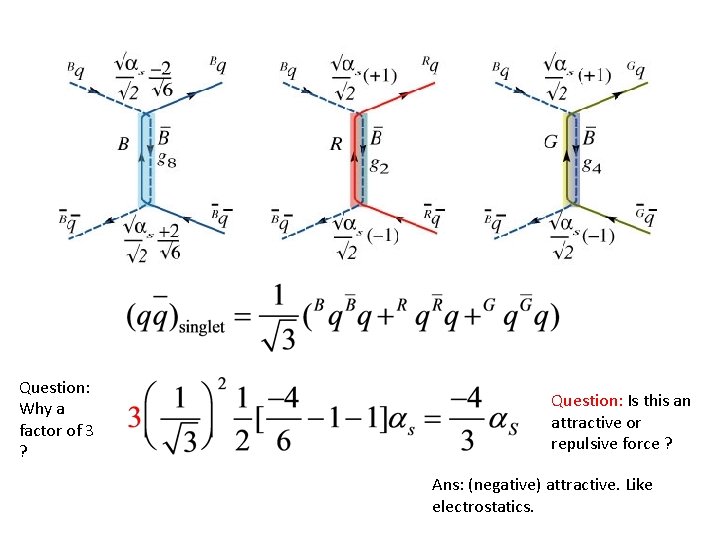
There are no free quarks or free gluons. Hadrons do not have any color charge, but are made up of colored quarks arranged so that the net color charge is neutral. So hadrons (mesons and baryons) will be color singlet state. Let try to make mesons first The meson color singlet state/wavefunction will be
Question: Why a factor of 3 ? Question: Is this an attractive or repulsive force ? Ans: (negative) attractive. Like electrostatics.
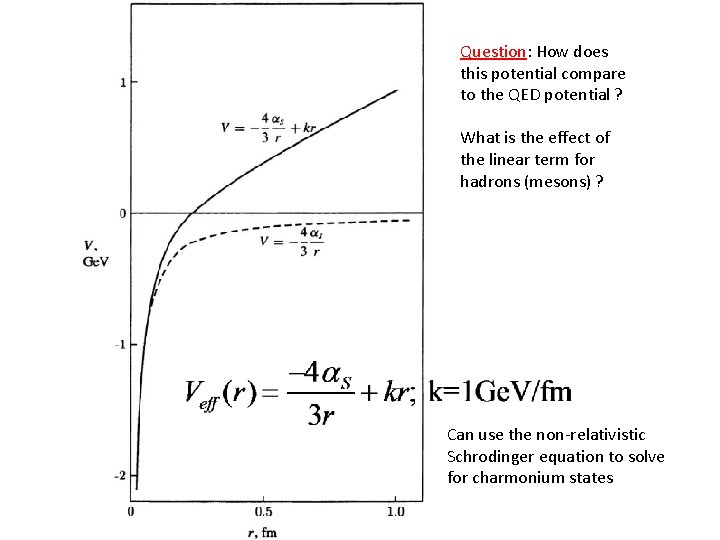
Question: How does this potential compare to the QED potential ? What is the effect of the linear term for hadrons (mesons) ? Can use the non-relativistic Schrodinger equation to solve for charmonium states
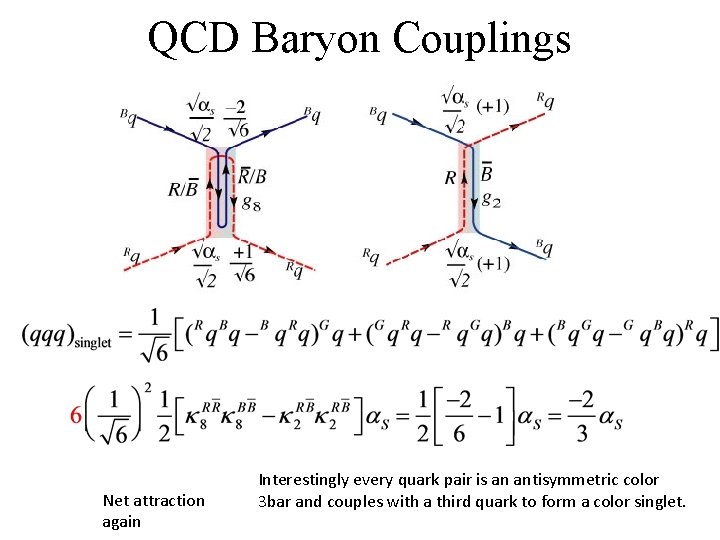
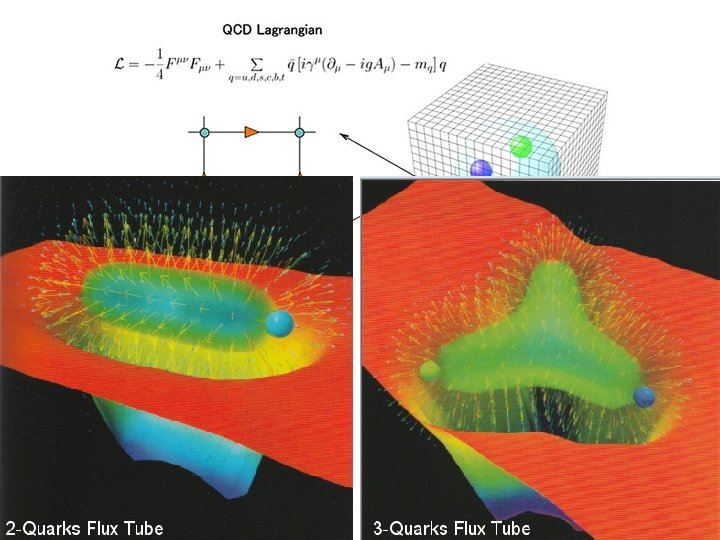
QCD Baryon Couplings Net attraction again Interestingly every quark pair is an antisymmetric color 3 bar and couples with a third quark to form a color singlet.
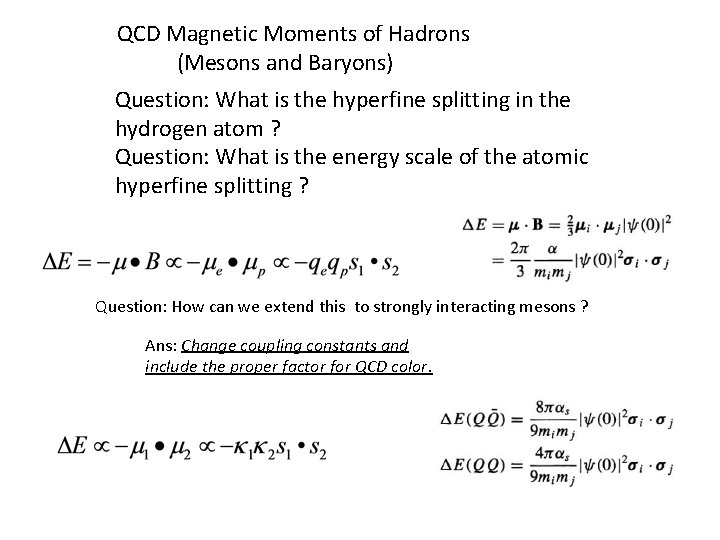
QCD Magnetic Moments of Hadrons (Mesons and Baryons) Question: What is the hyperfine splitting in the hydrogen atom ? Question: What is the energy scale of the atomic hyperfine splitting ? Question: How can we extend this to strongly interacting mesons ? Ans: Change coupling constants and include the proper factor for QCD color.
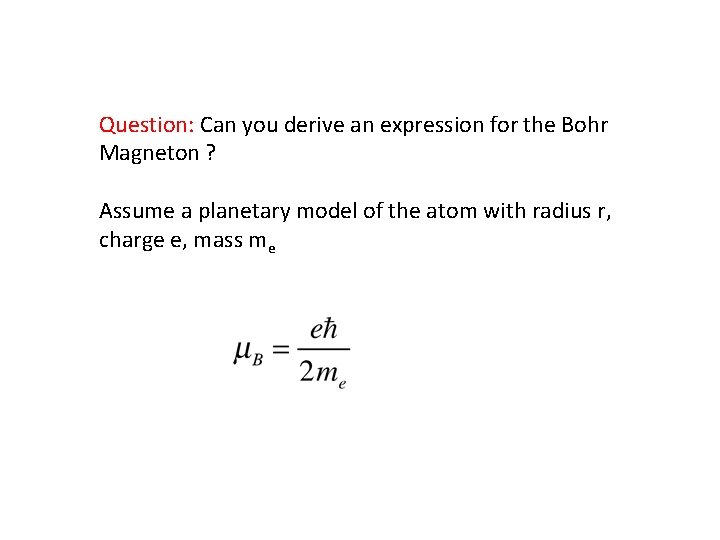
Question: Can you derive an expression for the Bohr Magneton ? Assume a planetary model of the atom with radius r, charge e, mass me
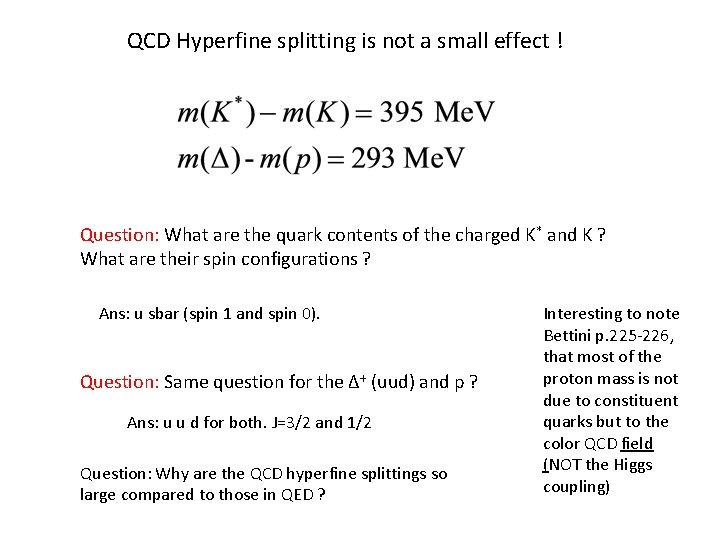
QCD Hyperfine splitting is not a small effect ! Question: What are the quark contents of the charged K* and K ? What are their spin configurations ? Ans: u sbar (spin 1 and spin 0). Question: Same question for the Δ+ (uud) and p ? Ans: u u d for both. J=3/2 and 1/2 Question: Why are the QCD hyperfine splittings so large compared to those in QED ? Interesting to note Bettini p. 225 -226, that most of the proton mass is not due to constituent quarks but to the color QCD field (NOT the Higgs coupling)
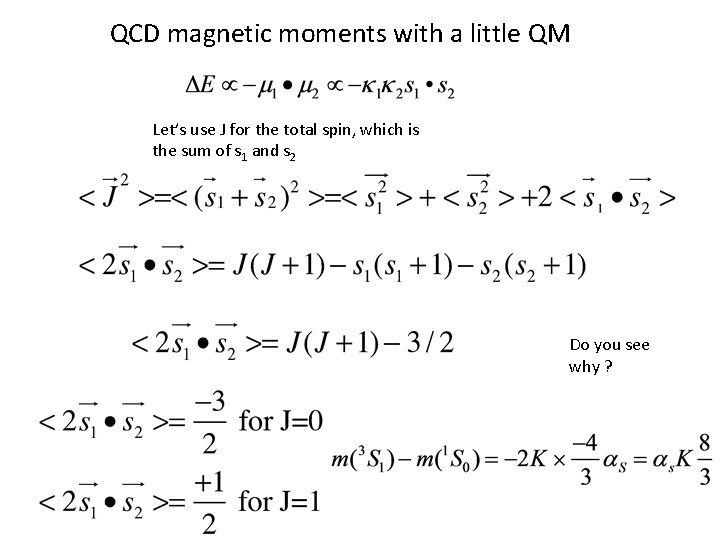
QCD magnetic moments with a little QM Let’s use J for the total spin, which is the sum of s 1 and s 2 Do you see why ?
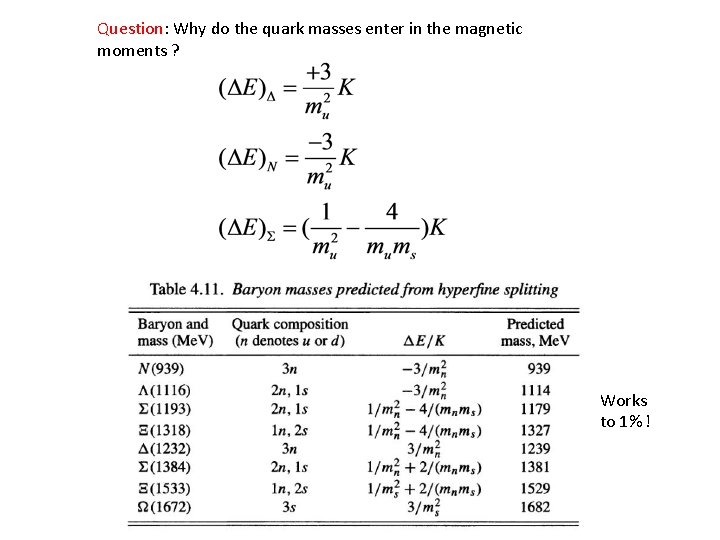
Question: Why do the quark masses enter in the magnetic moments ? Works to 1% !
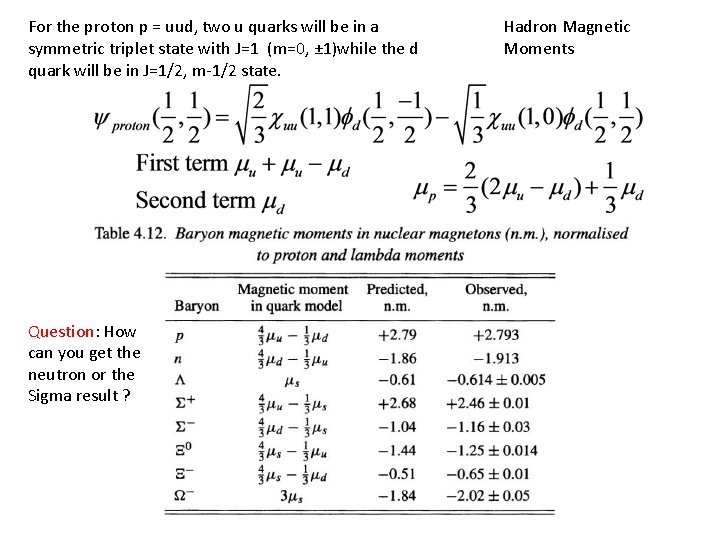
For the proton p = uud, two u quarks will be in a symmetric triplet state with J=1 (m=0, ± 1)while the d quark will be in J=1/2, m-1/2 state. Question: How can you get the neutron or the Sigma result ? Hadron Magnetic Moments
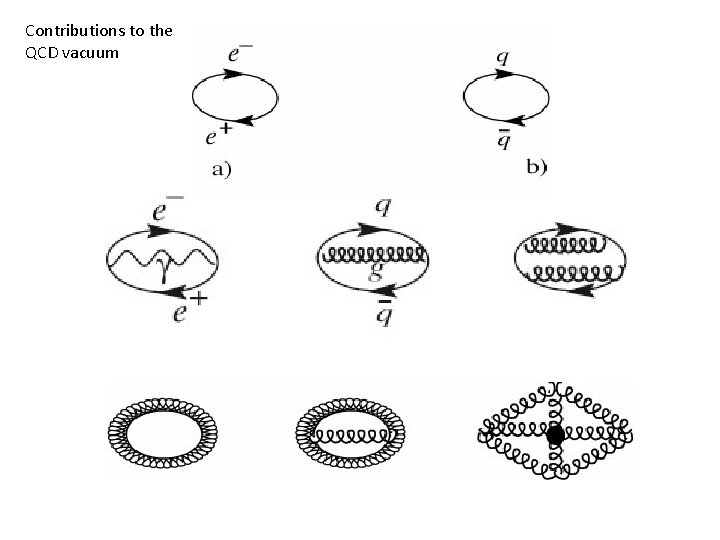
Contributions to the QCD vacuum
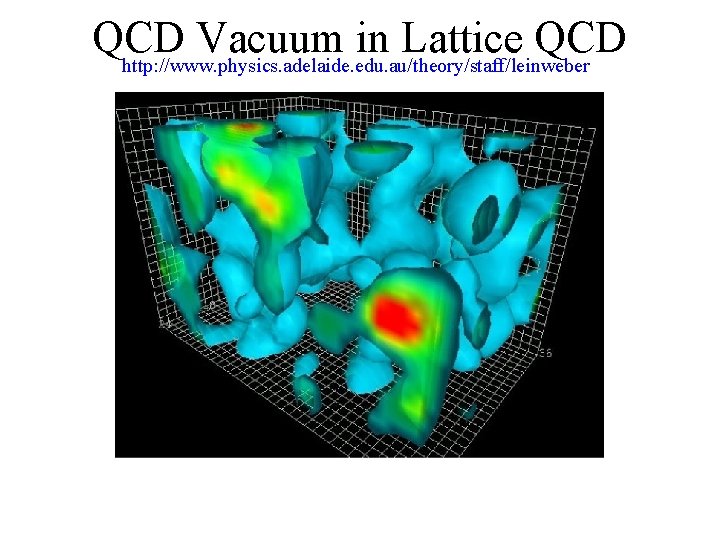
QCD Vacuum in Lattice QCD http: //www. physics. adelaide. edu. au/theory/staff/leinweber
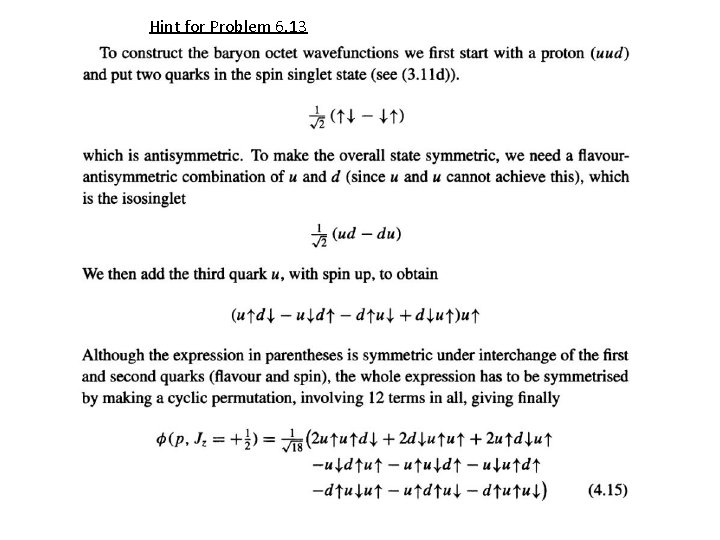
Hint for Problem 6. 13