Norman Malcolm on the Ontological Argument A Reply
- Slides: 14
Norman Malcolm on the Ontological Argument A Reply to Immanuel Kant around CONTINGENCY and NECESSITY Necessary Being 2
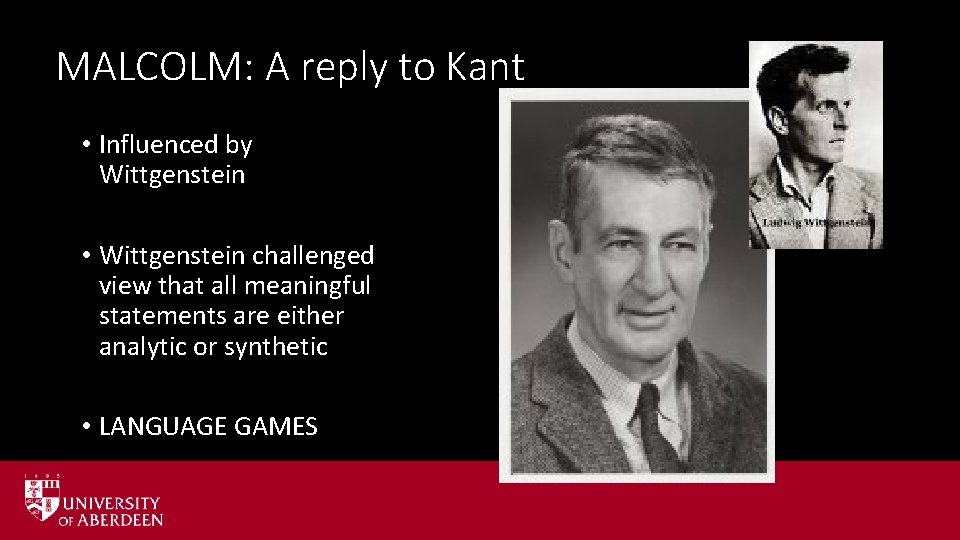
MALCOLM: A reply to Kant • Influenced by Wittgenstein • Wittgenstein challenged view that all meaningful statements are either analytic or synthetic • LANGUAGE GAMES
MALCOLM: A reply to Kant • This shifts burden of proof • Cannot divorce argument from religious context • Malcolm rejects first form of ontological argument: says with Kant existence is not a predicate of contingent things
MALCOLM: A reply to Kant • Challenges second of Kant’s criticisms (necessary existence is self contradictory) • INSTEAD – necessary existence is designed to show “God exists in the greatest conceivable manner, the ordinary and contingent way of existing being defective” • Necessary being is designed to exclude the possibility of nonexistence
MALCOLM: A reply to Kant • A Necessary Being is not nonsensical: it separates God from being confused with a limited being • Explains difference between contingent and necessary by looking at • Dependence • Independence
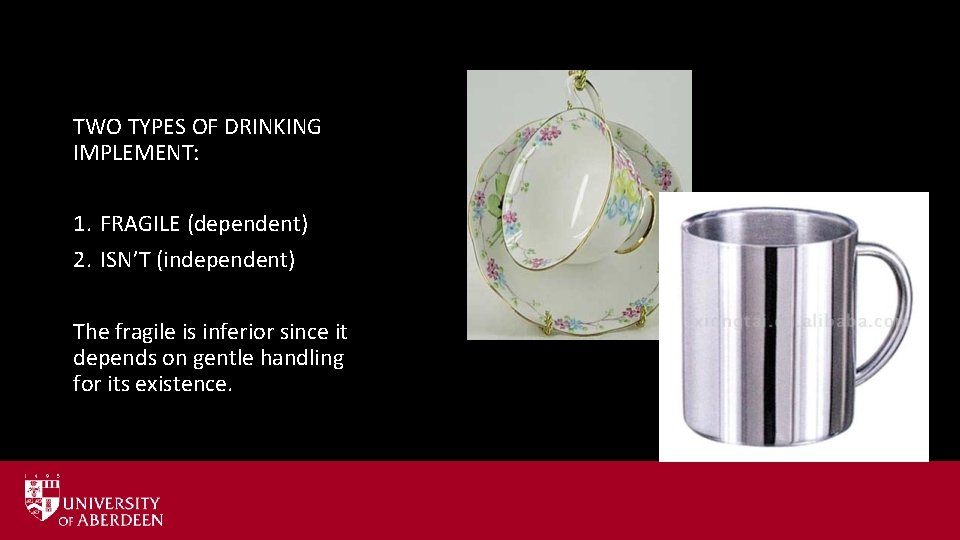
TWO TYPES OF DRINKING IMPLEMENT: 1. FRAGILE (dependent) 2. ISN’T (independent) The fragile is inferior since it depends on gentle handling for its existence.
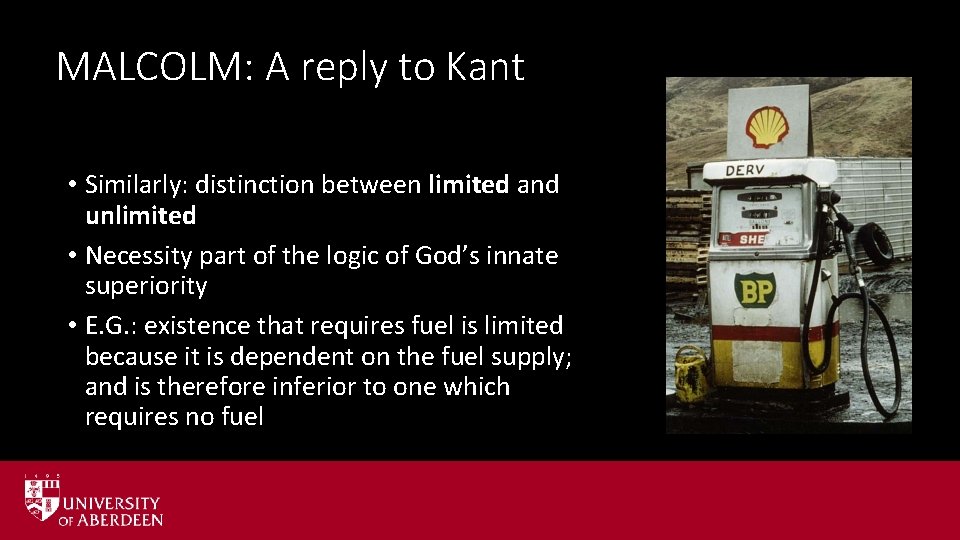
MALCOLM: A reply to Kant • Similarly: distinction between limited and unlimited • Necessity part of the logic of God’s innate superiority • E. G. : existence that requires fuel is limited because it is dependent on the fuel supply; and is therefore inferior to one which requires no fuel
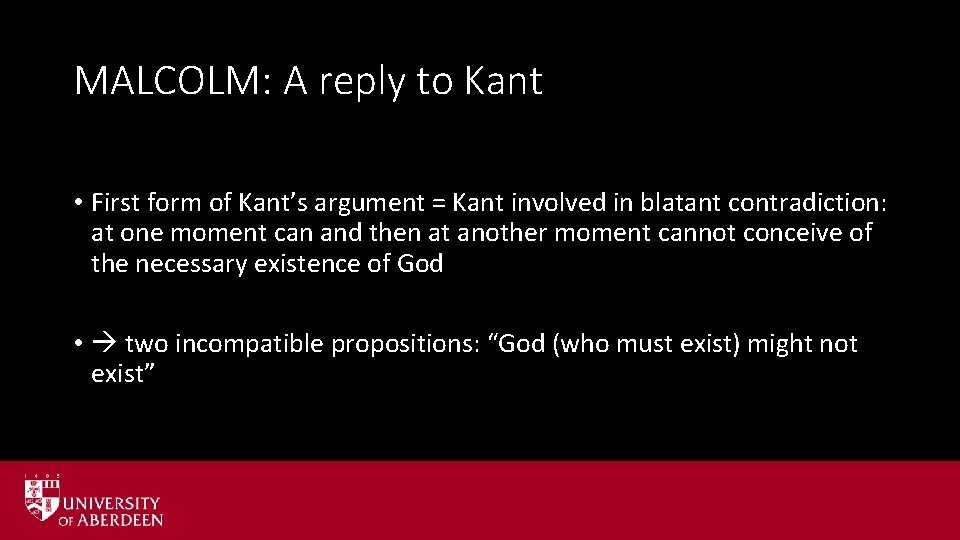
MALCOLM: A reply to Kant • First form of Kant’s argument = Kant involved in blatant contradiction: at one moment can and then at another moment cannot conceive of the necessary existence of God • two incompatible propositions: “God (who must exist) might not exist”
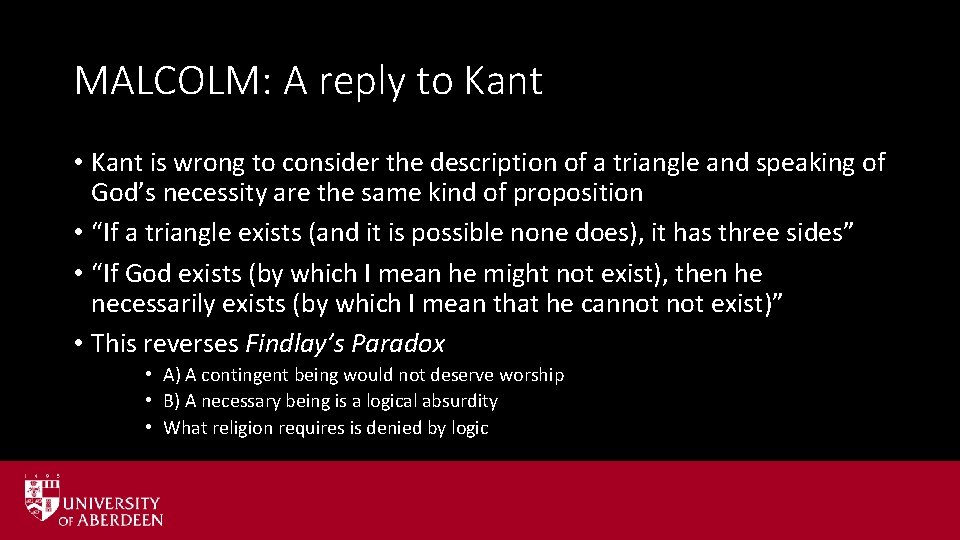
MALCOLM: A reply to Kant • Kant is wrong to consider the description of a triangle and speaking of God’s necessity are the same kind of proposition • “If a triangle exists (and it is possible none does), it has three sides” • “If God exists (by which I mean he might not exist), then he necessarily exists (by which I mean that he cannot exist)” • This reverses Findlay’s Paradox • A) A contingent being would not deserve worship • B) A necessary being is a logical absurdity • What religion requires is denied by logic
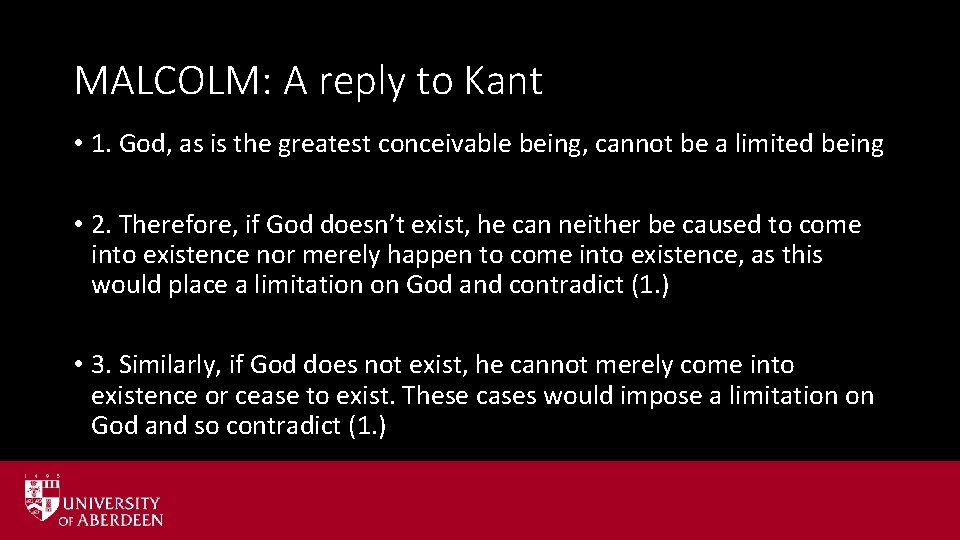
MALCOLM: A reply to Kant • 1. God, as is the greatest conceivable being, cannot be a limited being • 2. Therefore, if God doesn’t exist, he can neither be caused to come into existence nor merely happen to come into existence, as this would place a limitation on God and contradict (1. ) • 3. Similarly, if God does not exist, he cannot merely come into existence or cease to exist. These cases would impose a limitation on God and so contradict (1. )
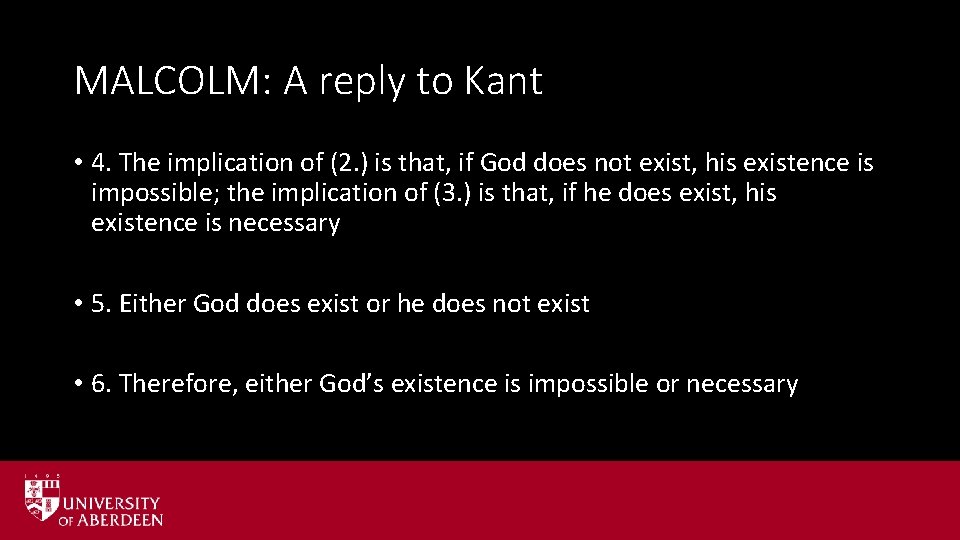
MALCOLM: A reply to Kant • 4. The implication of (2. ) is that, if God does not exist, his existence is impossible; the implication of (3. ) is that, if he does exist, his existence is necessary • 5. Either God does exist or he does not exist • 6. Therefore, either God’s existence is impossible or necessary
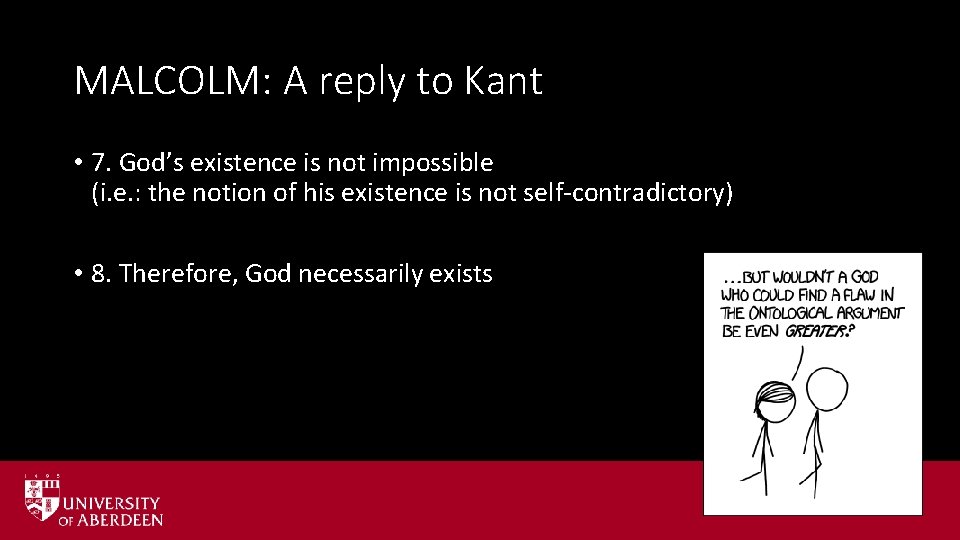
MALCOLM: A reply to Kant • 7. God’s existence is not impossible (i. e. : the notion of his existence is not self-contradictory) • 8. Therefore, God necessarily exists
MALCOLM: A reply to Kant • Potential Critique of Malcolm • Confuses FACTUALLY necessary being (propositions 1 -4) with LOGICALLY necessary being (propositions 6 -8) • should we contrast impossible existence with eternal existence instead? This would mean there is a possibility of denying God’s existence without self-contradiction
MALCOLM: A reply to Kant • Aseity (un-derived [from Latin a "from" and se "self"] in contrast to being derived from or dependent on another ) = causal • Denial that a being exists a se • Malcolm cannot infer proposition 8