Noise 2 Void Learning Denoising from Single Noisy



- Slides: 8
Noise 2 Void - Learning Denoising from Single Noisy Images CVPR 2019
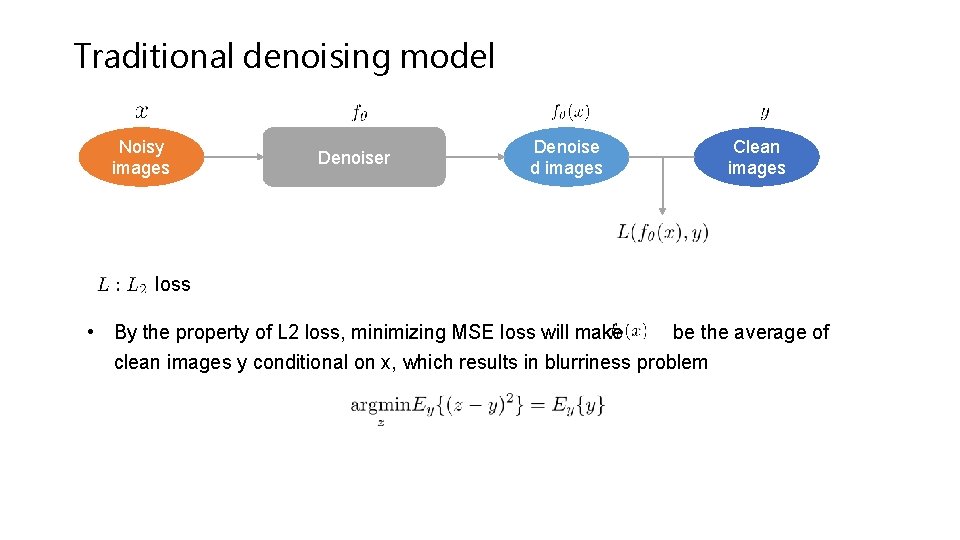
Traditional denoising model Noisy images Denoiser Denoise d images Clean images loss • By the property of L 2 loss, minimizing MSE loss will make be the average of clean images y conditional on x, which results in blurriness problem
Noise 2 Noise Noisy images Denoiser Denoise d images New noisy images loss • However, this property of L 2 loss also ensures that, adding some zero-mean noise to clean images will not change the optimization goal • Therefore we can train the network to transfer noise to noise, while achieving the same result as noise 2 clean • Note that two group noisy images must have the same content and independent noise
Noise 2 Void • If we don’t have new noisy images, we can only set the input image as training target. But the network will learn the identity function by simply picking the center pixel from its receptive field • Now we remove the center pixel from the receptive field • Assuming noises in different pixels are independent, then the input-outputindependence is satisfied again!
Implementation Details a) The noisy image b) The receptive field of a pixel. During N 2 V training, a randomly selected pixel is chosen (blue rectangle) and its intensity copied over to create a blind-spot c) The modified patch is used as input and unmodified pixel value is used as target In practice, we crop patches larger than the receptive field and randomly select several blind-spot to modify and calculate the loss.
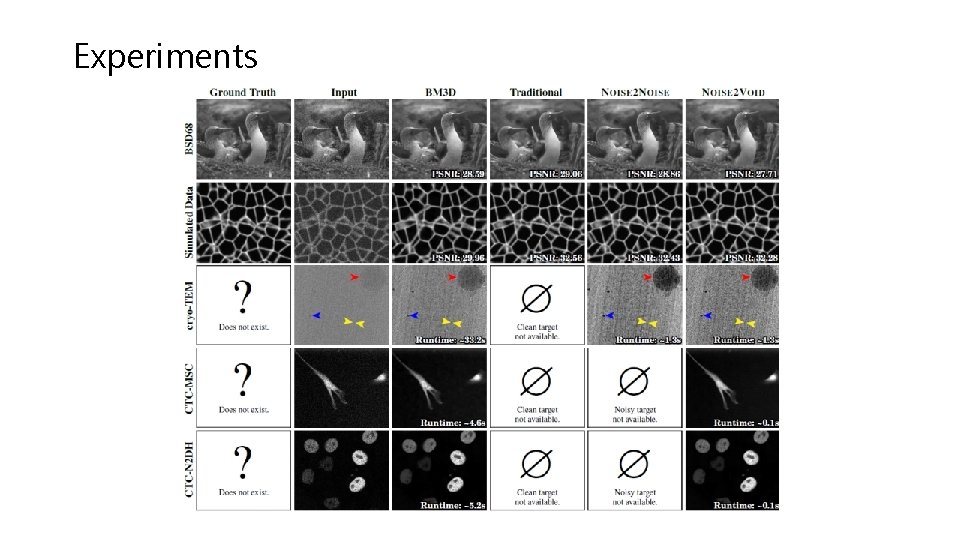
Experiments
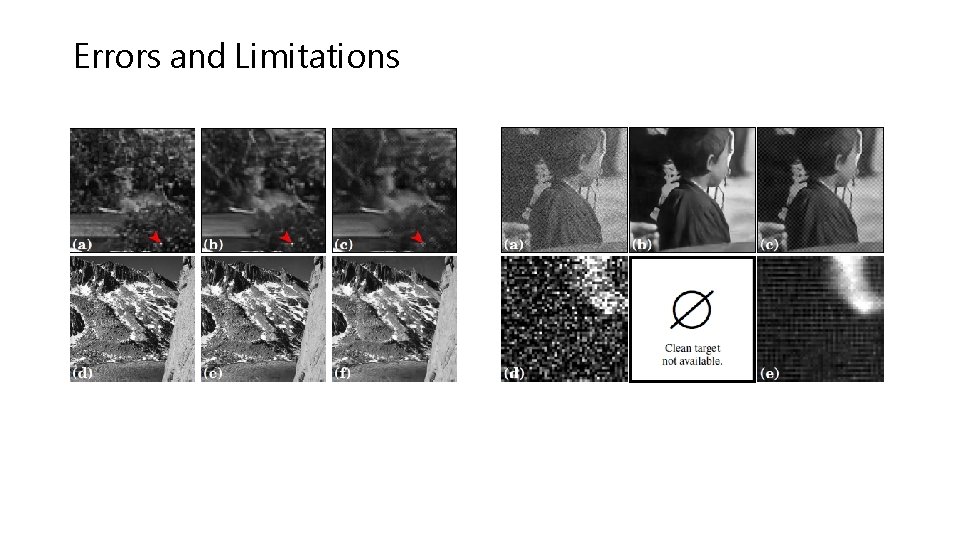
Errors and Limitations
Comments Pros • interesting and novel idea • can be used when clean images are unavailable Cons • too strong assumptions • cannot evaluate performance