New Continuing Competence regime in England Wales Jenny



- Slides: 21
New Continuing Competence regime in England Wales Jenny Crewe – Special Adviser, Legal Education and Training
Outline 1. 2. 3. 4. 5. 6. 7. Who’s who? Distinction between barristers and solicitors Legal regulation in England Wales Status quo in terms of education Training for Tomorrow (T 4 T) New regime of Continuing Competence What does the profession/Law Society think?
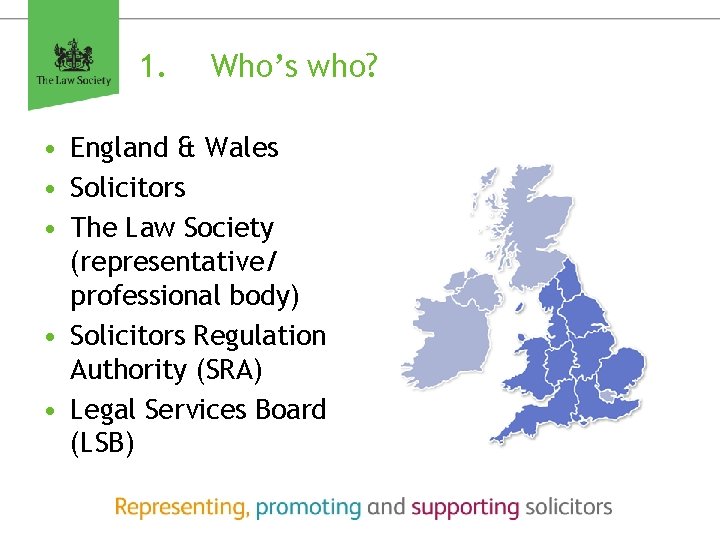
1. Who’s who? • England & Wales • Solicitors • The Law Society (representative/ professional body) • Solicitors Regulation Authority (SRA) • Legal Services Board (LSB)
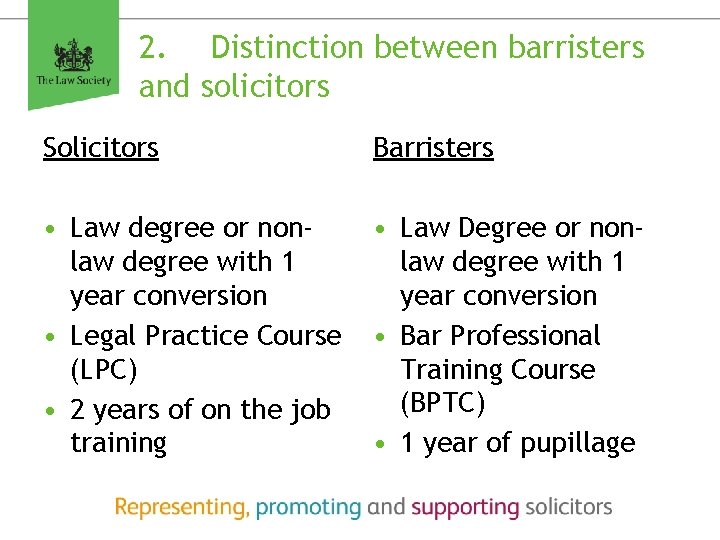
2. Distinction between barristers and solicitors Solicitors Barristers • Law degree or nonlaw degree with 1 year conversion • Legal Practice Course (LPC) • 2 years of on the job training • Law Degree or nonlaw degree with 1 year conversion • Bar Professional Training Course (BPTC) • 1 year of pupillage
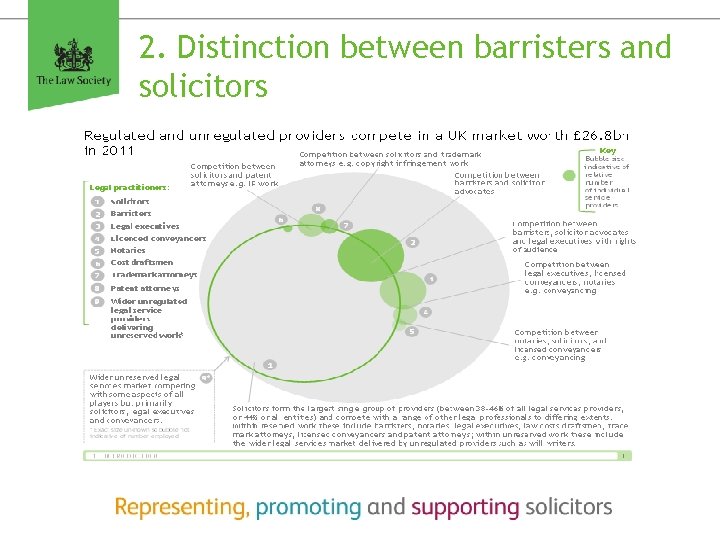
2. Distinction between barristers and solicitors
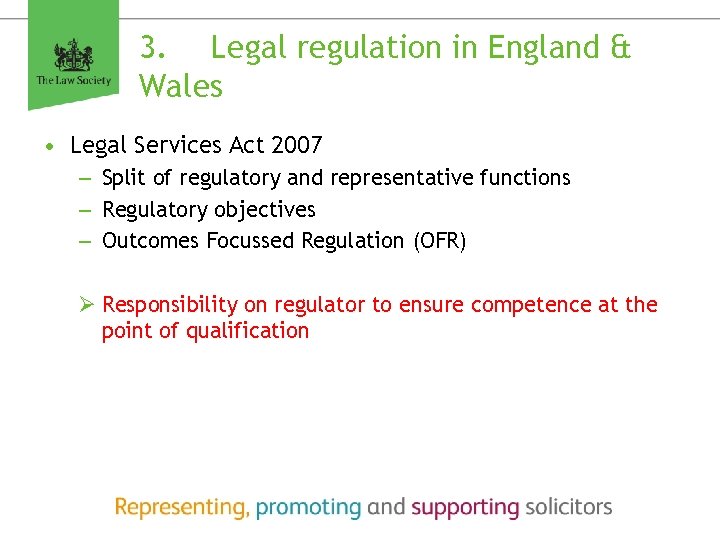
3. Legal regulation in England & Wales • Legal Services Act 2007 – Split of regulatory and representative functions – Regulatory objectives – Outcomes Focussed Regulation (OFR) Ø Responsibility on regulator to ensure competence at the point of qualification
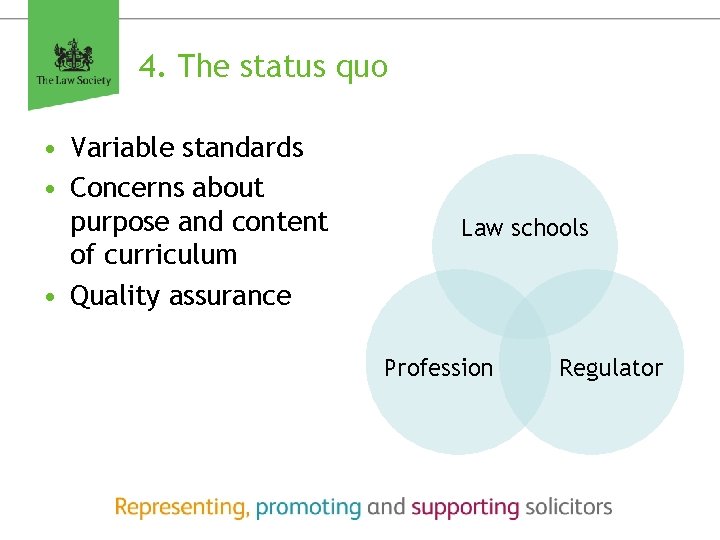
4. The status quo • Variable standards • Concerns about purpose and content of curriculum • Quality assurance Law schools Profession Regulator
5. Training for Tomorrow • Competence Statement – Statement of Solicitor Competence – Statement of Legal Knowledge – Threshold statement • Continuing Competence regime • New assessment framework
5. Training for Tomorrow – statement of solicitor competence q A: Ethics, Professionalism and Judgement q B: Technical Legal Practice q C: Working with other people q D: Managing themselves and their own work A 1 Act honestly and with integrity, in accordance with legal and regulatory requirements and the SRA Handbook and Code of Conduct, including • Recognising ethical issues and exercising effective judgement in addressing them • Understanding and applying the ethical concepts which govern their role and behaviour as a lawyer
5. Training for Tomorrow – statement of legal knowledge • Ethics, professionalism and regulation inc. money laundering and solicitors accounts • Wills and administration of estates • Tax • Law of organisations • Property • Torts • Criminal law & evidence • Criminal litigation • Contract law • Trusts and equitable wrongs • Constitutional law and EU law (inc. human rights) • Legal System of England & Wales • Civil litigation
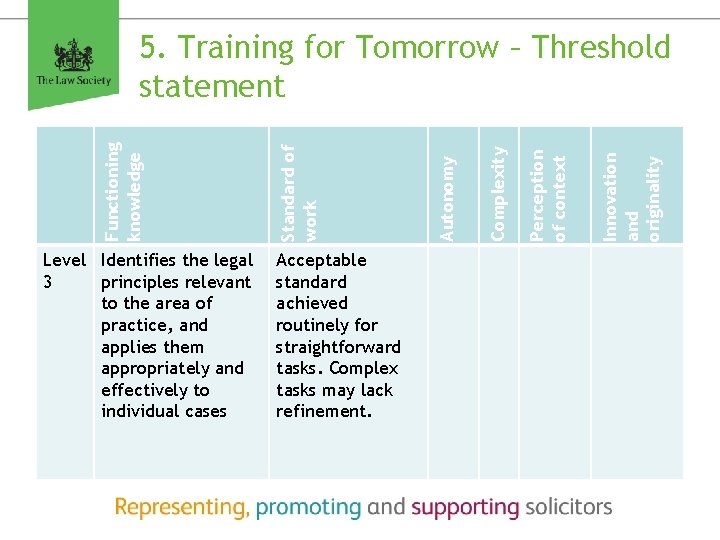
Level Identifies the legal 3 principles relevant to the area of practice, and applies them appropriately and effectively to individual cases Acceptable standard achieved routinely for straightforward tasks. Complex tasks may lack refinement. Innovation and originality Perception of context Complexity Autonomy Standard of work Functioning knowledge 5. Training for Tomorrow – Threshold statement
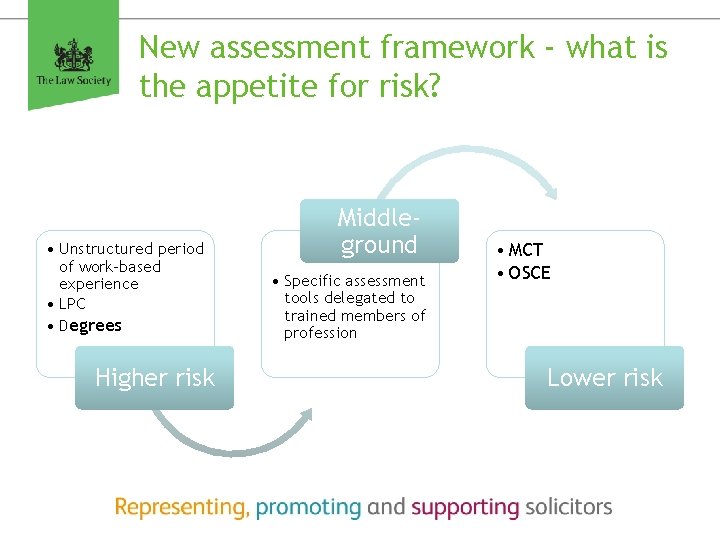
New assessment framework - what is the appetite for risk? • Unstructured period of work-based experience • LPC • Degrees Higher risk Middleground • Specific assessment tools delegated to trained members of profession • MCT • OSCE Lower risk
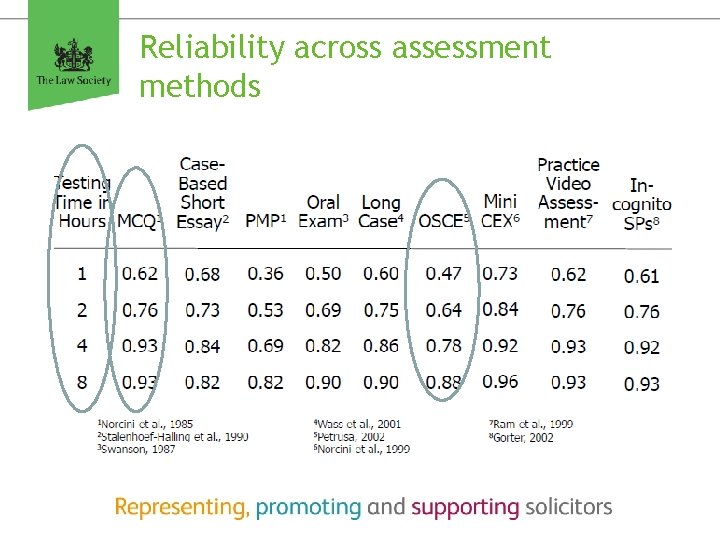
Reliability across assessment methods
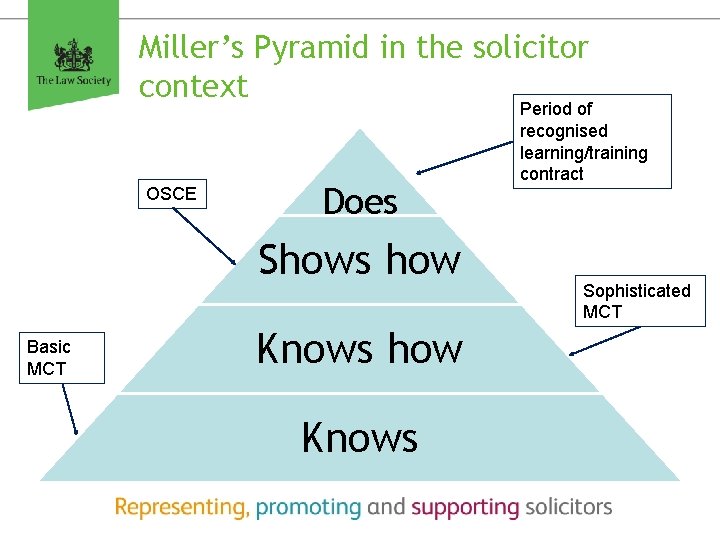
Miller’s Pyramid in the solicitor context OSCE Does Shows how Basic MCT Knows how Knows Period of recognised learning/training contract Sophisticated MCT
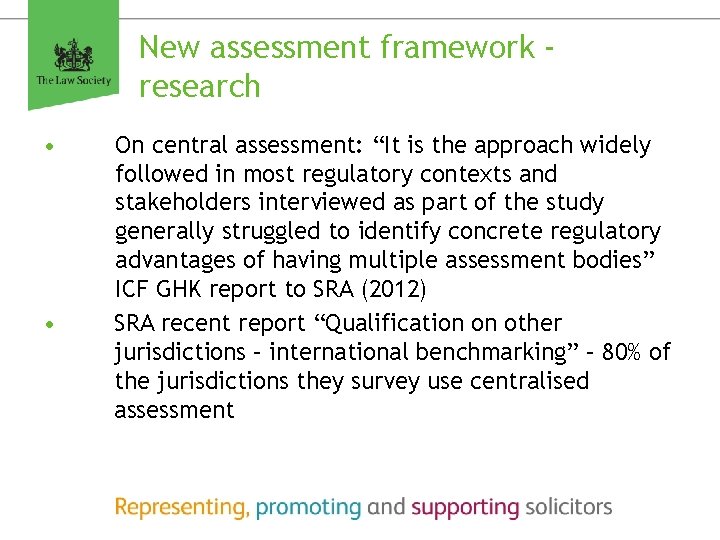
New assessment framework research • • On central assessment: “It is the approach widely followed in most regulatory contexts and stakeholders interviewed as part of the study generally struggled to identify concrete regulatory advantages of having multiple assessment bodies” ICF GHK report to SRA (2012) SRA recent report “Qualification on other jurisdictions – international benchmarking” – 80% of the jurisdictions they survey use centralised assessment
6. New regime of Continuing Competence – what is it? • Replaces 16 hours (4 hours at accredited training provider) • Benchmark is the Competence Statement • Reflective practice • Responsibility on the individual • Specific to own area of practice
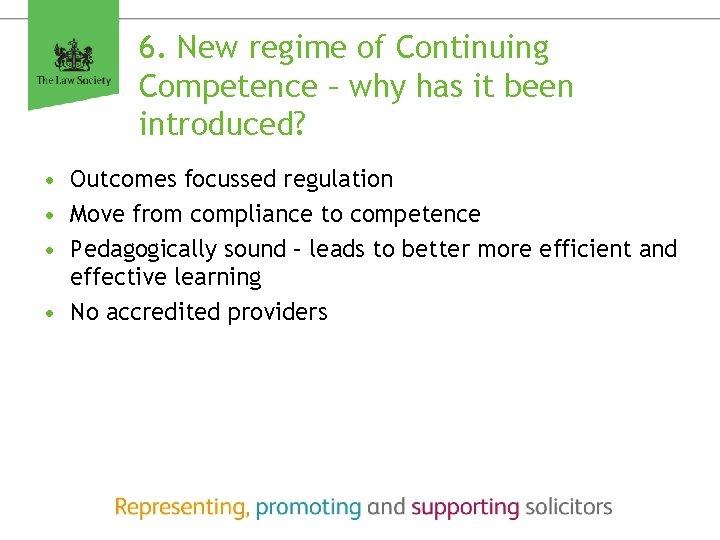
6. New regime of Continuing Competence – why has it been introduced? • Outcomes focussed regulation • Move from compliance to competence • Pedagogically sound – leads to better more efficient and effective learning • No accredited providers
7. What does the profession think? Perceived benefits • More relevant • More efficient • More flexible “It gets you to think and concentrate on what it is you really need – instead of just completing for the sake of getting CPD points”
7. What does the profession think? Perceived negatives • Some people won’t do it • No structure/too flexible • Requires self-discipline/motivation “People who are too busy won’t spend the appropriate time on it or won’t do it at all”
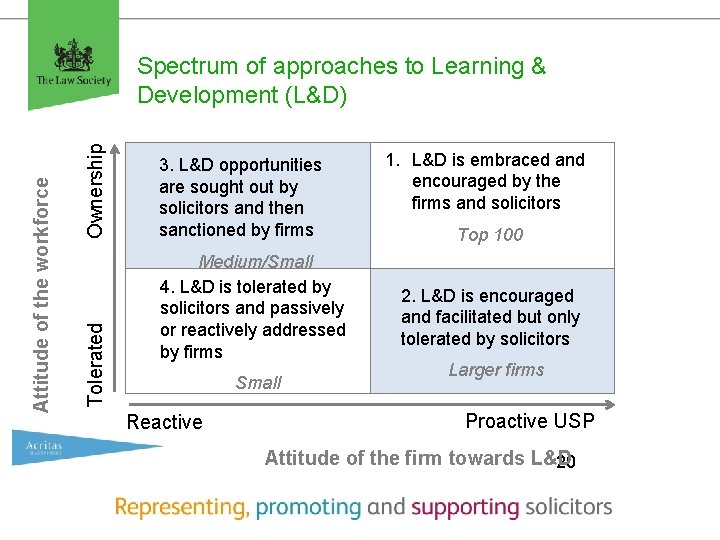
Ownership Tolerated Attitude of the workforce Spectrum of approaches to Learning & Development (L&D) 3. L&D opportunities are sought out by solicitors and then sanctioned by firms Medium/Small 4. L&D is tolerated by solicitors and passively or reactively addressed by firms Small Reactive 1. L&D is embraced and encouraged by the firms and solicitors Top 100 2. L&D is encouraged and facilitated but only tolerated by solicitors Larger firms Proactive USP Attitude of the firm towards L&D 20
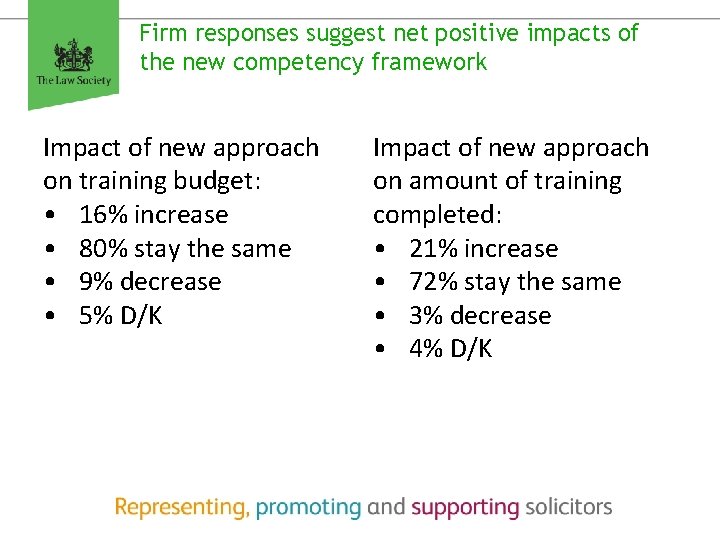
Firm responses suggest net positive impacts of the new competency framework Impact of new approach on training budget: • 16% increase • 80% stay the same • 9% decrease • 5% D/K Impact of new approach on amount of training completed: • 21% increase • 72% stay the same • 3% decrease • 4% D/K