Mustansiriyah University Class Third Year Faculty of Engineering


- Slides: 9
Mustansiriyah University Class: Third Year Faculty of Engineering Cryptographic Hash Functions Course name: Data Security Computer Engineering Dep. Lecturer: Fatimah Al-Ubaidy A Hash function (H) accepts a variable-length block of data M as input and produces a fixed-size hash value h = H(M). A “good” hash function has the property that the results of applying the function to a large set of inputs will produce outputs that are evenly distributed and apparently random. In general terms, the principal object of a hash function is data integrity. A Cryptographic hash function: is an algorithm for which it is computationally infeasible to find either (a) a data object that maps to a pre-specified hash result (the one-way property) or (b) two data objects that map to the same hash result (the collision-free property). Because of these characteristics, hash functions are often used to determine whether or not data has changed. Applications of Cryptographic Hash Functions: (1) Message authentication, (2) Digital Signature, (3) One-way password file, (4) Intrusion detection, (5) Virus detection, (6) Pseudorandom number generation. Message Authentication: is a mechanism or service used to verify the integrity of a message. It assures that data received are exactly as sent (i. e. , contain no modification, insertion, deletion, or replay). When a hash function is used to provide message authentication, the hash function value is often referred to as a message digest. * One-way password file: in which a hash of a password is stored by an operating system rather than the password itself. When a user enters a password, the hash of that password is compared to the stored hash value for verification. * Intrusion detection and virus detection: store H(F) for each file on a system and secure the hash values. One can later determine if a file has been modified by recomputing H(F). An intruder would need to change F without changing H(F). 1
Mustansiriyah University Class: Third Year Faculty of Engineering Cryptographic Hash Functions Course name: Data Security Computer Engineering Dep. Lecturer: Fatimah Al-Ubaidy Security Requirements of the Hash Functions: (1) Variable input size, (2) Fixed output size, (3) Efficiency, (4) Preimage resistant, (5) Second preimage resistant, (6) Collision resistant, (7) Pseudorandomness. * Preimage resistant, it is computationally infeasible to find any input that hashes to that output, i. e. , given y, it is difficult to find an x such that h(x) = y. * Second preimage resistant, it is computationally infeasible to find any second input which has the same output as that of a specified input, i. e. , given x, it is difficult to find a second preimage x′ ≠ x such that h(x) = h(x′). * Collision resistant, if this property is also satisfied, then it is referred to as a strong hash function. A strong hash function protects against an attack in which one party generates a message for another party to sign (if it is hard to find two inputs that hash to the same output). Attacks on Hash Functions: 1) Birthday Attack: the probability that in a set of n randomly chosen people, some pair of them will have the same birthday. Applied to hash function attacks, this means you have a 50% chance to break the collision resistance. 2) Brute-Force Attack: is to pick values of y at random and try each value until a collision occurs. 3) Preimage and Second Preimage Attack: For a preimage or second preimage attack, an adversary wishes to find a value y such that H(y) is equal to a given hash value h. 4) Collision Attack: For a collision resistant attack, an adversary wishes to find two messages or data blocks, x and y, that yield the same hash function. 2
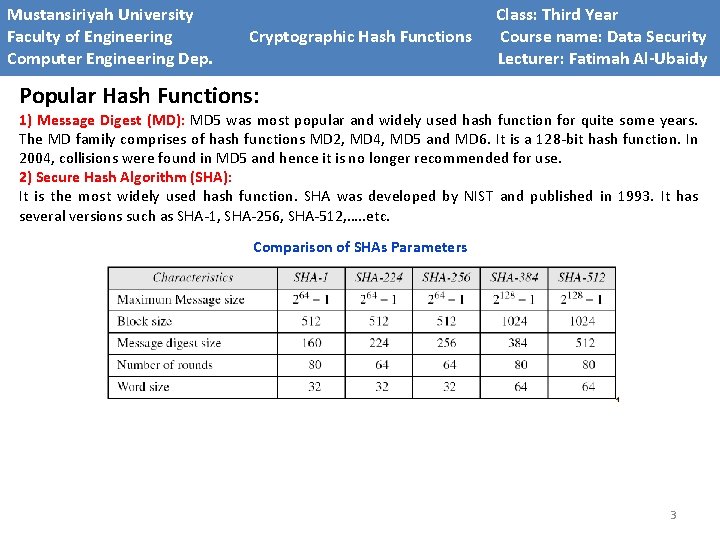
Mustansiriyah University Class: Third Year Faculty of Engineering Cryptographic Hash Functions Course name: Data Security Computer Engineering Dep. Lecturer: Fatimah Al-Ubaidy Popular Hash Functions: 1) Message Digest (MD): MD 5 was most popular and widely used hash function for quite some years. The MD family comprises of hash functions MD 2, MD 4, MD 5 and MD 6. It is a 128 -bit hash function. In 2004, collisions were found in MD 5 and hence it is no longer recommended for use. 2) Secure Hash Algorithm (SHA): It is the most widely used hash function. SHA was developed by NIST and published in 1993. It has several versions such as SHA-1, SHA-256, SHA-512, …. . etc. Comparison of SHAs Parameters 3
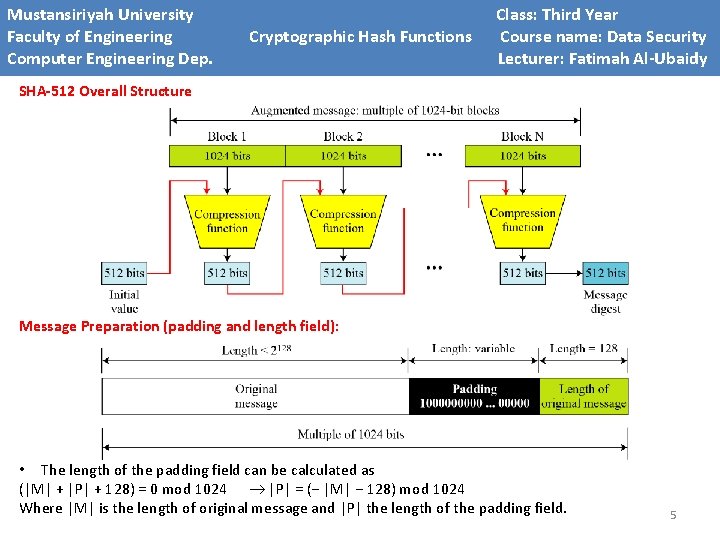
Mustansiriyah University Class: Third Year Faculty of Engineering Cryptographic Hash Functions Course name: Data Security Computer Engineering Dep. Lecturer: Fatimah Al-Ubaidy SHA-512 Logic: The algorithm takes as input a message with a maximum length of less than 2128 bits and produces as output a 512 -bit message digest. The input is processed in 1024 -bit blocks. The overall processing of a message to produce a digest can be summarized as follows: Step 1 Append padding bits. The message is padded so that its length is congruent to 896 modulo 1024 [length K 896 (mod 1024)]. Padding is always added, even if the message is already of the desired length. Thus, the number of padding bits is in the range of 1 to 1024. The padding consists of a single 1 bit followed by the necessary number of 0 bits. Step 2 Append length. A block of 128 bits is appended to the message. This block is treated as an unsigned 128 -bit integer (most significant byte first) and contains the length of the original message (before the padding). Step 3 Initialize hash buffer. A 512 -bit buffer is used to hold intermediate and final results of the hash function. The buffer can be represented as eight 64 -bit registers (a, b, c, d, e, f, g, h). Step 4 Process message in 1024 -bit blocks. The heart of the algorithm is a module that consists of 80 rounds. Each round takes as input the 512 -bit buffer value, abcdefgh, and updates the contents of the buffer. The output of the eightieth round is added to the input to the first round (Hi-1) to produce Hi using addition modulo 264. Step 5 Output. After all N 1024 -bit blocks have been processed, the output from he Nth stage is the 512 bit message digest. 4
Mustansiriyah University Class: Third Year Faculty of Engineering Cryptographic Hash Functions Course name: Data Security Computer Engineering Dep. Lecturer: Fatimah Al-Ubaidy SHA-512 Overall Structure Message Preparation (padding and length field): • The length of the padding field can be calculated as (|M| + |P| + 128) = 0 mod 1024 |P| = (− |M| − 128) mod 1024 Where |M| is the length of original message and |P| the length of the padding field. 5
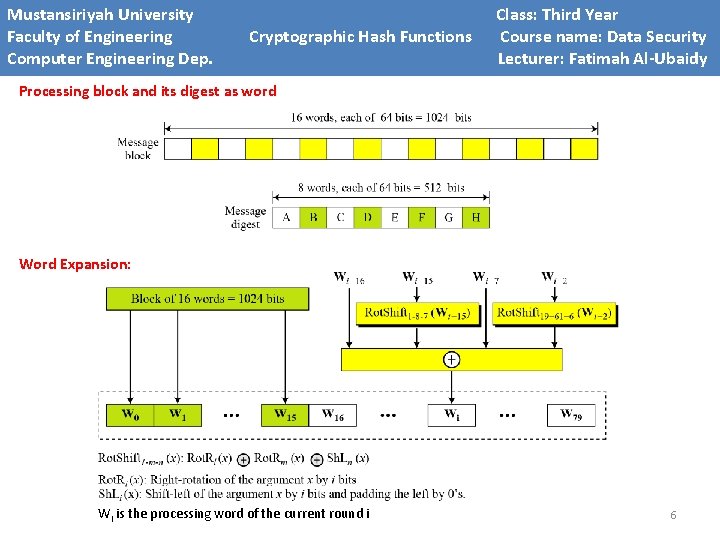
Mustansiriyah University Class: Third Year Faculty of Engineering Cryptographic Hash Functions Course name: Data Security Computer Engineering Dep. Lecturer: Fatimah Al-Ubaidy Processing block and its digest as word Word Expansion: Wi is the processing word of the current round i 6
Mustansiriyah University Class: Third Year Faculty of Engineering Cryptographic Hash Functions Course name: Data Security Computer Engineering Dep. Lecturer: Fatimah Al-Ubaidy SHA-512 Compression Function: Ki is a constant variable at round i where i =0, 1… 79. 7
Mustansiriyah University Class: Third Year Faculty of Engineering Cryptographic Hash Functions Course name: Data Security Computer Engineering Dep. Lecturer: Fatimah Al-Ubaidy Structure of each round in SHA-512: A = T 1 + T 2 B = A C = B D = C E = D + T 1 F = E G = F H = G T 1 = H + conditional(E, F, G) + rotate(E) + Wi + Ki T 2 = majority(A, B, C) + rotate(A) 8
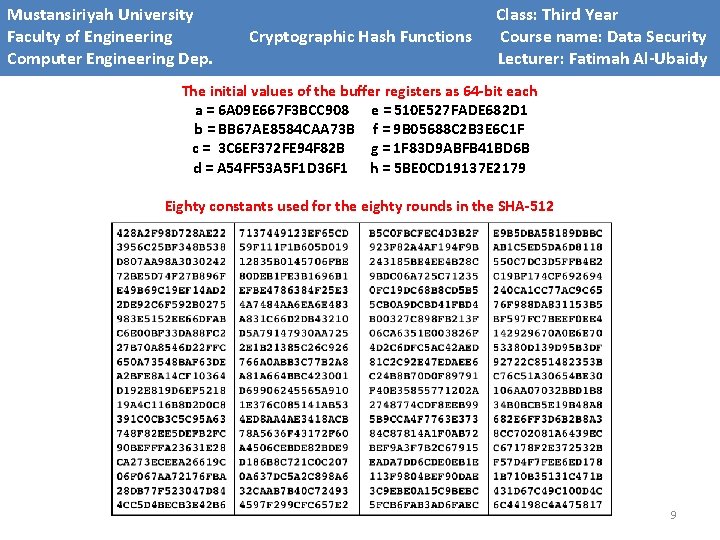
Mustansiriyah University Class: Third Year Faculty of Engineering Cryptographic Hash Functions Course name: Data Security Computer Engineering Dep. Lecturer: Fatimah Al-Ubaidy The initial values of the buffer registers as 64 -bit each a = 6 A 09 E 667 F 3 BCC 908 e = 510 E 527 FADE 682 D 1 b = BB 67 AE 8584 CAA 73 B f = 9 B 05688 C 2 B 3 E 6 C 1 F c = 3 C 6 EF 372 FE 94 F 82 B g = 1 F 83 D 9 ABFB 41 BD 6 B d = A 54 FF 53 A 5 F 1 D 36 F 1 h = 5 BE 0 CD 19137 E 2179 Eighty constants used for the eighty rounds in the SHA-512 9