Module 12 Quality Assurance DEPARTMENT OF MINERALS AND
- Slides: 51
Module 12: Quality Assurance DEPARTMENT OF MINERALS AND ENERGY DME-Danida Capacity Building in Energy Efficiency & Renewable Energy Ensuring that audits comply with DME requirements DME Supervising Engineers Course
Learning Objectives DEPARTMENT of MINERALS and ENERGY z Describe the essential features of the DME Audit Guidelines z Summarize the prescribed process for preliminary and detailed audits z Ensure that the preliminary and detailed audits address all required assessment issues z Ensure that appropriate service providers for the audit and quality assurance are selected DME Supervising Engineers Course 2
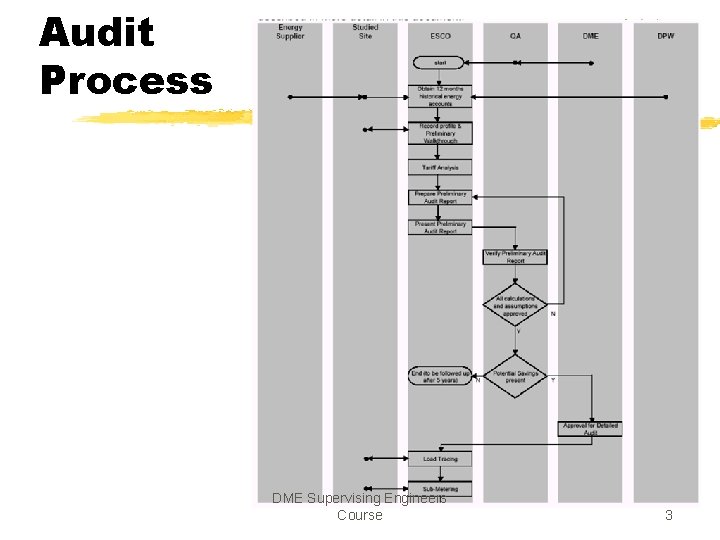
Audit Process DEPARTMENT of MINERALS and ENERGY DME Supervising Engineers Course 3
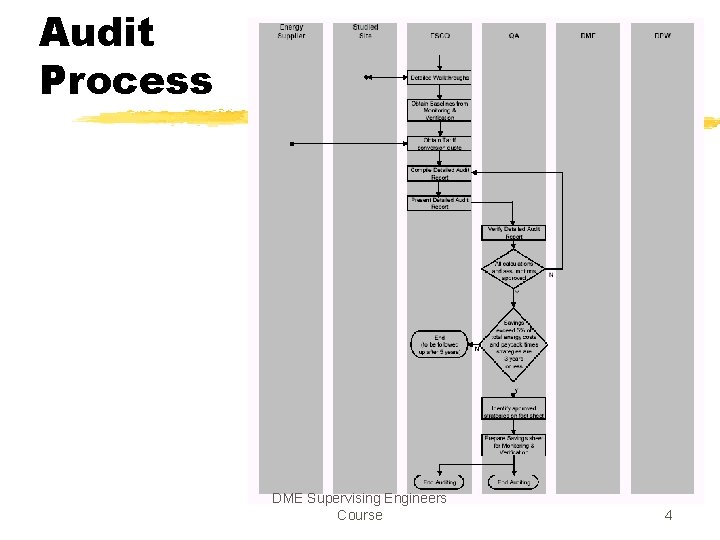
Audit Process DEPARTMENT of MINERALS and ENERGY DME Supervising Engineers Course 4
Parties to the Process DEPARTMENT of MINERALS and ENERGY z Energy Supplier (utilities) z Site Management z ESCO z Quality Assurer z DME z DPW DME Supervising Engineers Course 5
Preliminary Audit z Purpose DEPARTMENT of MINERALS and ENERGY z Steps ythe need for or merits of a detailed audit, based on performance indices: xconsumption index MJ/m 2/year yhistorical analysis ycollect building data ydemand profile ywalk-through ytariff analysis xdemand index VAaverage/m 2/month DME Supervising Engineers Course 6
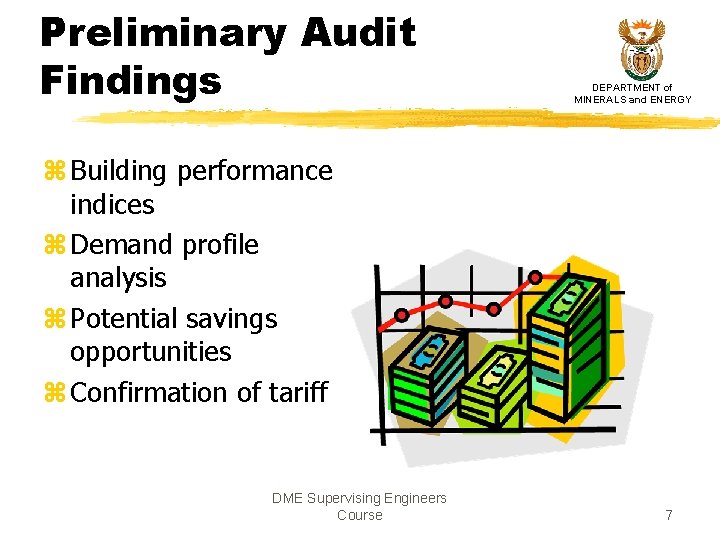
Preliminary Audit Findings DEPARTMENT of MINERALS and ENERGY z Building performance indices z Demand profile analysis z Potential savings opportunities z Confirmation of tariff DME Supervising Engineers Course 7
Detailed Audit z Purpose DEPARTMENT of MINERALS and ENERGY z Steps yidentify specific measures to reduce consumption, demand, cost yexamine site drawings yprepare load inventory yassess demand profile yassess all energy load areas yprovide baseline criterion yassess tariff change opportunity DME Supervising Engineers Course 8
EMO Checklist DEPARTMENT of MINERALS and ENERGY z. Lighting z. HVAC z. Building envelope z. Domestic hot and cold water z. Steam distribution z. Fuel switching z. Compressed air DME Supervising Engineers Course 9
Quality Assurance Issues DEPARTMENT of MINERALS and ENERGY z. Ensure that the process is followed z. Select the right ESCO z. Select the right Quality Assurer • Education of employees, in particular additional specific Energy Management related certification or degrees. • Expertise and integrity of company. • Reference projects and other experience. • Stability of company (assets / turnover). • Professional indemnity and contractor’s liability insurances. DME Supervising Engineers Course 10
Module 13: Project Development Cycle DEPARTMENT OF MINERALS AND ENERGY DME-Danida Capacity Building in Energy Efficiency & Renewable Energy Planning, Implementation and Evaluation DME Supervising Engineers Course
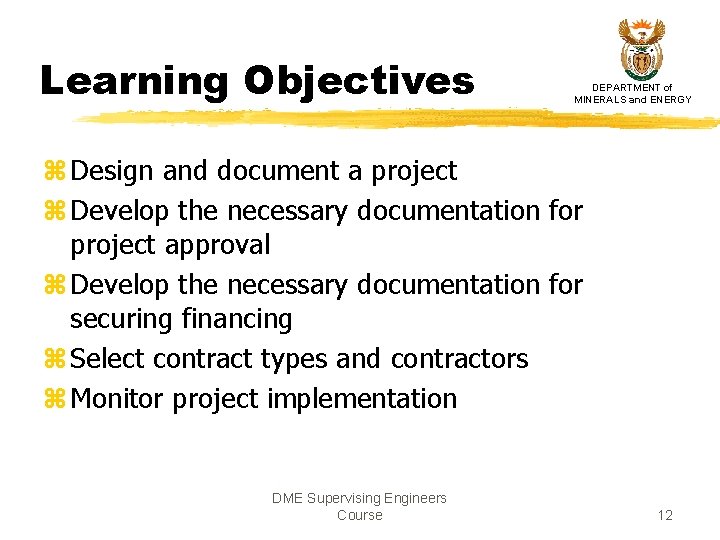
Learning Objectives DEPARTMENT of MINERALS and ENERGY z Design and document a project z Develop the necessary documentation for project approval z Develop the necessary documentation for securing financing z Select contract types and contractors z Monitor project implementation DME Supervising Engineers Course 12
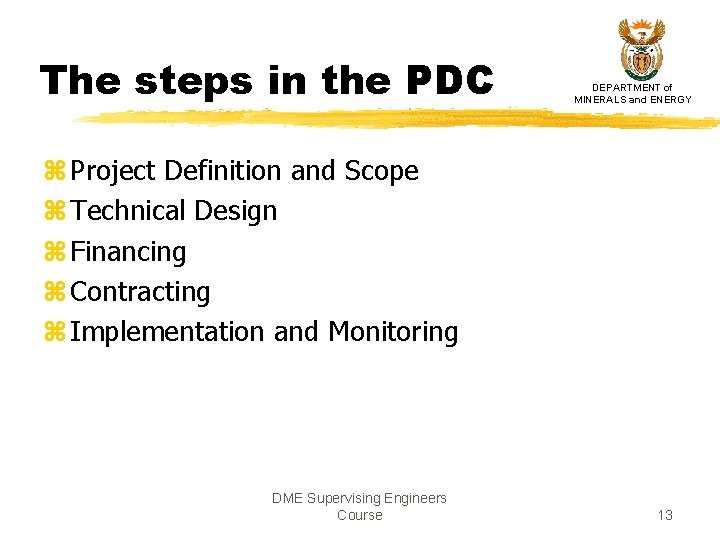
The steps in the PDC DEPARTMENT of MINERALS and ENERGY z Project Definition and Scope z Technical Design z Financing z Contracting z Implementation and Monitoring DME Supervising Engineers Course 13
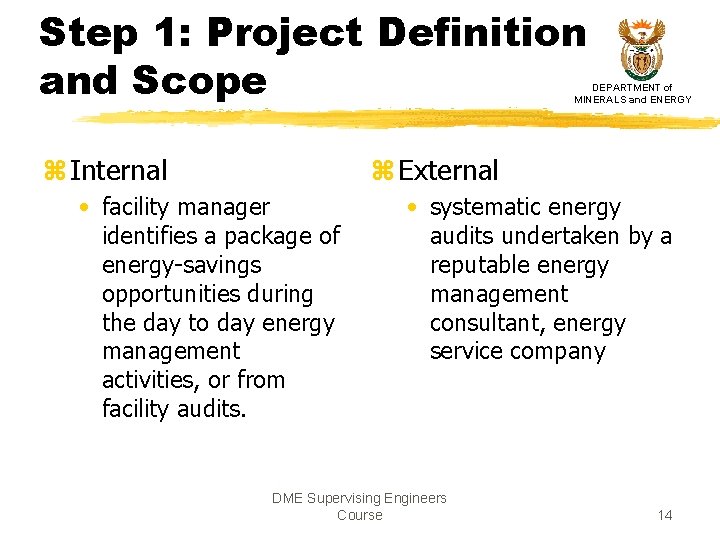
Step 1: Project Definition and Scope DEPARTMENT of MINERALS and ENERGY z Internal z External • facility manager identifies a package of energy-savings opportunities during the day to day energy management activities, or from facility audits. • systematic energy audits undertaken by a reputable energy management consultant, energy service company DME Supervising Engineers Course 14
Criteria for Prioritisation DEPARTMENT of MINERALS and ENERGY z. Cost-effectiveness z. Sustainability of the savings z. Ease of quantifying, monitoring, and verifying savings z. Availability of technology z. Other environmental and social costs and benefits DME Supervising Engineers Course 15
Step 2: Technical Design DEPARTMENT of MINERALS and ENERGY z The proposed technologies, process modifications, equipment replacements and other measures z Product/technology/material supply chain z Commercial viability of the measures (IRR, NPV, cash flow, payback) z Any special technical complexities z Preliminary designs, manufacturer’s name and contact details, and capital cost estimate z Organisational and management plan for implementation DME Supervising Engineers Course 16
Step 3: Financial Proposal DEPARTMENT of MINERALS and ENERGY z Amount of financing already secured z Project cost structure • investment required at each stage • proposed investment structure (debt-equity) • risk mechanisms (insurance, currency exposure, guarantees, etc. ) z Use of proceeds from the loan z Certification on due diligence and efficiency DME Supervising Engineers Course 17
Loan Agreements DEPARTMENT of MINERALS and ENERGY z. Conditions regarding goods and services procurement z. Inspection provisions z. Conditions regarding insurance z. Information requirements z. Termination provisions DME Supervising Engineers Course 18
ESCO Services DEPARTMENT of MINERALS and ENERGY z An energy efficiency opportunity analysis z Project development z Engineering z Financing z Construction/implementation z Training z Measurement and verification DME Supervising Engineers Course 19
Benefits of 3 rd Party Financing z Reduced or eliminated need for corporate capital z Accelerate existing energy efficiency programs and building renewal z Helping manage debt through off balance sheet financing z Decreased operating costs DEPARTMENT of MINERALS and ENERGY z Turn-key installation z Participation of local energy utilities z Enhanced staff training z Savings fund repayments, based on performance against quantifiable results z Transferred risk to a third party (ESCO) DME Supervising Engineers Course 20
Step 4: Contracting Options DEPARTMENT of MINERALS and ENERGY z. Traditional contract z. Extended technical guarantee/service z. Extended financing terms z. Guaranteed savings performance contract z. Shared savings performance contract DME Supervising Engineers Course 21
ESCO Contract Types DEPARTMENT of MINERALS and ENERGY z First Out - ESCO retains savings until an agreed-upon financial goal is achieved; client company then receives future savings z Shared Savings - ESCO and client company share savings as they are achieved z Guaranteed Savings - ESCO guarantees project costs (exclusive of client add-ons); debt service is covered by the income stream. z Discounted Energy Savings (Chauffage) - Client company pays ESCO a fee equal to the base year energy bill minus an agreed upon discount; ESCO pays actual energy bill DME Supervising Engineers Course 22
Step 5: Implementation Guidelines DEPARTMENT of MINERALS and ENERGY z. Limit long lead times z. Manage out-of-pocket development costs by focusing efforts z. Manage construction carefully DME Supervising Engineers Course 23
Module 14: M&V DEPARTMENT OF MINERALS AND ENERGY DME-Danida Capacity Building in Energy Efficiency & Renewable Energy Savings Verification DME Supervising Engineers Course
Learning Objectives DEPARTMENT of MINERALS and ENERGY z Identify the key concepts involved in savings verification z Define the kinds of data required for energy performance analysis, and analyze energy consumption as a function of degree-days z Define the fundamental relationship for determining savings for a given ECM z Describe the elements of a verification plan z Identify the data and information required to define base year conditions z Describe and select from the four methods of savings verification z Describe techniques for developing an energy performance model z Apply adjustments to the base year conditions DME Supervising Engineers Course 25
Working Definitions z Measurement and Verification: ya process of quantifying energy consumption before and after an EMO is implemented to verify and report on the savings actually achieved DEPARTMENT of MINERALS and ENERGY z Monitoring and Targeting ya management technique to “keep operations efficient”, and to “monitor utility costs”-management strategies to drive energy costs downwards as a continuous improvement cycle DME Supervising Engineers Course 26
Why Measure & Verify? DEPARTMENT of MINERALS and ENERGY z to increase energy savings z to reduce the cost of financing projects z to encourage better project engineering z to demonstrate and capture the value of reduced GHG emissions z to increase public understanding of energy management as a public policy tool z to promote and achieve resource efficiency and environmental objectives DME Supervising Engineers Course 27
Spend more to reduce costs? DEPARTMENT of MINERALS and ENERGY M&V y. Increases the confidence of funders in sufficient savings to make debt payments yreduces the investment risk yreduces the expected rate of return of the investment—and your costs of borrowing DME Supervising Engineers Course 28
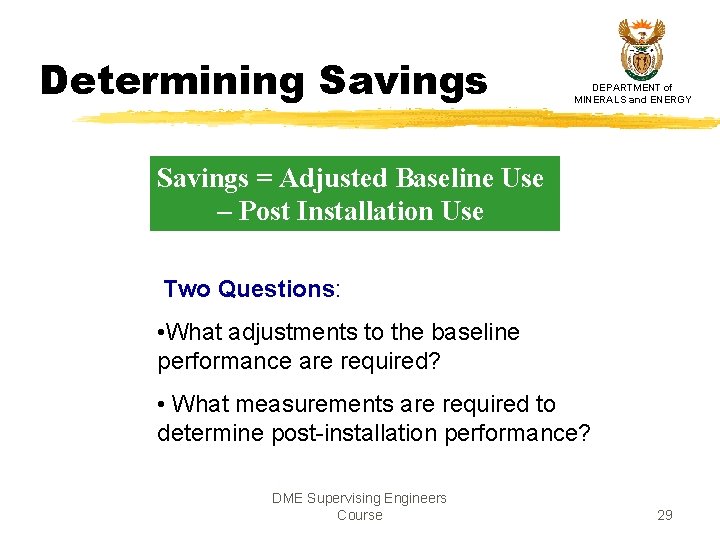
Determining Savings DEPARTMENT of MINERALS and ENERGY Savings = Adjusted Baseline Use – Post Installation Use Two Questions: • What adjustments to the baseline performance are required? • What measurements are required to determine post-installation performance? DME Supervising Engineers Course 29
The IPMVP - M&V Options DEPARTMENT of MINERALS and ENERGY z To what extent can the retrofit be measured separately from other facility components? z To what extent can performance variables be measured? www. ipmvp. org DME Supervising Engineers Course 30
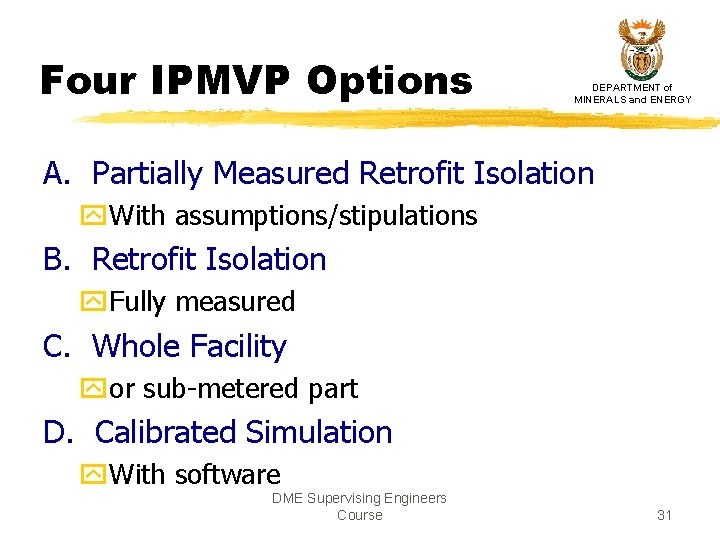
Four IPMVP Options DEPARTMENT of MINERALS and ENERGY A. Partially Measured Retrofit Isolation y. With assumptions/stipulations B. Retrofit Isolation y. Fully measured C. Whole Facility yor sub-metered part D. Calibrated Simulation y. With software DME Supervising Engineers Course 31
Variants of Regression Pattern DME Supervising Engineers Course DEPARTMENT of MINERALS and ENERGY 34
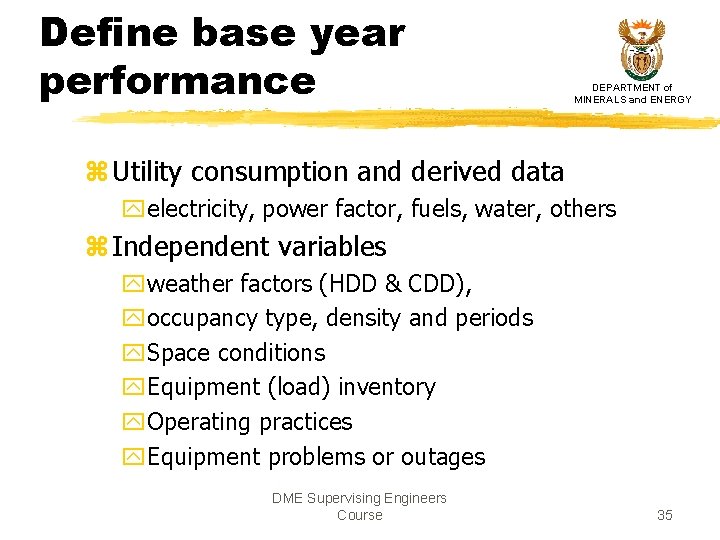
Define base year performance DEPARTMENT of MINERALS and ENERGY z Utility consumption and derived data yelectricity, power factor, fuels, water, others z Independent variables yweather factors (HDD & CDD), yoccupancy type, density and periods y. Space conditions y. Equipment (load) inventory y. Operating practices y. Equipment problems or outages DME Supervising Engineers Course 35
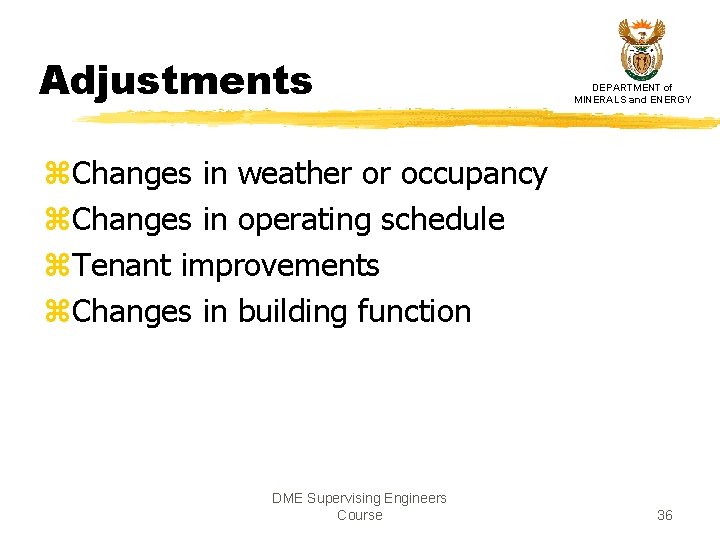
Adjustments DEPARTMENT of MINERALS and ENERGY z. Changes in weather or occupancy z. Changes in operating schedule z. Tenant improvements z. Changes in building function DME Supervising Engineers Course 36
Adjustments and IPMVP Option DEPARTMENT of MINERALS and ENERGY z Option A: partial retrofit isolation - many performance variables are stipulated z Option B: retrofit isolation - adjustments applied in the performance model z Option C: whole building - adjustments applied in the performance model z Option D: simulation - adjustments built into the simulation DME Supervising Engineers Course 37
Option Selection DEPARTMENT of MINERALS and ENERGY z project costs z expected savings z complexity and number of measures installed z anticipated changes to post-installation facility or system usage z tolerance for uncertainty or risk of savings being achieved z risk allocation between the owner and the contractor DME Supervising Engineers Course 38
M&V Cost and Uncertainty DEPARTMENT of MINERALS and ENERGY z. How much uncertainty can we tolerate? z. The lower the acceptable uncertainty the higher the cost DME Supervising Engineers Course 39
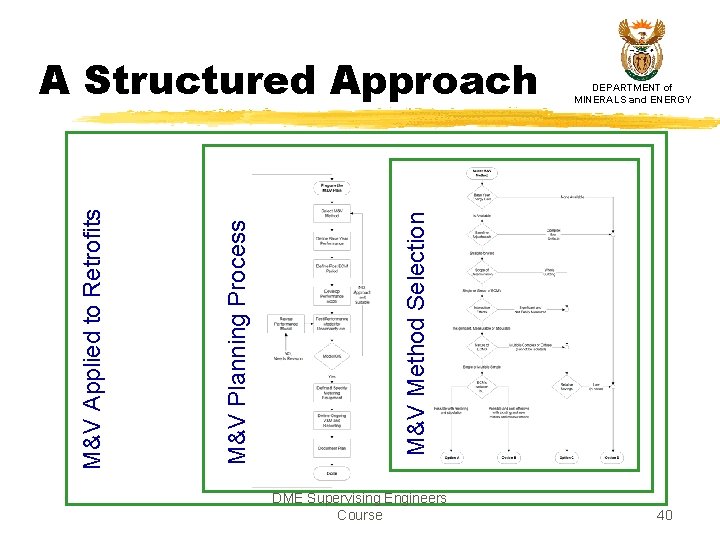
DEPARTMENT of MINERALS and ENERGY M&V Method Selection M&V Planning Process M&V Applied to Retrofits A Structured Approach DME Supervising Engineers Course 40
Define Post-EMO Period DEPARTMENT of MINERALS and ENERGY z. Time z. Planned changes to base year conditions z. Conditions for comparison of base year and post-EMO period z. Non-routine baseline adjustments DME Supervising Engineers Course 41
Develop Energy Performance Model DEPARTMENT of MINERALS and ENERGY z. Select data analysis techniques z. Develop algorithms & equations z. Establish assumptions & stipulations z. Develop spreadsheets/ acquire software DME Supervising Engineers Course 42
Test/Revise Performance Model DEPARTMENT of MINERALS and ENERGY z. Quantify expected accuracy/uncertainty z. Assess budget impact of accuracy/uncertainty changes z. Define a cost effective level of accuracy/uncertainty acceptable to all parties DME Supervising Engineers Course 43
Define and specify metering equipment DEPARTMENT of MINERALS and ENERGY z. Make use of available data y. EMS, BMS, other systems z. Meter y. Accuracy y. Precision y. Calibration y. Commissioning DME Supervising Engineers Course 44
Define Ongoing M&V Activities DEPARTMENT of MINERALS and ENERGY z. Frequency z. Meter reading and witnessing z. Data analysis z. Quality assurance procedures z. Report formats and content DME Supervising Engineers Course 45
Implement the EMOs DEPARTMENT of MINERALS and ENERGY z. Install energy efficient equipment z. Install M&V measurement equipment z. Commission new systems and equipment DME Supervising Engineers Course 46
Implement the M&V Plan DEPARTMENT of MINERALS and ENERGY z. Collect data z. Apply performance model z. Make non-routine baseline adjustments z. Report/document energy savings z. Calculate energy cost savings and GHG emission reductions as needed DME Supervising Engineers Course 47
Risk Factors DEPARTMENT of MINERALS and ENERGY z. Financial, Operational and Performance z. Assess potential impact z. Identify z. Assign &/or clarify responsibility for management and mitigation DME Supervising Engineers Course 48
Financial Risk Factor DEPARTMENT of MINERALS and ENERGY z. Interest rates z. Energy prices z. Construction costs z. M&V Costs z. Delays z. Major changes in facility DME Supervising Engineers Course 49
Operational Risk Factors DEPARTMENT of MINERALS and ENERGY z. Operating hours z. Equipment loads z. Weather z. Life of equipment z. User participation DME Supervising Engineers Course 50
Performance Risk Factor DEPARTMENT of MINERALS and ENERGY z. Equipment performance z. Maintenance z. Operation DME Supervising Engineers Course 51
Applying Price & GHG Factors to Energy Savings DEPARTMENT of MINERALS and ENERGY z. Use incremental (marginal) prices for y. Electrical energy & demand y. Thermal contract demand (gas, steam etc. ) y. Thermal energy z. GHG emissions factors (kg/TJ or kg/k. Wh etc. ) y. Provincial marginal or average y. National marginal or average DME Supervising Engineers Course 52
Applying Energy Prices DEPARTMENT of MINERALS and ENERGY z. Need to know: y. Energy saved (k. Wh, GJ) x. By time-of-day for TOU rates y. Demand saved (k. VA, l/day, kg/hr) x. For on/off peak periods z. Other factors: y. Transformer credits y. Demand ratchets y. Power factor y. Other discounts/surcharges DME Supervising Engineers Course 53