Military Airworthiness and UAS A European perspective 1



- Slides: 18
Military Airworthiness and UAS A European perspective 1 st February 2008 Heiko Possel
Contents • Involvement of EDA • What are the problems for military aviation • UAV traffic insertion • Military Aviation Safety • Role of EASA • Conclusions
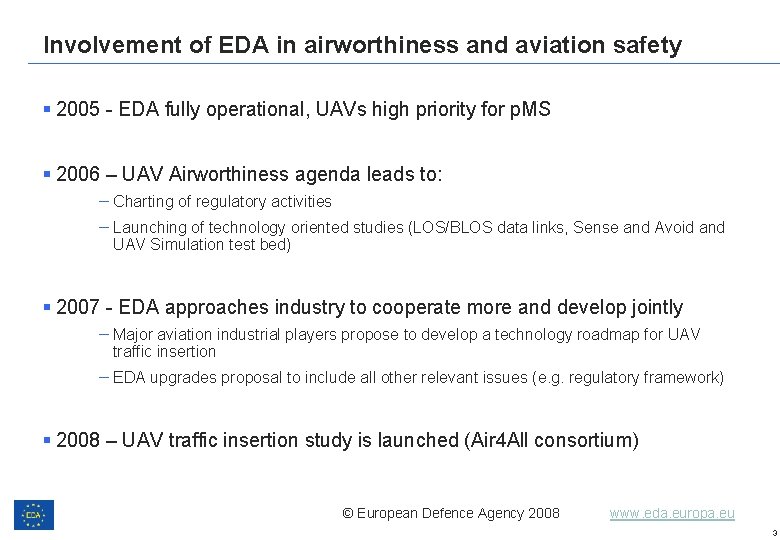
Involvement of EDA in airworthiness and aviation safety § 2005 - EDA fully operational, UAVs high priority for p. MS § 2006 – UAV Airworthiness agenda leads to: - Charting of regulatory activities - Launching of technology oriented studies (LOS/BLOS data links, Sense and Avoid and UAV Simulation test bed) § 2007 - EDA approaches industry to cooperate more and develop jointly - Major aviation industrial players propose to develop a technology roadmap for UAV traffic insertion - EDA upgrades proposal to include all other relevant issues (e. g. regulatory framework) § 2008 – UAV traffic insertion study is launched (Air 4 All consortium) © European Defence Agency 2008 www. eda. europa. eu 3
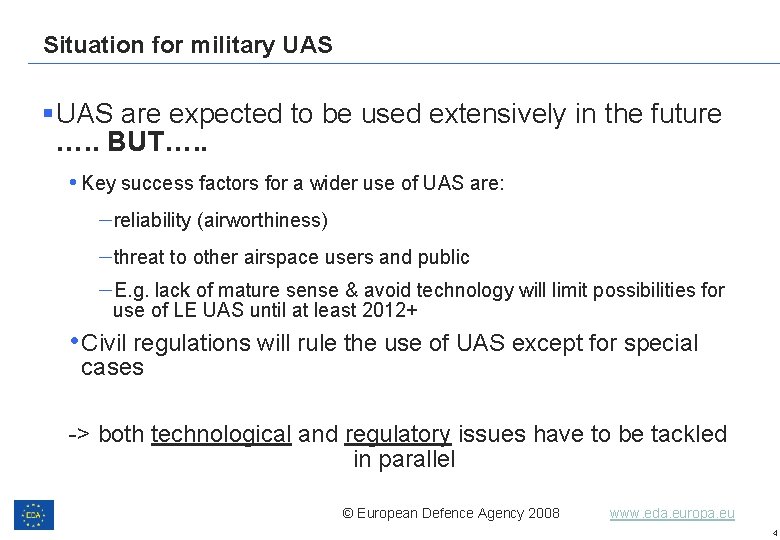
Situation for military UAS §UAS are expected to be used extensively in the future …. . BUT…. . • Key success factors for a wider use of UAS are: -reliability (airworthiness) -threat to other airspace users and public -E. g. lack of mature sense & avoid technology will limit possibilities for use of LE UAS until at least 2012+ • Civil regulations will rule the use of UAS except for special cases -> both technological and regulatory issues have to be tackled in parallel © European Defence Agency 2008 www. eda. europa. eu 4
What are the problems? §Fragmentation of activities: • Lots of initiatives but little coordination/ cooperation - Several industries build experimental UAS - Several working groups address the regulatory issues - Several nations are developing sense&avoid technology • Island solutions or coherent EU/NATO approach? -No (common) regulatory framework for military UAS -little involvement of responsible military authorities? © European Defence Agency 2008 www. eda. europa. eu 5
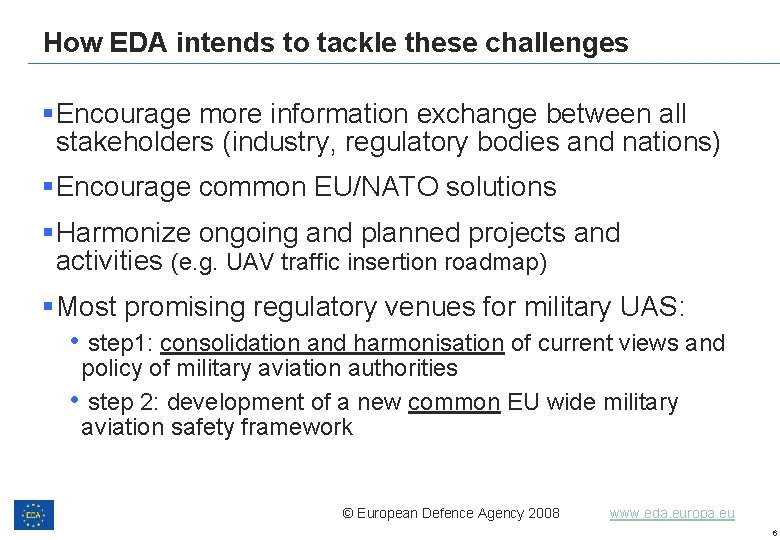
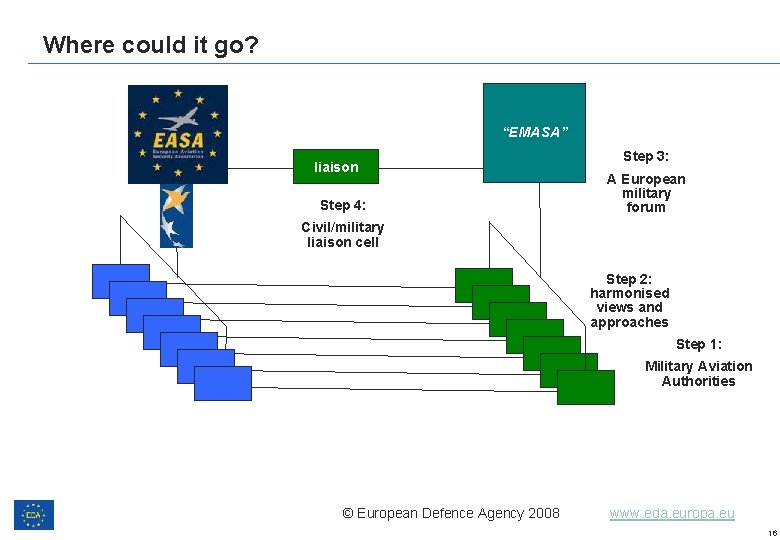
How EDA intends to tackle these challenges §Encourage more information exchange between all stakeholders (industry, regulatory bodies and nations) §Encourage common EU/NATO solutions §Harmonize ongoing and planned projects and activities (e. g. UAV traffic insertion roadmap) §Most promising regulatory venues for military UAS: • step 1: consolidation and harmonisation of current views and policy of military aviation authorities • step 2: development of a new common EU wide military aviation safety framework © European Defence Agency 2008 www. eda. europa. eu 6
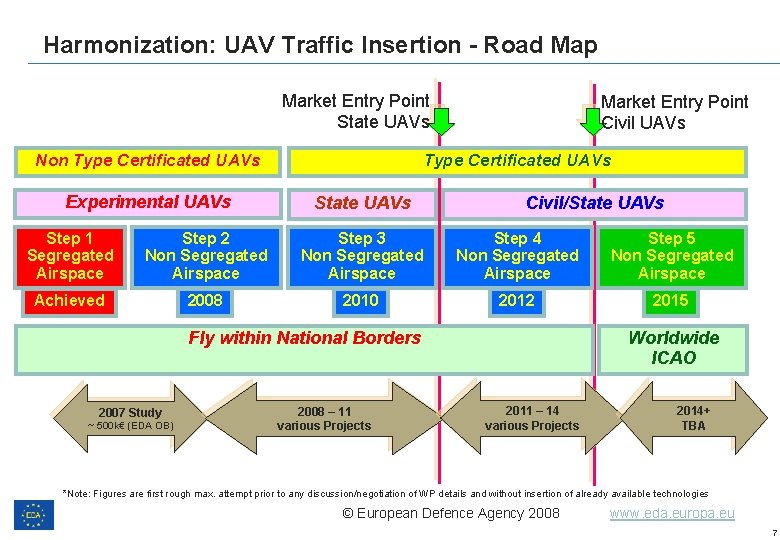
Harmonization: UAV Traffic Insertion - Road Map Market Entry Point State UAVs Non Type Certificated UAVs Experimental UAVs Market Entry Point Civil UAVs Type Certificated UAVs State UAVs Civil/State UAVs Step 1 Segregated Airspace Step 2 Non Segregated Airspace Step 3 Non Segregated Airspace Step 4 Non Segregated Airspace Step 5 Non Segregated Airspace Achieved 2008 2010 2012 2015 Fly within National Borders 2007 Study ~ 500 k€ (EDA OB) 2008 – 11 various Projects Worldwide ICAO 2011 – 14 various Projects 2014+ TBA *Note: Figures are first rough max. attempt prior to any discussion/negotiation of WP details and without insertion of already available technologies © European Defence Agency 2008 www. eda. europa. eu 7
Contents • Involvement of EDA • What are the problems for military aviation • UAV traffic insertion • Military Aviation Safety • Role of EASA • Conclusions
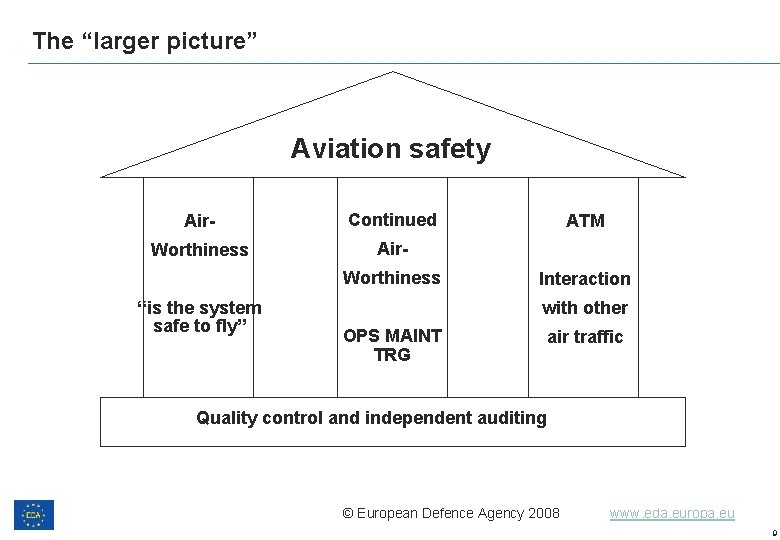
The “larger picture” Aviation safety Air- Continued Worthiness Air. Worthiness “is the system safe to fly” ATM Interaction with other OPS MAINT TRG air traffic Quality control and independent auditing © European Defence Agency 2008 www. eda. europa. eu 9
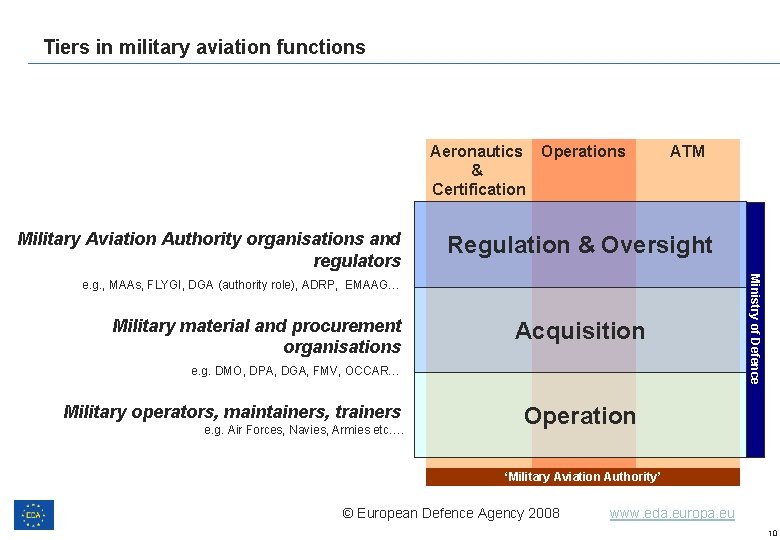
Tiers in military aviation functions Aeronautics Operations & Certification Military Aviation Authority organisations and regulators ATM Regulation & Oversight Military material and procurement organisations Acquisition e. g. DMO, DPA, DGA, FMV, OCCAR… Military operators, maintainers, trainers e. g. Air Forces, Navies, Armies etc…. Ministry of Defence e. g. , MAAs, FLYGI, DGA (authority role), ADRP, EMAAG… Operation ‘Military Aviation Authority’ © European Defence Agency 2008 www. eda. europa. eu 10
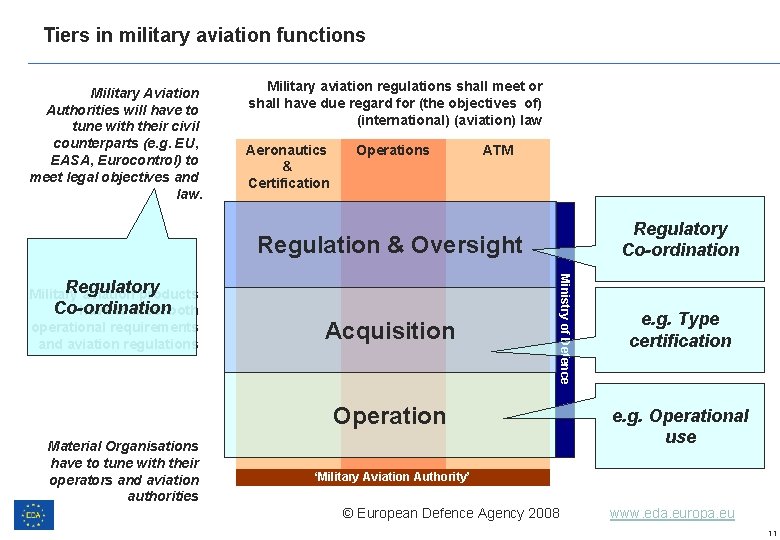
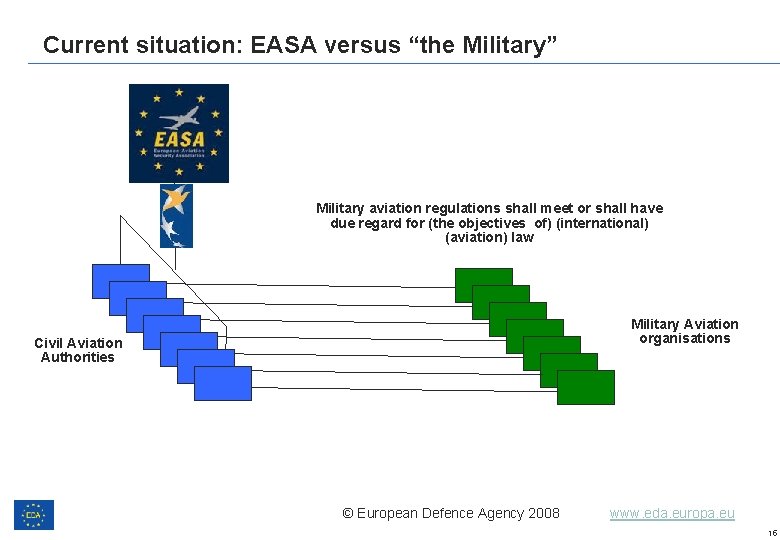
Tiers in military aviation functions Military Aviation Authorities will have to tune with their civil counterparts (e. g. EU, EASA, Eurocontrol) to meet legal objectives and law. Military aviation regulations shall meet or shall have due regard for (the objectives of) (international) (aviation) law Aeronautics & Certification Operations ATM Regulatory Co-ordination Regulation & Oversight Acquisition Ministry of Defence Regulatory Military aviation products Co-ordination have to meet both operational requirements and aviation regulations Operation Material Organisations have to tune with their operators and aviation authorities e. g. Type certification e. g. Operational use ‘Military Aviation Authority’ © European Defence Agency 2008 www. eda. europa. eu 11
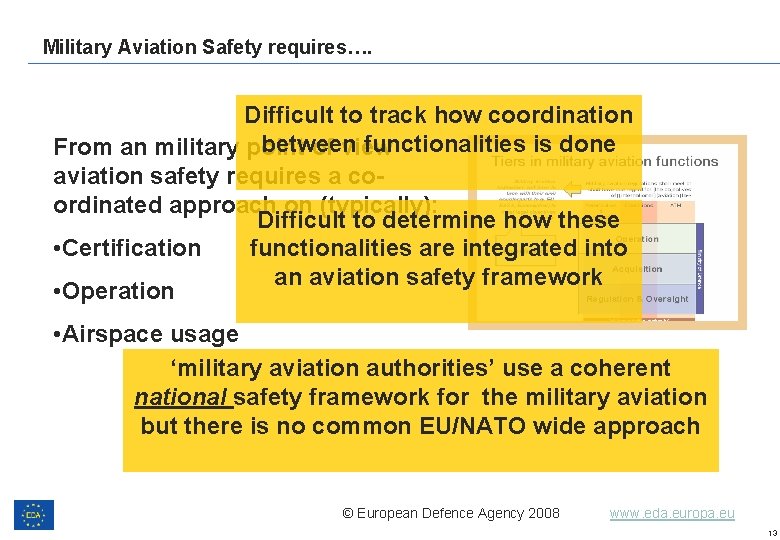
Military Aviation Safety requires…. Difficult to track how coordination between functionalities is done From an military point of view aviation safety requires a coordinated approach on (typically): Difficult to determine how these • Certification functionalities are integrated into an aviation safety framework • Operation • Airspace usage ‘military aviation authorities’ use a coherent national safety framework for the military aviation but there is no common EU/NATO wide approach © European Defence Agency 2008 www. eda. europa. eu 13
© European Defence Agency 2008 www. eda. europa. eu 14
Current situation: EASA versus “the Military” Military aviation regulations shall meet or shall have due regard for (the objectives of) (international) (aviation) law Military Aviation organisations Civil Aviation Authorities © European Defence Agency 2008 www. eda. europa. eu 15
Where could it go? “EMASA” liaison Step 4: Step 3: A European military forum Civil/military liaison cell Step 2: harmonised views and approaches Step 1: Military Aviation Authorities © European Defence Agency 2008 www. eda. europa. eu 16
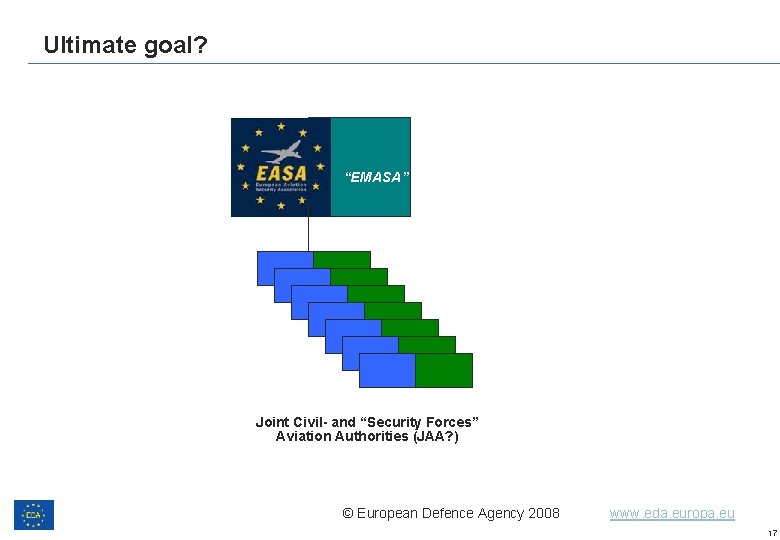
Ultimate goal? “EMASA” Joint Civil- and “Security Forces” Aviation Authorities (JAA? ) © European Defence Agency 2008 www. eda. europa. eu 17
Conclusions § EDA is focusing on: • Addressing the challenges to achieve UAV traffic insertion • Encouraging more and intensified cooperation between industries and governments to • create a viable aeronautical industrial base Encouraging military aviation organisations to harmonize views and approaches and collaborate more and better § EDA suggests that: • EASA should take the lead in tackling the regulatory issues around UAVs and traffic • • insertion EASA should try to involve military authorities in the regulatory process to enable “state” use of UAVs EUROCONTROL should remain involved in EUROCAE, FINAS and the EDA traffic insertion study § EDA encourages: • Military aviation organisations to evolve in recognisable, transparent military aviation • • authorities Military Aviation Authorities to intensify the sharing of experiences and views Military Aviation Authorities to work on harmonisation of regulations and procedures on a European scale in line with European ambitions © European Defence Agency 2008 www. eda. europa. eu 18
QUESTIONS ? ?