Mechanical Properties of Wood Group 4 Hunter Klein

- Slides: 18
Mechanical Properties of Wood Group 4 Hunter Klein Patrick Kloecker Matthew Brenfleck
Significance/Relation to Future Engineering Career • People use wood for all types of structures: • • Buildings Footbridges Playgrounds Shelter / Homes • Wood is used as a structural material frequently • Crucial for engineers to understand its varying properties • Create useable and safe designs
Purpose / Objective • Purpose: • Measure the mechanical properties of wood as a function of grain orientation, moisture content, and loading conditions • Compression, shear, and bending stress tests • Shrinkage • Objective: • Gain an understanding of wood characteristics, such as strength, stiffness and shrinkage
Theory/Background (Hunter)
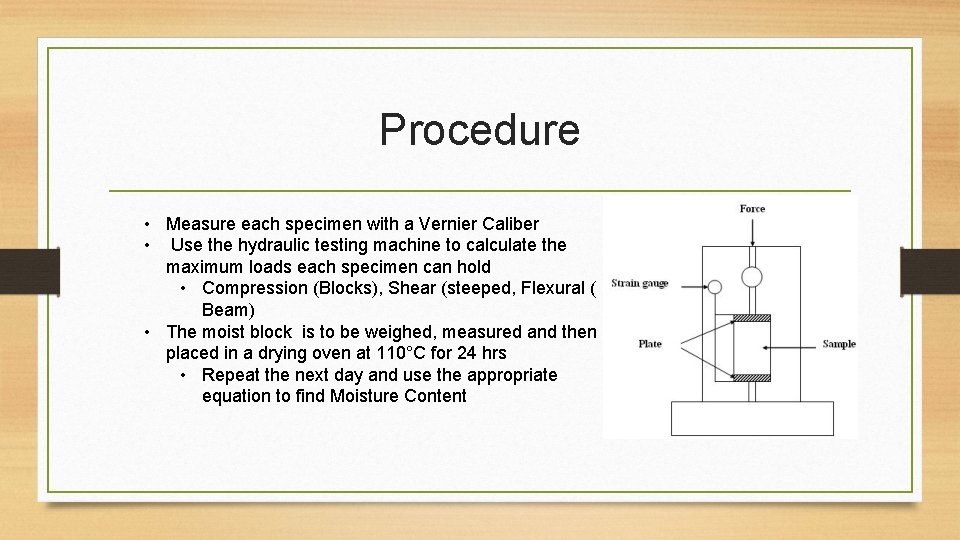
Procedure • Measure each specimen with a Vernier Caliber • Use the hydraulic testing machine to calculate the maximum loads each specimen can hold • Compression (Blocks), Shear (steeped, Flexural ( Beam) • The moist block is to be weighed, measured and then placed in a drying oven at 110°C for 24 hrs • Repeat the next day and use the appropriate equation to find Moisture Content
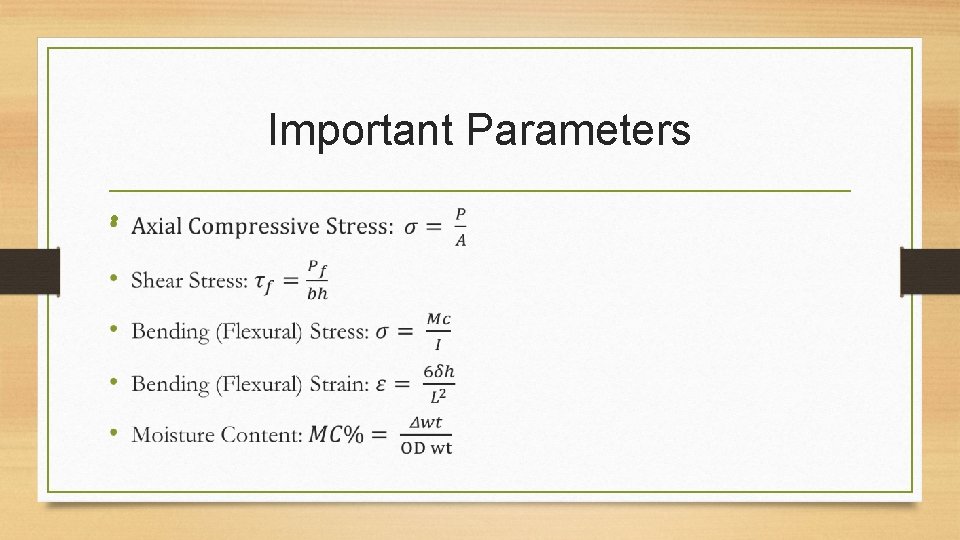
Compression • One block is to be placed going with grain and one against • Force Parallel with wood fibers: • The block fails when there are physical signs of the wood splitting • Force Perpendicular to wood fiber: • Block fails when it reaches a deformation of 0. 075, seen on the dial gauge • Apply the Axial Compressive Stress equations
Shear • Place stepped specimen in device • Add force until specimen breaks along shear plane • Apply Shear Stress equation
Flexural (beam) • Place beam on two metal blocks • Record deflection measurements as load increases • Add load to beam in increments 0. 075 in found on dial until splitting
Important Parameters •
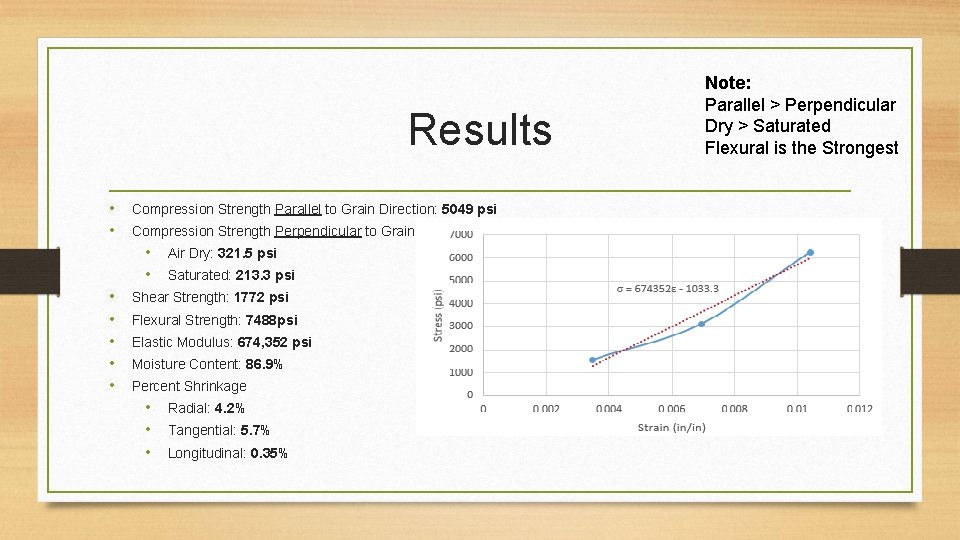
Results • • Compression Strength Parallel to Grain Direction: 5049 psi Compression Strength Perpendicular to Grain: • • Air Dry: 321. 5 psi Saturated: 213. 3 psi Shear Strength: 1772 psi Flexural Strength: 7488 psi Elastic Modulus: 674, 352 psi Moisture Content: 86. 9% Percent Shrinkage • • • Radial: 4. 2% Tangential: 5. 7% Longitudinal: 0. 35% Note: Parallel > Perpendicular Dry > Saturated Flexural is the Strongest
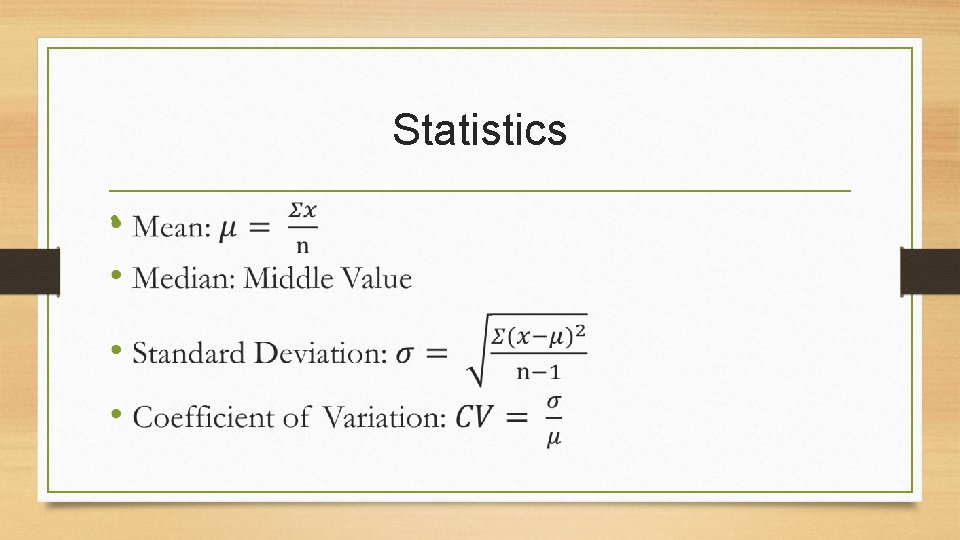
Statistics •
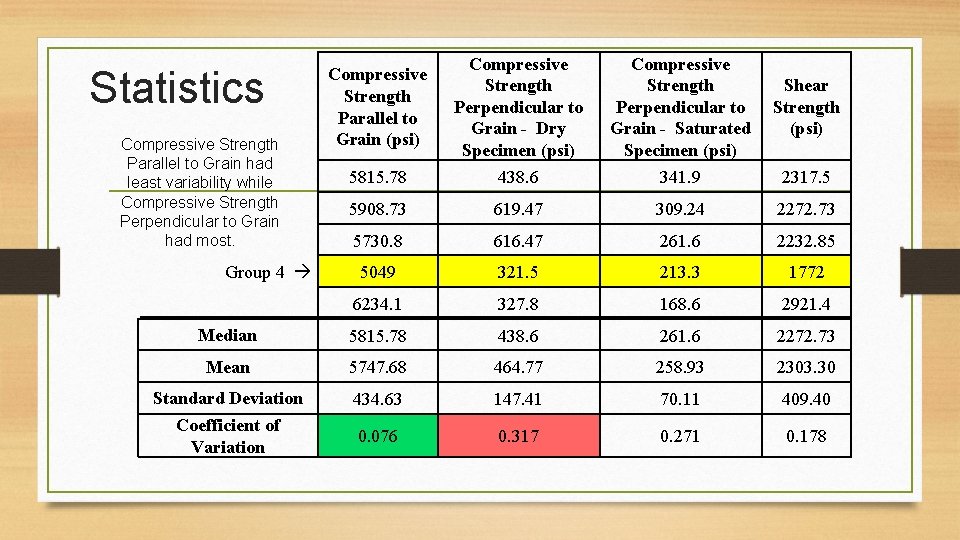
Compressive Strength Parallel to Grain (psi) Compressive Strength Perpendicular to Grain - Dry Specimen (psi) Compressive Strength Perpendicular to Grain - Saturated Specimen (psi) Shear Strength (psi) 5815. 78 438. 6 341. 9 2317. 5 5908. 73 619. 47 309. 24 2272. 73 5730. 8 616. 47 261. 6 2232. 85 5049 321. 5 213. 3 1772 6234. 1 327. 8 168. 6 2921. 4 Median 5815. 78 438. 6 261. 6 2272. 73 Mean 5747. 68 464. 77 258. 93 2303. 30 Standard Deviation Coefficient of Variation 434. 63 147. 41 70. 11 409. 40 0. 076 0. 317 0. 271 0. 178 Statistics Compressive Strength Parallel to Grain had least variability while Compressive Strength Perpendicular to Grain had most. Group 4
Sources of Error: Systematic • Reproducible inaccuracies due to a problem that persists throughout the entire experiment • Examples: • If dial gage not properly zeroed, but experimenters think so • Improperly reading the Vernier Caliper when taking dimension measurements (or misreading any measurement)
Sources of Error: Random • Statistical fluctuations caused by small, unknown and unpredictable changes in the experiment • Examples: • Imperfections in the wood samples • (knots vs. no knots) • Environmental variations • Temperature • Humidity
Correcting Errors Add some? • Know how to use all equipment • Double check experiment set up • Same experiment conditions • Environment • Similar Specimens • Take multiple measurements
Conclusions – Mechanical Properties of Wood • Specimens with fewer grain lines and more distance between the grain lines have a higher load capacity than specimens with more, close together grain lines. These visible marks on the wood most likely are imperfections and are the reason behind the lower strength. • A dry specimen is stronger than the same specimen in a saturated state. • Wood is stronger when a force is applied parallel to the grain rather than perpendicular to the grain. • Structural wood is strongest when put under a bending force. Therefore, wood’s best use as a construction material is as beams that withstand flexural forces. • The elastic modulus of wood is roughly 700, 000 psi. This value is lower than that of structural steel and structural concrete, which is why these materials tend to be used on larger buildings that will endure greater loads.
Conclusions – Statistical Analysis • Variability exists in the data sets due to two different types of errors, systematic and random • Systematic errors: reproducible inaccuracies • Random errors: statistical fluctuations • Compressive Strength Parallel to Grain had least variability while Compressive Strength Perpendicular to Grain had most • Include questions regarding accuracy/precision, repeatability/reproducibility?
Questions?