INTRO TO HUNTER SAFETY EDUCATION Lesson 1 Introduction

- Slides: 13
INTRO TO HUNTER SAFETY EDUCATION Lesson 1
Introduction To Hunter Education Why Hunter Education? Mandated hunter education program began in New York in 1949. Later, safety coordinators formed the International Hunter Education Association (IHEA). IHEA’s mission is to foster hunting by developing safe, responsible, and knowledgeable hunters. IHEA developed the core curriculum on which this course is based.
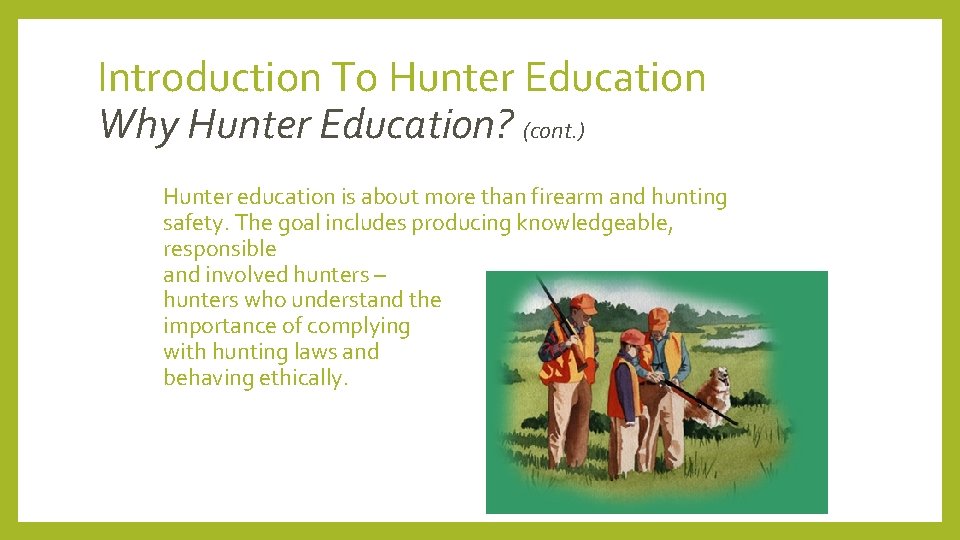
Introduction To Hunter Education Why Hunter Education? (cont. ) Hunter education is about more than firearm and hunting safety. The goal includes producing knowledgeable, responsible and involved hunters – hunters who understand the importance of complying with hunting laws and behaving ethically.
Introduction To Hunter Education Why Hunter Education? (cont. ) Hunter education strives to instill responsibility, improve skills and knowledge and encourage the involvement of hunters. • Responsibility: A true hunter has responsible behavior – including courtesy, respect of others and of wildlife, and involvement. Responsible hunters obey hunting laws, hunt fairly, practice safety rules and wait for a clean kill before shooting.
Introduction To Hunter Education Why Hunter Education? (cont. ) • Safety Skills: Hunting-related safety skills gained through hands-on training and practice. • Knowledge: Before being trained in the skill of firearm shooting, you should know how the firearm operates and how to safely handle it. • Involvement: A true, responsible sportsman is involved in efforts to make hunting a respected sport – teaching others, working with landowners, and cooperating with game wardens. It also includes joining conservation organizations, which will help preserve habitat and promote wildlife management.
North American Wildlife Conservation Model History • As early settlers made their way West, North America’s wildlife populations diminished due to market-hunting and habitat loss. Many species were on the brink of extinction. Elk, bison, bighorn sheep, black bears—even whitetail deer—had all but disappeared across the country. Hunters and anglers realized they needed to set limits in order to protect what they loved and assume responsibility for the stewardship of our natural resources. • Hunters like Theodore Roosevelt and George Bird Grinnell rallied fellow sportsmen. They pushed for hunting regulations and established conservation groups to protect habitat.
North American Wildlife Conservation Model The principles of the North American Wildlife Conservation Model are explained more fully through a set of guidelines known as the Seven Sisters for Conservation. • Sister #1 – Wildlife is Held in the Public Trust: In North America, natural resources and wildlife on public lands are managed by government agencies to ensure that current and future generations always have wildlife and wild places to enjoy. • Sister #2 – Prohibition on Commerce of Dead Wildlife: Commercial hunting and the sale of wildlife is prohibited to ensure the sustainability of wildlife populations.
North American Wildlife Conservation Model • Sister #3 – Democratic Rule of Law : Hunting and fishing laws are created through the public process where everyone has the opportunity and responsibility to develop systems of wildlife conservation and use. • Sister #4 – Hunting Opportunity for All: Every citizen has an opportunity, under the law, to hunt and fish in the United States and Canada. • Sister #5 – Non-Frivolous Use: In North America, individuals may legally kill certain wild animals under strict guidelines for food and fur, self-defense and property protection. Laws restrict against the casual killing of wildlife merely for antlers, horns or feathers.
North American Wildlife Conservation Model • Sister #6 – International Resources: Wildlife and fish migrate freely across boundaries between states, provinces and countries. Working together, the United States and Canada jointly coordinate wildlife and habitat management strategies. The Migratory Bird Treaty Act of 1918 demonstrates this cooperation between countries to protect wildlife. The Act made it illegal to capture or kill migratory birds, except as allowed by specific hunting regulations. • Sister #7 – Scientific Management: Sound science is essential to managing and sustaining North America’s wildlife and habitats. For example, researchers put radio collars on elk to track the animals’ movements to determine where elk give birth and how they react to motor vehicles on forest roads.
Introduction To Hunter Education Funding Sources U. S. Fish and Wildlife Service provides federal aid to state wildlife agencies to support hunting-related projects. Federal Aid in Wildlife Restoration funding was established in 1937 by the Pittman. Robertson Act:
Introduction To Hunter Education Funding Sources (cont. ) • The Act funds selection, restoration, and improvement of wildlife habitat, and wildlife management research. It was amended in 1970 to include funding for hunter education and for public target ranges. • Funds for the Act come from federal excise tax on sporting arms, ammunition, and archery equipment, and handguns. • Each state’s proportion of the federal funds is based on the area of the state and number of licensed hunters.
Introduction To Hunter Education Funding Sources (cont. ) • State wildlife agencies sponsor the hunter education programs that are found in each state or province. • Non-governmental organizations (Ducks Unlimited, National Rifle Association, International Hunter Education Association, etc. ) offer hunter education and firearm safety education materials and training • Firearms and archery manufacturers often provide training materials on use of their products. • Local hunting and civic clubs, and businesses often provide the facilities and equipment for hunter education courses.
Introduction To Hunter Education Review Questions v. What is a primary objective of hunter education? v. Name three hunting-related projects for which the Federal Aid in Wildlife Restoration Act (Pittman-Robertson Act) provides funding. v. Is a state highway department a source of hunter education funding? v. Name three behaviors of a responsible hunters.