Measuring Innovation in Education and Training Innovation in
- Slides: 7
Measuring Innovation in Education and Training Innovation in Services Brainstorming session Paris, 11 June 2009
Innovation in Services • Services are now the largest sector in OECD economies • Innovation in services may differ from innovation in manufacturing: – In manufacturing: accumulation of capabilities: Knowledge stocks and flows – In Services: Knowledge flows • Innovation in services tend to be: – The creation of new knowledge or information – New ways of organising internal operations – New ways of handling things or people
Innovation in Services • Characteristics of innovation in services: – Close relationship between client and service supplier – Solutions tend to be more taylor-made than standardised – Innovation output is often intangible (quality vs productivity improvement)
Measuring Innovation in Services • Indicators and methods for valuing innovation in manufacturing may only be partially applicable for business services: – R&D investment (no formalised R&D depts) – Employees in R&D – Patents (intangible outputs) • Can indicators from CIS measure Innovation in Services? – Partially. Some indicators may be more used, but they are not sufficient
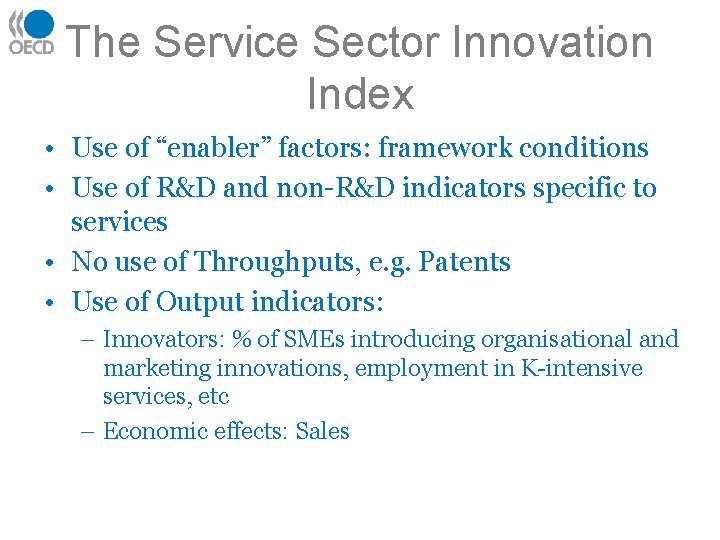
The Service Sector Innovation Index • Use of “enabler” factors: framework conditions • Use of R&D and non-R&D indicators specific to services • No use of Throughputs, e. g. Patents • Use of Output indicators: – Innovators: % of SMEs introducing organisational and marketing innovations, employment in K-intensive services, etc – Economic effects: Sales
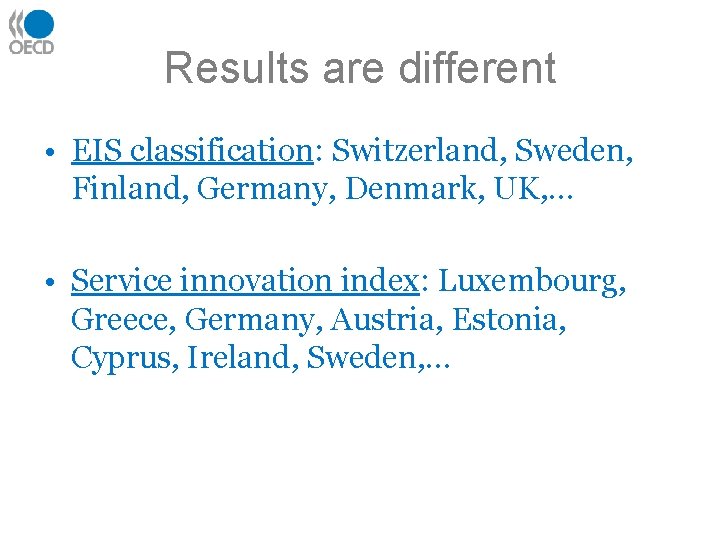
Results are different • EIS classification: Switzerland, Sweden, Finland, Germany, Denmark, UK, … • Service innovation index: Luxembourg, Greece, Germany, Austria, Estonia, Cyprus, Ireland, Sweden, …
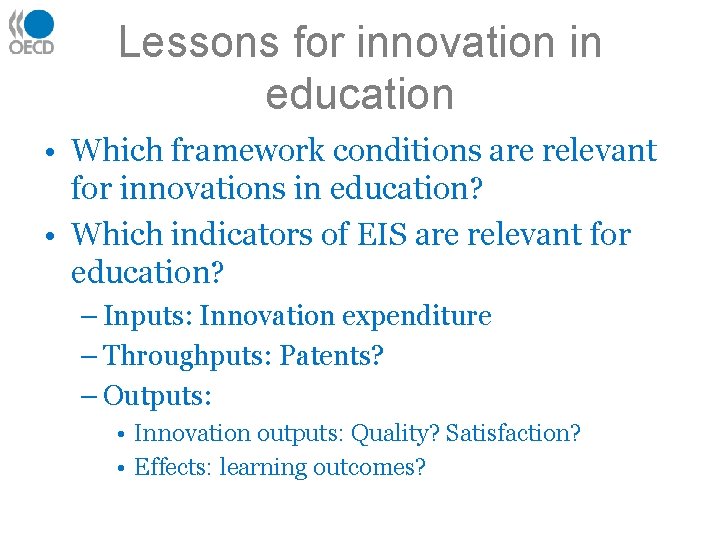
Lessons for innovation in education • Which framework conditions are relevant for innovations in education? • Which indicators of EIS are relevant for education? – Inputs: Innovation expenditure – Throughputs: Patents? – Outputs: • Innovation outputs: Quality? Satisfaction? • Effects: learning outcomes?