Master in Health Economics and Policy Ethics and
- Slides: 19
Master in Health Economics and Policy Ethics and Health (April 10 -June 19, 2012) Marc Le Menestrel marc. lemenestrel@upf. edu Raquel Gallego raquel. gallego@uab. cat
Session 5: Agenda setting and policy decision making. 1. Where does policy come from? Which and whose interests influence policymaking? 2. Case: Swine flu. Essay: Use an example to analyse how an issue is included on the agenda and how it is brought to a decision stage. Required reading: • Colebach, H. K. 2005. Policy. Buckingham. Open University Press. 2 nd edition. Ch. 3 -4, pp. 22 -48. [PDF] • Swine Flu case. [PDF] Optional reading: • Colebach, H. K. 2005. Policy. Buckingham. Open University Press. 2 nd edition. Ch. 5 -6, pp. 49 -81. • Smith, K. ; Larimer, C. 2009. The Public Policy Theory Primer, Westview Press, pp. 49 -99.
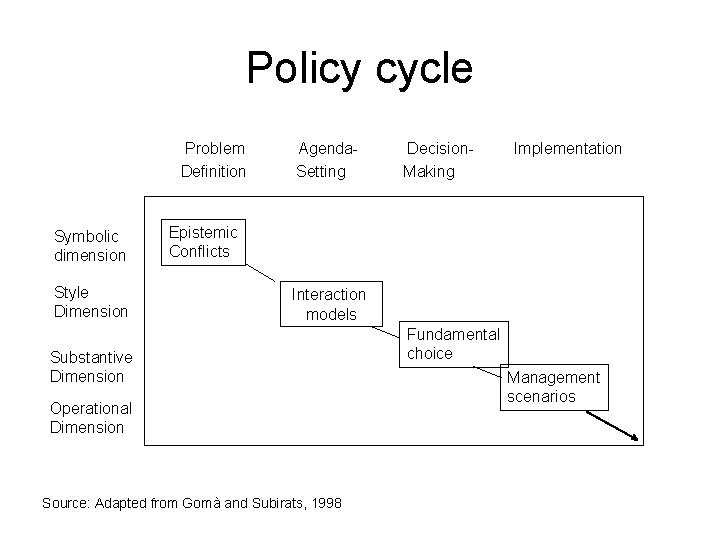
Policy cycle Problem Definition Symbolic dimension Style Dimension Agenda. Setting Decision. Making Implementation Epistemic Conflicts Interaction models Substantive Dimension Operational Dimension Source: Adapted from Gomà and Subirats, 1998 Fundamental choice Management scenarios
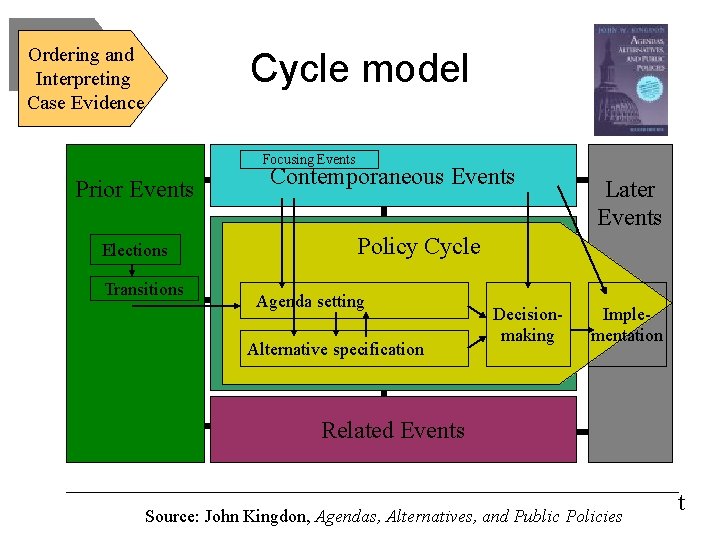
Ordering and Interpreting Case Evidence Cycle model Focusing Events Prior Events Elections Transitions Contemporaneous Events Later Events Policy Cycle Agenda setting The Episode Alternative specification Decisionmaking Implementation Related Events Source: John Kingdon, Agendas, Alternatives, and Public Policies t
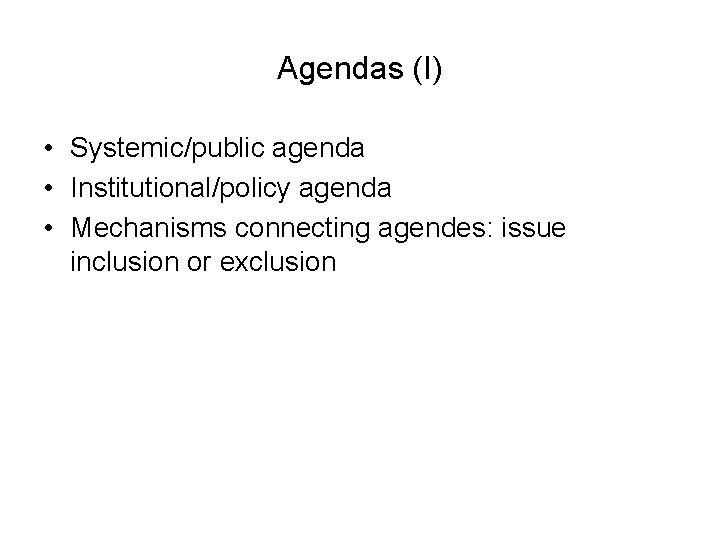
Agendas (I) • Systemic/public agenda • Institutional/policy agenda • Mechanisms connecting agendes: issue inclusion or exclusion
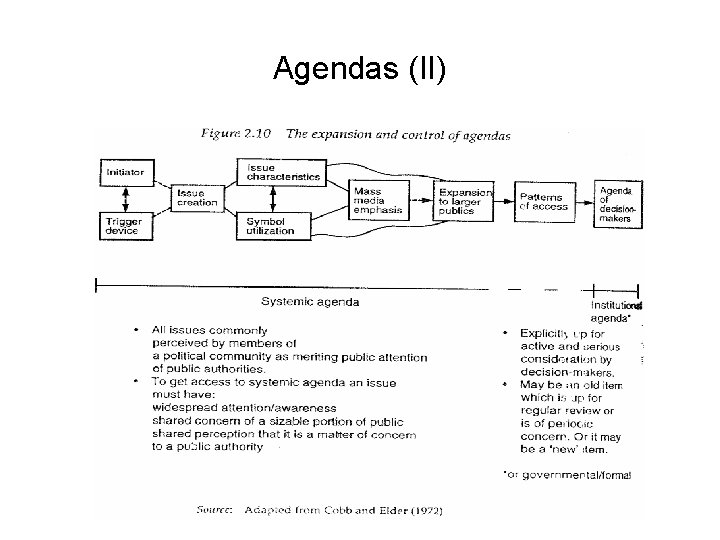
Agendas (II)
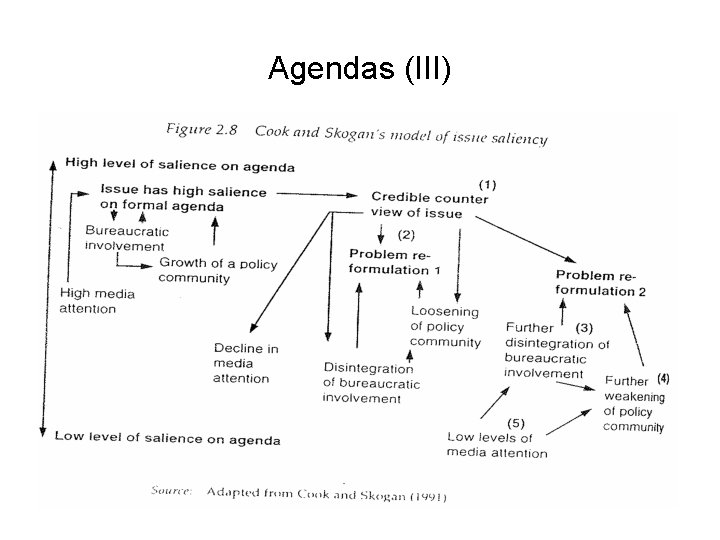
Agendas (III)
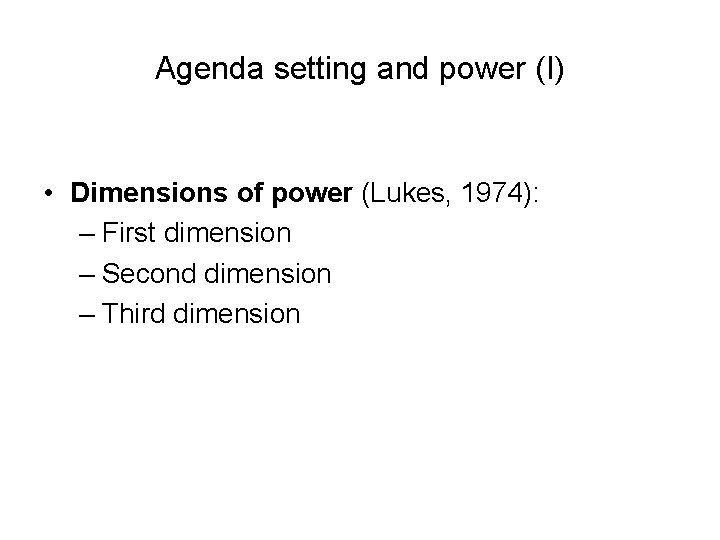
Agenda setting and power (I) • Dimensions of power (Lukes, 1974): – First dimension – Second dimension – Third dimension
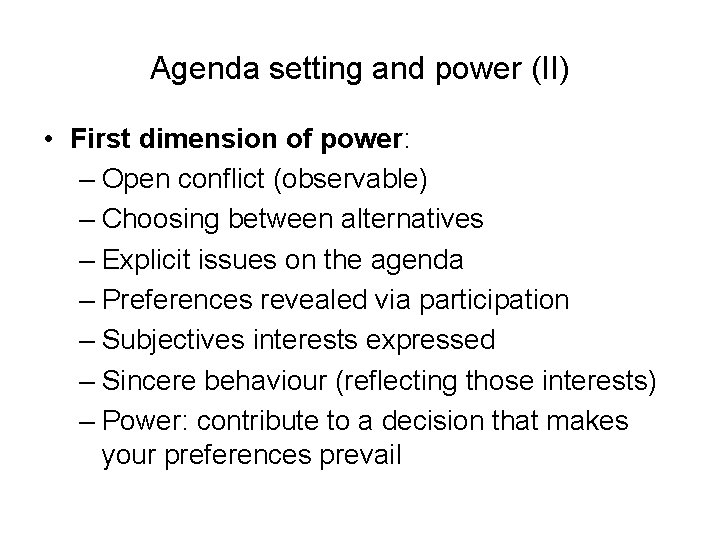
Agenda setting and power (II) • First dimension of power: – Open conflict (observable) – Choosing between alternatives – Explicit issues on the agenda – Preferences revealed via participation – Subjectives interests expressed – Sincere behaviour (reflecting those interests) – Power: contribute to a decision that makes your preferences prevail
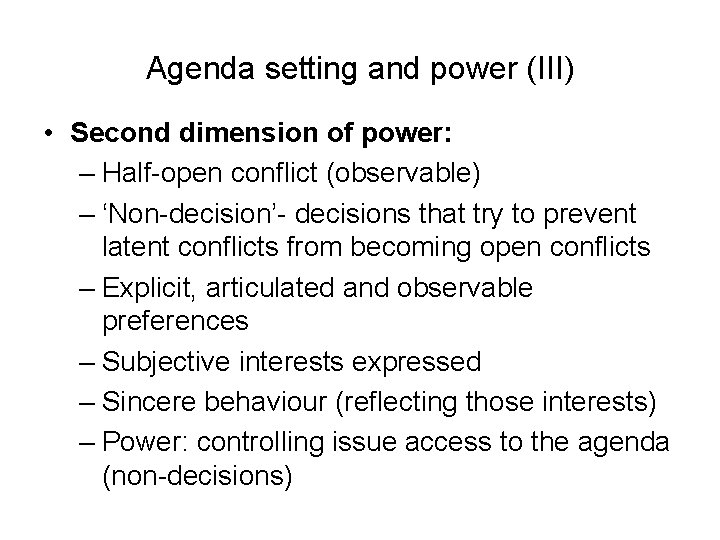
Agenda setting and power (III) • Second dimension of power: – Half-open conflict (observable) – ‘Non-decision’- decisions that try to prevent latent conflicts from becoming open conflicts – Explicit, articulated and observable preferences – Subjective interests expressed – Sincere behaviour (reflecting those interests) – Power: controlling issue access to the agenda (non-decisions)
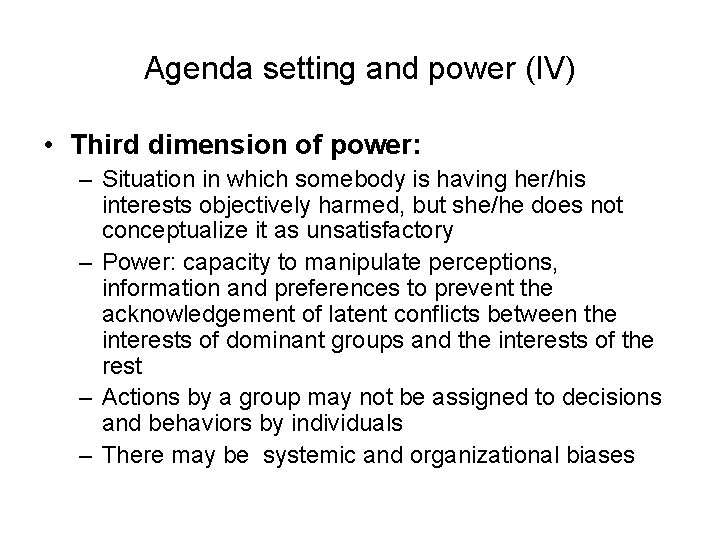
Agenda setting and power (IV) • Third dimension of power: – Situation in which somebody is having her/his interests objectively harmed, but she/he does not conceptualize it as unsatisfactory – Power: capacity to manipulate perceptions, information and preferences to prevent the acknowledgement of latent conflicts between the interests of dominant groups and the interests of the rest – Actions by a group may not be assigned to decisions and behaviors by individuals – There may be systemic and organizational biases
Agenda setting and decision making (I) • Kingdon’s model (1984) – Political stream – Problem stream – Policy choices
Agenda setting and decision making (II) • Baumgartner and Jones’s model (1993) – Issue image – Domain structure – Policy subsystem
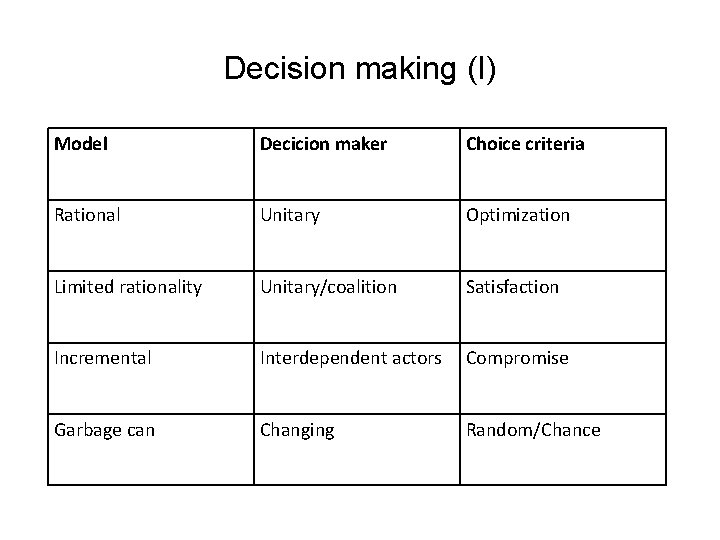
Decision making (I) Model Decicion maker Choice criteria Rational Unitary Optimization Limited rationality Unitary/coalition Satisfaction Incremental Interdependent actors Compromise Garbage can Changing Random/Chance
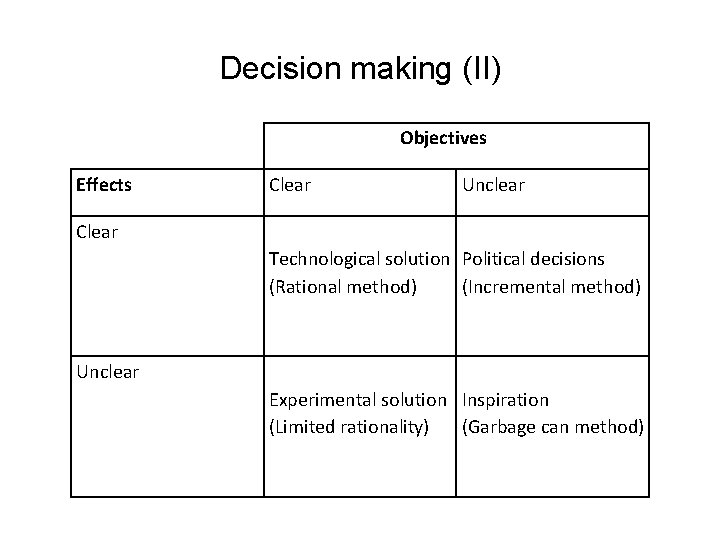
Decision making (II) Effects Objectives Clear Unclear Clear Technological solution Political decisions (Rational method) (Incremental method) Unclear Experimental solution Inspiration (Limited rationality) (Garbage can method)
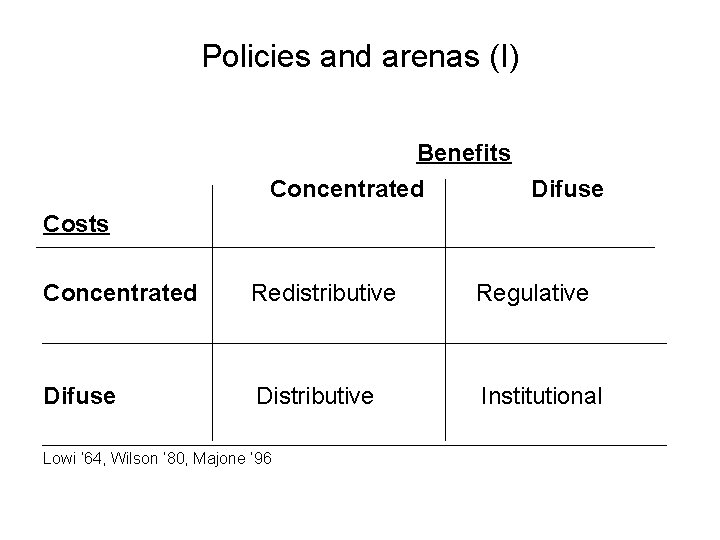
Policies and arenas (I) Benefits Concentrated Difuse Costs Concentrated Redistributive Regulative Difuse Distributive Institutional Lowi ’ 64, Wilson ’ 80, Majone ‘ 96
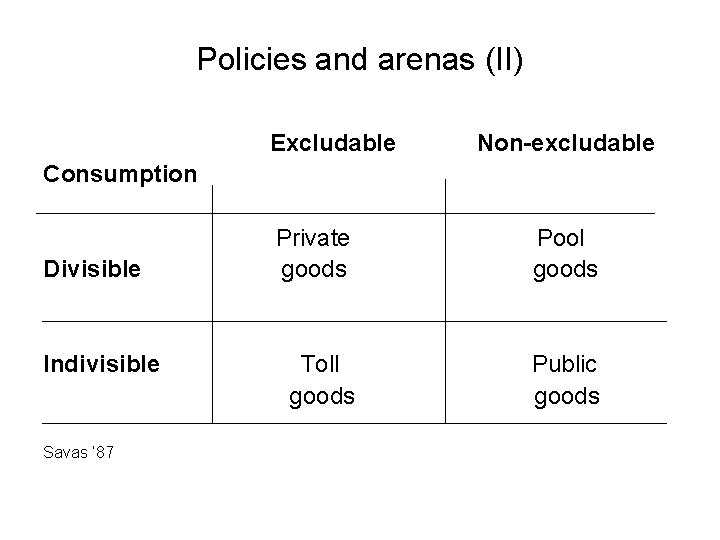
Policies and arenas (II) Excludable Non-excludable Consumption Divisible Indivisible Savas ’ 87 Private goods Pool goods Toll goods Public goods
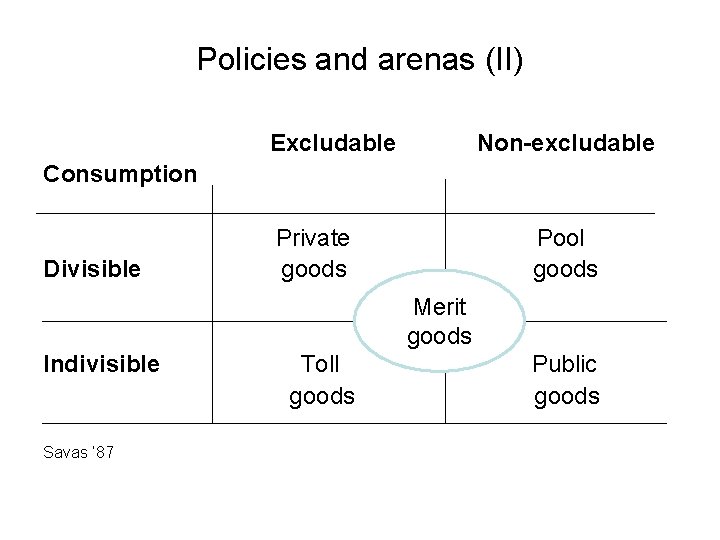
Policies and arenas (II) Excludable Non-excludable Consumption Divisible Private goods Pool goods Merit goods Indivisible Savas ’ 87 Toll goods Public goods
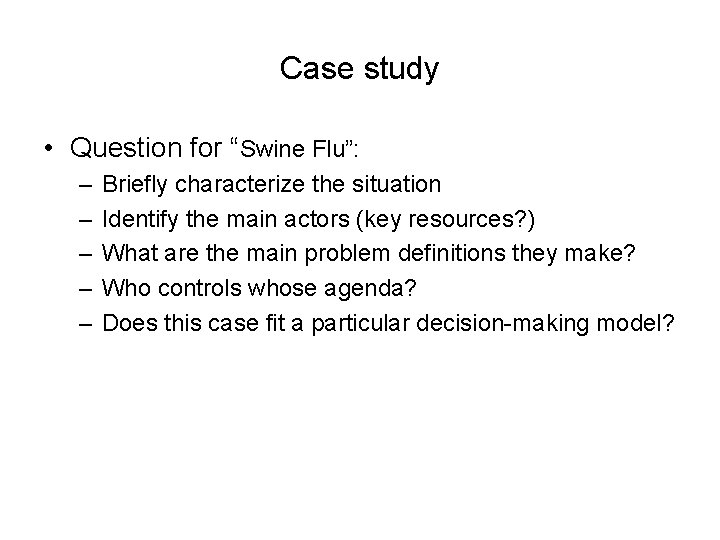
Case study • Question for “Swine Flu”: – – – Briefly characterize the situation Identify the main actors (key resources? ) What are the main problem definitions they make? Who controls whose agenda? Does this case fit a particular decision-making model?