Mary Godwin Shelley 1797 1851 LIFE Daughter of

- Slides: 8
Mary Godwin Shelley (1797 -1851)
LIFE • Daughter of William Godwin – an anarchist philosopher and a radical – and Mary Wollstonecraft – a feminist writer( “A Vindication of the Rights of Woman”) who died ten days after Mary was born as a result of puerperal fever. • Lived in a highly stimulating intellectual atmosphere where the main political issues and the literary trends of the periods were discussed. • Coleridge was a friend of her father and she heard him recite his famous “Rime of the Ancient Mariner”. • At 17 she eloped to France with the romantic poet Shelley, who was a disciple of her father’s. • In May 1816, they travelled to Lake Geneva to spend the summer near the famous and scandalous poet Lord Byron. • In December 1816, after Shelley's first wife’s suicide, they got married and Mary started to write “Frankenstein”.
Origins of “Frankenstein” • During the summer spent at Villa Diodati by Lake Geneva in Switzerland the weather was too cold and dreary to enjoy the traditional outdoor vacation activities they had planned, so forced to stay indoors they decided to read “Fantasmagoriana”, an anthology of German ghost stories. • Byron challenged the Shelleys and the other guests to compose their own story about the supernatural. The contest would be won by whoever wrote the scariest tale. • Mary herself , initially, had no inspiration for a story, which was a matter of great concern to her. • Finally, Mary conceived an idea after she fell into a waking dream(a sort of nightmare arousing feelings of intense fear, horror, and distress). • This nightmare served as the basis for the novel that she entitled “Frankenstein or the Modern Prometheus” (1818). • She also wrote other novels, such as “Valperga” and “The Last Man”, but they were not successful.
Main features of “Frankenstein” • It belongs to the Gothic tradition of fiction; • It doesn’t retain all the typical features of gothic stories: • it is not set in a gothic castle and does not deal with the supernatural. • Its Gothic elements • the description of the ugliness of the monster; • the horror it produces in its creator; • the terrible setting; • the use of a highly emotional language.
Main Themes • • • • 1. the Scientific Research issue the development of science of that period, the responsibility scientists have towards humanity, the Romantics’ desire to penetrate the secrets of life. 2. the Social Issue the ill-treatment the monster experiences, Jean Jacques Rousseau’s theory of the natural man. 3. the Search for Forbidden Knowledge Victor Frankenstein’s experiment can be seen as a warning against those who wanted to overcome the bounds and limits of natural laws and go beyond the boundaries of human knowledge. 4. the Overreacher Dr Frankenstein and Walton in their attempt to help human progress exceed their limits 5. the Double Walton and the Creature can be seen as Dr Frankenstein’s doubles; 6. the Loss of the woman’s role in the process of procreation sexual reproduction is no longer necessary if human beings can create life in the laboratory;
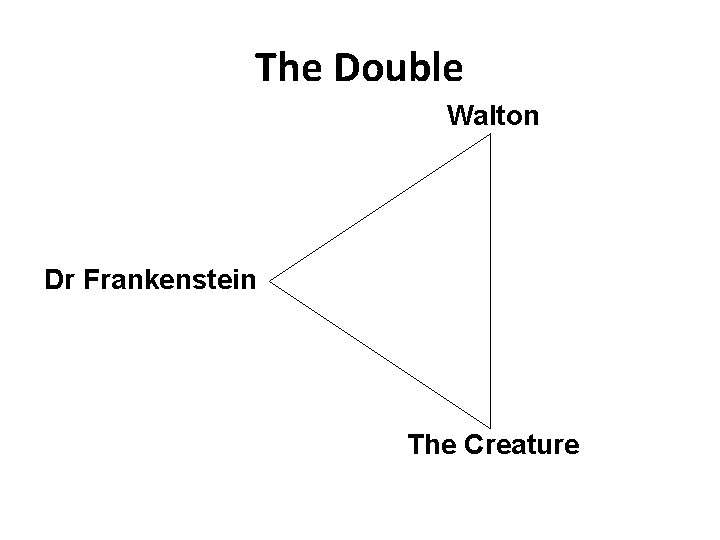
The Double Walton Dr Frankenstein The Creature
The Double • Walton is Dr Frankenstein’s alter ego because, like Dr Frankenstein, he … … has great ambitions; … overestimates his capacities; … wishes to overcome human limits; … finds himself alone in his hope to find a passage to the East; … is self-righteous (= somebody who believes that their own ideas and behaviour are morally better than those of other people); … is proud of being different from others; • The Creature represents Dr Frankenstein’s double because, like Dr Frankenstein, he … … suffers from a sense of isolation and alienation; … initially, desires to be good but then is obsessed by revenge and hate; • He also stands for the evil side of Dr Frankenstein’s personality (he kills several people and is responsible for the death of others)
The myth of Prometheus • Ancient Greek god, Prometheus, stole fire from the forge of Hephaestus and delivered it to mankind, teaching them how to use it both for light and warmth and, eventually, for cooking as well. With those final gifts, mortal man began to develop rapidly and soon turned away from the gods they had once worshipped so blindly