Markkinoiden juridinen toimintaymprist Kalvot 7 Yhtioikeus Piia Aitta

- Slides: 27
Markkinoiden juridinen toimintaympäristö Kalvot 7 Yhtiöoikeus Piia Aitta ja Matti Rudanko
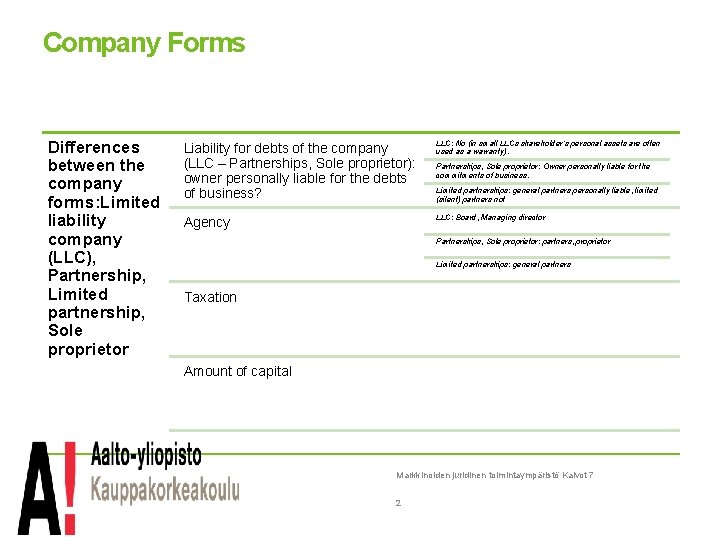
Company Forms Differences between the company forms: Limited liability company (LLC), Partnership, Limited partnership, Sole proprietor Liability for debts of the company (LLC – Partnerships, Sole proprietor): owner personally liable for the debts of business? LLC: No (in small LLCs shareholder’s personal assets are often used as a warranty). Agency LLC: Board, Managing director Partnerships, Sole proprietor: Owner personally liable for the commitments of business. Limited partnerships: general partners personally liable, limited (silent) partners not Partnerships, Sole proprietor: partners, proprietor Limited partnerships: general partners Taxation Amount of capital Markkinoiden juridinen toimintaympäristö Kalvot 7 2
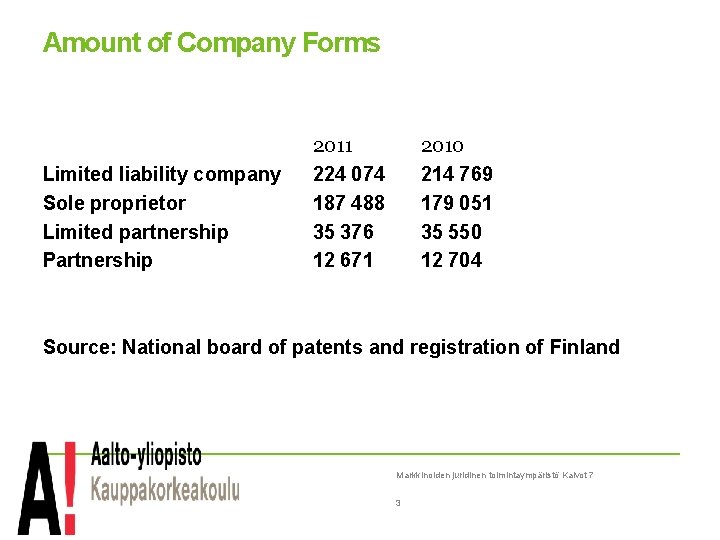
Amount of Company Forms Limited liability company Sole proprietor Limited partnership Partnership 2011 224 074 187 488 35 376 12 671 2010 214 769 179 051 35 550 12 704 Source: National board of patents and registration of Finland Markkinoiden juridinen toimintaympäristö Kalvot 7 3
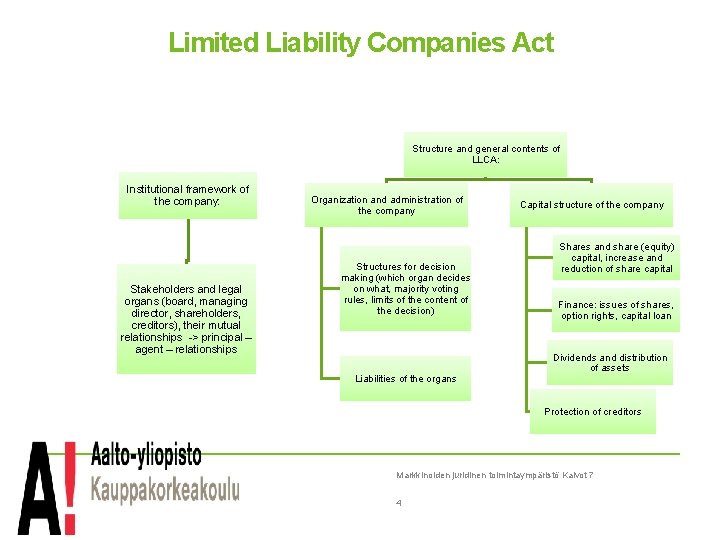
Limited Liability Companies Act Structure and general contents of LLCA: Institutional framework of the company: Stakeholders and legal organs (board, managing director, shareholders, creditors), their mutual relationships -> principal – agent – relationships Organization and administration of the company Structures for decision making (which organ decides on what, majority voting rules, limits of the content of the decision) Liabilities of the organs Capital structure of the company Shares and share (equity) capital, increase and reduction of share capital Finance: issues of shares, option rights, capital loan Dividends and distribution of assets Protection of creditors Markkinoiden juridinen toimintaympäristö Kalvot 7 4
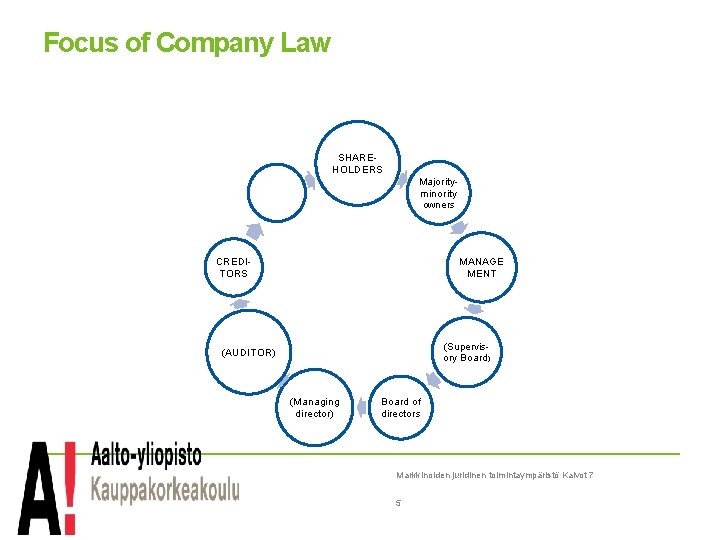
Focus of Company Law SHAREHOLDERS Majorityminority owners MANAGE MENT CREDITORS (Supervisory Board) (AUDITOR) (Managing director) Board of directors Markkinoiden juridinen toimintaympäristö Kalvot 7 5
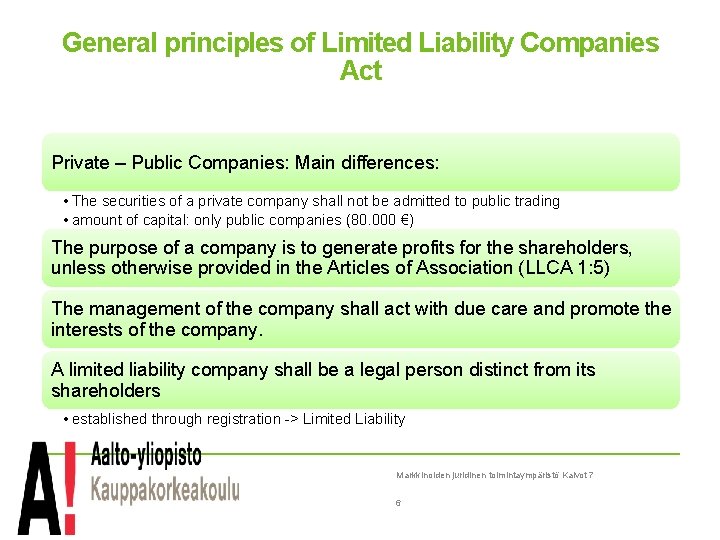
General principles of Limited Liability Companies Act Private – Public Companies: Main differences: • The securities of a private company shall not be admitted to public trading • amount of capital: only public companies (80. 000 €) The purpose of a company is to generate profits for the shareholders, unless otherwise provided in the Articles of Association (LLCA 1: 5) The management of the company shall act with due care and promote the interests of the company. A limited liability company shall be a legal person distinct from its shareholders • established through registration -> Limited Liability Markkinoiden juridinen toimintaympäristö Kalvot 7 6
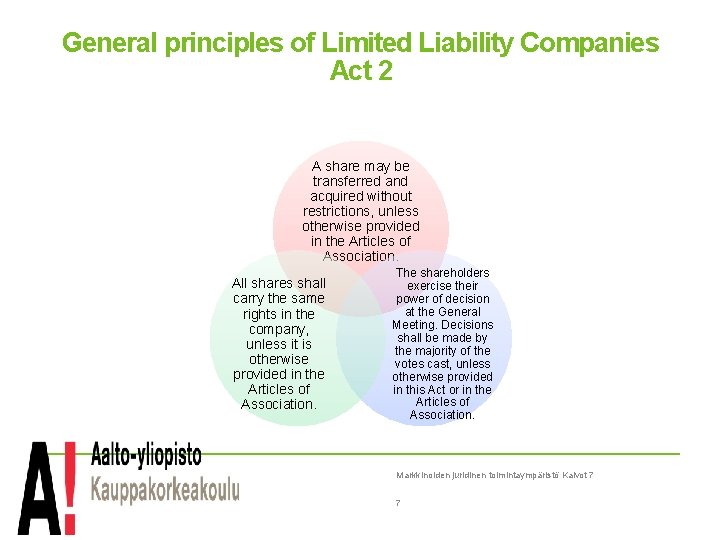
General principles of Limited Liability Companies Act 2 A share may be transferred and acquired without restrictions, unless otherwise provided in the Articles of Association. All shares shall carry the same rights in the company, unless it is otherwise provided in the Articles of Association. The shareholders exercise their power of decision at the General Meeting. Decisions shall be made by the majority of the votes cast, unless otherwise provided in this Act or in the Articles of Association. Markkinoiden juridinen toimintaympäristö Kalvot 7 7
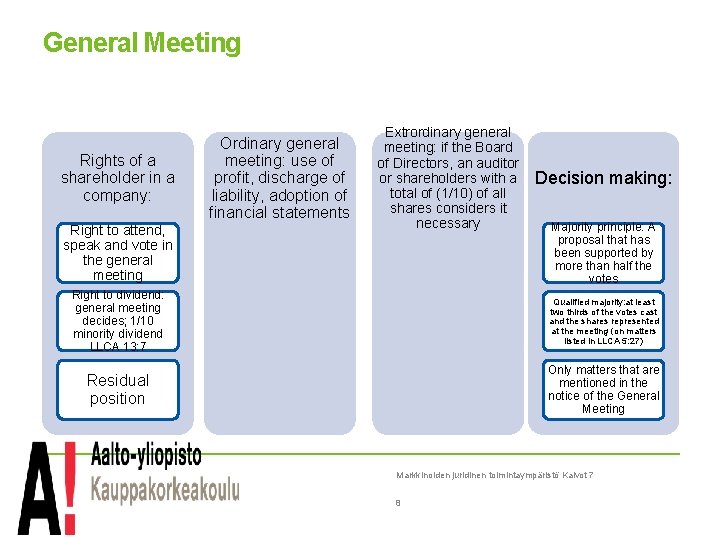
General Meeting Rights of a shareholder in a company: Right to attend, speak and vote in the general meeting Ordinary general meeting: use of profit, discharge of liability, adoption of financial statements Extrordinary general meeting: if the Board of Directors, an auditor or shareholders with a total of (1/10) of all shares considers it necessary Decision making: Majority principle: A proposal that has been supported by more than half the votes Right to dividend: general meeting decides; 1/10 minority dividend LLCA 13: 7 Qualified majority: at least two thirds of the votes cast and the shares represented at the meeting (on matters listed in LLCA 5: 27) Residual position Only matters that are mentioned in the notice of the General Meeting Markkinoiden juridinen toimintaympäristö Kalvot 7 8
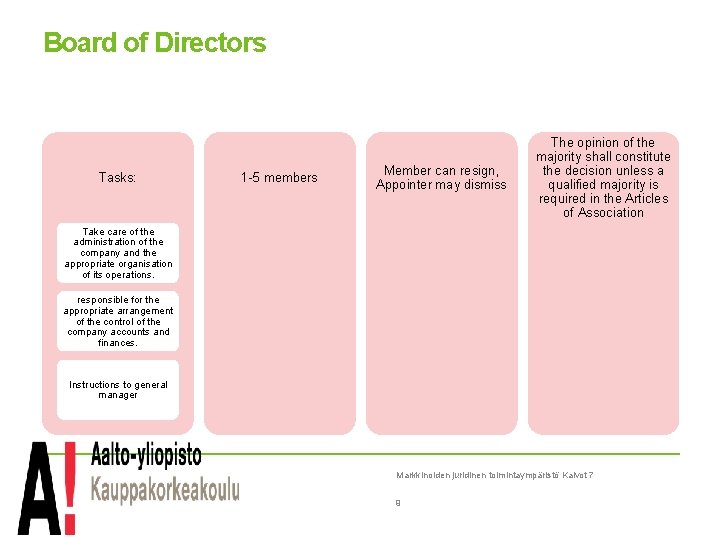
Board of Directors Tasks: 1 -5 members Member can resign, Appointer may dismiss The opinion of the majority shall constitute the decision unless a qualified majority is required in the Articles of Association Take care of the administration of the company and the appropriate organisation of its operations. responsible for the appropriate arrangement of the control of the company accounts and finances. Instructions to general manager Markkinoiden juridinen toimintaympäristö Kalvot 7 9
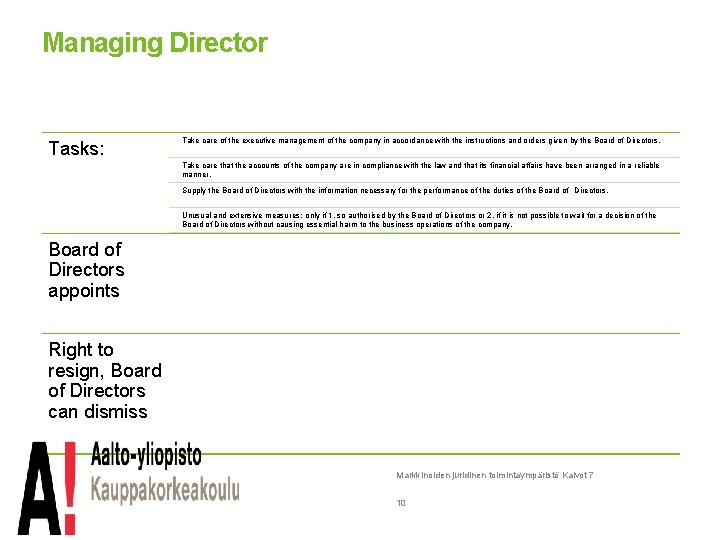
Managing Director Tasks: Take care of the executive management of the company in accordance with the instructions and orders given by the Board of Directors. Take care that the accounts of the company are in compliance with the law and that its financial affairs have been arranged in a reliable manner. Supply the Board of Directors with the information necessary for the performance of the duties of the Board of Directors. Unusual and extensive measures: only if 1. so authorised by the Board of Directors or 2. if it is not possible to wait for a decision of the Board of Directors without causing essential harm to the business operations of the company. Board of Directors appoints Right to resign, Board of Directors can dismiss Markkinoiden juridinen toimintaympäristö Kalvot 7 10
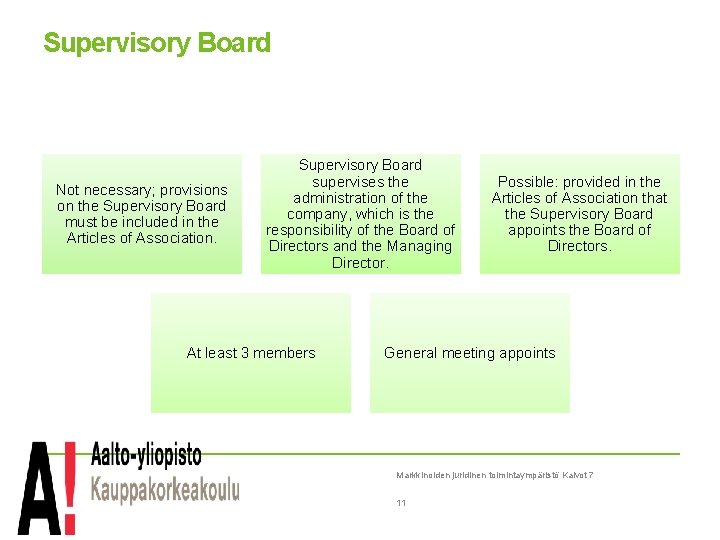
Supervisory Board Not necessary; provisions on the Supervisory Board must be included in the Articles of Association. Supervisory Board supervises the administration of the company, which is the responsibility of the Board of Directors and the Managing Director. At least 3 members Possible: provided in the Articles of Association that the Supervisory Board appoints the Board of Directors. General meeting appoints Markkinoiden juridinen toimintaympäristö Kalvot 7 11
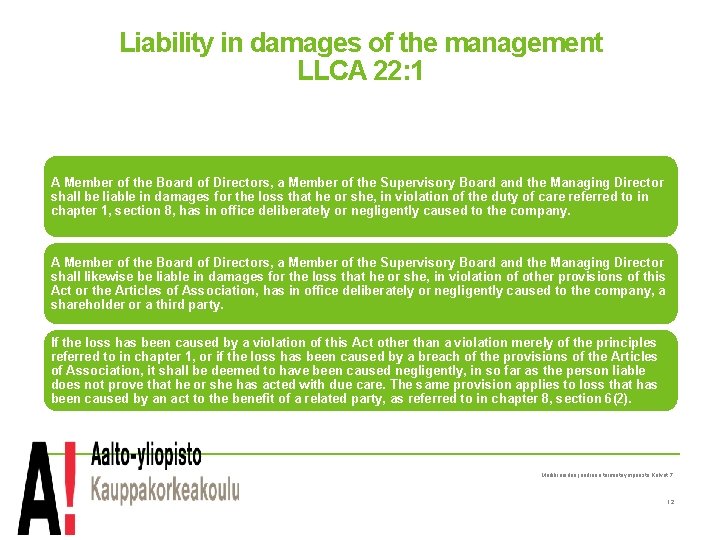
Liability in damages of the management LLCA 22: 1 A Member of the Board of Directors, a Member of the Supervisory Board and the Managing Director shall be liable in damages for the loss that he or she, in violation of the duty of care referred to in chapter 1, section 8, has in office deliberately or negligently caused to the company. A Member of the Board of Directors, a Member of the Supervisory Board and the Managing Director shall likewise be liable in damages for the loss that he or she, in violation of other provisions of this Act or the Articles of Association, has in office deliberately or negligently caused to the company, a shareholder or a third party. If the loss has been caused by a violation of this Act other than a violation merely of the principles referred to in chapter 1, or if the loss has been caused by a breach of the provisions of the Articles of Association, it shall be deemed to have been caused negligently, in so far as the person liable does not prove that he or she has acted with due care. The same provision applies to loss that has been caused by an act to the benefit of a related party, as referred to in chapter 8, section 6(2). Markkinoiden juridinen toimintaympäristö Kalvot 7 12
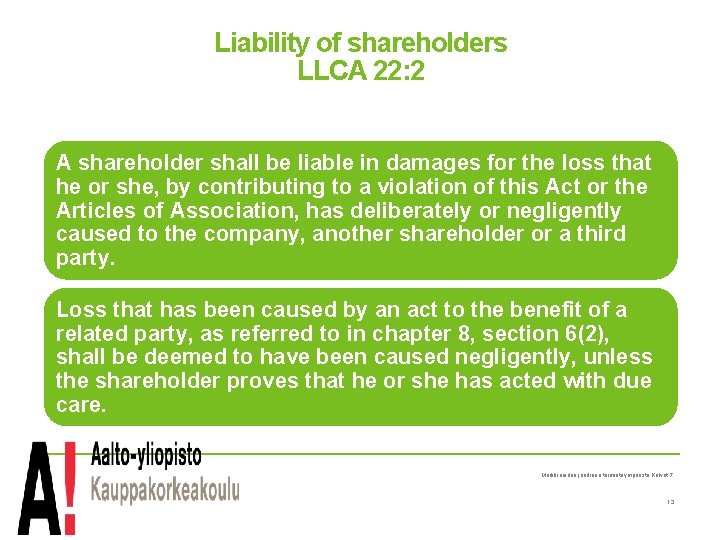
Liability of shareholders LLCA 22: 2 A shareholder shall be liable in damages for the loss that he or she, by contributing to a violation of this Act or the Articles of Association, has deliberately or negligently caused to the company, another shareholder or a third party. Loss that has been caused by an act to the benefit of a related party, as referred to in chapter 8, section 6(2), shall be deemed to have been caused negligently, unless the shareholder proves that he or she has acted with due care. Markkinoiden juridinen toimintaympäristö Kalvot 7 13
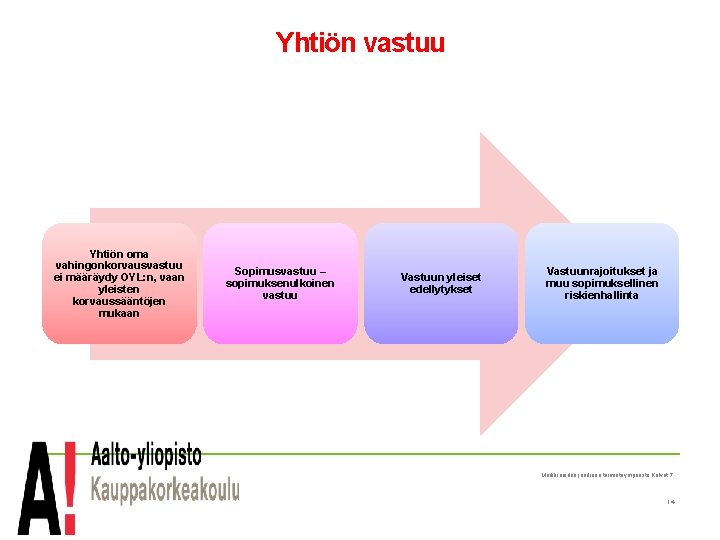
Yhtiön vastuu Yhtiön oma vahingonkorvausvastuu ei määräydy OYL: n, vaan yleisten korvaussääntöjen mukaan Sopimusvastuu – sopimuksenulkoinen vastuu Vastuun yleiset edellytykset Vastuunrajoitukset ja muu sopimuksellinen riskienhallinta Markkinoiden juridinen toimintaympäristö Kalvot 7 14
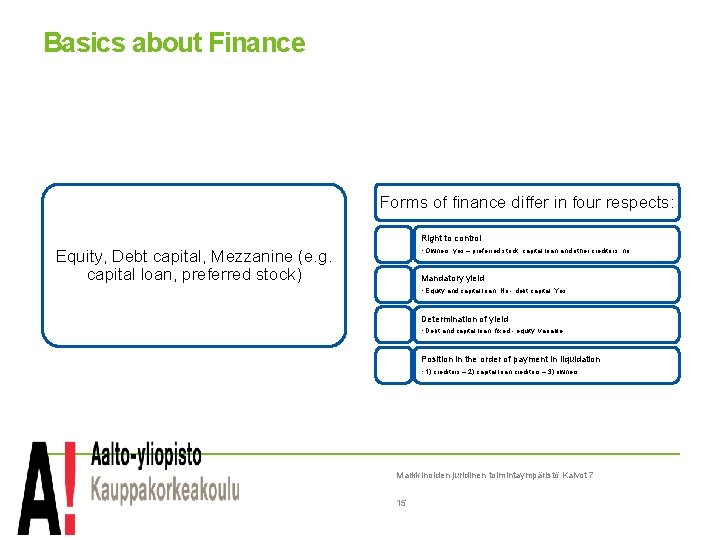
Basics about Finance Forms of finance differ in four respects: Right to control • Owners: yes – preferred stock, capital loan and other creditors: no Equity, Debt capital, Mezzanine (e. g. capital loan, preferred stock) Mandatory yield • Equity and capital loan: No - debt capital: Yes Determination of yield • Debt and capital loan: fixed - equity: variable Position in the order of payment in liquidation • 1) creditors – 2) capital loan creditors – 3) owners Markkinoiden juridinen toimintaympäristö Kalvot 7 15
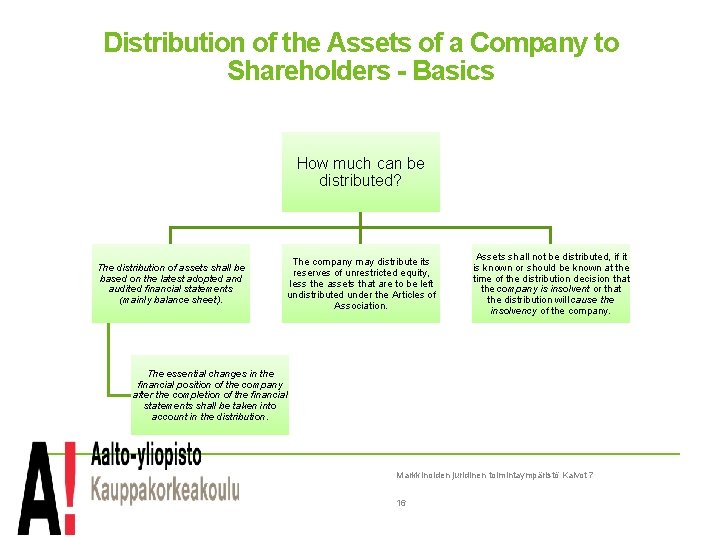
Distribution of the Assets of a Company to Shareholders - Basics How much can be distributed? The distribution of assets shall be based on the latest adopted and audited financial statements (mainly balance sheet). The company may distribute its reserves of unrestricted equity, less the assets that are to be left undistributed under the Articles of Association. Assets shall not be distributed, if it is known or should be known at the time of the distribution decision that the company is insolvent or that the distribution will cause the insolvency of the company. The essential changes in the financial position of the company after the completion of the financial statements shall be taken into account in the distribution. Markkinoiden juridinen toimintaympäristö Kalvot 7 16
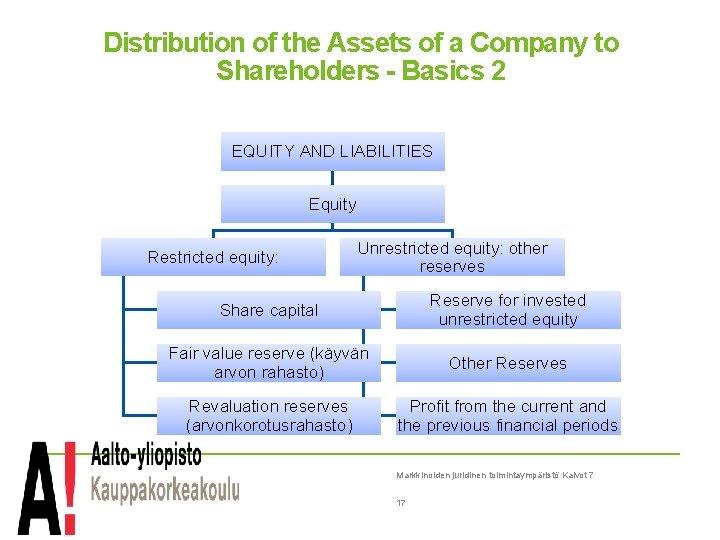
Distribution of the Assets of a Company to Shareholders - Basics 2 EQUITY AND LIABILITIES Equity Restricted equity: Unrestricted equity: other reserves Share capital Reserve for invested unrestricted equity Fair value reserve (käyvän arvon rahasto) Other Reserves Revaluation reserves (arvonkorotusrahasto) Profit from the current and the previous financial periods Markkinoiden juridinen toimintaympäristö Kalvot 7 17
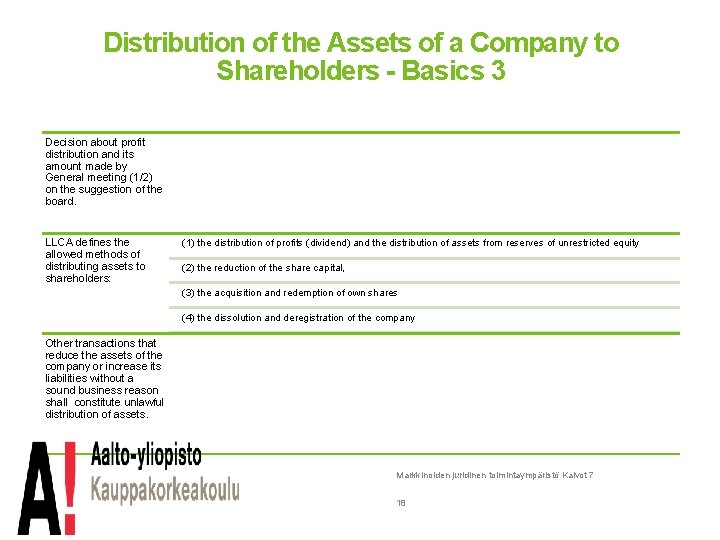
Distribution of the Assets of a Company to Shareholders - Basics 3 Decision about profit distribution and its amount made by General meeting (1/2) on the suggestion of the board. LLCA defines the allowed methods of distributing assets to shareholders: (1) the distribution of profits (dividend) and the distribution of assets from reserves of unrestricted equity (2) the reduction of the share capital, (3) the acquisition and redemption of own shares (4) the dissolution and deregistration of the company Other transactions that reduce the assets of the company or increase its liabilities without a sound business reason shall constitute unlawful distribution of assets. Markkinoiden juridinen toimintaympäristö Kalvot 7 18
Limited Liability Companies and Financial Markets
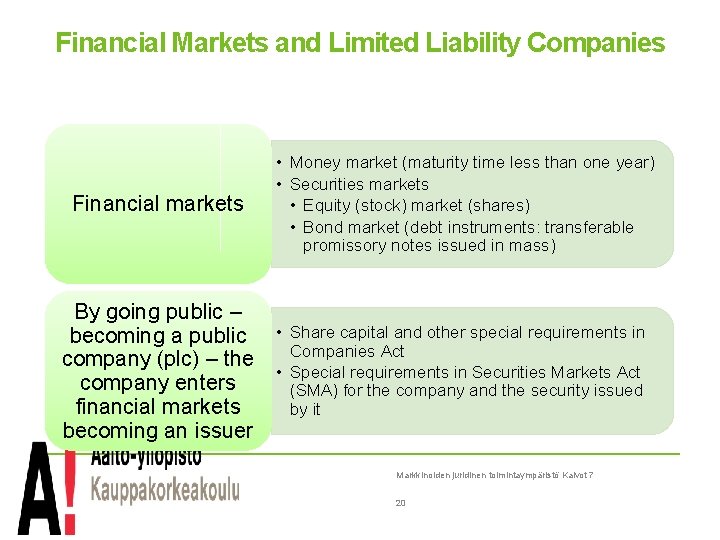
Financial Markets and Limited Liability Companies Financial markets • Money market (maturity time less than one year) • Securities markets • Equity (stock) market (shares) • Bond market (debt instruments: transferable promissory notes issued in mass) By going public – becoming a public company (plc) – the company enters financial markets becoming an issuer • Share capital and other special requirements in Companies Act • Special requirements in Securities Markets Act (SMA) for the company and the security issued by it Markkinoiden juridinen toimintaympäristö Kalvot 7 20
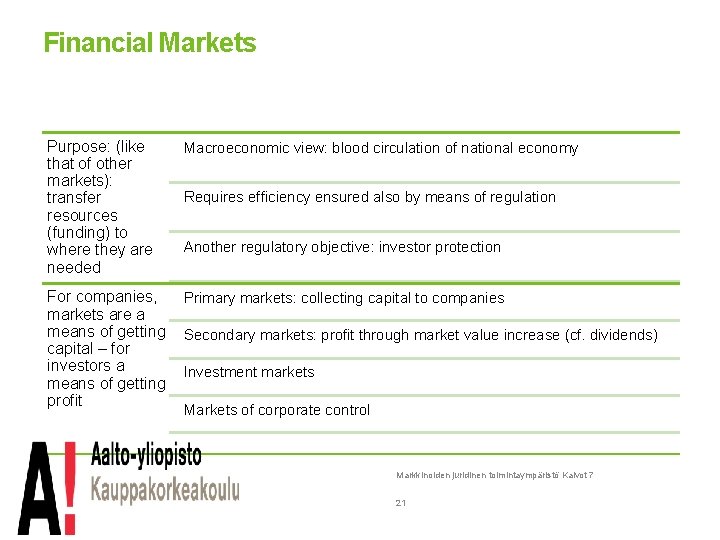
Financial Markets Purpose: (like that of other markets): transfer resources (funding) to where they are needed Macroeconomic view: blood circulation of national economy For companies, markets are a means of getting capital – for investors a means of getting profit Primary markets: collecting capital to companies Requires efficiency ensured also by means of regulation Another regulatory objective: investor protection Secondary markets: profit through market value increase (cf. dividends) Investment markets Markets of corporate control Markkinoiden juridinen toimintaympäristö Kalvot 7 21
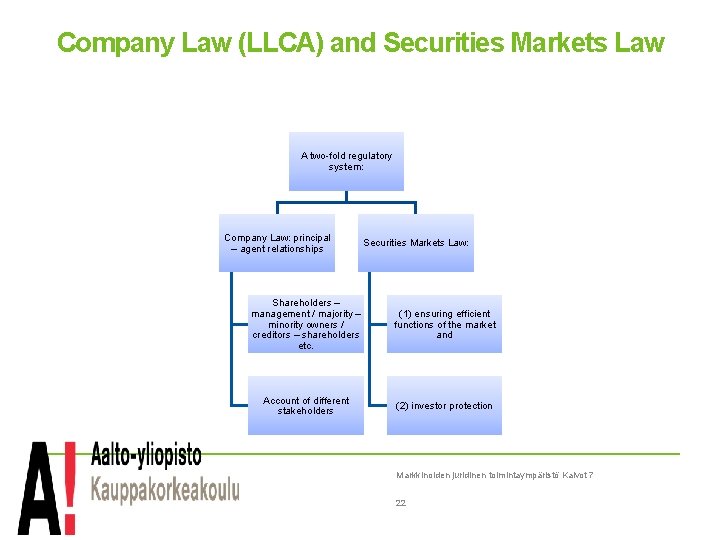
Company Law (LLCA) and Securities Markets Law A two-fold regulatory system: Company Law: principal – agent relationships Securities Markets Law: Shareholders – management / majority – minority owners / creditors – shareholders etc. (1) ensuring efficient functions of the market and Account of different stakeholders (2) investor protection Markkinoiden juridinen toimintaympäristö Kalvot 7 22
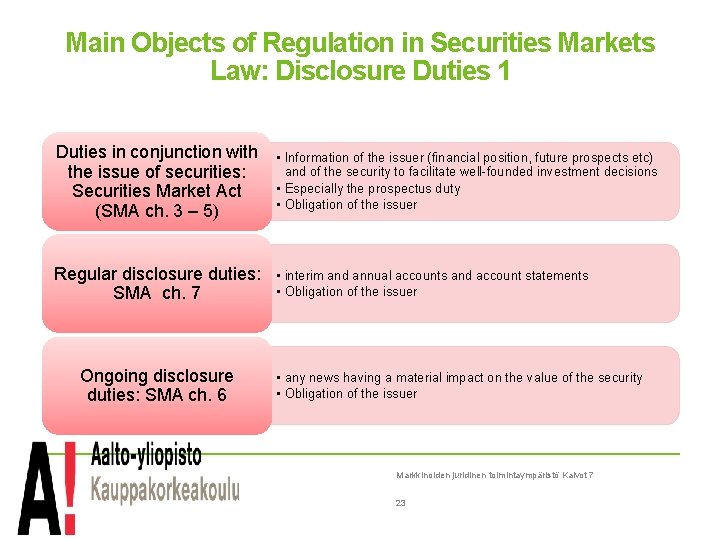
Main Objects of Regulation in Securities Markets Law: Disclosure Duties 1 Duties in conjunction with the issue of securities: Securities Market Act (SMA ch. 3 – 5) • Information of the issuer (financial position, future prospects etc) and of the security to facilitate well-founded investment decisions • Especially the prospectus duty • Obligation of the issuer Regular disclosure duties: SMA ch. 7 • interim and annual accounts and account statements • Obligation of the issuer Ongoing disclosure duties: SMA ch. 6 • any news having a material impact on the value of the security • Obligation of the issuer Markkinoiden juridinen toimintaympäristö Kalvot 7 23
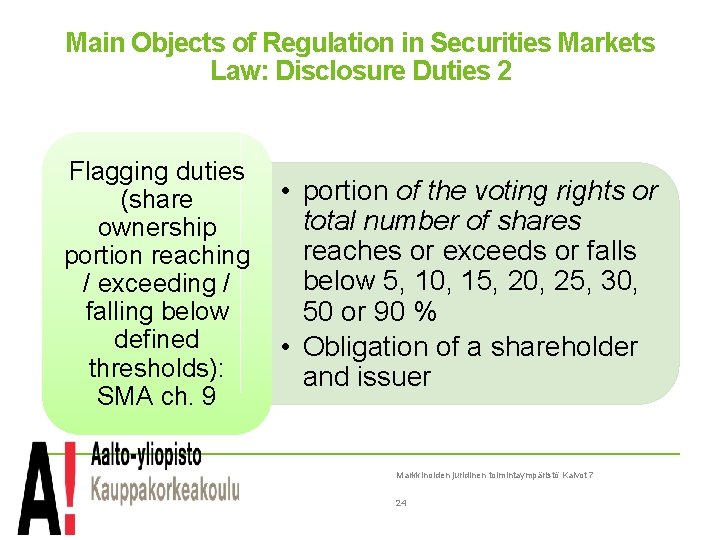
Main Objects of Regulation in Securities Markets Law: Disclosure Duties 2 Flagging duties (share ownership portion reaching / exceeding / falling below defined thresholds): SMA ch. 9 • portion of the voting rights or total number of shares reaches or exceeds or falls below 5, 10, 15, 20, 25, 30, 50 or 90 % • Obligation of a shareholder and issuer Markkinoiden juridinen toimintaympäristö Kalvot 7 24
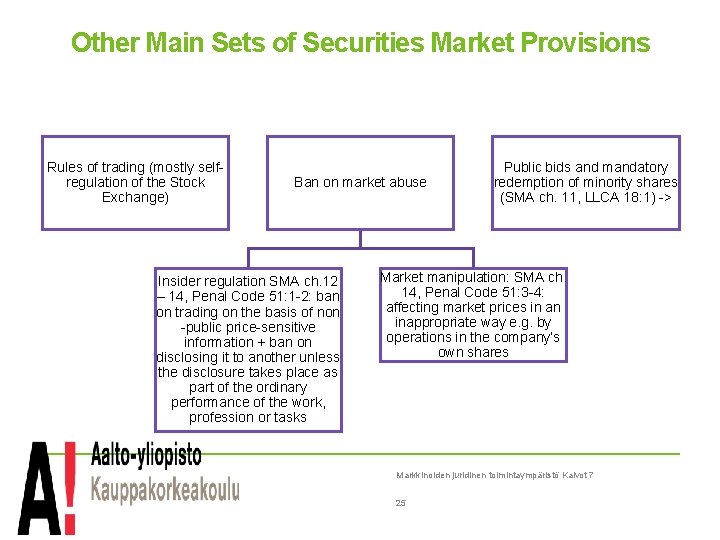
Other Main Sets of Securities Market Provisions Rules of trading (mostly selfregulation of the Stock Exchange) Ban on market abuse Insider regulation SMA ch. 12 – 14, Penal Code 51: 1 -2: ban on trading on the basis of non -public price-sensitive information + ban on disclosing it to another unless the disclosure takes place as part of the ordinary performance of the work, profession or tasks Public bids and mandatory redemption of minority shares (SMA ch. 11, LLCA 18: 1) -> Market manipulation: SMA ch. 14, Penal Code 51: 3 -4: affecting market prices in an inappropriate way e. g. by operations in the company’s own shares Markkinoiden juridinen toimintaympäristö Kalvot 7 25
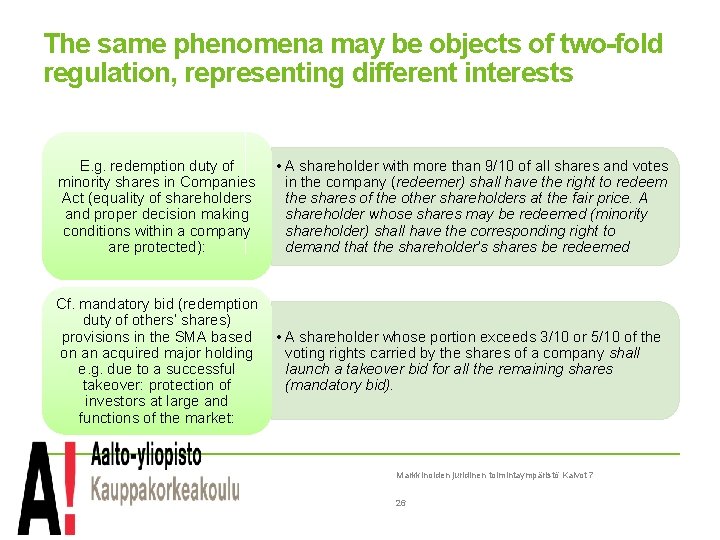
The same phenomena may be objects of two-fold regulation, representing different interests E. g. redemption duty of minority shares in Companies Act (equality of shareholders and proper decision making conditions within a company are protected): • A shareholder with more than 9/10 of all shares and votes in the company (redeemer) shall have the right to redeem the shares of the other shareholders at the fair price. A shareholder whose shares may be redeemed (minority shareholder) shall have the corresponding right to demand that the shareholder’s shares be redeemed Cf. mandatory bid (redemption duty of others’ shares) provisions in the SMA based on an acquired major holding e. g. due to a successful takeover: protection of investors at large and functions of the market: • A shareholder whose portion exceeds 3/10 or 5/10 of the voting rights carried by the shares of a company shall launch a takeover bid for all the remaining shares (mandatory bid). Markkinoiden juridinen toimintaympäristö Kalvot 7 26
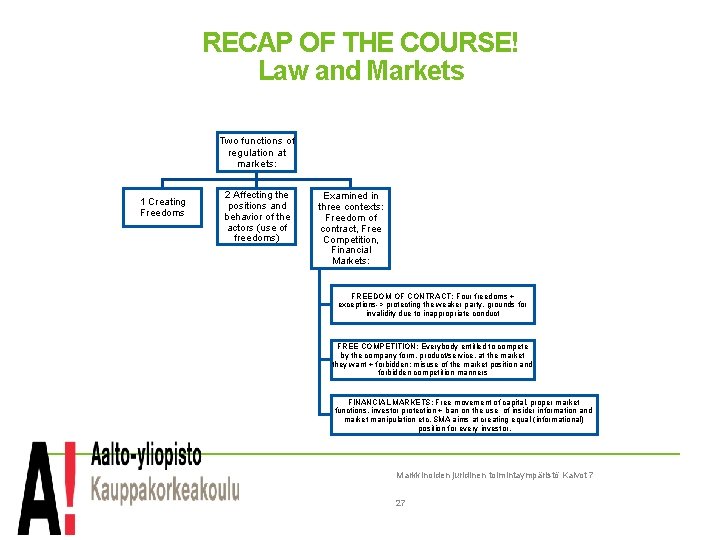
RECAP OF THE COURSE! Law and Markets Two functions of regulation at markets: 1 Creating Freedoms 2 Affecting the positions and behavior of the actors (use of freedoms) Examined in three contexts: Freedom of contract, Free Competition, Financial Markets: FREEDOM OF CONTRACT: Four freedoms + exceptions-> protecting the weaker party, grounds for invalidity due to inappropriate conduct FREE COMPETITION: Everybody entitled to compete by the company form, product/service, at the market they want + forbidden: misuse of the market position and forbidden competition manners FINANCIAL MARKETS: Free movement of capital, proper market functions, investor protection + ban on the use of insider information and market manipulation etc. SMA aims at creating equal (informational) position for every investor. Markkinoiden juridinen toimintaympäristö Kalvot 7 27