Many adjectives in the English language end in



- Slides: 9
Many adjectives in the English language end in the same sound made with either –ant or –ent. It is often tricky to decide which ending to use when you are spelling them… e. g. is it observant or observent?
A good rule to follow is if the root word can be given an –ation ending then it will usually end in –ant. observation observant Working with a partner, can you write a sentence about the long-eared owl that contains the adjective ‘observant’?
So if the root word can be given an –ation ending, then it will usually end in –ant (and not –ent). Here are some more example words that follow the same rule: toleration tolerant hesitation hesitant
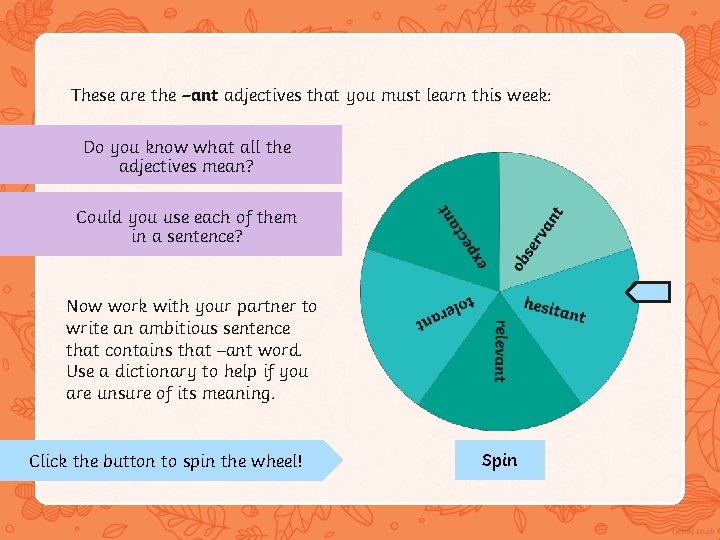
These are the –ant adjectives that you must learn this week: Do you know what all the adjectives mean? Could you use each of them in a sentence? Now work with your partner to write an ambitious sentence that contains that –ant word. Use a dictionary to help if you are unsure of its meaning. Click the button to spin the wheel! Spin
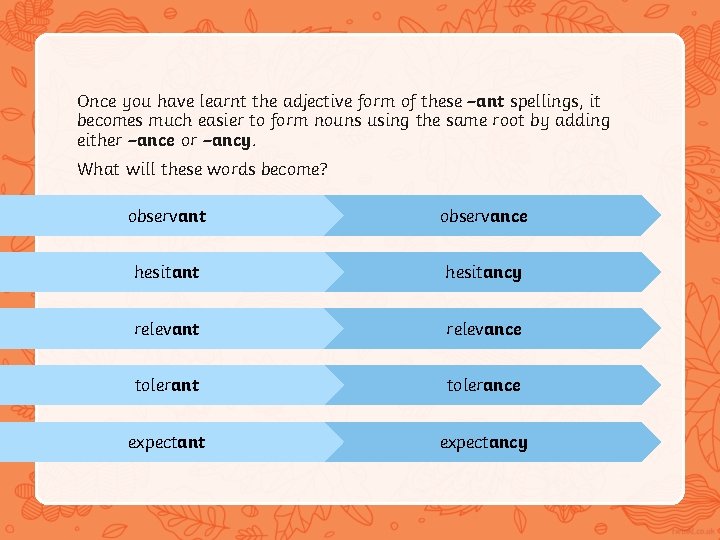
Once you have learnt the adjective form of these –ant spellings, it becomes much easier to form nouns using the same root by adding either –ance or –ancy. What will these words become? observant observance hesitant hesitancy relevant relevance tolerant tolerance expectant expectancy
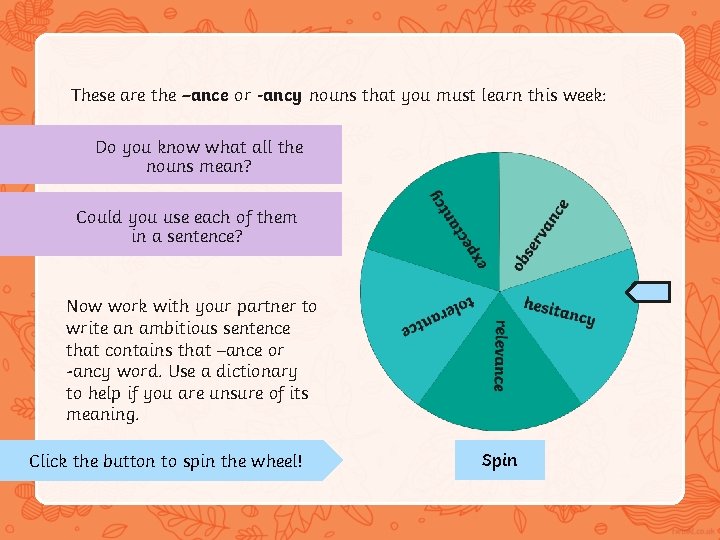
These are the –ance or -ancy nouns that you must learn this week: Do you know what all the nouns mean? Could you use each of them in a sentence? Now work with your partner to write an ambitious sentence that contains that –ance or -ancy word. Use a dictionary to help if you are unsure of its meaning. Click the button to spin the wheel! Spin
Here all your spelling words for this week. They are adjectives with -ant and nouns with –ancy or –ance.