LIGHT IN THE TIME OF SHADOWS DR VERONICA

- Slides: 25
LIGHT IN THE TIME OF SHADOWS DR VERONICA STANGANELLI CYMHS MACKAY, QUEENSLAND AUSTRALIA RANZCP CONGRESS HONG KONG, 2016
LIGHT IN THE TIME OF SHADOWS Presentations Our experience in cluster of youth suicides in Mackay Suicidal attempts in children in Mackay Promising approaches in two different countries Australia and Uruguay
LIGHT IN THE TIME OF SHADOWS Background Over the past years, unemployment, family relocation, hopelessness due to mining and sugar industries as well as financial issues have affected the Mackay Region. Point clusters are suicides in both time and space into a small geographical area. They have a cumulative harm into the youth population’s life and perpetuate the risk of re -incidence. Objectives The aim of the first presentation is to share a retrospective analysis of the impact on our adolescents after the first 2008 youth- suicide cluster that took 8 lives and with another peak of 10 adolescents in 2015.
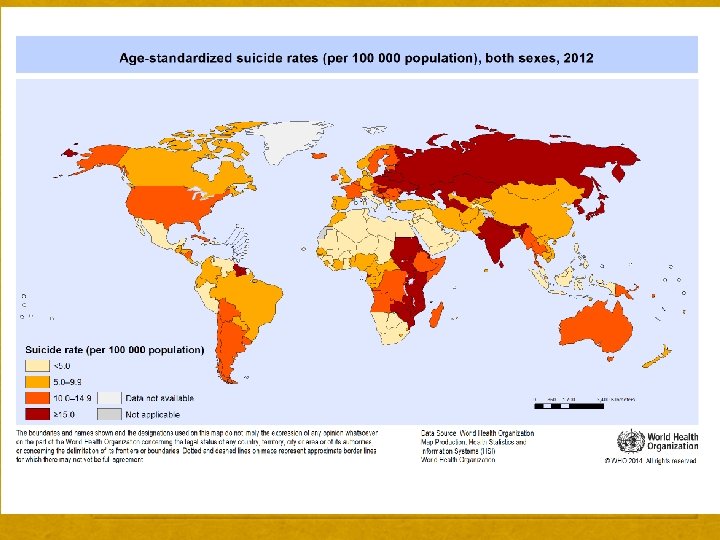
LIGHT IN THE TIME OF SHADOWS Introduction Suicide is the 3 rd leading cause worldwide of youth mortality between 10 to 18 years old. 1, 2. (WHO, 2014) Causes are not fully understood Complex multi-factorial interaction Under-reported in numerous countries Researches and statistics differ in numbers Definitions across papers are not clear
LIGHT IN THE TIME OF SHADOWS Definitions Suicide is the act of intentionally ending his/her life. Suicide behaviours or gestures refer to thoughts and acts to ending his/her life. Suicidal ideation refers to thoughts: Fleeting thoughts, suicide plan, and plot. Suicidal attempt which refers to engagement in potentially selfharming behaviour to ending life. Self-harming behaviors defined as intentional self-injury or selfpoisoning regardless of motive with or without suicidal thoughts. 3(NICE clinical guidelines/CG 133)
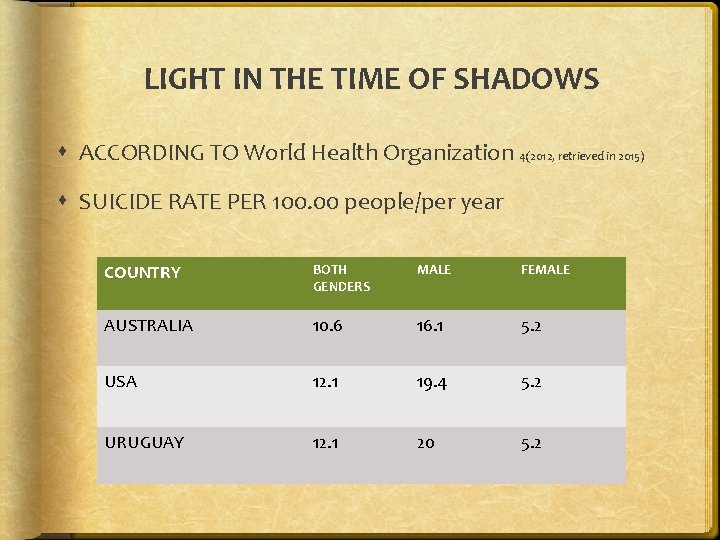
LIGHT IN THE TIME OF SHADOWS ACCORDING TO World Health Organization 4(2012, retrieved in 2015) SUICIDE RATE PER 100. 00 people/per year COUNTRY BOTH GENDERS MALE FEMALE AUSTRALIA 10. 6 16. 1 5. 2 USA 12. 1 19. 4 5. 2 URUGUAY 12. 1 20 5. 2
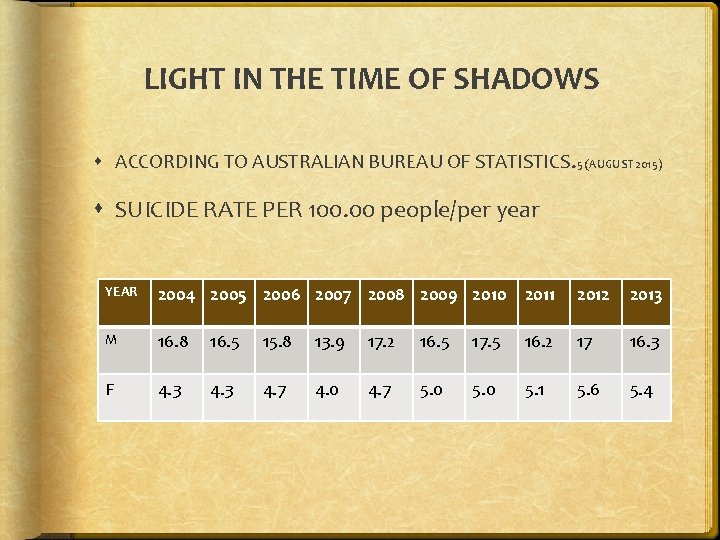
LIGHT IN THE TIME OF SHADOWS ACCORDING TO AUSTRALIAN BUREAU OF STATISTICS. 5 (AUGUST 2015) SUICIDE RATE PER 100. 00 people/per year YEAR 2004 2005 2006 2007 2008 2009 2010 2011 2012 2013 M 16. 8 16. 5 15. 8 13. 9 17. 2 16. 5 17. 5 16. 2 17 16. 3 F 4. 3 4. 7 4. 0 4. 7 5. 0 5. 1 5. 6 5. 4
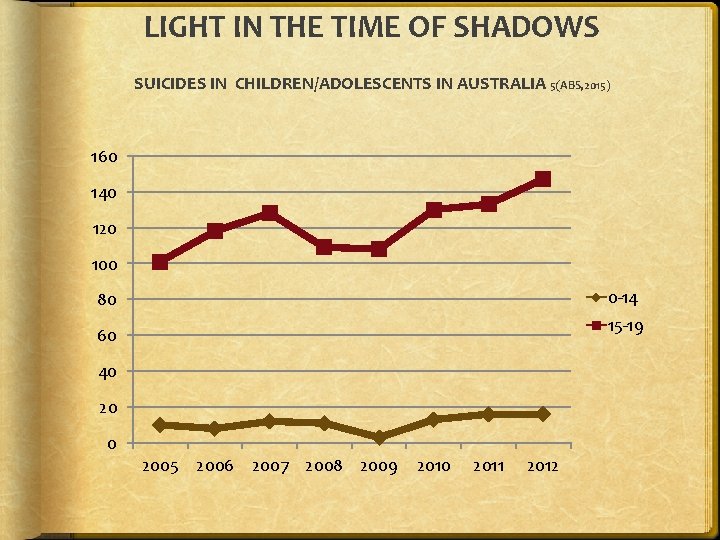
LIGHT IN THE TIME OF SHADOWS SUICIDES IN CHILDREN/ADOLESCENTS IN AUSTRALIA 5(ABS, 2015) 160 140 120 100 0 -14 80 15 -19 60 40 2005 2006 2007 2008 2009 2010 2011 2012
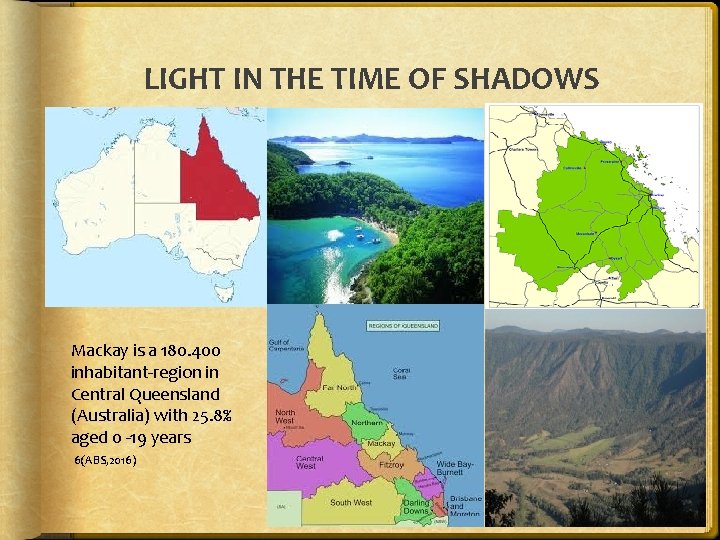
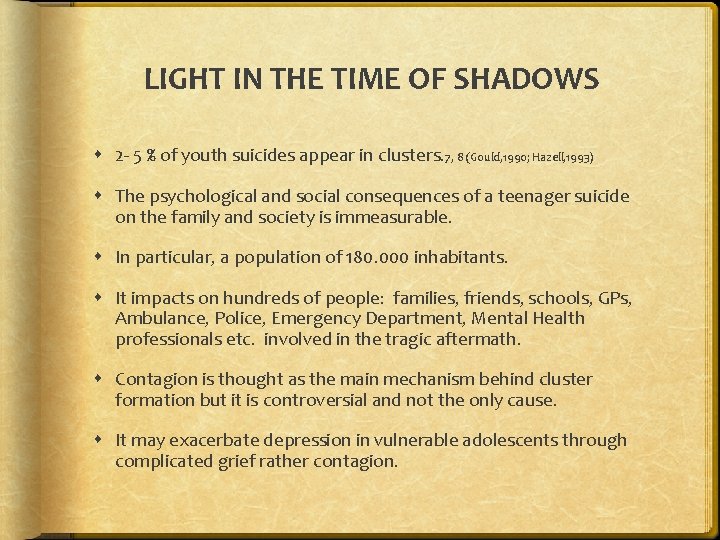
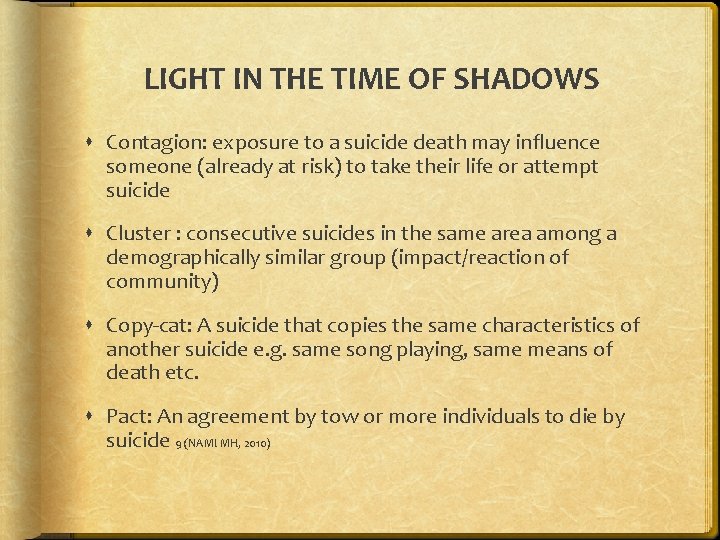
LIGHT IN THE TIME OF SHADOWS Mackay is a 180. 400 inhabitant-region in Central Queensland (Australia) with 25. 8% aged 0 -19 years 6(ABS, 2016)
LIGHT IN THE TIME OF SHADOWS 2 - 5 % of youth suicides appear in clusters. 7, 8 (Gould, 1990; Hazell, 1993) The psychological and social consequences of a teenager suicide on the family and society is immeasurable. In particular, a population of 180. 000 inhabitants. It impacts on hundreds of people: families, friends, schools, GPs, Ambulance, Police, Emergency Department, Mental Health professionals etc. involved in the tragic aftermath. Contagion is thought as the main mechanism behind cluster formation but it is controversial and not the only cause. It may exacerbate depression in vulnerable adolescents through complicated grief rather contagion.
LIGHT IN THE TIME OF SHADOWS Contagion: exposure to a suicide death may influence someone (already at risk) to take their life or attempt suicide Cluster : consecutive suicides in the same area among a demographically similar group (impact/reaction of community) Copy-cat: A suicide that copies the same characteristics of another suicide e. g. same song playing, same means of death etc. Pact: An agreement by tow or more individuals to die by suicide 9 (NAMI MH, 2010)
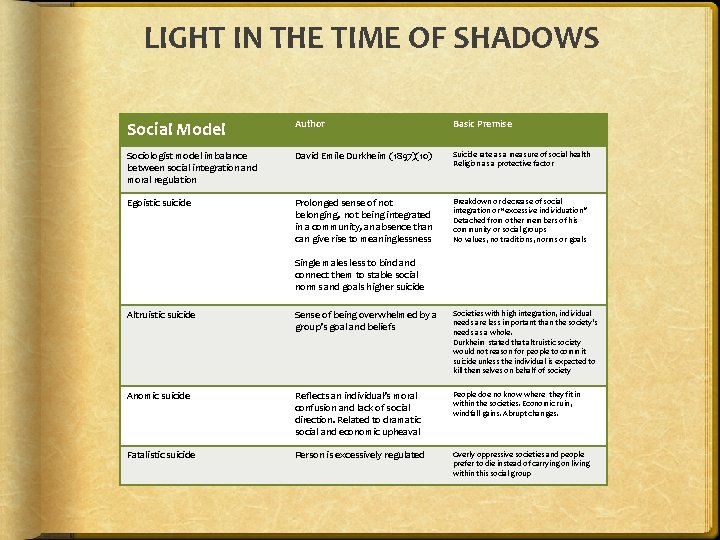
LIGHT IN THE TIME OF SHADOWS Social Model Author Basic Premise Sociologist model imbalance between social integration and moral regulation David Emile Durkheim (1897)(10) Suicide rate as a measure of social health Religion as a protective factor Egoistic suicide Prolonged sense of not belonging, not being integrated in a community, an absence than can give rise to meaninglessness Breakdown or decrease of social integration or “excessive individuation” Detached from other members of his community or social groups No values, no traditions, norms or goals Single males less to bind and connect them to stable social norms and goals higher suicide Altruistic suicide Sense of being overwhelmed by a group’s goal and beliefs Societies with high integration, individual needs are less important than the society’s needs as a whole. Durkheim stated that altruistic society would not reason for people to commit suicide unless the individual is expected to kill themselves on behalf of society Anomic suicide Reflects an individual’s moral confusion and lack of social direction. Related to dramatic social and economic upheaval People doe no know where they fit in within the societies. Economic ruin, windfall gains. Abrupt changes. Fatalistic suicide Person is excessively regulated Overly oppressive societies and people prefer to die instead of carrying on living within this social group
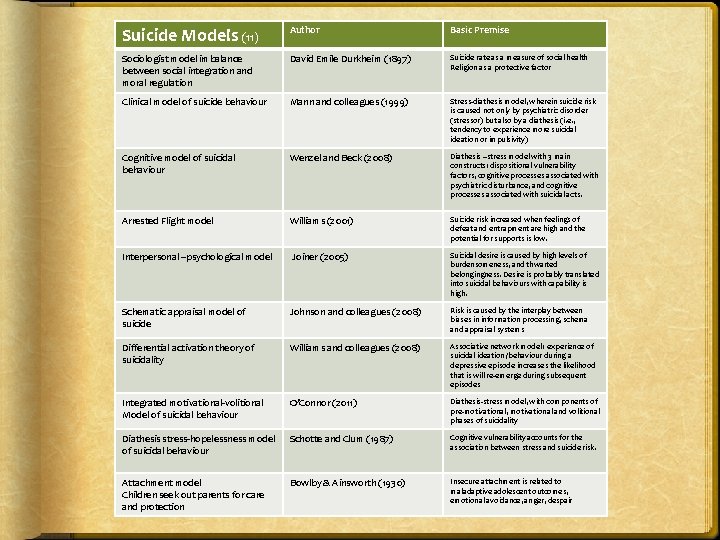
Suicide Models (11) Author Basic Premise Sociologist model imbalance between social integration and moral regulation David Emile Durkheim (1897) Suicide rate as a measure of social health Religion as a protective factor Clinical model of suicide behaviour Mann and colleagues (1999) Stress-diathesis model, wherein suicide risk is caused not only by psychiatric disorder (stressor) but also by a diathesis (i. e. , tendency to experience more suicidal ideation or impulsivity) Cognitive model of suicidal behaviour Wenzel and Beck (2008) Diathesis –stress model with 3 main constructs: dispositional vulnerability factors, cognitive processes associated with psychiatric disturbance, and cognitive processes associated with suicidal acts. Arrested Flight model Williams (2001) Suicide risk increased when feelings of defeat and entrapment are high and the potential for supports is low. Interpersonal –psychological model Joiner (2005) Suicidal desire is caused by high levels of burdensomeness, and thwarted belongingness. Desire is probably translated into suicidal behaviours with capability is high. Schematic appraisal model of suicide Johnson and colleagues (2008) Risk is caused by the interplay between biases in information processing, schema and appraisal systems Differential activation theory of suicidality Williams and colleagues (2008) Associative network model: experience of suicidal ideation /behaviour during a depressive episode increases the likelihood that is will re-emerge during subsequent episodes Integrated motivational-volitional Model of suicidal behaviour O’Connor (2011) Diathesis-stress model, with components of pre-motivational, motivational and volitional phases of suicidality Diathesis stress-hopelessness model of suicidal behaviour Schotte and Clum (1987) Cognitive vulnerability accounts for the association between stress and suicide risk. Attachment model Children seek out parents for care and protection Bowlby & Ainsworth (1930) Insecure attachment is related to maladaptive adolescent outcomes, emotional avoidance, anger, despair
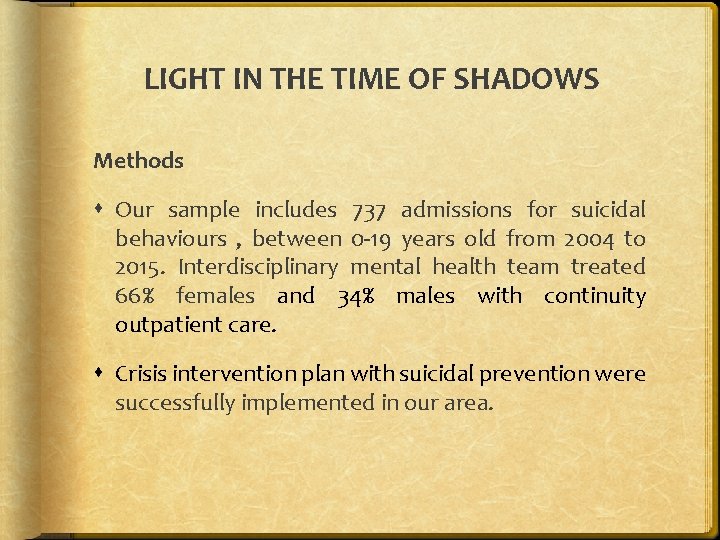
LIGHT IN THE TIME OF SHADOWS Methods Our sample includes 737 admissions for suicidal behaviours , between 0 -19 years old from 2004 to 2015. Interdisciplinary mental health team treated 66% females and 34% males with continuity outpatient care. Crisis intervention plan with suicidal prevention were successfully implemented in our area.
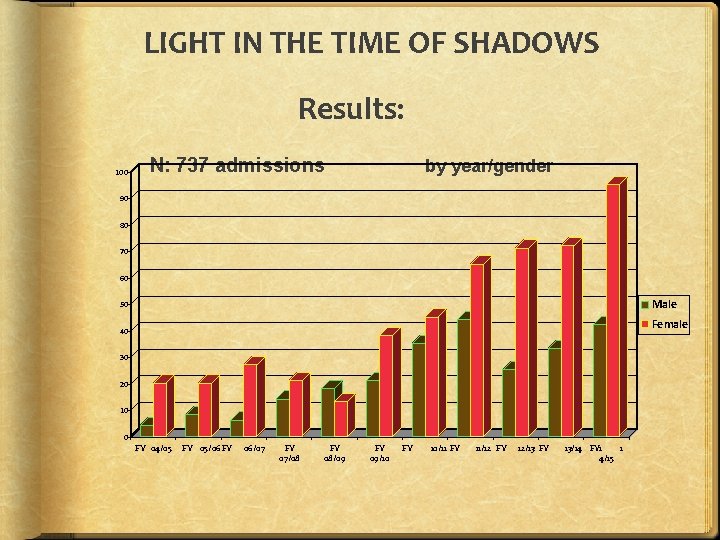
LIGHT IN THE TIME OF SHADOWS Results: 100 N: 737 admissions by year/gender 90 80 70 60 Male 50 Female 40 30 20 10 0 FY 04/05 FY 05/06 FY 06/07 FY 07/08 FY 08/09 FY 09/10 FY 10/11 FY 11/12 FY 12/13 FY 13/14 FY 1 1 4/15
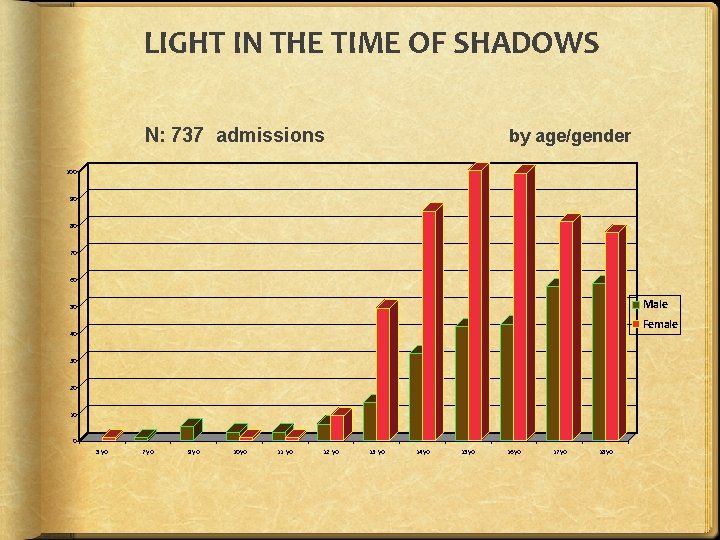
LIGHT IN THE TIME OF SHADOWS N: 737 admissions by age/gender 100 90 80 70 60 Male 50 Female 40 30 20 10 0 5 yo 7 yo 9 yo 10 yo 11 yo 12 yo 13 yo 14 yo 15 yo 16 yo 17 yo 18 yo
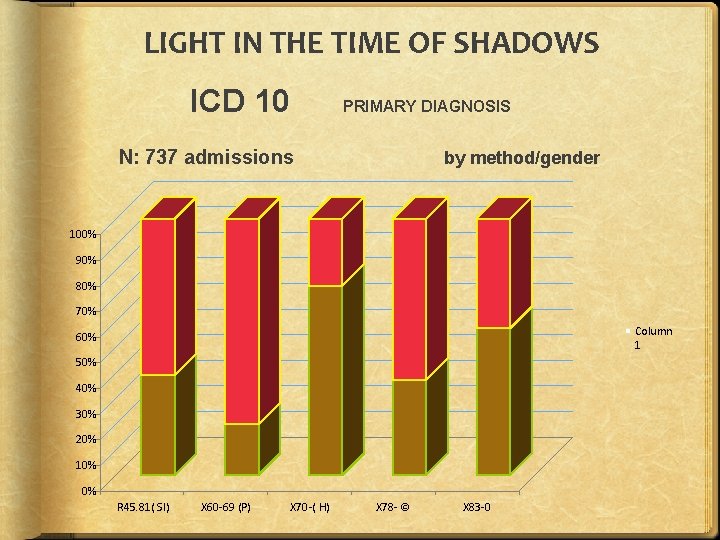
LIGHT IN THE TIME OF SHADOWS ICD 10 PRIMARY DIAGNOSIS N: 737 admissions by method/gender 100% 90% 80% 70% Column 1 60% 50% Female 40% 30% 20% 10% 0% R 45. 81( SI) X 60 -69 (P) X 70 -( H) X 78 - © X 83 -0
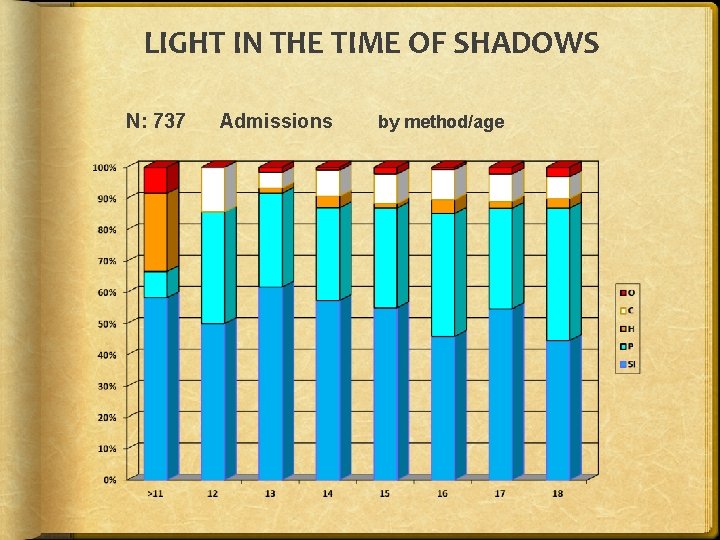
LIGHT IN THE TIME OF SHADOWS N: 737 Admissions by method/age
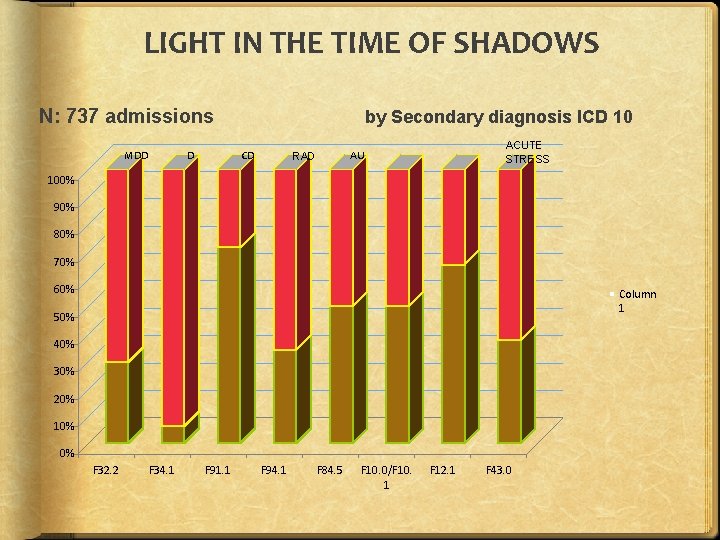
LIGHT IN THE TIME OF SHADOWS N: 737 admissions MDD D by Secondary diagnosis ICD 10 CD ACUTE STRESS AU RAD 100% 90% 80% 70% 60% Column 1 50% Female 40% 30% 20% 10% 0% F 32. 2 F 34. 1 F 91. 1 F 94. 1 F 84. 5 F 10. 0/F 10. 1 F 12. 1 F 43. 0
LIGHT IN THE TIME OF SHADOWS Mackay Child and Youth Mental health experienced a 140 % increased in hospital admissions for suicidal behaviours. Rate of suicide/100. 000 people is 18. 0 in Mackay There is no strong research evidence that inpatients admissions will reduce repetition of self harming in young people. (12)Nock et al, 2013) A systematic review of psychological treatments reported that the evidence for effective interventions for adolescents was scant. 13(Robinson et al. ) A clinical review by Brent et al. , 2013 showed that interventions that have demonstrated an effect with regard to adolescent suicidal ideation/attempts focused on improving family interactions and improving social support. (14)
LIGHT IN THE TIME OF SHADOWS What do adolescents want to communicate with suicidal attempts? 80 % : “Nobody listens”. 90 % use of MEDIA as a way to communicate with others. 83 % had attachment disorder as secondary diagnoses Families complained that “adolescents communicate feelings with them” do 65% parents with mental illnesses Guidance officers and teachers as secondary support persons for adolescents not
LIGHT IN THE TIME OF SHADOWS 2 - 5 % of youth suicides appear in clusters Complicated grief among adolescents with guilt, despair, identification and idealization. 90 % used Social media to communicate feelings of criticism, despair, death of peers and connections between them. Whole range of community approaches has been promising but long-term outcomes are still debatable. Somehow, it seems like searching for light in the time of shadows.
LIGHT IN THE TIME OF SHADOWS References 1. WHO “Health for the world’s adolescents report (May, 2014) 2. WHO/MSD/MER? 14. 2 -World Health Organization 2014 www. who. int/mental_health/suicide-prevention/exe_summary_english. pdf 3. NICE. GUIDELINES CG 133 - WWW. NICE. ORG. UK/guidance/cg 16 4. “Suicide rates DATA by country: WHO 2012, Retrieved 13 June 2015// apps. who. int/gho/data/node. main. MHSUICIDE? lang=EN 5. www. abs. gov. au/ausstats/abs@. nsf/Lookup/4125. Omain+features 210 Aug%202015 6. Stat. abs. gov. au/itt/r, jsp? Region. Summary®ion+312&dataset Mackay, 2016.
LIGHT IN THE TIME OF SHADOWS 7. Gould MS. Suicide clusters and media exposure. APA, 1990, pp 517 -532 8. Hazell P. Adolescent suicide clusters- Australian and NZ Journal of Psychiatry 4. Vol. 27, 1993. 9. NAMI MH, 2010 10. When too much integration and regulation hurts. Re envisioning Durkheim’s altruistic suicide. Society and Mental Health. March 2016 6; pp: 56 -71 11. The psychology of suicidal behaviour- O’Connor and Nock. www. thelancet. com/psychiatry May 2, 2014 - htpp: //dx. doi. org/10. 1016/522150366(14)70222 -6 12. Nock et al. Prevalence, Correlates and Treatment of lifetime suicidal Behaviour among adolescents. JAMA Psychiatry, 70(3), 300. doi: 10. 1001/2013. jamapsychiatry. 55 13. Robinson et al. Preventing suicide in young people systematic review. Aust. NZJ Psychiatry, 2011, 45 (1), pp 3 -26. 14. Brent, D et al. Protecting Adolescents from Self-harm: A Clinical Review of Intervention studies. Journal of the Am. Acad. Of Child &Adolescent Psychiatry, 2013, 52(12), 1260 -1271