Lesson Overvie 17 3 The Process of Speciation
- Slides: 17
Lesson Overvie 17. 3 The Process of Speciation
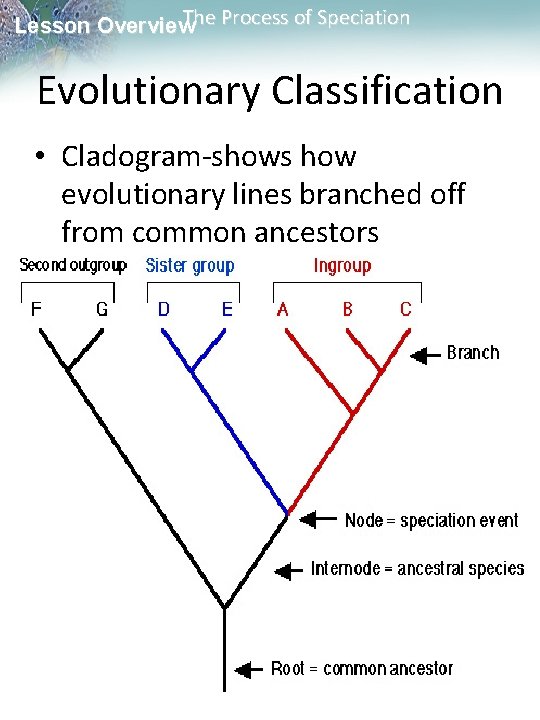
The Process of Speciation Lesson Overview Evolutionary Classification • Cladogram-shows how evolutionary lines branched off from common ancestors
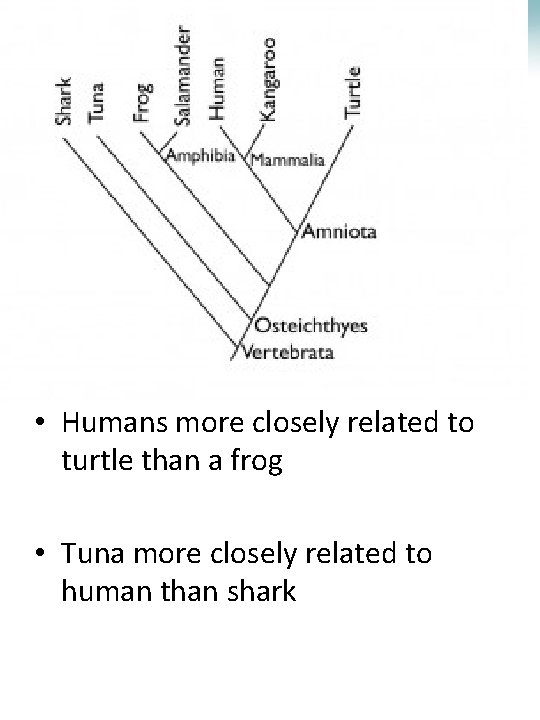
The Process of Speciation Lesson Overview • Humans more closely related to turtle than a frog • Tuna more closely related to human than shark
The Process of Speciation Lesson Overview Genetic equilibrium – a MODEL to explain what would happen to a hypothetical, nonevolving population Allele frequencies NOT changing Hardy-Weinberg principle – states that allele frequencies in a population should remain constant unless something causes them to change
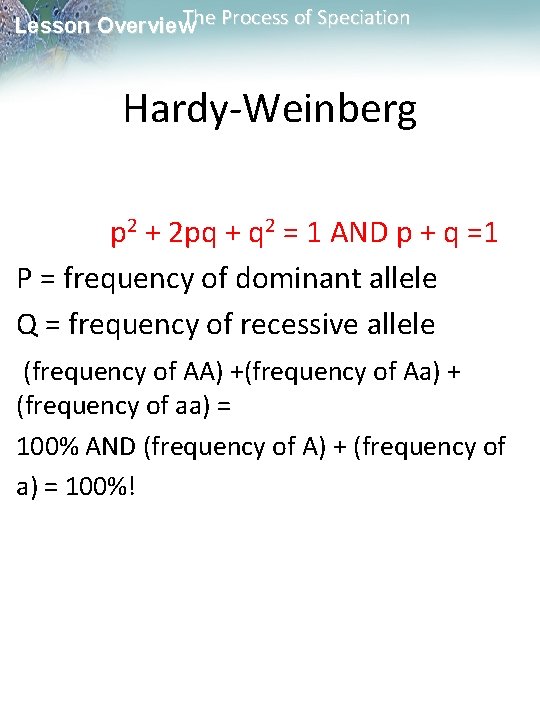
The Process of Speciation Lesson Overview Hardy-Weinberg p 2 + 2 pq + q 2 = 1 AND p + q =1 P = frequency of dominant allele Q = frequency of recessive allele (frequency of AA) +(frequency of Aa) + (frequency of aa) = 100% AND (frequency of A) + (frequency of a) = 100%!
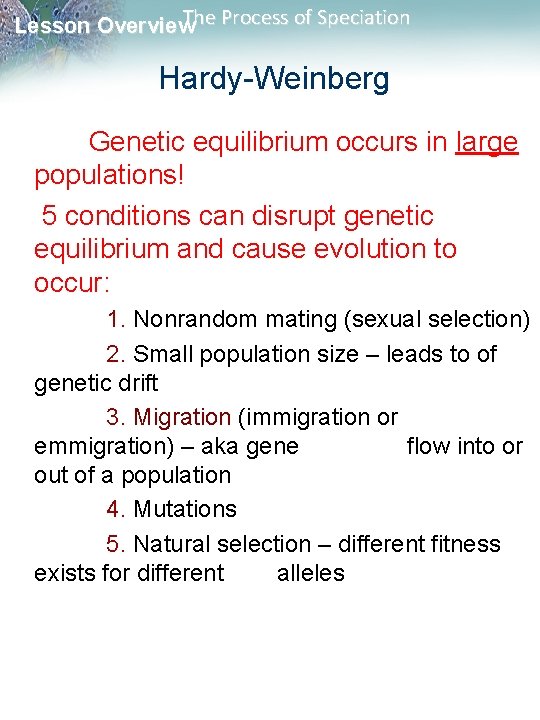
The Process of Speciation Lesson Overview Hardy-Weinberg Genetic equilibrium occurs in large populations! 5 conditions can disrupt genetic equilibrium and cause evolution to occur: 1. Nonrandom mating (sexual selection) 2. Small population size – leads to of genetic drift 3. Migration (immigration or emmigration) – aka gene flow into or out of a population 4. Mutations 5. Natural selection – different fitness exists for different alleles
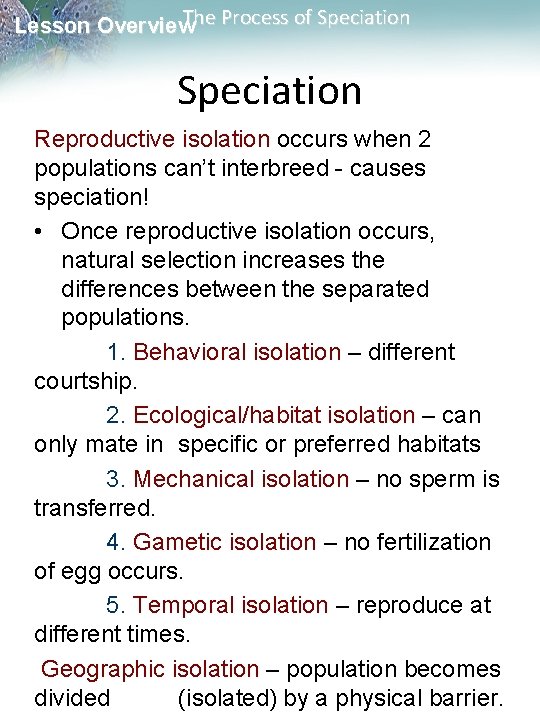
The Process of Speciation Lesson Overview Speciation Reproductive isolation occurs when 2 populations can’t interbreed - causes speciation! • Once reproductive isolation occurs, natural selection increases the differences between the separated populations. 1. Behavioral isolation – different courtship. 2. Ecological/habitat isolation – can only mate in specific or preferred habitats 3. Mechanical isolation – no sperm is transferred. 4. Gametic isolation – no fertilization of egg occurs. 5. Temporal isolation – reproduce at different times. Geographic isolation – population becomes divided (isolated) by a physical barrier.
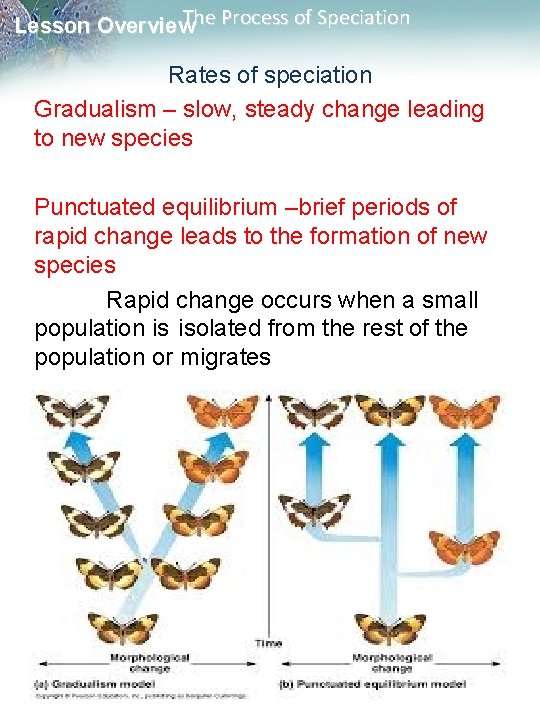
The Process of Speciation Lesson Overview Rates of speciation Gradualism – slow, steady change leading to new species Punctuated equilibrium –brief periods of rapid change leads to the formation of new species Rapid change occurs when a small population is isolated from the rest of the population or migrates
The Process of Speciation Lesson Overview Patterns of evolution Divergent evolution – related species evolve different traits. usually a result of the same species to different and isolated environments through genetic drift and natural selection. adaptive radiation can also happen due to random mutation Divergent evolution is the accumulation of differences between groups which can lead to the Ex. Dinosaurs Darwin’s finches video
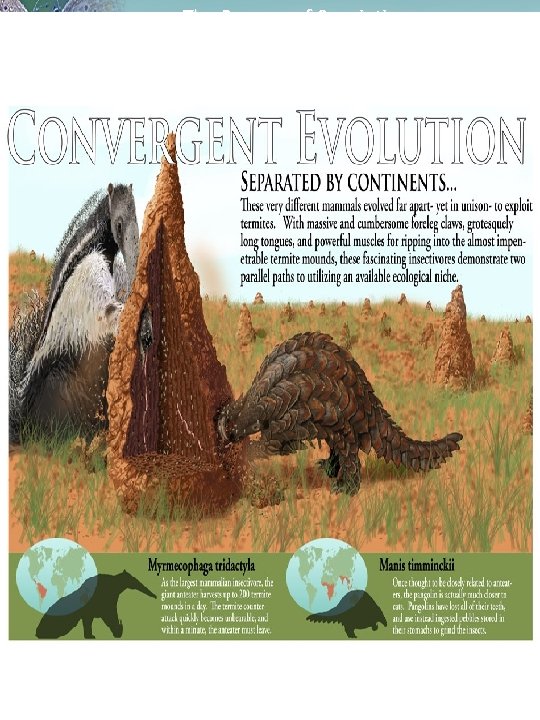
The Process of Speciation Lesson Overview Convergent Evolution Convergent evolution – similar structures are produced in distantly related organisms Convergent Evolution : two unrelated species independently evolve similar traits to cope with specific evolutionary challenges. Sometimes convergent evolution is so powerful that creatures that began as entirely different animals start to look almost the same, Ex. Mammals that feed on ants/termites evolved
The Process of Speciation Lesson Overview
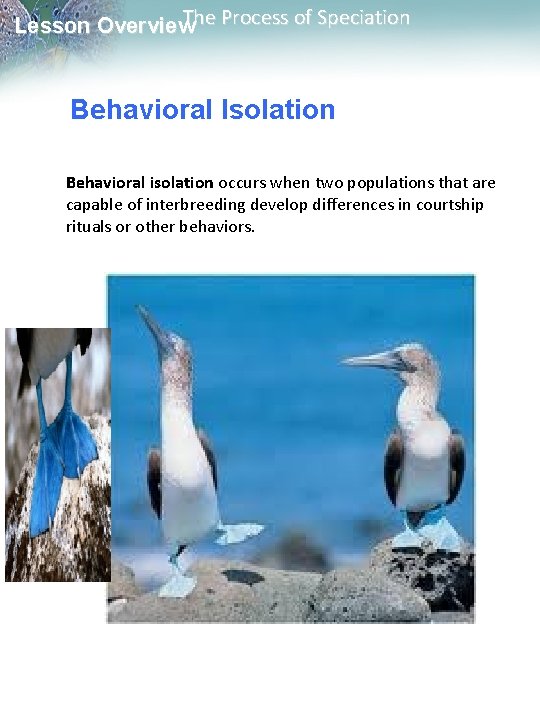
The Process of Speciation Lesson Overview Behavioral Isolation Behavioral isolation occurs when two populations that are capable of interbreeding develop differences in courtship rituals or other behaviors.
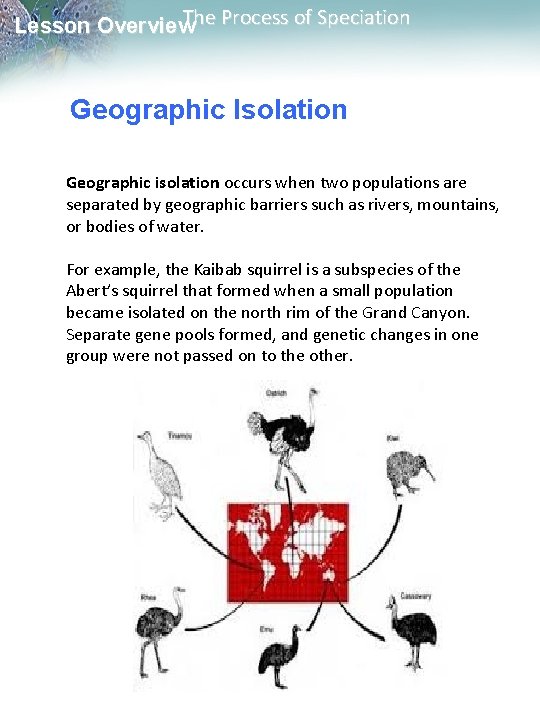
The Process of Speciation Lesson Overview Geographic Isolation Geographic isolation occurs when two populations are separated by geographic barriers such as rivers, mountains, or bodies of water. For example, the Kaibab squirrel is a subspecies of the Abert’s squirrel that formed when a small population became isolated on the north rim of the Grand Canyon. Separate gene pools formed, and genetic changes in one group were not passed on to the other.
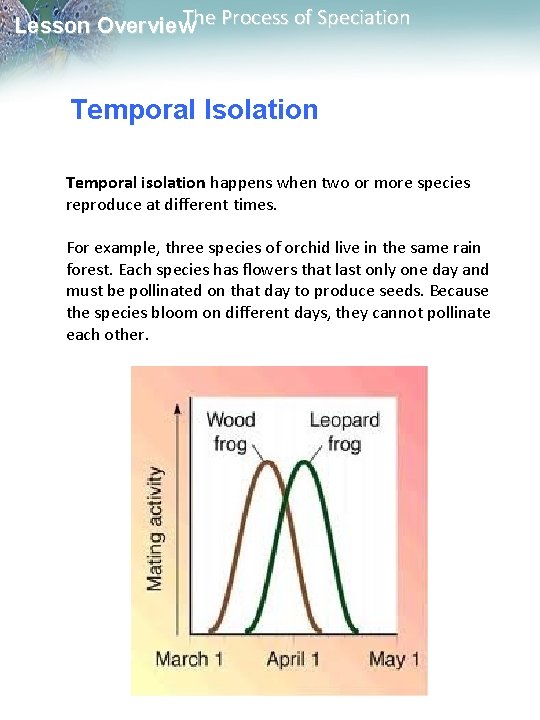
The Process of Speciation Lesson Overview Temporal Isolation Temporal isolation happens when two or more species reproduce at different times. For example, three species of orchid live in the same rain forest. Each species has flowers that last only one day and must be pollinated on that day to produce seeds. Because the species bloom on different days, they cannot pollinate each other.
The Process of Speciation Lesson Overview Testing Natural Selection in Nature What did the Grants’ scientific investigation show about Galápagos finches? long-term studies demonstrating evolution in action in Galápagos finches. Demonstrated how very rapid changes in body and beak size in response to changes in the food supply are driven by natural selection. Variation within a species increases the likelihood that the species can adapt and survive environmental change.
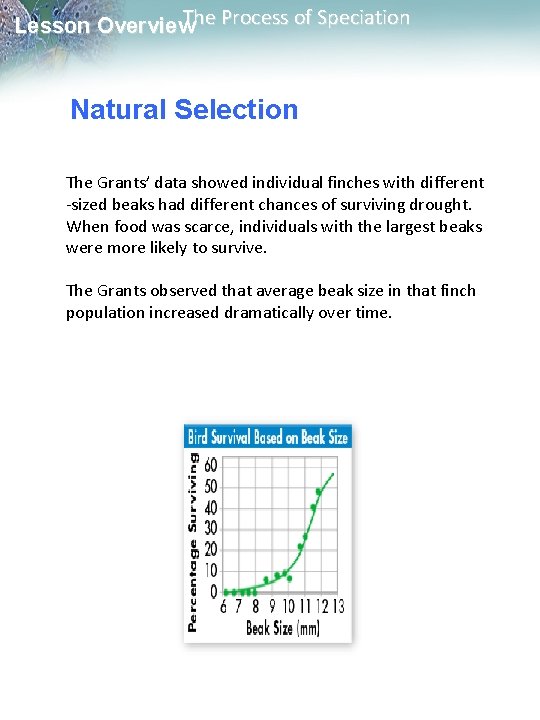
The Process of Speciation Lesson Overview Natural Selection The Grants’ data showed individual finches with different -sized beaks had different chances of surviving drought. When food was scarce, individuals with the largest beaks were more likely to survive. The Grants observed that average beak size in that finch population increased dramatically over time.
The Process of Speciation Lesson Overview Finch Research in Perspective The Grants documented directional selection in nature. Their data also shows that competition and climate change drive natural selection. In addition, their work shows that variation within a species increases the likelihood that the species can adapt and survive environmental change.