Lasse Deleuran Aarhus University Polygonal Line Simplification Euclidean
- Slides: 1
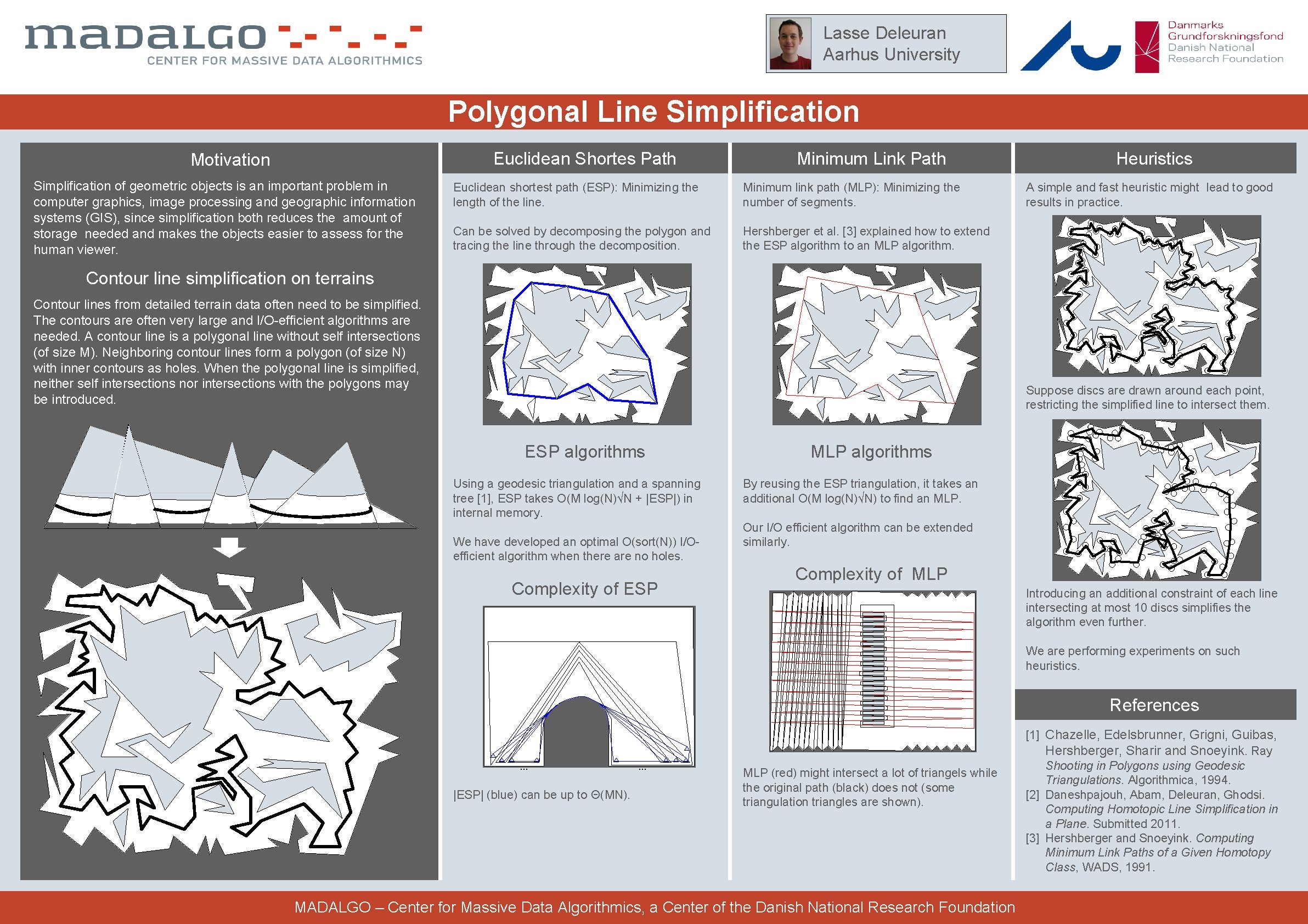
Lasse Deleuran Aarhus University Polygonal Line Simplification Euclidean Shortes Path Motivation Simplification of geometric objects is an important problem in computer graphics, image processing and geographic information systems (GIS), since simplification both reduces the amount of storage needed and makes the objects easier to assess for the human viewer. Minimum Link Path Euclidean shortest path (ESP): Minimizing the length of the line. Minimum link path (MLP): Minimizing the number of segments. Can be solved by decomposing the polygon and tracing the line through the decomposition. Hershberger et al. [3] explained how to extend the ESP algorithm to an MLP algorithm. Heuristics A simple and fast heuristic might lead to good results in practice. Contour line simplification on terrains Contour lines from detailed terrain data often need to be simplified. The contours are often very large and I/O-efficient algorithms are needed. A contour line is a polygonal line without self intersections (of size M). Neighboring contour lines form a polygon (of size N) with inner contours as holes. When the polygonal line is simplified, neither self intersections nor intersections with the polygons may be introduced. Suppose discs are drawn around each point, restricting the simplified line to intersect them. ESP algorithms Using a geodesic triangulation and a spanning tree [1], ESP takes O(M log(N)√N + |ESP|) in internal memory. We have developed an optimal O(sort(N)) I/Oefficient algorithm when there are no holes. Complexity of ESP MLP algorithms By reusing the ESP triangulation, it takes an additional O(M log(N)√N) to find an MLP. Our I/O efficient algorithm can be extended similarly. Complexity of MLP Introducing an additional constraint of each line intersecting at most 10 discs simplifies the algorithm even further. We are performing experiments on such heuristics. References . . . |ESP| (blue) can be up to Θ(MN). . MLP (red) might intersect a lot of triangels while the original path (black) does not (some triangulation triangles are shown). MADALGO – Center for Massive Data Algorithmics, a Center of the Danish National Research Foundation [1] Chazelle, Edelsbrunner, Grigni, Guibas, Hershberger, Sharir and Snoeyink. Ray Shooting in Polygons using Geodesic Triangulations. Algorithmica, 1994. [2] Daneshpajouh, Abam, Deleuran, Ghodsi. Computing Homotopic Line Simplification in a Plane. Submitted 2011. [3] Hershberger and Snoeyink. Computing Minimum Link Paths of a Given Homotopy Class, WADS, 1991.