Knowledge transfer and industry involvement The impact of


- Slides: 18
Knowledge transfer and industry involvement The impact of CERN on high tech industry developments Focus: The construction of the LHC G. Marsella Università del Salento and INFN Cntt INFN
1: Particle Physics context PP characteristics • PP research requires the construction of very complex and extremely large devices (one-off developments) • PP is a highly collaborative open science environment requiring expertise in many technology domains requiring long-term and tight collaboration with high-tech Industry offering top quality education and training from apprentice to post-doctoral • PP is extremely demanding in terms of equipment design, it generates novel technical approach which benefits many research disciplines and ultimately society World standard institutions (centres of excellence) with high tech laboratories for: • Accelerators Accelerator elements, vacuum technologies, magnets, super-conductivity and cryogenics, mechanics & surface treatments • Particle detectors Electronics • Data and computer-intensive software
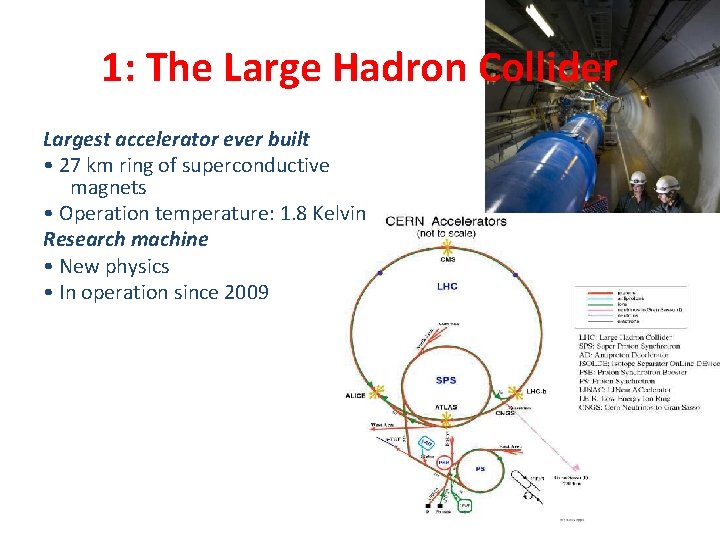
1: The Large Hadron Collider Largest accelerator ever built • 27 km ring of superconductive magnets • Operation temperature: 1. 8 Kelvin Research machine • New physics • In operation since 2009
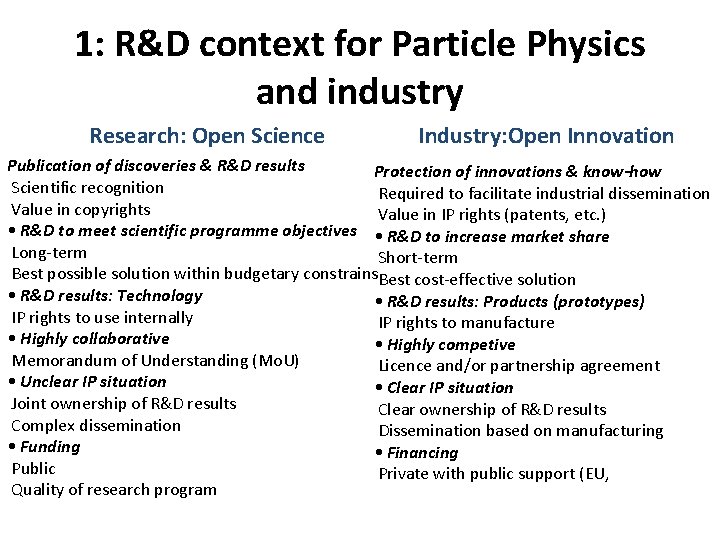
1: R&D context for Particle Physics and industry Research: Open Science Industry: Open Innovation Publication of discoveries & R&D results Protection of innovations & know-how Scientific recognition Required to facilitate industrial dissemination Value in copyrights Value in IP rights (patents, etc. ) • R&D to meet scientific programme objectives • R&D to increase market share Long-term Short-term Best possible solution within budgetary constrains. Best cost-effective solution • R&D results: Technology • R&D results: Products (prototypes) IP rights to use internally IP rights to manufacture • Highly collaborative • Highly competive Memorandum of Understanding (Mo. U) Licence and/or partnership agreement • Unclear IP situation • Clear IP situation Joint ownership of R&D results Clear ownership of R&D results Complex dissemination Dissemination based on manufacturing • Funding • Financing Public Private with public support (EU, Quality of research program
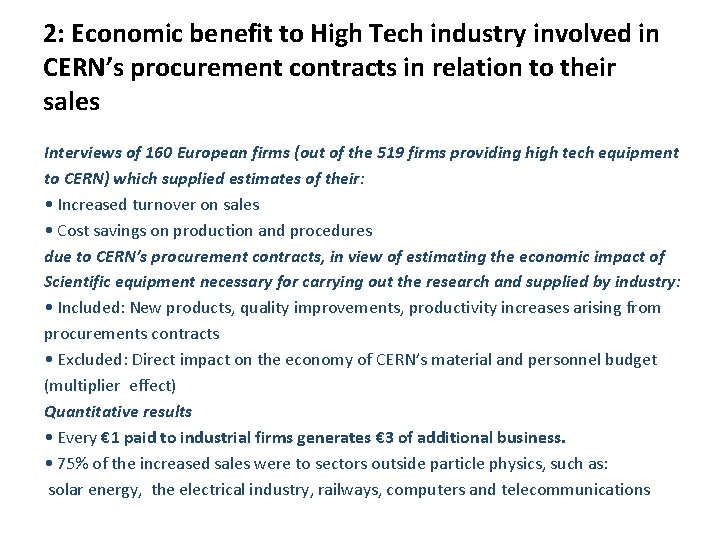
2: Economic benefit to High Tech industry involved in CERN’s procurement contracts in relation to their sales Interviews of 160 European firms (out of the 519 firms providing high tech equipment to CERN) which supplied estimates of their: • Increased turnover on sales • Cost savings on production and procedures due to CERN’s procurement contracts, in view of estimating the economic impact of Scientific equipment necessary for carrying out the research and supplied by industry: • Included: New products, quality improvements, productivity increases arising from procurements contracts • Excluded: Direct impact on the economy of CERN’s material and personnel budget (multiplier effect) Quantitative results • Every € 1 paid to industrial firms generates € 3 of additional business. • 75% of the increased sales were to sectors outside particle physics, such as: solar energy, the electrical industry, railways, computers and telecommunications
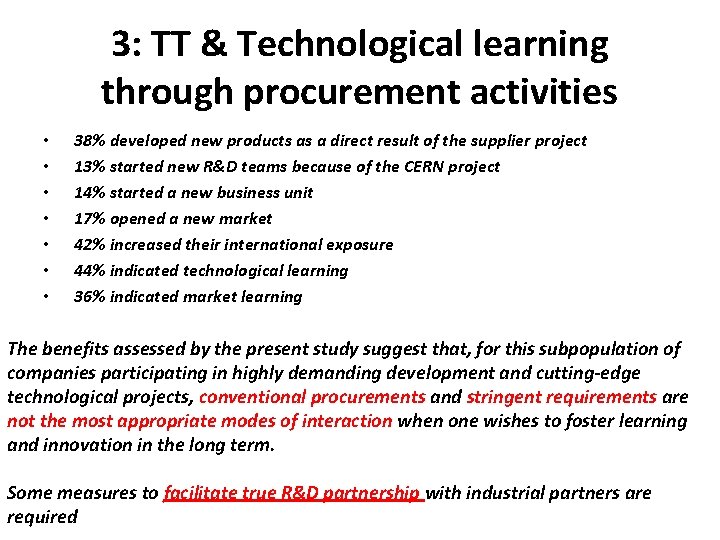
3: TT & Technological learning through procurement activities • • 38% developed new products as a direct result of the supplier project 13% started new R&D teams because of the CERN project 14% started a new business unit 17% opened a new market 42% increased their international exposure 44% indicated technological learning 36% indicated market learning The benefits assessed by the present study suggest that, for this subpopulation of companies participating in highly demanding development and cutting-edge technological projects, conventional procurements and stringent requirements are not the most appropriate modes of interaction when one wishes to foster learning and innovation in the long term. Some measures to facilitate true R&D partnership with industrial partners are required
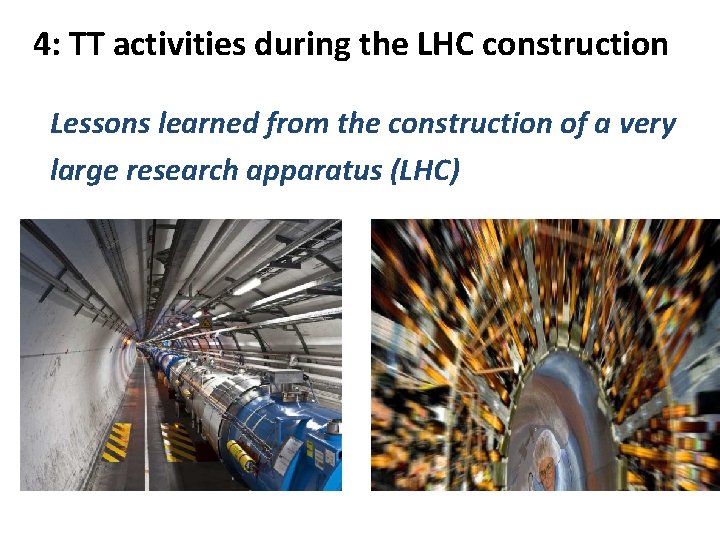
4: TT activities during the LHC construction Lessons learned from the construction of a very large research apparatus (LHC)
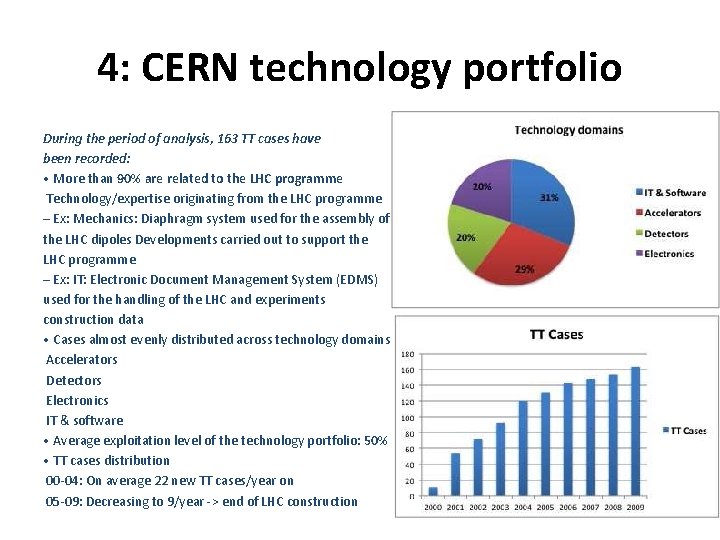
4: CERN technology portfolio During the period of analysis, 163 TT cases have been recorded: • More than 90% are related to the LHC programme Technology/expertise originating from the LHC programme – Ex: Mechanics: Diaphragm system used for the assembly of the LHC dipoles Developments carried out to support the LHC programme – Ex: IT: Electronic Document Management System (EDMS) used for the handling of the LHC and experiments construction data • Cases almost evenly distributed across technology domains Accelerators Detectors Electronics IT & software • Average exploitation level of the technology portfolio: 50% • TT cases distribution 00 -04: On average 22 new TT cases/year on 05 -09: Decreasing to 9/year -> end of LHC construction
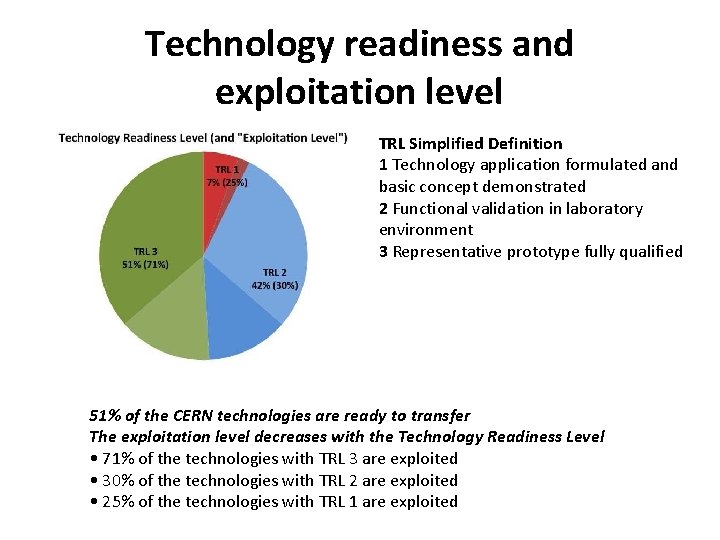
Technology readiness and exploitation level TRL Simplified Definition 1 Technology application formulated and basic concept demonstrated 2 Functional validation in laboratory environment 3 Representative prototype fully qualified 51% of the CERN technologies are ready to transfer The exploitation level decreases with the Technology Readiness Level • 71% of the technologies with TRL 3 are exploited • 30% of the technologies with TRL 2 are exploited • 25% of the technologies with TRL 1 are exploited
CERN Patent portfolio 37 patents in the CERN portfolio at the end of 2009 • An average of 3. 7 new patents per year • 51% of the patents are related to the LHC programme • 22% are in co-ownership (academia, industry: filed as a result of partnerships) • 40% of the portfolio is currently licenced • Starting 2007: Stricter criteria on the commercial potential of the portfolio have been applied
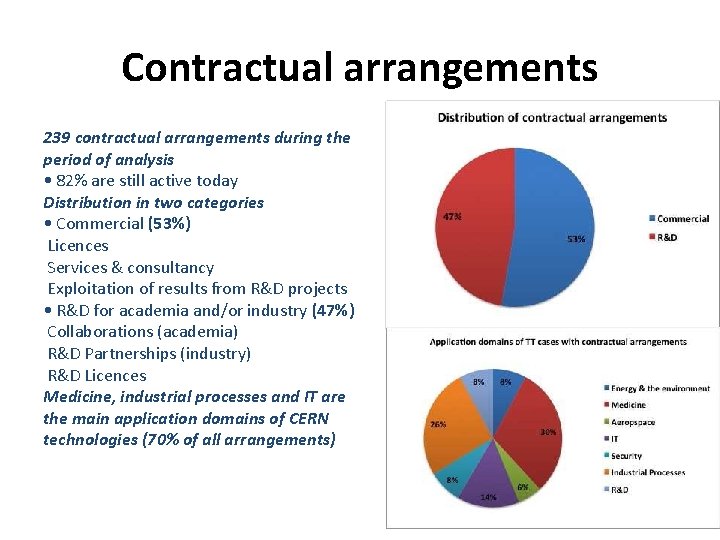
Contractual arrangements 239 contractual arrangements during the period of analysis • 82% are still active today Distribution in two categories • Commercial (53%) Licences Services & consultancy Exploitation of results from R&D projects • R&D for academia and/or industry (47%) Collaborations (academia) R&D Partnerships (industry) R&D Licences Medicine, industrial processes and IT are the main application domains of CERN technologies (70% of all arrangements)
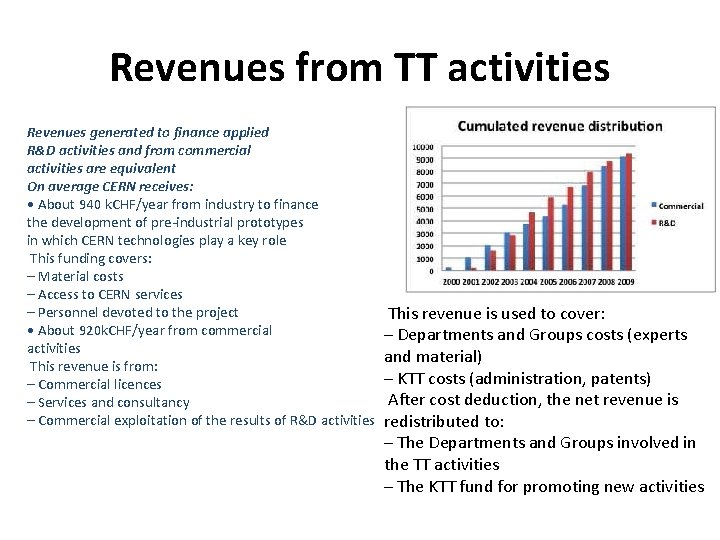
Revenues from TT activities Revenues generated to finance applied R&D activities and from commercial activities are equivalent On average CERN receives: • About 940 k. CHF/year from industry to finance the development of pre-industrial prototypes in which CERN technologies play a key role This funding covers: – Material costs – Access to CERN services – Personnel devoted to the project • About 920 k. CHF/year from commercial activities This revenue is from: – Commercial licences – Services and consultancy – Commercial exploitation of the results of R&D activities This revenue is used to cover: – Departments and Groups costs (experts and material) – KTT costs (administration, patents) After cost deduction, the net revenue is redistributed to: – The Departments and Groups involved in the TT activities – The KTT fund for promoting new activities
4: TT lessons learned from the construction of the LHC A large scale physics research programme boosts innovation • 90% of the technology disclosures to the KTT group during the period of analysis corresponded to technologies & know-how related to the LHC programme The LHC programme has fostered a rich variety of technologies and know-how • Showing effective transfer 50% of the technology portfolio is exploited • The maturity of the technologies increases the chances of transfer 71% of the technologies with high readiness level are exploited A large fraction of the CERN know-how and technologies is not patentable • Patents are not the most suited protection for know-how and electronics • Complex joint-ownership of developments reduces chances of filing patents • Results of R&D partnerships with industry are an additional source of patents (co-ownership) Pooling PP technologies can enhance dissemination prospects • Various institutions are working on the same technology topic • Pooling results can make the PP offer more attractive to industry
4: TT Lessons learned (2) CERN technologies can be used in various domains but a large fraction lacks readiness • Only 51% of the technologies are at the highest technology readiness level for transfer • Promoting technologies and know-how is often insufficient to attract industrial interests • Difficulty to identify pertinent applications where: The technology should be adapted to the needs of industry The use of the technology will definitely give industry a competitive advantage No alternative technology is easily accessible to industry • Lack of dedicated funds to finance early demonstrators aiming to attract industrial interests CERN technologies require further applied R&D to increase their market readiness • About half of the contractual arrangements addresses R&D matters • About 50% of the annual revenue is for financing R&D activities aiming to get closer to the market Typical time to market for PP technologies ranges between 10 to 20 years • Typical R&D project duration ranges between 3 to 5 years • Commercialisation of products occurs typically 8 to 10 years after patent filing
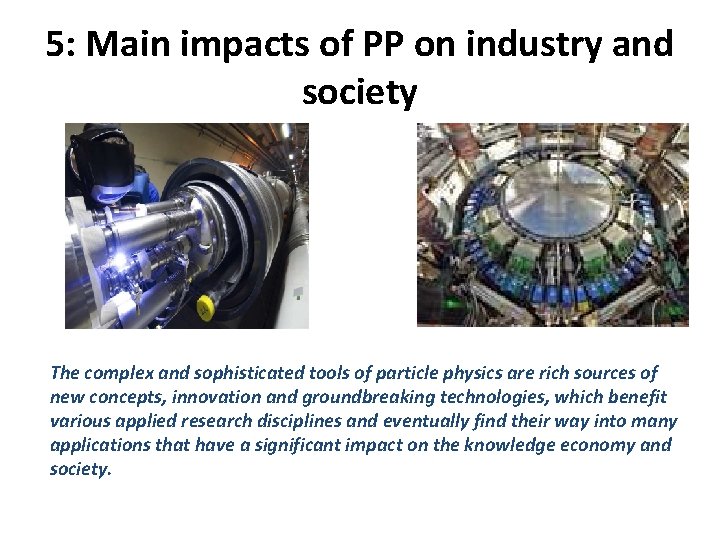
5: Main impacts of PP on industry and society The complex and sophisticated tools of particle physics are rich sources of new concepts, innovation and groundbreaking technologies, which benefit various applied research disciplines and eventually find their way into many applications that have a significant impact on the knowledge economy and society.
Economic benefits More than 30, 000 accelerators are active worldwide; Less than 200 are for research purposes. The impact of the world economy is much larger than just the sales of these accelerators; Products and processes produced have a monetary value that is 100 -1000 times larger than the initial capital cost. All the final products that are processed, treated or inspected by the particle beams of industrial accelerators worldwide, have a collective annual value of more than € 500 billion.
HEPTech: A model for setting up R&D collaborations with industry? Analysis of the situation • PP laboratories with important experimental facilities Have expertise and technology that can significantly benefit a large variety of applications Lack resources (Human and Financial) and time to take care of the construction of the pre-industrial demonstrator – Same experts to work on too many projects – Compensations • Multi disciplinary Institutions Active in applied R&D – Have expertise on aspects that are complementary to PP – Have pertinent industrial contacts – Have access to dedicated national funds to support the construction of pre-industrial demonstrators Interest in building in-house expertise on PP high-tech matters – To position itself better with respect to the PP Community Interested in enhancing their visibility – At the national level – With the PP community • The HEPTech offers a pool of expertise and contacts and acts as a facilitator and catalyst
Conclusions Research in curiosity-driven science is a key driver for technological innovation and economic success Technology transfer activities related to PP do not properly reflect the impact of the discipline on society Procurement, publications, networking events and researchers mobility are key drivers for Knowledge transfer Fostering synergies between academia and industry in R&D for future PP projects is instrumental to sustainable KT There is a clear need to join forces at the PP research community level and across other research disciplines • Joint TT actions are essential to bridge the funding and time gaps between research and industry