Kingdom Plantae Transport How Does Water and dissolved



- Slides: 14
Kingdom Plantae Transport
How Does… �Water and dissolved nutrients get upwards from the root? �Carbohydrates produced in leaves get to the rest of plant?
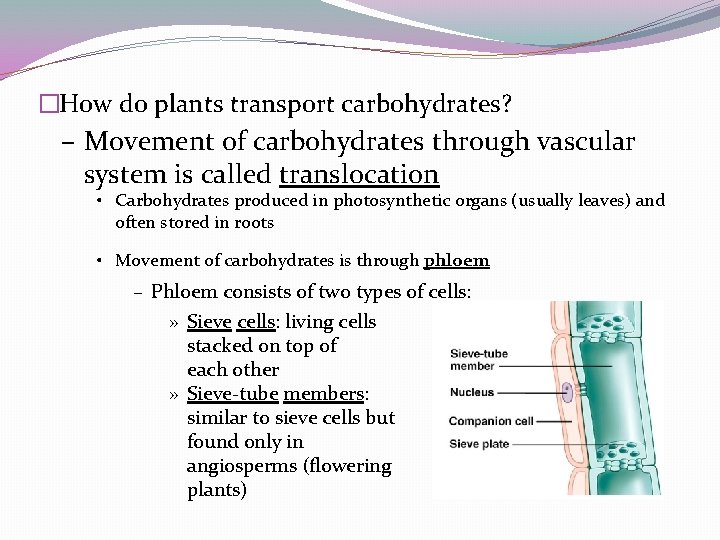
�How do plants transport carbohydrates? – Movement of carbohydrates through vascular system is called translocation • Carbohydrates produced in photosynthetic organs (usually leaves) and often stored in roots • Movement of carbohydrates is through phloem – Phloem consists of two types of cells: » Sieve cells: living cells stacked on top of each other » Sieve-tube members: similar to sieve cells but found only in angiosperms (flowering plants)
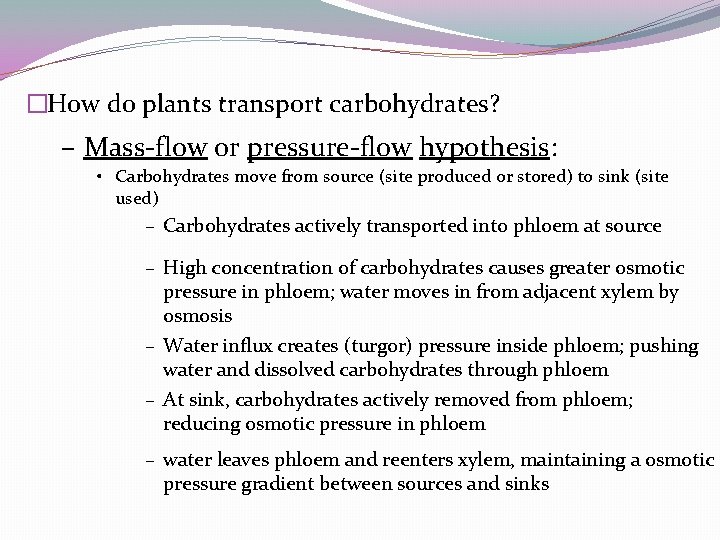
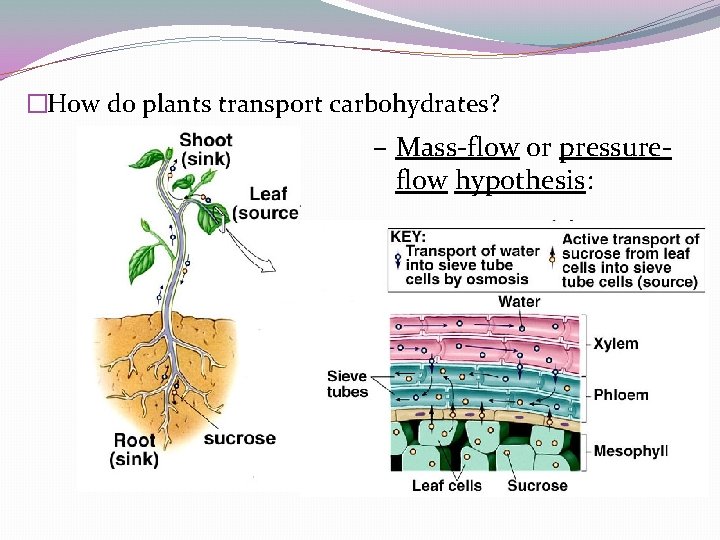
�How do plants transport carbohydrates? – Mass-flow or pressure-flow hypothesis: • Carbohydrates move from source (site produced or stored) to sink (site used) – Carbohydrates actively transported into phloem at source – High concentration of carbohydrates causes greater osmotic pressure in phloem; water moves in from adjacent xylem by osmosis – Water influx creates (turgor) pressure inside phloem; pushing water and dissolved carbohydrates through phloem – At sink, carbohydrates actively removed from phloem; reducing osmotic pressure in phloem – water leaves phloem and reenters xylem, maintaining a osmotic pressure gradient between sources and sinks
�How do plants transport carbohydrates? – Mass-flow or pressureflow hypothesis:
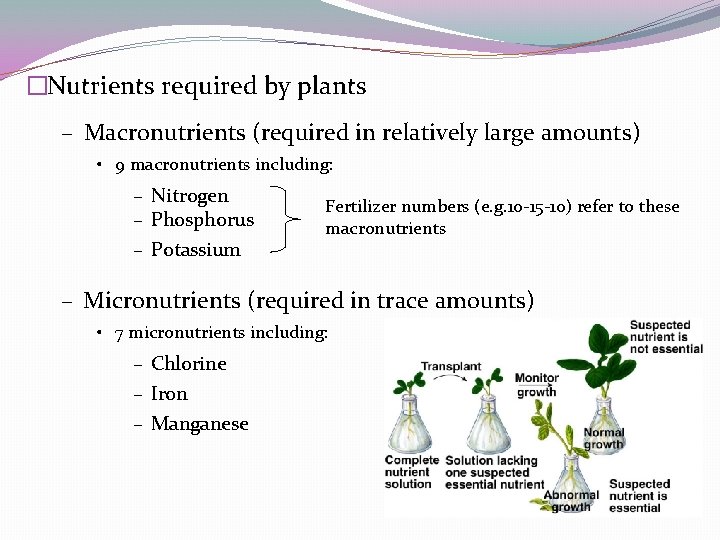
�Nutrients required by plants – Macronutrients (required in relatively large amounts) • 9 macronutrients including: – Nitrogen – Phosphorus – Potassium Fertilizer numbers (e. g. 10 -15 -10) refer to these macronutrients – Micronutrients (required in trace amounts) • 7 micronutrients including: – Chlorine – Iron – Manganese
�Nutrients required by plants – Most nutrients needed by plants obtained from soil • Most roots found in topsoil – Mineral particles (nutrients) – Living organisms (particularly detritivores) – Humus (partly decayed organic matter) • Some plants in acidic bogs obtain Nitrogen by trapping and digesting insects (e. g. Venus flytrap) • Legumes house Nitrogen-fixing bacteria in root nodules • Most plants have mycorrhizal fungi that enhance nutrient uptake by increasing surface area of ‘roots’
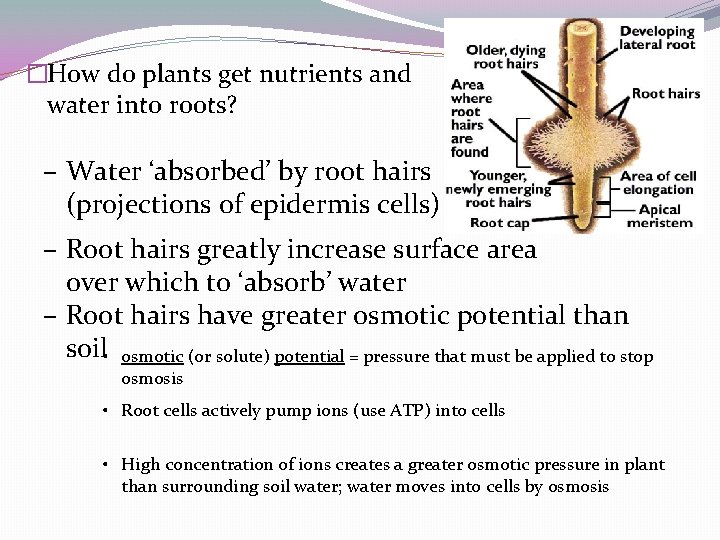
�How do plants get nutrients and water into roots? – Water ‘absorbed’ by root hairs (projections of epidermis cells) – Root hairs greatly increase surface area over which to ‘absorb’ water – Root hairs have greater osmotic potential than soil • osmotic (or solute) potential = pressure that must be applied to stop osmosis • Root cells actively pump ions (use ATP) into cells • High concentration of ions creates a greater osmotic pressure in plant than surrounding soil water; water moves into cells by osmosis
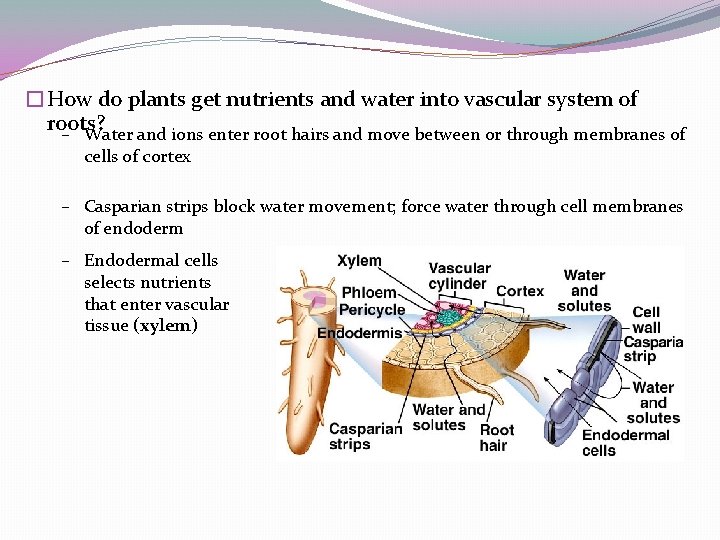
�How do plants get nutrients and water into vascular system of roots? – Water and ions enter root hairs and move between or through membranes of cells of cortex – Casparian strips block water movement; force water through cell membranes of endoderm – Endodermal cells selects nutrients that enter vascular tissue (xylem)
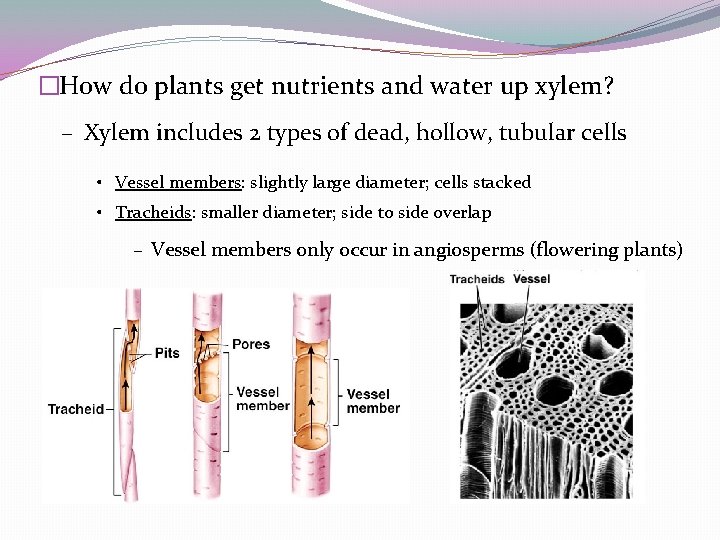
�How do plants get nutrients and water up xylem? – Xylem includes 2 types of dead, hollow, tubular cells • Vessel members: slightly large diameter; cells stacked • Tracheids: smaller diameter; side to side overlap – Vessel members only occur in angiosperms (flowering plants)
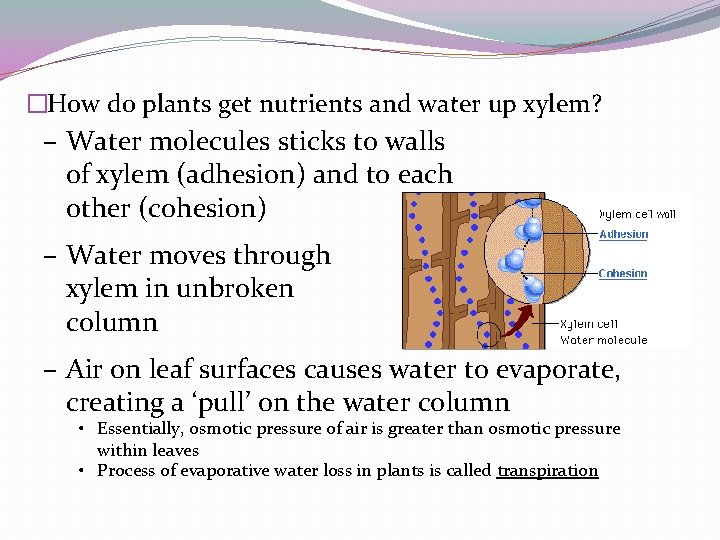
�How do plants get nutrients and water up xylem? – Water molecules sticks to walls of xylem (adhesion) and to each other (cohesion) – Water moves through xylem in unbroken column – Air on leaf surfaces causes water to evaporate, creating a ‘pull’ on the water column • Essentially, osmotic pressure of air is greater than osmotic pressure within leaves • Process of evaporative water loss in plants is called transpiration
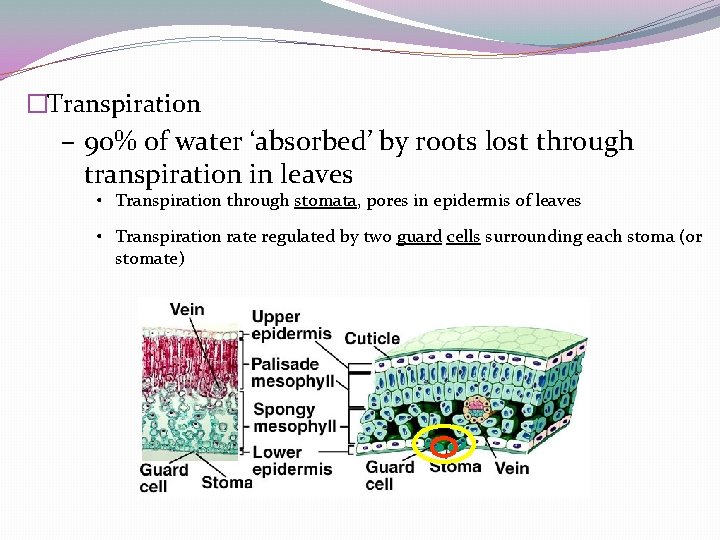
�Transpiration – 90% of water ‘absorbed’ by roots lost through transpiration in leaves • Transpiration through stomata, pores in epidermis of leaves • Transpiration rate regulated by two guard cells surrounding each stoma (or stomate)
�Transpiration – Action of guard cells • Guard cells open when water moves into cells by osmosis (i. e. cells are turgid) – Turgor results from active uptake of Potassium (K+) ions; and subsequent influx of water by osmosis