Key Issue 4 Why Do Services Cluster Downtown

- Slides: 8
Key Issue #4: Why Do Services Cluster Downtown? • Central Business District (CBD) – downtown area, usually center of the city; one of the oldest parts (site of original settlement); compact/dense; contains large % of shops/offices/public buildings – – – • Attracts consumer & business services because of high accessibility – easiest to reach, focal point of regional transportation network Infrastructure – roads/rail, utilities/communications; centered on CBD Consumer (Retail) Services in CBD High Threshold – – Large department stores (typically cluster near one another) High rent (land values) in CBD because of high-accessibility Recently, many high threshold shops have closed downtown branches (moved to suburban malls) Some retail stores remain to serve downtown offices workers, tourists, innercity residents
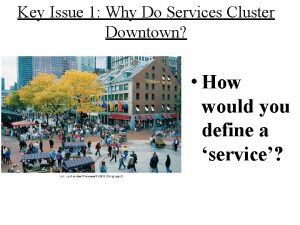
Key Issue #4: Why Do Services Cluster Downtown? • Consumer (Retail) Services in CBD – • • • – • • • High Range Very specialized, infrequently shopped at; customers scattered over a wide area Examples: fine jewelry & furs Many have moved to suburban malls; still thrive in CBD if paired with leisure/recreation/open space Near new/revived urban malls – Faneuil Hall in Boston, Harbor Place in Baltimore, Gallery at Market East in Philadelphia, Atlantic Station in Atlanta, former Peabody Place in Memphis Some cities have preserved old markets – grocery for inner city, exotic/luxury/high quality goods Retail Services Serving Downtown Workers eat/shop during lunch or immediately before/after work Businesses with office supplies, computers, clothing, shoe repair, dry cleaning, photocopying, eating, etc. Outside of N. America, more supermarkets/bakeries/butchers in CBD (sometimes no or limited hours on weekends or evenings) Expanding number of shops for office workers in CBD Revitalization of CBD & older neighborhoods – some cities have banned motor vehicles on certain streets (pedestrian only); widespread in NW Europe; Main St. mall in Memphis
Key Issue #4: Why Do Services Cluster Downtown? • Business Services Offices cluster in CBD for accessibility Chain of interdependency – temporary agencies near law offices, law offices near courts, etc. Central location draws workers from a variety of neighborhoods – – – • High Land Costs in CBD (Bid-rent theory) – – • • • Accessibility creates high demand & competition for limited sites (small land area, compact) High demand = high cost; Example: Tokyo CBD over $125, 000 per square meter ($500, 000 per acre) Shortage of buildable land in many CBDs (limited supply = higher demand) Intensive Land Use in CBD High costs lead to more intensive use of land; build vertical cities (more space used above & below ground) “underground city: - parking, loading decks, utilities, subways, drainage Underground pedestrian passages & shops (Minneapolis, Toronto, Montreal, Atlanta) to segregate from cars & shield from winter weather
Key Issue #4: Why Do Services Cluster Downtown? • High Land Costs in CBD (Bid-rent theory) – • • Skyscrapers High demand & cost made high-rises economically feasible Create an iconic, unique skyline (cultural landscape) from arrangement, height, quantity, architectural styles 1 st built in 1880 s Chicago (elevator, steel-frame, built for 1893 World’s Fair) Skyscrapers can block light, air, create wind tunnels – have been improved by artificial lighting, ventilation, central heating, AC Most N. American & European cities have enacted zoning ordinances to control height & location of skyscrapers Too many built near one another leads to traffic congestion in narrow streets Vertical geography – different activities at different floors – – – • Shops near street level (walk-in customers, window shopping, higher rents) Offices above shops Hotels & residential at higher levels – reduced noise, good views, lower rents No skyscrapers in Washington DC CBD – no building can be taller than Capitol Dome (more horizontal CBD, historical, emphasis on monuments)
Key Issue #4: Why Do Services Cluster Downtown? – • • Activities Excluded from CBD High rents & land shortage discourage manufacturing & residents Decline in Manufacturing in CBD – – – • Warehouses, factories, slaughterhouses replaced by offices, skyscrapers, open space, museums, apartments/condos Modern industry requires 1 -story, large buildings – more available land, lower rent costs Improved suburban transportation (interstate highways) for industrial accessibility Port cities – waterfronts being converted from industry/warehouse to commercial/recreation Examples: Boston, Toronto, Baltimore, San Francisco, Jacksonville, London, Barcelona Lack of Residents in CBDs – – Many people used to live downtown – wealthy in mansions, penthouses & poor crowded in tenement apartments Residences mostly abandoned downtown in 20 th century » Push factors: high rents, business & consumer services willing to pay higher rents » Pull factors: suburbs, larger homes, yards, modern schools, away from crime/congestion/dirt/poverty, personal garages
Key Issue #4: Why Do Services Cluster Downtown? • Activities Excluded from CBD – • • • Lack of Residents in CBDs Re-growth of downtowns in U. S. (attracting residents) since 1990 New apartments, converted warehouses & office buildings to residential Attracts young professionals, singles, empty-nesters – – • • • Nightlife, restaurants, parks, entertainment, museums No concerns over schools if you don’t have kids More convenient to work European CBDs Less dominated by commercial than U. S. Legacy of low-rise buildings (under 10 stories) & narrow streets from medieval times – protected against development (sometimes restored); filled with churches, palaces, parks/plazas/gardens, public buildings, libraries, museums Preserve historic core by limited high rises & # of cars (Paris, Rome) Restored & reconstructed historical buildings/cities (Warsaw after WW 2) Renovation – expensive alternative to building new buildings for shops & offices; not enough space to meet demand (must renovate); higher rents in Europe than U. S.
Key Issue #4: Why Do Services Cluster Downtown? • Suburbanization of Business – – – • • • Business services & manufacturing moving to suburbs (periphery) because of lower land costs Consumer services moving to suburbs because of market/customer proximity Suburbanization of Retailing Traditionally shopped for daily needs at small neighborhood shops & in CBD for other products Retail in U. S. – 1950 s (in CBD), 1970 s (in suburban enclosed shopping malls), 1990 s (“big box” superstores & open shopping centers) CBD too far from many customers; growth of suburbs after WW 2 Rarely build small corner shops in newer suburbs – low density residential areas discourage walking (car-centric) & have restrictive zoning allowances (may only allow residential) Concentrate retailing in suburban shopping malls – – – Supermarkets Shopping centers/strip malls Large malls with department stores (used to be in CBD)
Key Issue #4: Why Do Services Cluster Downtown? • Suburbanization of Business – • • Suburbanization of Retailing Large parking lots in suburbs with large buildings and wide roads (lower land costs, more wasted space, more sprawl) Large malls – typically enclosed (growth in open-air malls) with over 100 shops, 1 million sq. ft. , 100 acres of land – – – • • Suburbanization of Factories & offices Factories & warehouses moved to suburbs for low land costs & better truck access (highways, interstates, less congestion) Offices that don’t require face-to-face moving to suburbs – – – • Very large parking lots Anchor stores (large department stores) Developer builds, lease to retailers Centers of activities – retirees walk/sit, shopping, concerts, exhibits, teenagers meet friends No charge for parking, lower rents Executives live closer to work; less traffic BUT fewer amenities/energy of CBD Hardships for lower-income workers (limited public transportation, too far to walk) Growth of “edge cities” – office parks/skyscrapers in suburbs