June 12 2021 ENGLISH LANGUAGE PAPER 1 Section
- Slides: 8
June 12, 2021 ENGLISH LANGUAGE PAPER 1 Section A: Explorations in Creative Reading
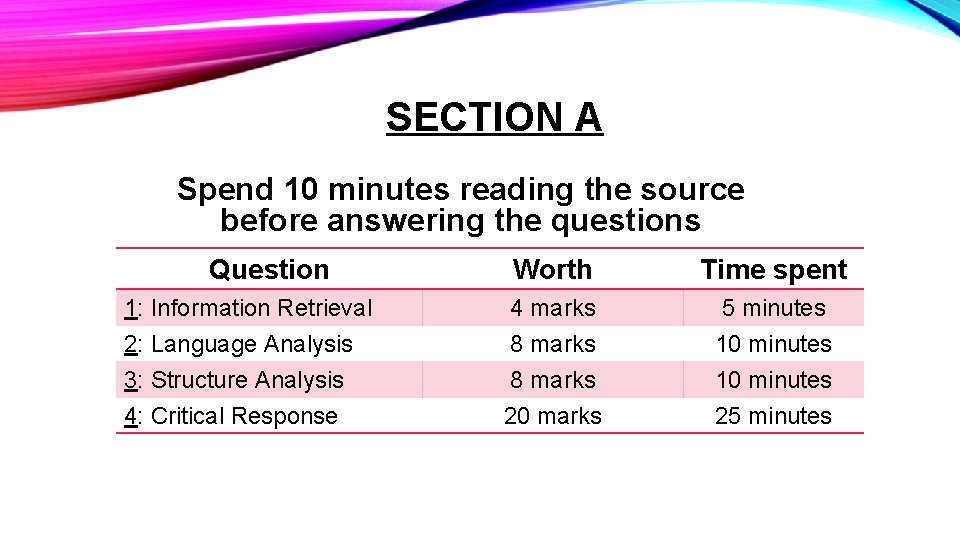
SECTION A Spend 10 minutes reading the source before answering the questions Question 1: Information Retrieval 2: Language Analysis 3: Structure Analysis 4: Critical Response Worth Time spent 4 marks 8 marks 20 marks 5 minutes 10 minutes 25 minutes
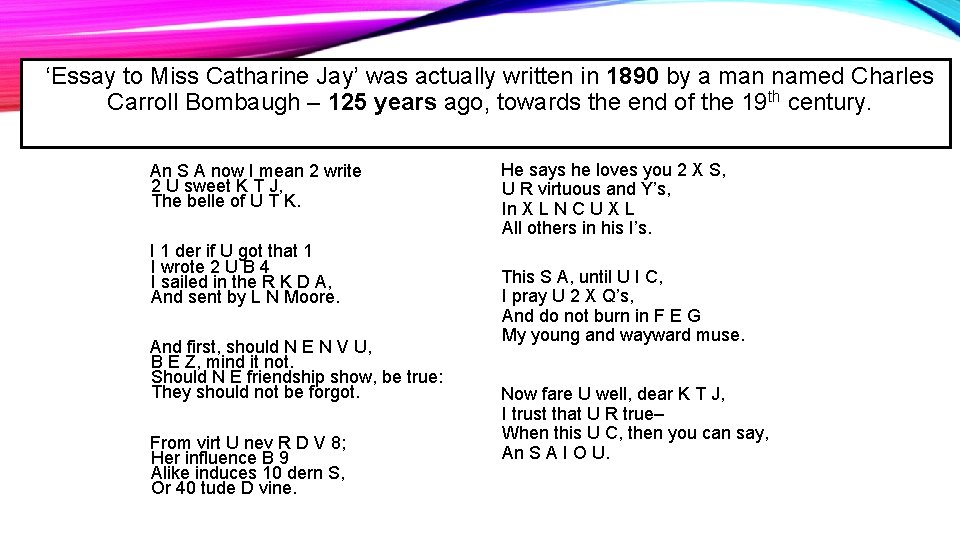
‘Essay to Miss Catharine Jay’ was actually written in 1890 by a man named Charles Carroll Bombaugh – 125 years ago, towards the end of the 19 th century. ESSAY TO MISS CATHARINE JAY An S A now I mean 2 write 2 U sweet K T J, The belle of U T K. I 1 der if U got that 1 I wrote 2 U B 4 I sailed in the R K D A, And sent by L N Moore. And first, should N E N V U, B E Z, mind it not. Should N E friendship show, be true: They should not be forgot. From virt U nev R D V 8; Her influence B 9 Alike induces 10 dern S, Or 40 tude D vine. He says he loves you 2 X S, U R virtuous and Y’s, In X L N C U X L All others in his I’s. This S A, until U I C, I pray U 2 X Q’s, And do not burn in F E G My young and wayward muse. Now fare U well, dear K T J, I trust that U R true– When this U C, then you can say, An S A I O U.
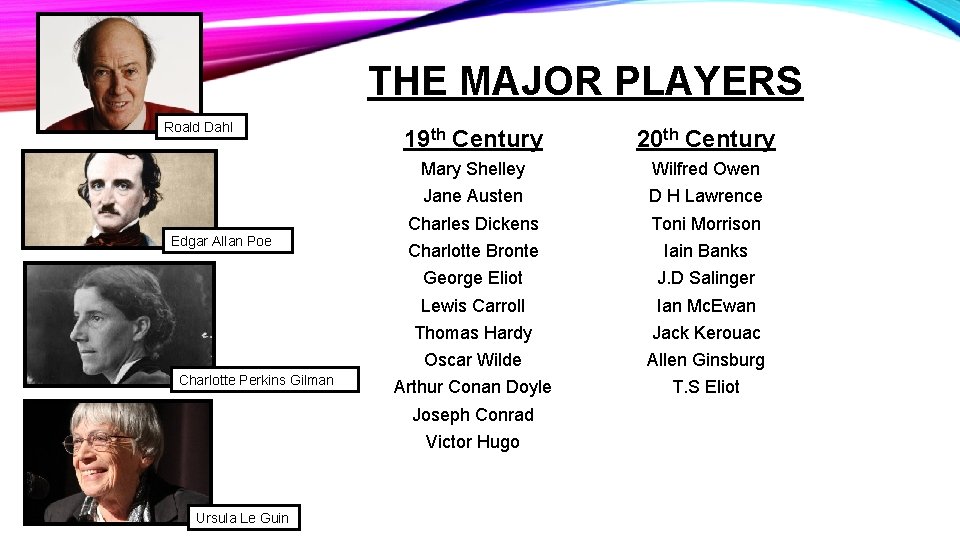
THE MAJOR PLAYERS Roald Dahl Edgar Allan Poe Charlotte Perkins Gilman 19 th Century 20 th Century Mary Shelley Wilfred Owen Jane Austen D H Lawrence Charles Dickens Toni Morrison Charlotte Bronte Iain Banks George Eliot J. D Salinger Lewis Carroll Ian Mc. Ewan Thomas Hardy Jack Kerouac Oscar Wilde Allen Ginsburg Arthur Conan Doyle T. S Eliot Joseph Conrad Victor Hugo Ursula Le Guin
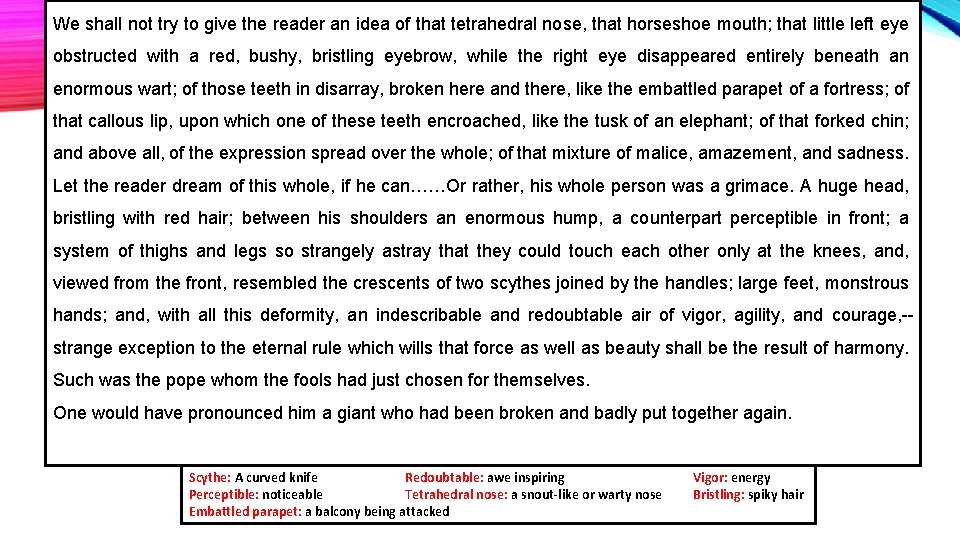
We shall not try to give the reader an idea of that tetrahedral nose, that horseshoe mouth; that little left eye obstructed with a red, bushy, bristling eyebrow, while the right eye disappeared entirely beneath an enormous wart; of those teeth in disarray, broken here and there, like the embattled parapet of a fortress; of that callous lip, upon which one of these teeth encroached, like the tusk of an elephant; of that forked chin; and above all, of the expression spread over the whole; of that mixture of malice, amazement, and sadness. Let the reader dream of this whole, if he can……Or rather, his whole person was a grimace. A huge head, bristling with red hair; between his shoulders an enormous hump, a counterpart perceptible in front; a system of thighs and legs so strangely astray that they could touch each other only at the knees, and, viewed from the front, resembled the crescents of two scythes joined by the handles; large feet, monstrous hands; and, with all this deformity, an indescribable and redoubtable air of vigor, agility, and courage, -strange exception to the eternal rule which wills that force as well as beauty shall be the result of harmony. Such was the pope whom the fools had just chosen for themselves. One would have pronounced him a giant who had been broken and badly put together again. Scythe: A curved knife Redoubtable: awe inspiring Perceptible: noticeable Tetrahedral nose: a snout-like or warty nose Embattled parapet: a balcony being attacked Vigor: energy Bristling: spiky hair
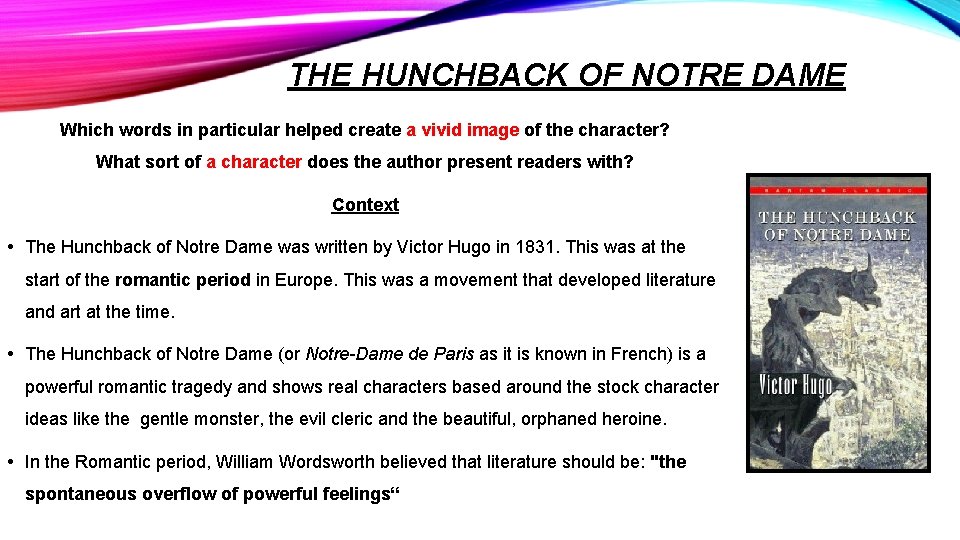
THE HUNCHBACK OF NOTRE DAME Which words in particular helped create a vivid image of the character? What sort of a character does the author present readers with? Context • The Hunchback of Notre Dame was written by Victor Hugo in 1831. This was at the start of the romantic period in Europe. This was a movement that developed literature and art at the time. • The Hunchback of Notre Dame (or Notre-Dame de Paris as it is known in French) is a powerful romantic tragedy and shows real characters based around the stock character ideas like the gentle monster, the evil cleric and the beautiful, orphaned heroine. • In the Romantic period, William Wordsworth believed that literature should be: "the spontaneous overflow of powerful feelings“
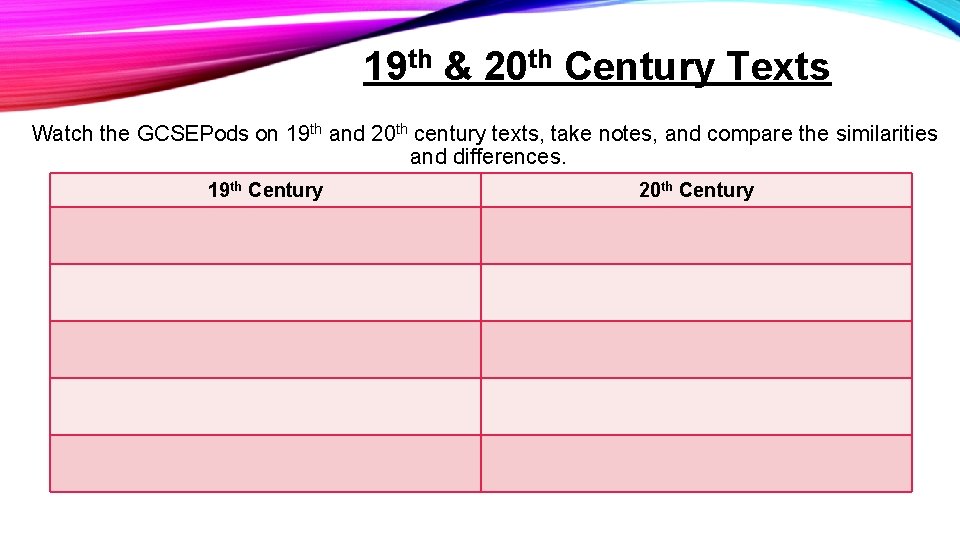
19 th & 20 th Century Texts Watch the GCSEPods on 19 th and 20 th century texts, take notes, and compare the similarities and differences. 19 th Century 20 th Century
The Hunchback of Notre Dame was written by Victor Hugo in 1831. Is this in the 19 th or 20 th century? Re-read the extract, and highlight the conventions or literary features being used.